A message lands: "EUR/USD — PUT — 5 min." Three fields, no context. Is that a trade you can act on, or a stranger's guess with an arrow on it?
If you trade binary options on Quotex, calls like that reach you from every direction — the platform's own signal panel, a Telegram channel someone forwarded, a WhatsApp group, an app that promises to do the thinking for you. From the outside they look identical: an asset, a direction, a number. What differs is everything you cannot see — how the call was produced, how long it stays valid, and whether anyone can show you how the last few hundred calls actually went.
This guide covers that whole picture in one pass: what a Quotex trading signal contains, how it turns into a placed position before the clock runs out, which categories of source exist and what each one costs you in trust, and the checklist to run any source through before it touches real money.
Key Takeaways
Every usable Quotex signal names four things — asset, direction, entry and expiry. A message missing any of them is an opinion, not a signal.
The expiry is a deadline, not a suggestion: a call read too late is a different trade from the one that was analysed.
You cannot verify a signal before it settles, so verify the source instead — a sample-backed win rate, published losses, a named operator, and a demo period you score yourself.
Table of Contents (20 min read)Contents
What Is a Quotex Trading Signal?
A Quotex trading signal is a time-boxed instruction to open one binary options position: which asset, which way, and by when the result is settled. That deadline is what separates it from a forecast. A forecast can be proved right next Tuesday; a binary options signal is right or wrong at a fixed minute, and nothing after that minute counts.
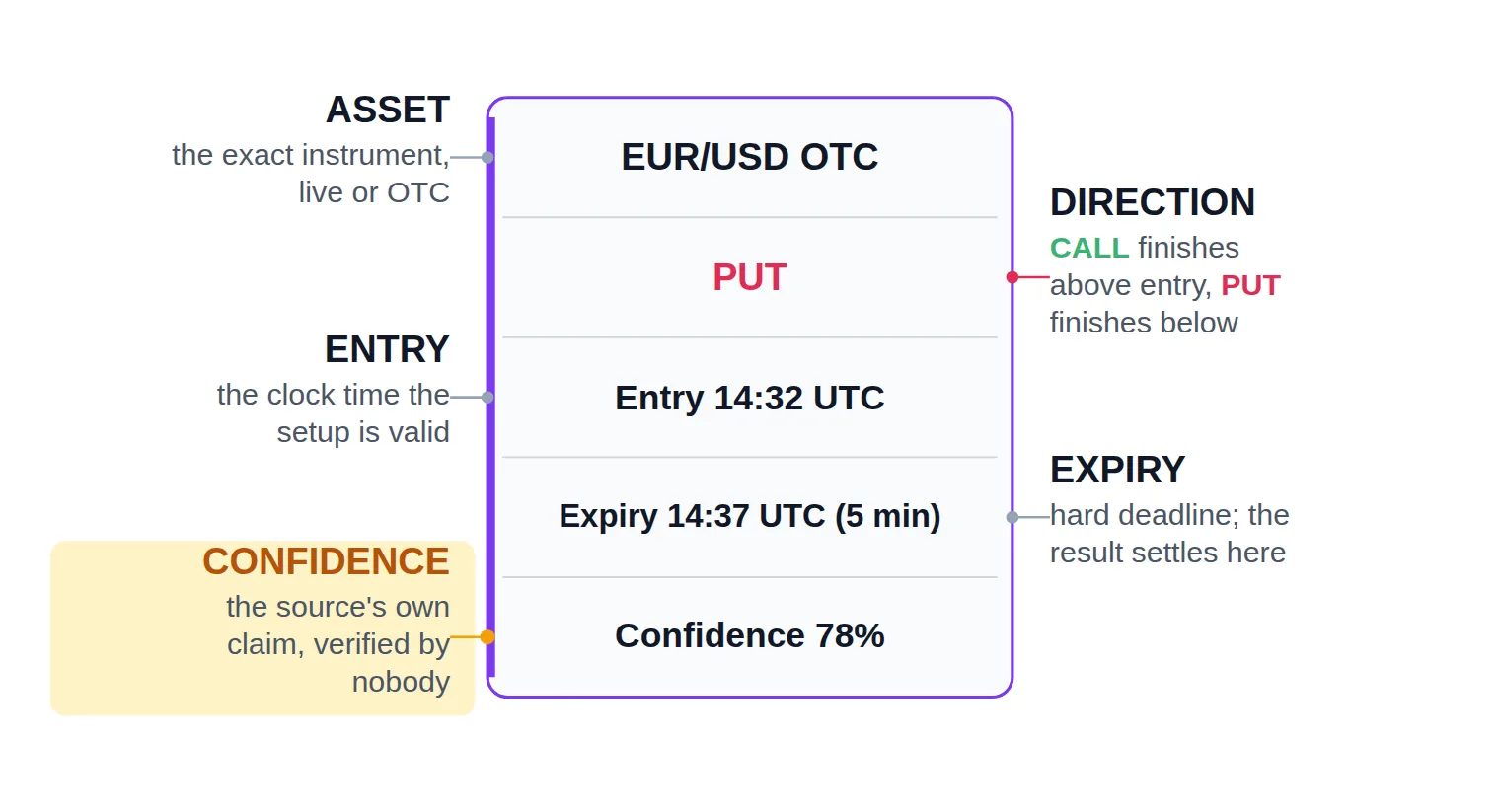
Whatever the source, the anatomy of a signal barely changes. Five fields carry the whole message:
Asset — the exact instrument the call applies to (EUR/USD, Gold, or the OTC variant of either). "EUR" is not an asset; "EUR/USD OTC" is.
Direction — CALL or PUT: price finishes above the entry level, or below it. There is no partial win in between.
Entry — the price level, or more often the clock time, at which the setup is considered valid. Enter late and you are trading a different setup from the one that was analysed.
Expiry — the expiry is a hard deadline, not a suggestion. A 1-minute call and a 15-minute call on the same asset in the same direction are two different trades with two different outcomes.
Confidence — an optional percentage attached by the source to say how strong it considers the setup.
That last field deserves suspicion the first four do not. A signal confidence score is produced by the source, defined by the source, and checked by nobody — it tells you what the sender believes, which is useful only once you know whether the sender's beliefs have historically been worth anything.
A message missing any of the first four is not a signal. It is an opinion with a ticker symbol attached.
The anatomy of a Quotex signal: four fields that must be present, and one that is only the sender's opinion.
From Alert to Placed Trade: How a Quotex Signal Becomes a Position
Every signal has two halves, and they fail for completely different reasons. The first half is generation — how the call was produced. The second is execution — what you do with it in the minutes that follow.
Generation is usually some form of confluence: a system watches a set of technical conditions on a fixed timeframe and fires when enough of them agree. Quotex's own panel works along these lines, scanning assets continuously and surfacing the ones its analysis flags, with a confidence figure attached. Third-party sources range from the same idea expressed in a script, to a person reading market structure manually, to a channel quietly relaying somebody else's feed under a new name. From your seat, generation is a black box unless the source describes its method — which is exactly why methodology disclosure carries so much weight in the checklist further down.
Execution is the half you control, and it is where most signals are lost before the market gets a vote:
An asset, a direction and an expiry arrive together, anchored to a specific clock time.
2
Check it is still live
Compare the entry time against the clock. A one-minute call posted three minutes ago is already a different trade.
3
Match the exact instrument
The symbol on your chart must be the one named in the alert. Live and OTC versions of a pair are not interchangeable.
4
Set the stake from your own rule
Decide the amount from your risk limit before a confident-looking call tempts you to raise it.
5
Place it before the window closes
Enter while the setup is still valid. Once placed, the result is decided at expiry, not by watching the chart.
6
Log the outcome against the source
Record win or loss per signal so you build your own sample instead of trusting the scoreboard the source publishes.
The three steps traders skip most often are the clock check, the instrument check and the log — and each of them decides trades before the market does.
The window matters more than beginners expect. A call built for a 1-minute expiry has a shelf life measured in seconds; by the time it has been written, posted, delivered and read, the setup it described may already be gone. Acting on it anyway means trading a stale signal — the same instruction, a different market. And even a perfectly fresh call loses sometimes: a false signal is a normal, expected output of every system ever built, not proof that the source is a fraud.
Reading a real signal end to end
Suppose the following arrives in a channel you are currently testing. Here is everything it tells you, field by field:
Essential answer
What is this signal actually instructing you to do?
Open one PUT position on EUR/USD OTC before 14:33 UTC; the result is settled at 14:37 UTC whatever happens in between.
AssetEUR/USD OTC
DirectionPUT
Entry time14:32:00 UTC
Expiry14:37:00 UTC (5 min)
Stated confidence78%
Usable window~90 seconds
Illustrative example built for this article — the figures are invented to show the structure, not a live call.
Read every signal as an instruction with a countdown, not as a tip you can act on whenever you next check your phone.
Three things follow from that card. The asset is the OTC variant, so it must be matched exactly on the platform rather than assumed. The usable window is under two minutes, so a call you read at 14:35 is not this trade any more. And the 78% is the channel's own claim about setups like this one — not a measured result, and not a promise about this particular trade.
Now the part the fields do not tell you. Whether a signal is worth taking at all depends as much on your payout percentage as on the direction being right:
Why the payout matters
Bounded risk, asymmetric payoff at expiry
━ Call payoff━ Put payoffx-axis: underlying price at expiry • y-axis: P&L per $100 staked
Binary risk is capped at the stake — but a win returns less than a loss costs, which is why win rate alone never settles the question.
At an 80% payout, a $100 win returns $80 while a loss costs the full $100, so you need to be right on roughly 56% of trades just to stand still. A source whose historical accuracy sits below that line is a losing feed no matter how confident each individual call sounds — and a source that never mentions payout at all is quoting you a number that cannot be interpreted. Work out the threshold for your own payout with the break-even win rate calculator before you subscribe to anything.
Where Quotex Signals Come From
There are five practical categories, and the honest difference between them is not accuracy — nobody can promise you that in advance. It is how much of the source you are able to inspect.
In-platform calls with a stated confidence figure, no setup required
The logic behind the figure, and how the panel performed last month
You want zero setup and no new party to trust
Telegram channels
Instant push alerts in a public or private channel, usually free to join
Whether losing calls were quietly deleted before you arrived
You will vet the channel properly before following it
Automated signal bots
Calls generated on a schedule and pushed to you around the clock
The rules the bot actually trades, behind the marketing label
You want frequency and will test it on demo first
WhatsApp groups
Alerts forwarded inside a closed group reached by invite link
Almost everything — no public history survives deletion
You already know who runs the group personally
Apps and browser add-ons
A panel that overlays calls directly on your Quotex chart
The code, the publisher, and what it does with page access
You can audit permissions and identify the developer
Ranked by transparency, not by accuracy: the less of a source you can inspect, the more evidence it owes you before it earns real money.
One dimension cuts across all five. When the live markets are closed, everything tradable on the platform is an OTC asset priced by the broker rather than by exchange order flow, so signals aimed at weekend OTC markets are being applied to a different data-generating process and deserve to be judged on their own separate sample.
Built-in platform signals
Quotex surfaces its own signals inside the trading interface, next to the chart, so there is nothing to install and nobody new to trust. The trade-off is opacity: you see an output and a confidence figure, not the reasoning, and you cannot replay how the same panel did across last quarter. Treat it as one input among several rather than a verdict.
Telegram channels
A Telegram signal channel is the most common way Quotex calls travel, because push delivery is close to instant and a channel costs nothing to start. That second part is also the problem — anyone can open one, post screenshots of the wins, and delete the losses before you scroll back. Vetting a specific Telegram channel is a discipline of its own, built around admin transparency and whether calls are published before their outcome is known.
Automated signal bots
Some sources are not people at all, but a binary options bot that generates calls on a schedule and delivers them without a human in the loop. A bot removes hesitation and posts around the clock, which is either discipline or noise depending entirely on the rules underneath. The mechanics differ enough between indicator-driven, AI-marketed and connector-driven signal bots that the category deserves its own comparison before you hand one your attention.
WhatsApp groups
Signals also circulate in private WhatsApp signal groups, usually reached through an invite link passed on by somebody else. It is the hardest category to audit: no public archive, no way to check what was posted before you joined, and message deletion leaves no trace — which is why invite-link spam and recruitment-style groups cluster here. Worth considering only when you already know the person running it.
Downloadable software and browser add-ons
This category covers desktop tools, mobile apps and the trading browser extension panels that overlay calls directly onto the Quotex chart. The convenience is real, and so is the cost: you are granting unfamiliar code permission to read the page you trade on. Check what permissions it asks for, whether a publisher is named at all, and where the paid upgrade leads. A tool with a handful of installs, an anonymous developer and an upgrade path that ends in a private chat is a recognisable pattern, not a coincidence.
Free and paid feeds
Both exist inside every category above, and price is not a quality indicator in either direction. A fee buys you a commitment, not a track record; free feeds are usually funded by broker referrals, an upsell, or both. What actually changes between free and paid signals is who the customer is — so if you are specifically hunting free Quotex signals, run them through exactly the same checks as a subscription service.
How to Tell If a Quotex Signal Source Is Reliable
You cannot verify a signal before it settles. You can verify the source before you ever place one, and that is the only real leverage you have.
Start with the number everyone quotes and almost nobody defines. A historical win rate means nothing without its sample: how many signals, over what period, on which assets, published where. A high-sounding accuracy figure attached to no dataset is marketing copy, not evidence. A verified track record is different — calls timestamped before their outcome was known, losses included, in a place the source cannot quietly edit afterwards. Screenshots are not proof; they are the single easiest artefact in this industry to fabricate.
Then run the candidate through the whole list:
Reliability checklist
Vet a Quotex signal source before it touches real money
0 / 10
Find a results history that predates today — a source showing only this week's wins has given you nothing to test.
Confirm losing calls are published in the same place and format as the winning ones.
Check that any stated win rate names its sample: how many signals, over what period, on which assets.
Read the methodology. Which conditions, which timeframe, which sessions — 'proprietary AI' with no description is not a method.
Identify a real operator behind the source: a person, a company, a jurisdiction — not only a channel handle.
Compare the promised signal volume against what actually gets posted on a quiet day.
Check whether calls arrive with enough lead time to place the trade inside the stated entry window.
Score at least a few weeks of calls yourself on a demo account before funding anything.
Compare the claimed accuracy against the break-even win rate implied by your actual payout.
Watch how the source reacts to a losing streak — an explanation is healthy, a stake-doubling instruction is not.
★
Checklist complete — you’re cleared to proceed.
Ten checks you can run before risking a cent. A source that fails the first three has not earned the other seven.
Red flags that should end an evaluation early:
Unverifiable accuracy claims — a precise percentage with no sample, no dates and no losing trades on display. The bigger the number, the more evidence it owes you, and "sure shot" or guaranteed-accuracy wording is the version of that claim that has stopped pretending to have any.
Urgency used as a sales tool — countdowns on a subscription price, "last few spots", or a rule that you must enter within seconds of a post you have no way to check.
A deposit link you are required to use — a source that only "works" when you register through their specific link is being paid for your sign-up, whatever the calls do afterwards.
No identifiable operator — no company, no jurisdiction, no name. The platform itself puts you through KYC verification before you can withdraw; an anonymous channel selling you calls answers to nobody at all.
Loss-recovery instructions — any source that responds to a losing run by telling you to double the next stake is managing your emotions, not your risk. What separates a source worth testing from one worth ignoring is not the call itself — it is whether you can see inside.
The practical first step costs nothing. Run every candidate on a demo account long enough to build your own sample, scoring each call yourself instead of trusting the scoreboard the source publishes. A month of your own data outweighs any testimonial page. And keep the stakes in view: binary options can lose your capital regardless of how convincing a signal looked, which is worth reading in full on our risk warning page.
Many are. The platform's built-in panel comes with the account, and a large share of Telegram channels and bots cost nothing to join. Free does not mean neutral, though — a free feed is usually funded by broker referrals, its own paid tier, or both, so it earns exactly the same scrutiny as a paid one.
How accurate are Quotex signals?
There is no honest single number, because accuracy is a property of one specific source over one specific sample — not of "Quotex signals" as a category. What you can do is measure it yourself: log every call you receive with its outcome, then compare that result against the break-even win rate your payout implies.
Can I trust a source with no track record?
Not with real money. A source without an auditable history is not automatically dishonest — it may simply be new — but you have no basis for a decision in either direction. Give it a demo period and let it build the record it does not yet have.
Do signals work the same way on weekend OTC assets?
Not reliably. During weekend OTC trading the underlying markets are shut and pricing comes from the broker, so a system tuned to live-market behaviour is being pointed at something different. Judge weekend results on their own sample rather than blending them into a weekday record.
What expiry should I use if the signal does not state one?
None — treat a missing expiry as a missing signal. Choosing your own expiry means you are running a different trade from the one that was analysed, so whatever accuracy the source claims no longer describes what you placed.
See a Transparent Signal Feed in Action
Once you have the checklist, the useful next step is seeing what a source that meets it looks like in practice. Our live binary options signal feed is built that way deliberately: each call is published with its asset, direction, entry and expiry, with win-rate context shown openly on the page instead of quoted in a sales line — free to view, no account needed to look.
Use it the way you would use any other candidate. Compare a live call against the five fields from the anatomy section, watch how the stated context lines up with outcomes over a few weeks, and run our feed through the same ten checks you would run on a Telegram channel. One boundary worth stating plainly: it is a feed to read and validate against, not an auto-execution tool and not a Quotex integration. You still place the trade yourself on the platform, and if what you actually want is hands-off automation, this is not that product.
Trade the Source, Not the Signal
Come back to that first message — EUR/USD, PUT, five minutes. You can now read it completely: which four fields must be present for it to mean anything, what the deadline commits you to, and how much the confidence figure is really worth. That was the smaller half of the problem.
The larger half is that those same three fields mean entirely different things depending on who sent them. The durable skill is not reading signals, it is evaluating senders — so pick the source category that matches how you actually trade, test it on demo until the sample is yours rather than theirs, and let any feed earn real money one verified batch at a time.
Sources & Further Reading
Want to go deeper? These independent, authoritative sources shaped this guide — each one is worth reading in full:
The Binary Options Desk is the SignalBots editorial team for fixed-time and OTC trading coverage. We research and write the guides that explain expiry timing, payout structure and disciplined entry across the major brokers.



Discussions 0
Leave a comment