You have not paid for a signal service yet, and you would rather not — not before you know whether any of them are worth paying for. So you search quotex free signals, and the results arrive by the hundred: dashboards that refresh every few minutes, Telegram channels posting a dozen calls a session, browser extensions, bots, video thumbnails with FREE in capital letters.
The abundance is the confusing part. If accurate calls were scarce, nobody would hand them out. Something else is being exchanged, and it is worth knowing what before you build a trading routine on top of it.
This guide is about that exchange. Not is there a free option — there are more than you could test in a year — but what free specifically costs you, how to tell a fair free tier from a funnel dressed as one, and when free stops being enough for the way you actually trade. If you are still working out how Quotex signals work in general, that is a different question from this one.
Key Takeaways
Free signal sources are cheap to run and monetised downstream through broker partner links, so the calls were never the product — the audience was.
The real price shows up as five non-monetary costs: stale data, an unverifiable track record, an upsell funnel, permission and data exposure, and the time you spend filtering noise.
The line that matters is disclosed versus disguised, not free versus paid: a stated cap and a visible referral link beat a hidden one at any price.
Free is the right choice while you are on demo and scoring calls yourself; paying only earns its keep when you need a record you did not have to rebuild.
Table of Contents (23 min read)Contents
Why So Many "Free" Quotex Signal Sources Exist
Three things make a free signal provider almost costless to run, and all three shape what lands on your screen.
The first is production. A dashboard that publishes a binary options signal every five minutes is usually a small script reading indicator values off a public price feed and formatting the output. It needs no trading desk, no research team, and nobody awake at the London open.
The second is distribution. A Telegram channel, a static page and a video account all cost nothing to publish to, and each one scales to ten thousand readers as easily as to ten.
The third is the part most readers never see: the exit. Free sources still need revenue, and the standard route is the broker's partner programme — a signup link that tags your account to whoever referred you, after which the broker shares a slice of the revenue your trading generates.
The economics underneath
How a free signal source actually gets paid
1
Automate the calls
A script reads indicator values off a public feed and posts them on a fixed schedule. Running cost is close to nothing.
2
Give them away to build reach
Free calls are the cheapest audience-building tool in trading. At this stage volume matters more to the source than accuracy.
3
Attach a signup link
Every post, page or pinned message routes to a broker registration carrying the source's partner code.
4
You register and fund an account
The link tags your account to that partner for as long as the account stays open.
5
Your activity pays the source
The broker shares revenue generated by referred trading. The signal was the acquisition cost, not the product.
The calls are free because they were never what was being sold.
None of this is automatically dishonest. We run partner links ourselves and label them as such. It turns into a problem in two specific ways. When the arrangement is hidden, you cannot price the advice you are being given. And more subtly, a source paid on your trading activity has a structural reason to want you trading often rather than trading well — which is exactly what the signal count on most free feeds reflects.
What Free Quotex Signals Actually Cost You
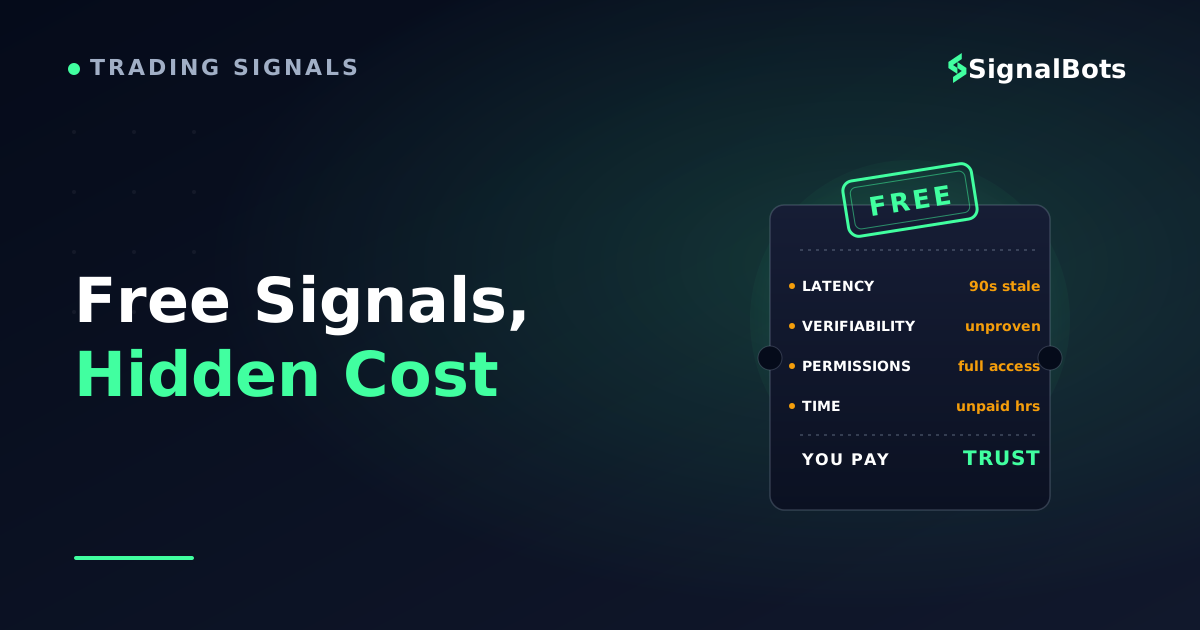
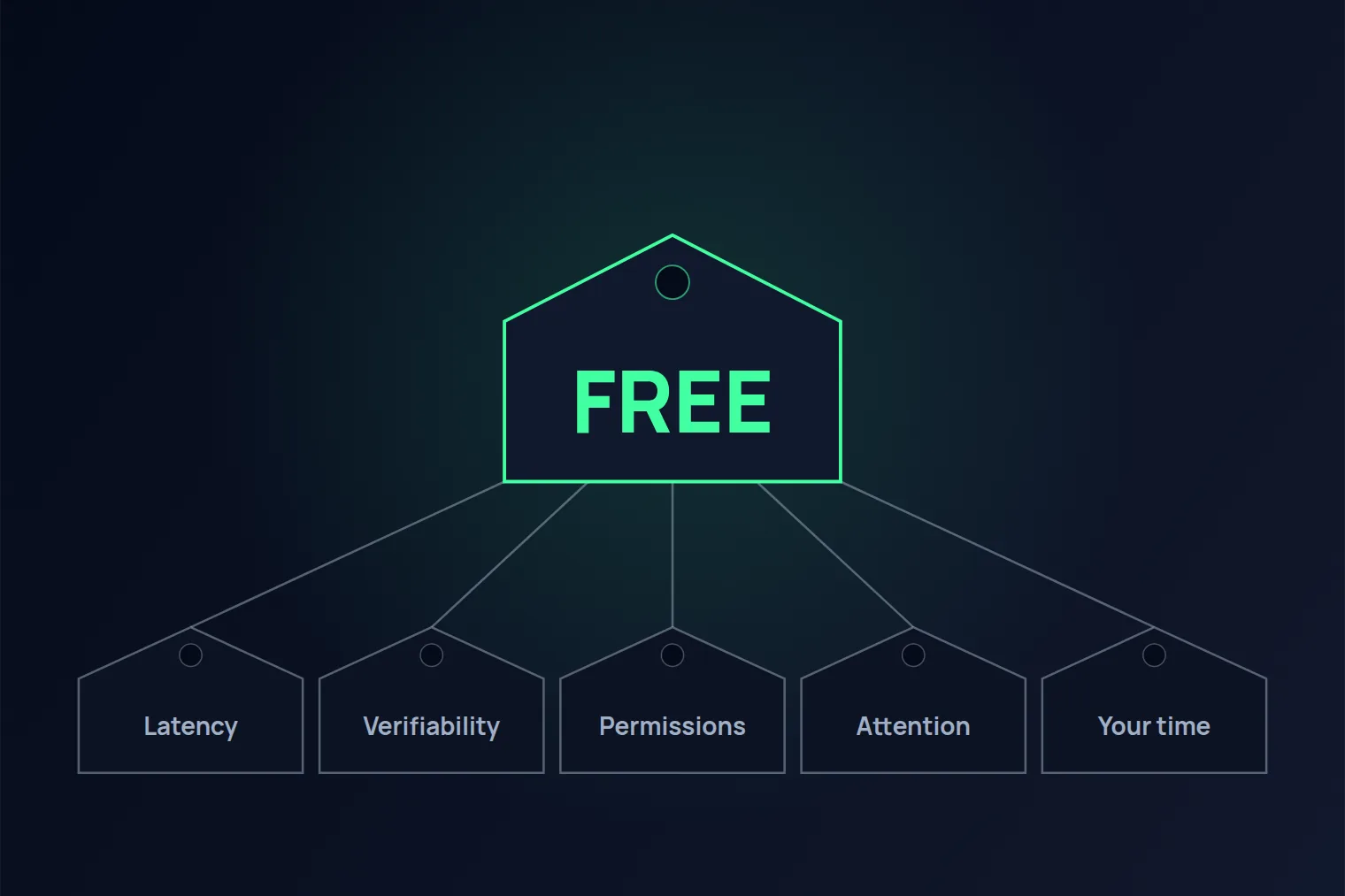
The price is real. It is simply not denominated in dollars. Five things get charged instead, and each one has a test you can run inside a week.
Free signals are not unpriced — they are priced in five things that never appear on an invoice.
Stale, Delayed, or Unverified Data
Free sources rarely touch the broker's own quote stream. They read a public feed, compute on the last closed candle, and publish on a timer. On a 60-second expiry that gap is not a rounding error — it is the trade. A call built on a candle that closed ninety seconds ago arrives as a stale signal no matter how sound the logic behind it was.
Fixed refresh intervals make this worse than ordinary signal latency, because the delay is structural rather than occasional: a dashboard on a five-minute clock cannot tell you anything about the minute you are currently trading.
The test: for one session, note the platform clock when a call is published and when you could realistically have entered. If the gap is routinely wide on short expiries, the source's accuracy claim describes a trade you were never able to take.
No Track Record You Can Check
An accuracy figure with no per-signal ledger behind it is a headline, not a historical win rate. The distance between those two words is the whole section: one is a claim, the other is a count.
A verified track record has three properties: every call is published before its expiry, every outcome is recorded whether it won or lost, and the sample size is large enough that ten more trades would not swing the number.
Free feeds have the strongest incentive of any source to fail all three, because nothing is at stake for them when they do. Losing calls quietly disappear. A recovery entry taken after a loss gets presented as though the first entry had worked. Results appear after expiry rather than before it, which converts a prediction into a report.
The test: screenshot the feed yourself for two weeks and score it. If you had to build the record, the record did not exist.
The Upsell Funnel Built Into "Free"
Most free tiers are the entrance to something, and the shapes repeat: a fixed number of free calls per day with the rest behind a paid tier; a tool that only activates once you open an account through its link; a channel whose pinned message is a registration page. The difference between VIP and free signals is frequently not quality at all — it is which slice of the session you get shown.
That last point deserves a moment. If a source reserves its strongest window for paying members, the free sample is deliberately unrepresentative, and whatever you conclude from it — flattering or damning — is a fact about the sample rather than about the service.
The test: find the cap and the exit before you take a single call. If five minutes of looking does not reveal how the source earns, that silence is itself the finding.
Data and Permission Risk From Extensions and Bots
Software that draws on your chart has to read the page. Software that clicks for you has to write to it. Both are legitimate needs, but they sit on a spectrum whose far end is an extension requesting access on all sites — which includes your funded broker session, your inbox, and everything else open in that browser profile. Read the extension permissions list at install time, not after something goes wrong.
Bots raise a second version of the same question. Anything asking for API keys, platform credentials or direct account linkage is requesting a level of trust that a free tool has not yet earned, and that trust is very hard to withdraw once granted.
The test: compare the requested permissions against the stated job. A read-only signal overlay that wants write access everywhere is not a signal overlay.
The Time Cost of Filtering the Noise Yourself
This is the cost nobody advertises and everybody pays. Free dashboards typically publish raw technical indicator output — RSI, MACD, Bollinger bands, ADX — for every pair on every timeframe, attach a signal confidence score, and stop there. No synthesis, no filter, no opinion about which of today's calls belong together.
You inherit that job. A dashboard covering thirty-odd pairs on a five-minute refresh can emit hundreds of state changes in a session, and you can act on a handful. Everything in between is a false signal you have to identify and discard in real time, while also trading.
The test: time one session of filtering. That number, multiplied by what your hour is worth, is the subscription fee you thought you had avoided.
Where People Actually Find Free Quotex Signals
Nearly every free option you will meet is one of seven shapes. Placing a source in the right bucket tells you which failure mode to check first — and the shapes hold whether you searched quotex free signals or señales gratis quotex, because the incentive underneath them does not change with the language of the pitch.
Free Signal Websites and Dashboards
A page listing pairs with a direction and a confidence figure, refreshed on a timer, usually reachable with no email and no account. The candid ones state that they run on affiliate revenue and put the link at the bottom of the page. Their failure mode is the time cost above, compounded by a refresh clock that has nothing to do with your expiry. Treat a dashboard as an indicator screen you did not have to build, not as a list of trades to take.
Free Browser Extensions
A trading browser extension overlays calls directly onto the platform chart, which is genuinely useful — you are not alt-tabbing during a 60-second expiry. Most free ones cap the daily count and route the remainder through a paid channel elsewhere. The failure mode is permissions, sharpened by the fact that a small extension with a handful of users has almost no review pressure behind it. Check what it asks for before you weigh what it promises.
Quotex publishes a signals panel inside the terminal itself, available to account holders, showing a pair, a direction, an issue time and a duration alongside the platform's indicator set. It is the least funnel-shaped free source you will find, because the broker already monetises your trading directly and has nothing to upsell you into. Its failure mode is the quiet one: you see the calls, never what happened to them. The same rule applies as everywhere else — score them yourself before you weight them.
Free Telegram Channels
The highest-volume free format and the most standardised: pair, time, direction, expiry, posted several times a session, often followed by a recovery entry after a loss. Vetting a Telegram signal channel properly — who runs it, whether posts are edited after the fact, whether the reach on each post matches the advertised membership — is a job of its own and worth an hour if this is where your calls come from. The failure mode specific to free channels is the referral link stapled to every post, including the ones that read as education. A Telegram signal channel is a distribution pipe, and the pipe has an owner with an incentive.
Free WhatsApp Groups
The same feed in a smaller, less searchable room, usually pitched as closer access to whoever runs it. The trade is different in kind: you hand over a phone number and, depending on the group's settings, visibility to everyone else in it. WhatsApp signal groups are also harder to audit than Telegram, because there is no public preview to scroll before joining — you commit first and look second, which inverts the order this article recommends.
Free Signal Bots and AI Tools
A binary options bot or chat bot that returns a call on demand, frequently labelled AI. The honest ones are indicator logic wearing a friendlier interface, and there is nothing wrong with that as long as it is described accurately. What Quotex signal bots actually compute — and whether a model claim is real or decorative — deserves its own examination. The immediate failure mode is any request for credentials or account linkage in exchange for a free call.
Free Social Video — YouTube and TikTok
Video is mostly where people first meet a free source, not where they receive one. A clip is a promise pointing somewhere else: a channel, a group, a tool, a tier. Judge the destination rather than the production, because editing quality tells you nothing about the alerts you will actually get — and in this category the strongest hook is simply the word FREE repeated in the title.
Claimed vs delivered
Free source type
What it advertises
What it actually hands you
What it wants back
Signal websites and dashboards
Entirely free, no email, no tiers
Raw indicator readouts on a fixed refresh clock
Traffic, plus a broker link at the foot of the page
Browser extensions
Signals drawn on your live chart
A capped number of daily calls, Pro tier elsewhere
Page permissions and an install you rarely re-audit
The platform's own panel
Built-in signals, free with your account
Direction and duration inside the terminal, no ledger
A funded account before you can see them
Telegram channels
Multiple daily calls plus win screenshots
A high-volume feed with recovery follow-ups
A signup through the channel's referral link
WhatsApp groups
Closer, more personal access
The same feed in a room you cannot preview
Your phone number and visibility to the group
Bots and AI tools
Automated calls, nothing to download
Indicator output relabelled as a model
Chat access, sometimes keys or account linkage
YouTube and TikTok
Free daily signals, results on camera
Discovery — a promise pointing somewhere else
The click into a channel, group or paid tier
Read the third and fourth columns together: the gap between them is the actual price of the first column.
How Do You Spot a "Free" Signal That's Actually Bait?
The useful distinction is not free versus paid. It is disclosed versus disguised. A source that states plainly how it earns, caps the free tier at a number it tells you in advance, and leaves its losing calls visible is behaving fairly, whatever it charges. Bait looks different, and it speaks a small, repetitive vocabulary. A free tier is an acquisition instrument first and a signal source second — the tells are in the sequencing.
Urgency manufactured by the source, not the market. Countdown timers, closing enrolment, "the session launches now". Genuine market timing does not need a graphic ticking down beside it.
A cap you discover rather than one you are told. "Unlock five more free signals by joining VIP" is the moment the free tier existed to produce, and the sequencing is the tell — you learn the limit only after you have started relying on the feed.
A referral link on every single post. Including the educational ones, the results screenshots, and the risk warnings. One link in a pinned message is disclosure; a link on every post is a business model.
Access wider than the stated job. The permission point from earlier belongs on this list too, because it is where "free" costs the most and shows the least.
Outcome language nobody can honour. Any variant of "sure shot", "risk-free" or "100% win rate" is a marketing decision rather than a statistical one. Phrases like sure shot signals recur often enough in this niche to deserve a closer look than one bullet can give them.
Results you cannot reconstruct. Wins posted after expiry with no matching pre-expiry call is the most common form, and the easiest of all of these to check: scroll back and try to find the original.
Name how this source gets paid — before you take a single call from it.
Check whether a referral or signup link rides on every post, including the educational ones.
Find the free tier's cap, and note whether it was disclosed up front or discovered later.
Look for urgency created by the source rather than by the market: countdowns, closing enrolment, 'starting now'.
Scroll back a week and confirm losing calls are still visible, not quietly removed.
Verify each posted result has a matching call published before the expiry, not after it.
Read the permission list before installing anything, and reject access wider than the stated job.
Score the source on a demo account over a real sample before it ever sees your funded balance.
★
Checklist complete — you’re cleared to proceed.
Eight checks, roughly five minutes. Any source that fails more than two is charging you something it has not named.
Running the Checklist Against a Real Signal Feed
A checklist is easy to agree with and hard to apply, so apply it now — to one of ours, rather than to a tidy hypothetical.
Our live binary options signal feed publishes current calls per asset, each card carrying the pair, the direction, the timeframe, the expiry and the strategy that produced it. Most of the cards on that page are visible with no login and no email. A subset are marked "VIP Clients Only" and open an unlock prompt tied to a partner broker signup. That is a gate, and this article's own checklist says to go looking for exactly that — so here it is, named rather than exempted.
Now run the rest of the list. The commercial arrangement is stated rather than implied. There is no countdown and no closing-enrolment language, because the feed updates on market conditions rather than on a marketing clock. Nothing installs, so there is no permission list to weigh. And on the item that matters most, our page sits in the same position as every other source in this article: you still have to score the calls yourself, over a real sample, before you decide how much weight they deserve. No feed — ours included — can hand you that conviction pre-built. A signal describes a setup and its reward-to-risk context, not your outcome, which is why our risk warning sits alongside every signal surface we publish.
Read it for what it is: a live feed to observe and stress-test, not a Telegram group to join or a bot to install. If what you specifically want is a source with nothing gated at all, or one of the other formats mapped above, ours will not be your answer — and a checklist that never sends you elsewhere was not a checklist.
Is Free Ever Enough — or Should You Pay?
Two questions settle this, and neither of them is about price.
The decision
Is a free Quotex signal source enough for you right now?
Take itProceed with careSkip / stand aside
Nothing in this tree turns on price. Every branch turns on whether you can verify what you are acting on.
Where free stops being a compromise and starts being a blind spot.
The first question is what stage you are at. While you are on a demo account, free is not a compromise — it is the correct choice, because what you need at that stage is material to evaluate, and paying for material you have not yet learned to judge buys you nothing. The same holds if you already trade a system of your own and use signals only as a second opinion on direction.
The second question is what money would actually buy. Paying should purchase two things a free source structurally struggles to provide: a track record you did not have to reconstruct yourself, and accountability — a provider whose revenue depends on the calls being good rather than on your deposit existing. A paid service offering neither is a free channel with an invoice attached, and there are plenty of those.
Whichever way you lean, the arithmetic decides rather than the marketing. On a binary trade the payout percentage sets your break-even before any signal enters the picture: if a winning trade returns 80% of your stake while a losing one costs all of it, you need to win more than five trades in every nine simply to stand still. That is the bar any source — free, paid, or your own analysis — has to clear across a real sample, so it is worth calculating your own break-even win rate at your actual payout before you judge anybody's calls.
So the abundance you started with is not the problem, and free is not the problem either. What costs money is accepting a source without knowing what it charges you or how it earns — and you can now name both in about five minutes, in whichever language the pitch happens to arrive.
Yes, in the sense that no separate subscription is charged for them — the panel sits inside the platform and is available to account holders alongside the chart tools. What it does not include is an outcome history for the calls it publishes, so free here still leaves you the work of recording results yourself before you decide how much weight to give them.
Can I use free signals on weekend OTC pairs?
You can, and many free sources publish heavily on them precisely because they trade when everything else is closed. The caution is that an OTC market instrument prices differently from its weekday equivalent, so indicator logic tuned on regular sessions — and any accuracy claim built on that data — does not automatically carry across. How OTC market signals behave differently is a subject in its own right.
Is it safe to install a free Quotex signal extension?
Safety here is a permissions question rather than a reputation question. An overlay that reads only the platform page it runs on is a narrow and reasonable ask; anything requesting access across all sites can see every other tab in that browser profile, including your funded broker session. When the requested access is wider than the described job, that mismatch is your answer.
How do I score a free source without building a spreadsheet?
Screenshot the feed at the moment each call is published, mark the outcome at expiry, and keep three running tallies: wins, losses, and calls you could not have entered in time. Thirty to fifty logged calls is usually enough to tell whether a source deserves more of your attention, and that third tally is frequently more revealing than the first two.
Should I pay for signals while I am still on demo?
There is rarely a reason to. Demo is where you learn to evaluate a source, free material is sufficient for that, and paying earlier mostly buys confidence you have not tested. The moment paying starts to make sense is when you need a verifiable record and someone accountable for it — a live-capital problem, not a learning one.
Sources & Further Reading
Want to go deeper? These independent, authoritative sources shaped this guide — each one is worth reading in full:
The Binary Options Desk is the SignalBots editorial team for fixed-time and OTC trading coverage. We research and write the guides that explain expiry timing, payout structure and disciplined entry across the major brokers.



Discussions 0
Leave a comment