Search "quotex signals bot" and you get a wall of product names — Q-Bot, AI Hunter, "Quotex Robot", a "Chinese bot" someone swears by in a Telegram group — and almost no explanation of what any of them actually is. One is a browser extension. One is a desktop app that wants your broker login. One is a rule file running inside MetaTrader with a bridge to your account. All three are sold with the same three words, and they are not the same kind of software.
That distinction matters more than which one has the nicer dashboard. The category a tool belongs to decides where its calls come from, whether you can ever check those calls, and what installing it hands over. This guide sorts the automated Quotex tools you will actually meet into three architectures, walks the data-to-trade pipeline they all share, spells out what each type asks for at install time, and lists the red flags that belong to automation specifically — the ones a checklist written for human-run channels never covers.
Key Takeaways
Almost every Quotex signals bot is one of three architectures — indicator-based, AI/prediction-branded, or an MT4/MT5 connector running your own EA rule — and they share the same data-in, decision, output pipeline.
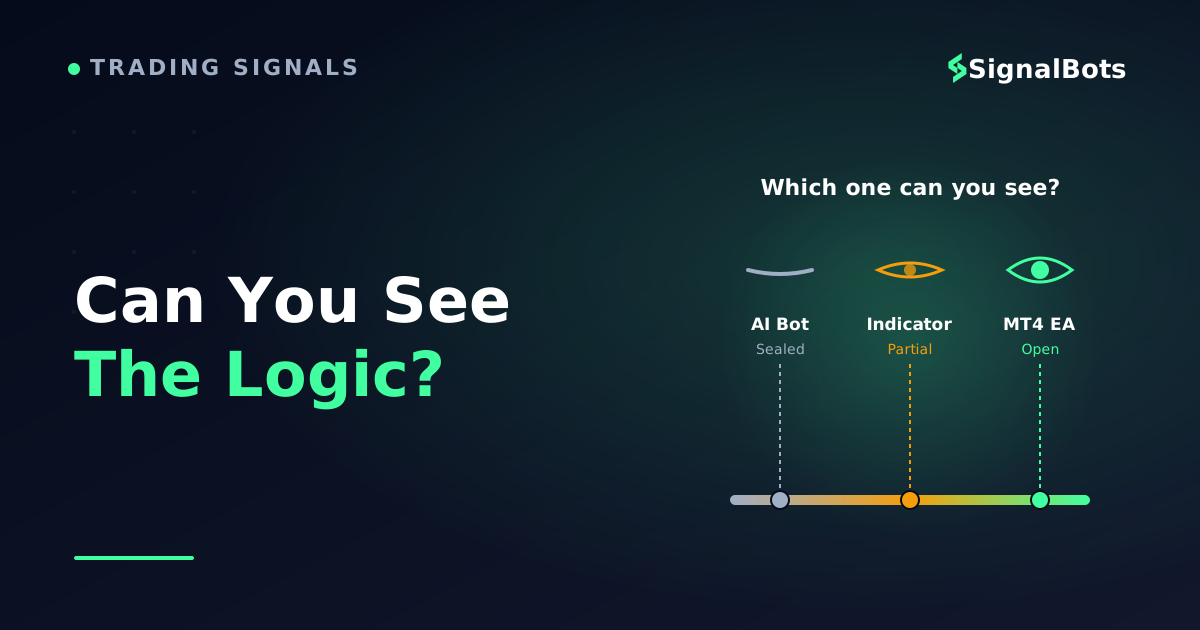
The decision stage is the only one that truly separates them: indicator rules are partly visible, an "AI" label is not a mechanism, and a connector's rule is a file you can read and backtest.
Installing a bot grants access, not just attention: browser-extension host permissions, broker credentials in a desktop app, or a local terminal setup are three very different risk classes.
Automation-specific red flags — win-rate claims with no method, signals that appear after the candle closes, default stake scaling, and permission creep — are what a general signal checklist misses.
Table of Contents (24 min read)Contents
What Makes a Tool a "Signal Bot" on Quotex?
A binary options bot is any software that produces a directional call — or places the trade outright — without a person forming that opinion at the moment it fires. That is the whole definition, and it is broader than most product pages imply.
The contrast with a human-run channel is sharper than it looks. A person watching a chart can stay silent for three hours because nothing is clean, then post one call with context. A bot is a condition plus a scheduler: it evaluates, and if the condition is true it speaks. It has no instinct to abstain unless somebody coded abstention into it. That is simultaneously its strength — no fatigue, no fear of missing out, no revenge entry after a loss — and the reason a bad rule produces bad calls tirelessly, all day.
Any tool you find can be placed with three questions:
Where does the decision come from? Published indicator conditions, an undisclosed model, or a rule you wrote yourself.
What does it do with the decision? Renders it for you to act on, or clicks for you.
What did it need from you to work at all? A browser permission, a broker credential, a running terminal, a linked chat.
Most marketing answers the second question, hints at the first, and stays completely silent on the third. The third is the one with a real cost attached.
One clarification before the taxonomy: a bot that posts into a Telegram signal channel is not a separate species. Telegram is a delivery pipe. The same call can arrive in a browser overlay, a desktop window, or a chat message — where it lands tells you nothing about how it was made.
The Three Architectures Behind Quotex Signal Bots
Almost everything marketed as a Quotex bot signal tool is one of three things under the branding. Learn to recognise them and the market stops looking like a hundred products and starts looking like three designs with a hundred skins.
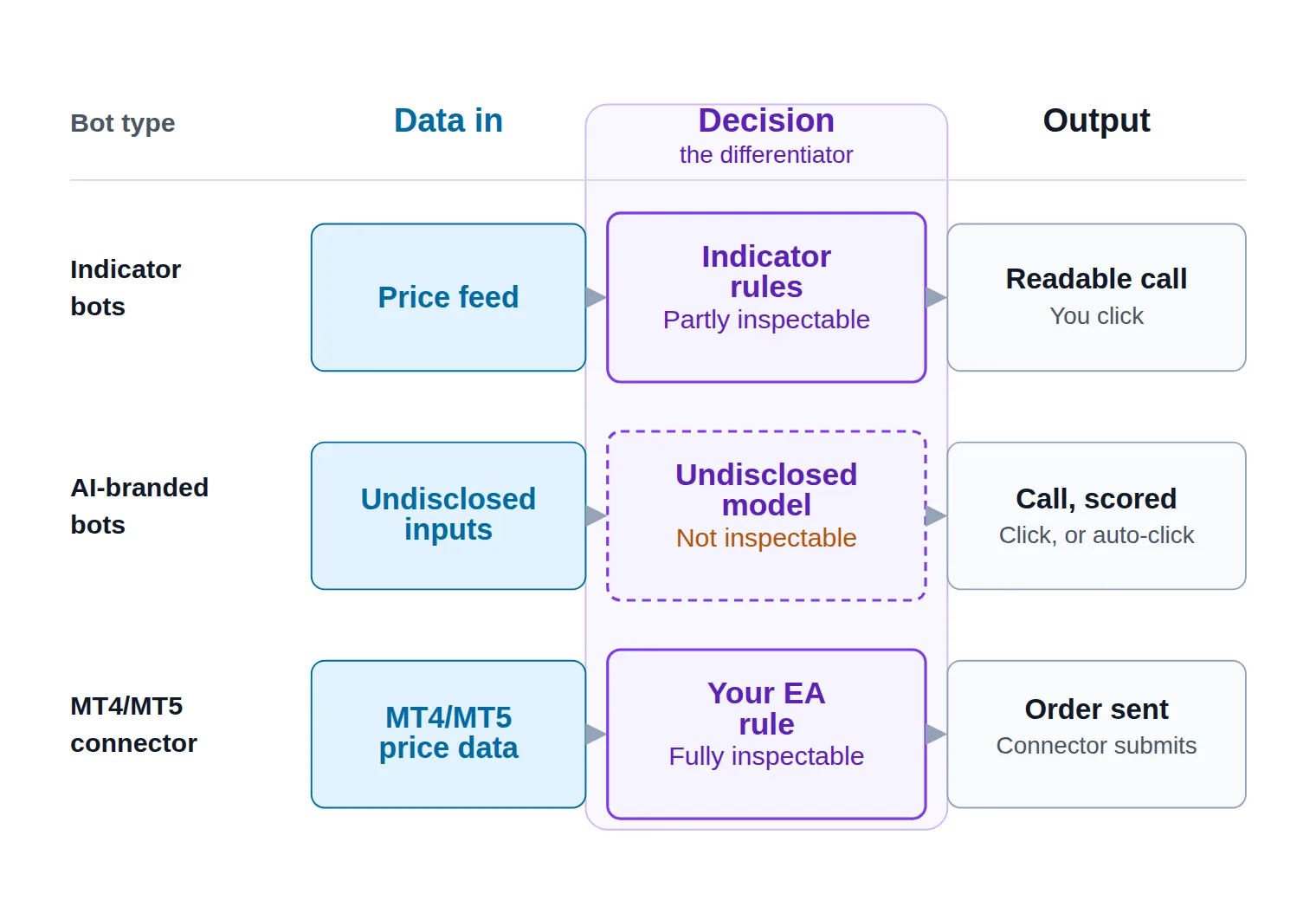
Same skeleton, three decision stages: the middle column is the entire difference between the architectures.
Indicator-Based Bots
The most common design, and the most honest by default. The bot reads a price series, computes a handful of standard technical indicators — a relative strength index, moving averages, Bollinger bands, MACD, an ADX trend filter — and fires a call when a combination of thresholds is true. A typical rule is nothing more exotic than "RSI crossed back above its oversold line while price is above the slow moving average, on the 1-minute chart."
The output is a readable call: asset, direction, expiry time, and often a "confidence" figure. That figure is worth understanding. In most indicator bots it is not a probability of anything — it is a vote count, the share of the bot's own conditions currently agreeing. Four of five conditions aligned renders as 80%, whether or not that combination has ever been profitable on this asset.
This is the design behind most tools advertised as a free Quotex signals bot or a signal generator: cheap to run, nothing proprietary, and easy to give away because the value is in getting you to the broker, not in the arithmetic. Its real weakness is context. Standard indicators describe momentum and stretch; they do not know that a rate decision lands in nine minutes, or that this pair has been chopping sideways since the session opened.
AI- and Prediction-Branded Bots
The second family is sold on the promise of prediction — "Quotex prediction software", "future signals", an AI that reads the next candle. Some are genuinely trained classifiers. Some are the indicator script above, wearing a different word. From the outside, the marketing is identical, which is precisely the problem: the label "AI" describes a category of technique, not a mechanism, and it tells you nothing you can act on.
A model that genuinely learned something has parts you can ask about. What were the inputs? What exactly was it trained to predict — direction over the next five minutes, on which assets? How was it validated on data it had never seen? How often is it retrained, and what happens when the market regime it learned no longer exists? A vendor who can answer those has built something. A vendor whose answer is a logo and a rising equity image has handed you a black-box trading system and asked you to trust the box.
The same applies to the names that circulate in groups — a "Chinese bot" signal for Quotex, an "AI Hunter", a robot with a version number. A name is not a mechanism. Two tools sharing a nickname across three Telegram groups are frequently different builds by different people, and neither one's screenshots tell you which you downloaded.
MT4/MT5-Connector and EA-Based Bots
The third architecture inverts the relationship. Instead of a vendor's decision arriving at your screen, the decision is made on your machine, in software you can open. An expert advisor — a rule file written in MQL and running inside MetaTrader 4 or 5 — evaluates its conditions on the terminal's price data. When it fires, an MT4/MT5 connector translates that decision into an order on your binary options account, carrying the stake and expiry you configured.
Three consequences follow, and they are the reason this category deserves separating from the other two.
The logic is a file. You can read it, change a threshold, and see exactly which conditions produce a call.
You can backtest it in MetaTrader's own strategy tester, on your own historical data, before a cent is at risk — a genuinely different thing from believing a vendor's screenshot.
The failure modes move to your side: a wrong symbol mapping, an expiry that does not match the rule's timeframe, a terminal that went to sleep at 3 a.m.
It is the most transparent design and the most work. That trade is the whole story of this category.
Where Telegram and Copiers Fit
A fourth thing gets called a bot and is really plumbing. A Telegram bot that posts calls, or a copier that reads those messages and pushes them into a terminal, sits downstream of whichever of the three architectures actually made the decision. It changes how fast a call reaches you and whether a human hand is involved in acting on it — never how the call was produced. When someone recommends "the Telegram bot", the useful follow-up question is what is generating the messages it forwards.
How Does a Quotex Bot Turn Data Into a Trade?
Strip the branding off any of the three and the same five-stage pipeline is underneath. Knowing the stages is what lets you ask a vendor a question they cannot deflect.
Data in, trade out
The five stages every Quotex signal bot runs through
1
Read a price feed
It pulls candles for one or more assets — from the broker chart rendered in the page, or from a third-party market feed of its own.
2
Evaluate its conditions
Indicator thresholds, a pattern rule or a trained model score the current candle and produce a raw direction: up or down.
3
Apply its filters
Session windows, a news blackout, a cooldown after a loss or a minimum score decide whether that raw direction survives to become a call.
4
Emit the output
Either a readable call — asset, direction, expiry, stake — or an order instruction addressed at your account.
5
Execute and record
You click, or the tool clicks for you. Whether the result is written back and measured is what separates a serious tool from a signal firehose.
Stage two is the only one vendors advertise. Stages three and five are where the honest tools separate themselves.
Two stages deserve more attention than they usually get.
The feed the bot reads is not always the price you trade. A tool computing indicators from a third-party market feed and a broker quoting its own synthetic series can disagree, and on weekend synthetic instruments they will disagree more. A call built on one price stream and executed against another is a quiet source of false signals that no amount of indicator tuning fixes.
The filter stage is where a bot becomes usable or unusable. A rule with no session filter fires at 2 a.m. into a spread nobody wants. A rule with no cooldown fires again immediately after a loss, into the same conditions that just beat it. When a product page lists no filters at all, the honest reading is that the tool sends everything its rule produces and expects you to sort it out.
The Same Rule, Two Very Different Endings
Take one concrete rule and follow it down both branches. The rule: on the 1-minute EUR/USD chart, RSI crosses back above its oversold line while price sits above the slow moving average — call up, five-minute expiry, stake fixed at 2% of the balance. (Illustrative numbers, not a recommendation.)
Manual signal vs auto-execution
One rule fires — what happens next depends on the architecture
A signal you read
The call renders as text: EUR/USD, up, 5-minute expiry, suggested stake.
You still hold the last decision — you can look at the clock and skip it.
You see the payout offered on that asset right now before committing.
Your reaction time and your discipline are part of the result.
Slower, but every trade passed a human filter.
VS
A trade already placed
The order is submitted with the stake and expiry you configured, at rule-fire time.
No pause, no second look — the veto had to be written into the rule in advance.
It fires while you sleep, and it fires during a news release unless a filter says otherwise.
Every trade is identical in size and process, which is what makes the record readable.
Consistent by design — including consistently wrong when the rule is wrong.
Automation does not improve a rule. It removes your hesitation from it, in both directions.
The practical point: the value of automating is that a mediocre rule followed exactly often beats a good rule followed emotionally. The cost is that every weakness in the rule is now expressed at full volume, with no human standing between it and your balance.
What Installing a Quotex Bot Actually Requires
This is where automated tools differ from a human-run channel in a way nobody markets. A channel asks for your attention. A bot asks for access — and each architecture asks for a different kind.
Browser extensions. A trading browser extension needs host permission on the broker's domain to do its job. In plain terms, that permission lets it read and modify everything rendered on that page: your balance, your open positions, the chart, the trade ticket — and it can simulate the clicks that submit a trade. Read the extension permission list before installing, and treat "on all sites" as a different category of request entirely, because it covers every tab you open, not just the broker. Extensions also update silently; the build you inspected is not necessarily the build running next month.
Desktop robots. These typically ask for one of two things: your broker credentials, entered into a third-party application, or permission to drive an automated browser session on your behalf. Credentials handed to software you did not write are full account access — including the pages where money leaves. If a desktop tool offers a read-only or session-token mode, that is a meaningfully safer configuration than a stored password.
Telegram-linked bots. Linking a bot in Telegram is low-risk on its own; it receives messages, and you act on them. It becomes a different question the moment the same vendor offers "auto-trade", because execution has to happen somewhere — via an extension, a desktop app, or a copier into a terminal. At that point you are back to one of the two access questions above, with an extra hop in between.
MT4/MT5 setups. The EA file goes into the terminal's data folder and runs locally under your own algo-trading permission; the connector holds whatever credential bridges your terminal to the broker account. Nothing about your broker password needs to live in a stranger's cloud, which is the structural privacy advantage of this design. The corresponding responsibility is uptime — your terminal, or a VPS, has to stay awake for the rule to run.
Whichever type you are testing, the sequence below is the cheap insurance. Run it on a demo account first, always: a week of demo tells you more about a bot's real signal frequency than any promotional video.
Run it on a demo account for at least a full week, across both quiet and news-heavy sessions, and log every call it produces.
Read the exact permission list at install. For an extension, confirm whether it asks for the broker domain only or for every site you visit.
Confirm where your credentials live. A tool that stores your broker password on its own server is a different risk class from one that runs locally.
Cap the stake yourself and turn off any stake-scaling or recovery mode that is enabled by default.
Find the stop before you need it: identify the single action that halts the bot mid-session, and test that it works.
Compare a few signal timestamps against the candle they refer to — a call that appears after the candle closed is not a forecast.
Test removal: uninstall the extension or revoke the app's access and confirm your account is genuinely disconnected.
Keep bot extensions in a separate browser profile from your email, banking and password manager.
★
Checklist complete — you’re cleared to proceed.
Every item here is a yes/no you can verify in an afternoon — before any money is exposed.
A last mechanical detail worth building into your setup: know how to halt the thing instantly. Whether it is a documented kill switch, a toggle in the terminal, or simply closing the tab, the moment to discover your stop procedure is not the moment a rule starts misfiring into a live balance.
When "AI-Powered" Really Means Black Box
The general advice about vetting signal sources — check the track record, watch the sample size, be sceptical of screenshots — applies here and is not repeated. What follows is the subset that only exists because the tool is automated.
The red flags below all reduce to one question: is the decision stage sealed, or can you open it?
An accuracy claim with no method attached. A historical win rate means something only alongside the period, the asset set, the expiry, and the stake rule that produced it. Without those four, a percentage on a landing page is decoration. Automated tools are especially prone to this because a bot can generate an enormous number of calls, and a large number makes any cherry-picked window look substantial.
Signals that appear after the candle they describe. Repainting is the automation-specific failure: an indicator or overlay that redraws its marker once the bar completes, so the historical chart shows a flawless record that was never tradeable in real time. Check timestamps against candle closes — it takes ten minutes and it disqualifies a whole class of tools.
Stake scaling switched on by default. A martingale recovery mode — double after a loss until a win — is the single most common way an automated tool converts a normal losing streak into an emptied account, because it never gets tired of doubling. If a bot ships with recovery enabled, run the numbers on what its ladder does to your balance after six consecutive losses using our martingale calculator before you let it trade a cent.
No stated scope. A bot that fires on every asset, every timeframe and every hour has no thesis. Rules that work describe conditions; a tool that never declines to trade is not filtering anything.
Permission creep and silent updates. An extension that adds host permissions in an update, or a "helper" install that arrives with the bot, deserves the same scrutiny as the original install.
Any variation on "risk-free" or "cannot lose". Quoting the phrase to name it: a tool advertised as risk-free or guaranteed is describing a marketing decision, not a trading system, and that single line is enough to disqualify it. Automated tools attract that language because software sounds infallible in a way a human never does.
Two structural notes to hold alongside the list. First, no model — trained on however much history — predicts a future price; it estimates the odds of a pattern repeating, and the honest ones talk that way. Second, the more a tool insists its edge is too proprietary to describe, the less there is to evaluate, and "proprietary" is not an answer to "what does it read and what does it output". Trading any of these tools carries real risk of loss, whoever wrote them and however they were tested — read the full risk warning before putting money behind an automated rule.
The Real Cost of a "Free" Quotex Signals Bot
A large share of these tools are free, which surprises people until they see the funding model. There are only four, and each one shapes the tool's incentives:
Broker attribution. The bot is free if you register through the vendor's link. The vendor is then paid on your trading activity by the broker, so their revenue tracks your volume and deposits — not your net result. That is not automatically disqualifying, but it is a conflict you should price in, and it explains why so many free Quotex signal bots insist on a fresh account.
Freemium. Free calls are delayed, limited to a couple of assets, or manual-only; the paid tier adds auto-execution and the rest of the asset list. Judge the free tier on its own terms — it is a sample, engineered to look good.
One-off licence or subscription. The most straightforward model, and the one that should come with the most documentation. Paying for a black box is worse value than getting one free.
Your data or your attention. Ad-supported dashboards, or tools whose real product is the audience they can message later.
We should be plain about our own position here: SignalBots is funded through broker partnerships too. That is exactly why the question worth asking of every free Quotex signal source — including ours — is not "why is it free" but "what does the provider get paid on, and does that align with me trading well or simply trading often".
Which Bot Type Fits How You Trade?
Place the tool first, then judge it. The table below is the compressed version of everything above — the columns are deliberately the ones a product page will not fill in for you.
Choosing by architecture, not branding
Bot type
Where the decision is made
What it outputs
Can you inspect the logic?
Setup effort
Main risk to price in
Indicator-based
Published indicator conditions, run by the vendor
A readable call: asset, direction, expiry
Partly — indicator names, rarely the thresholds
Low
No market context; repeated calls in choppy conditions
AI / prediction-branded
An undisclosed model — or a relabelled script
A call, often with a 'confidence' figure
No
Low
You cannot tell a trained model from indicator arithmetic
MT4/MT5 connector + EA
Your own rule, in your own terminal
An order sent to your broker account
Yes — the rule is a file you can read and backtest
High
Misconfiguration and uptime are now yours to manage
Telegram-delivered
Whatever generated it upstream
Chat messages, sometimes auto-copied onward
Only as far as the upstream tool allows
Low
The pipe hides the mechanism; calls can arrive late
The 'inspect the logic' column is the one that actually separates these architectures — everything else is convenience.
Read it against how you already trade:
You want to keep the final click. Indicator-based tools with manual output suit you; you get an alert with context you can accept or ignore, and no software touches your ticket.
You cannot watch the screen during your best sessions. Auto-execution is the honest answer — but only from a rule you can inspect, or you are automating something you have never read.
You can read or write a rule. The connector route gives you the whole chain: your logic, your backtest, your stake policy, your kill switch.
You cannot inspect it and cannot afford to lose the stake. Then it stays on demo. A tool you cannot evaluate is not made safer by being free.
Seeing a Rules-Based Bot Up Close
If the third architecture is the one that appeals to you, here is what it looks like on our side, using the same rule from earlier as the example.
Our binary options MT4/MT5 connector executes trades from rules configured in your own MT4 or MT5 terminal, so the logic stays visible to you rather than sitting behind an unexplained "AI" label. The RSI-plus-moving-average rule lives in your EA, where you can change the oversold level, add a session window, or make it stand down during a news release. You backtest it in MetaTrader's strategy tester on your own history. When it fires, the connector carries that decision to your binary options account with the stake and expiry you set — the same five stages as any other bot, with stage two open on your screen.
Where it is not the right fit: it assumes you already run MT4 or MT5 and are willing to configure or adapt an EA. It is not a plug-and-play tool for someone who wants zero setup — if that is what you want, the browser-extension and desktop types earlier are genuinely easier, and the price of that ease is the black box you accept along with it.
Placing the Next Bot You Find
The next tool that reaches you will arrive the same way as the last one: a name, a screenshot, and a claim. You now have a faster path through it than reading the sales page. What feed does it read, what makes the decision, does it hand you a call or place the trade, and what does it need access to? Four answers, and the thing is placed — including the honest verdict that a vendor who cannot answer any of them has told you enough.
You arrived with
“a list of Quotex bot names — Q-Bot, AI Hunter, a 'Chinese bot' — and no way to tell what any of them actually is.”
and you leave with
three architectures and one decisive question: can you see how the decision is made, and what did you give it access to?.
Sort the tool first, judge it second
Indicator-based, prediction-branded and connector-based bots share one pipeline but differ completely at the stage that matters — the decision. Everything else on a product page is packaging. Place the tool in its category, ask what it reads and what it needs from you, and test it on demo long enough to see its real signal frequency before any live balance is exposed.
Yes — free tools are common, and the free version is usually real rather than a trick. What is rarely free is the arrangement behind it: most free bots are funded by broker attribution, so you are asked to register through a specific link, and the provider earns on your trading activity. Judge a free tool exactly as you would a paid one, because the calls cost the same when they are wrong.
Can a bot predict the next Quotex candle?
No software predicts a future price. What a well-built tool does is estimate the odds that a pattern which behaved a certain way in the past behaves that way again — which is a real, useful thing and a different claim entirely. Any tool marketed as knowing the next candle is describing its marketing, not its mechanism, and it is the clearest single signal to walk away.
Are automated tools allowed on my Quotex account?
Broker terms about third-party automation vary by broker and change over time, so read your account terms rather than a forum post — and be aware that the category most often restricted is software that automates clicks on the broker's own web page, since that is the one interacting directly with their interface. A connector that routes an order from your own terminal is a different technical arrangement. Check before you automate, not after.
What is the "Chinese bot" people mention for Quotex?
It is a nickname that circulates in trading groups, not a specific product with a maintainer you can look up. Different builds share the label, which is exactly why the name tells you nothing useful. Treat it like any other unlabelled tool: find out what data it reads, what produces the decision, and what it wants access to. If those answers are not available, the nickname is not a substitute for them.
How long should I test a bot on demo before going live?
Long enough to see its behaviour in more than one market condition — at minimum a full week covering quiet sessions and at least one high-impact news day. You are not measuring profit over that window; the sample is far too small for that. You are measuring how often it fires, whether the calls appear before or after the candle they describe, and whether it does anything you did not expect.
Do I need MetaTrader to run a bot on Quotex?
Not at all — the extension and desktop categories are designed to work without it. MetaTrader matters only if you want the connector architecture, where the rule runs in your own terminal and you can read and backtest it. That is a choice between transparency and convenience, and it is worth making deliberately rather than by default.
Sources & Further Reading
Want to go deeper? These independent, authoritative sources shaped this guide — each one is worth reading in full:
The Binary Options Desk is the SignalBots editorial team for fixed-time and OTC trading coverage. We research and write the guides that explain expiry timing, payout structure and disciplined entry across the major brokers.



Discussions 0
Leave a comment