Prop Firm Challenge

Prop Firm Profit Calculator

See the exact profit your prop firm challenge needs in dollars, and estimate how many trades it could take at your own risk, reward-to-risk, and win rate.

$100,000

The funded balance of the challenge account.

8%

Percent gain the firm requires to pass this phase.

$500

Dollars you put at risk on each trade.

2.0

How many times your risk you aim to make per winner.

50%

Historical share of your trades that close as winners.

Profit needed to pass $8,000.00

That is 8% of a $100,000 account. At these inputs, expect roughly 32 trades to reach it.

Target ($)$8,000.00
Target (%)8.00%
Expectancy / trade$250.00
Est. trades to pass32

For educational purposes only. Read our risk warning before trading.

The Math

How the profit target and trade estimate work

The dollar target is just the account size times the percent goal. The trade estimate uses expectancy — your average result per trade given win rate and reward-to-risk — then divides the target by it. If expectancy is zero or negative, the target is not reachable at those inputs.

Quick Reference

Common prop firm profit targets

Account size6% target8% target10% target
$25,000$1,500$2,000$2,500
$50,000$3,000$4,000$5,000
$100,000$6,000$8,000$10,000
$200,000$12,000$16,000$20,000

Frequently Asked Questions

How is the dollar profit target found?

Multiply your account size by the firm's percent goal. An 8% target on a $100,000 account is $8,000 in profit before the phase passes.

What is expectancy per trade?

It is your average result per trade: risk multiplied by win rate times reward-to-risk, minus your loss rate. Positive expectancy means your edge tends to add up over many trades.

Why does it say the target is unreachable?

When expectancy is zero or negative, the math expects no net gain, so no trade count reaches the target. Raise your win rate or reward-to-risk to move it positive.

Is the trade count a guarantee?

No. It is an educational estimate based on average outcomes. Real results vary trade to trade, and your firm's rules on drawdown and time can change the picture.

Target in dollars

Prop Firm Profit Calculator for Your Challenge Target in Dollars

A prop firm profit calculator turns the percentage in your challenge rulebook into dollars you can plan around. Enter your account size, the profit target your firm sets for this phase, your risk per trade, your reward-to-risk and your win rate, and it returns the dollar target plus an estimate of how many trades could get you there. The default example is a $100,000 account with an 8% target, which is $8,000 in profit, with $500 at risk on each trade. It is free, instant and browser-based, and the trade count is an educational estimate, because trading carries risk of loss.
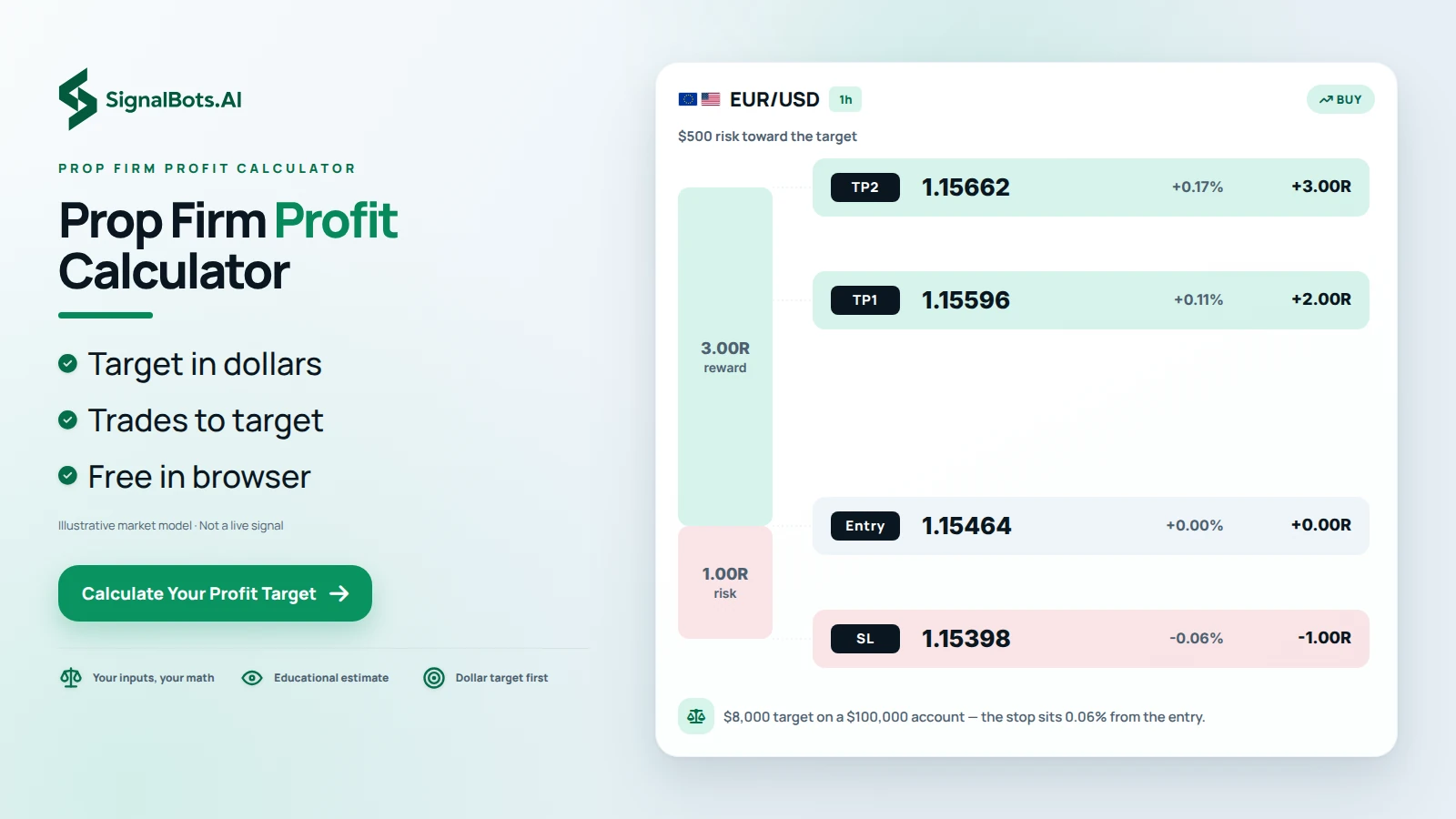
A risk ladder showing a EUR/USD 1h long plan with entry, stop-loss and two take-profit rungs drawn to scale, sized $500 risk toward an $8,000 profit target on a $100,000 account.
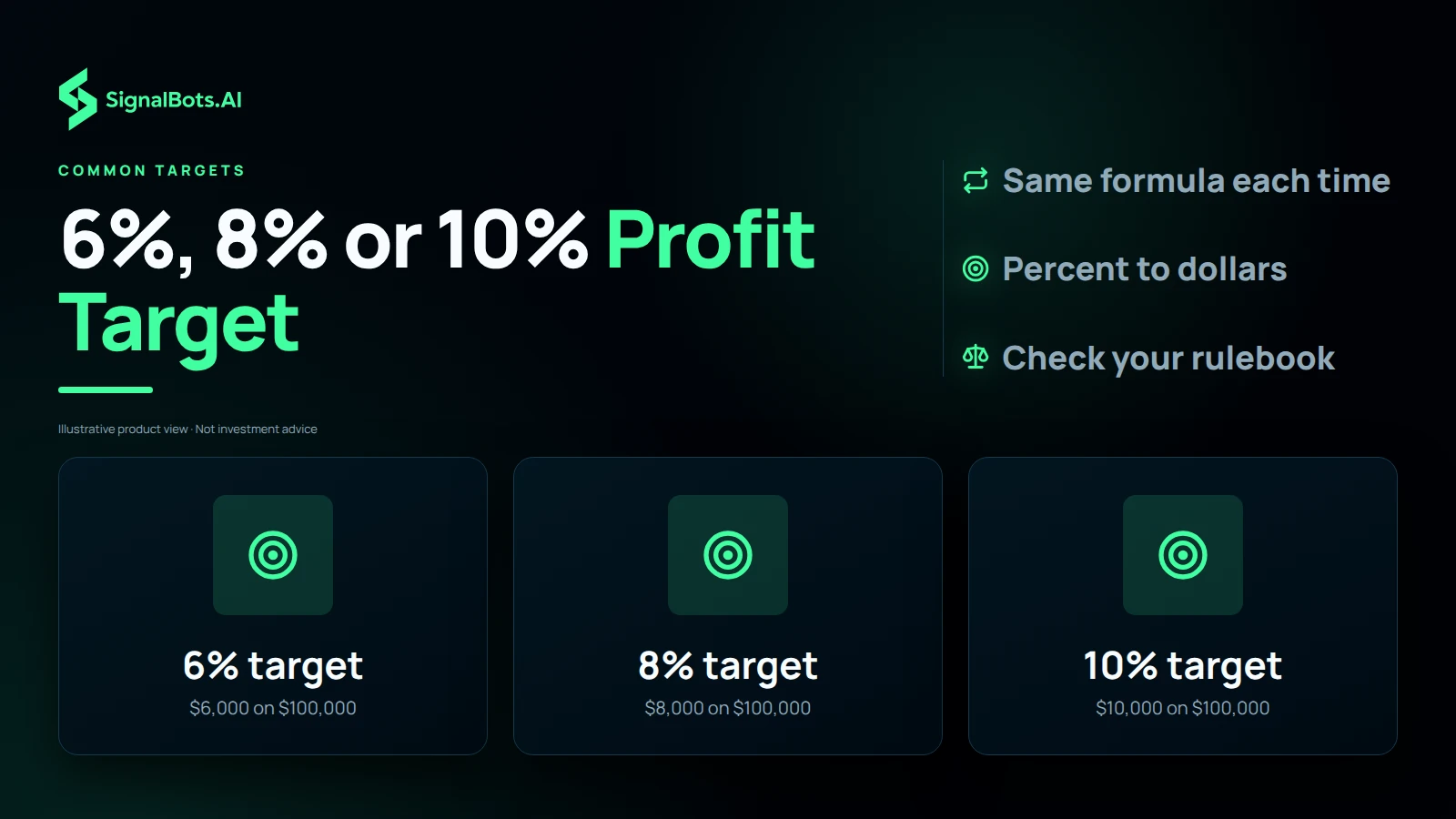
Three tiles for the 6%, 8% and 10% prop firm profit targets, each showing the dollar amount it requires on a $100,000 account.

Common targets

6%, 8% or 10% Prop Firm Profit Target on a $100,000 Account

A prop firm profit target is a percentage of account size, and the common levels are 6%, 8% and 10%. On a $100,000 account those percent goals ask for $6,000, $8,000 or $10,000 in profit before the phase passes. On a $25,000 account the same three ask for $1,500, $2,000 or $2,500, and on a $200,000 account for $12,000, $16,000 or $20,000. The multiplication never changes: account size times the percent goal. Check which figure your firm's rulebook sets for this evaluation phase before you plan the trades it takes, and keep in mind that trading carries risk of loss.

Risk and trade count

Risk Per Trade and the Trades Needed to Reach an 8% Target

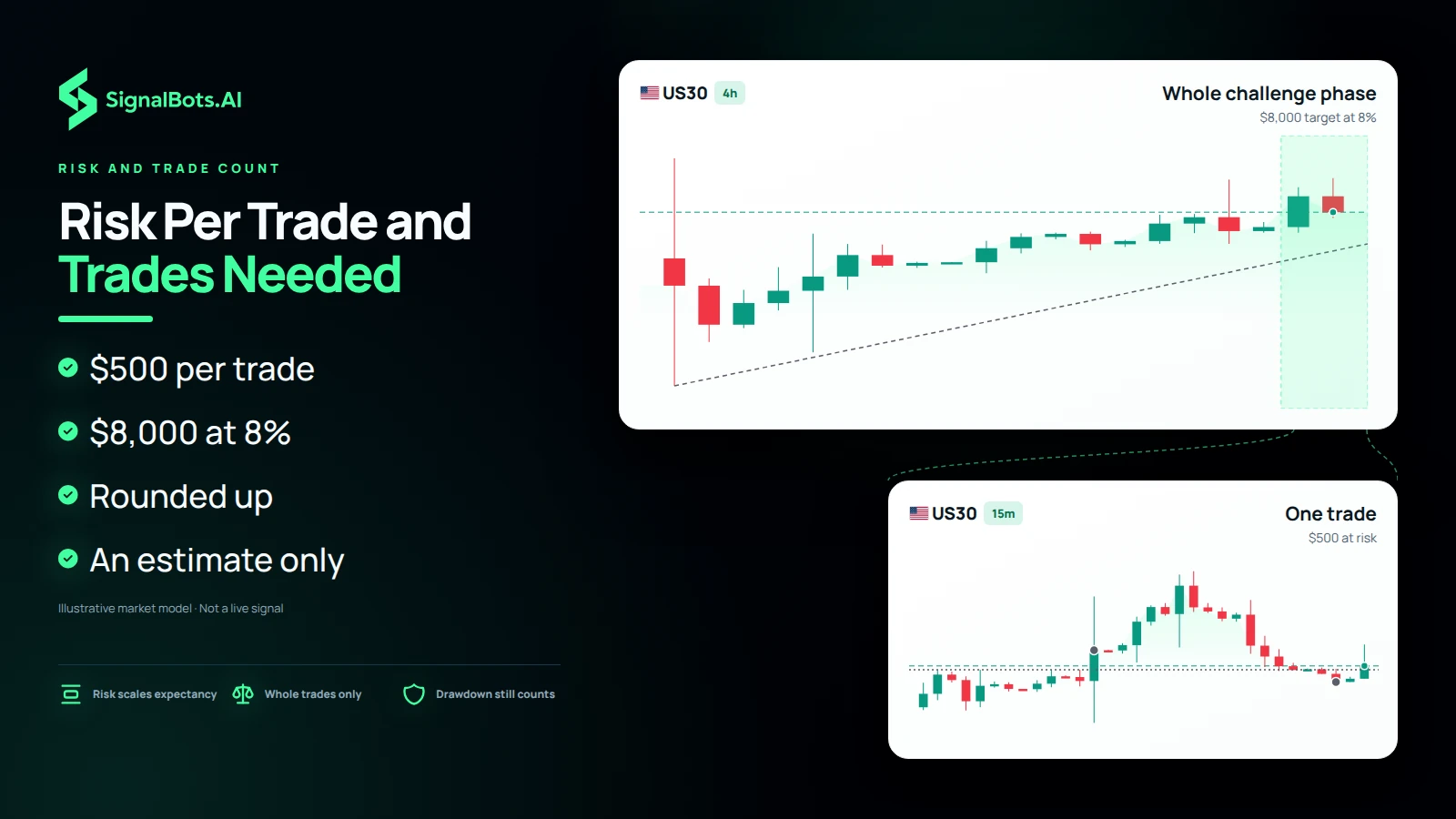
Risk per trade is the dollar amount you put on each position, $500 in the default example, and it sits at the front of the expectancy formula: risk multiplied by your win rate times reward-to-risk, minus your loss rate. The calculator divides the dollar target, $8,000 on a $100,000 account at 8%, by that expectancy and rounds up to a whole number of trades. Because expectancy scales with risk, a larger risk per trade shortens the estimate, yet every losing trade then takes more out of your drawdown limit. Read the trade count as an estimate of averages, since trading carries risk of loss.

A US30 4h context pane labelled the whole challenge phase at an $8,000 target opening into a 15m execution pane labelled one trade with $500 at risk.
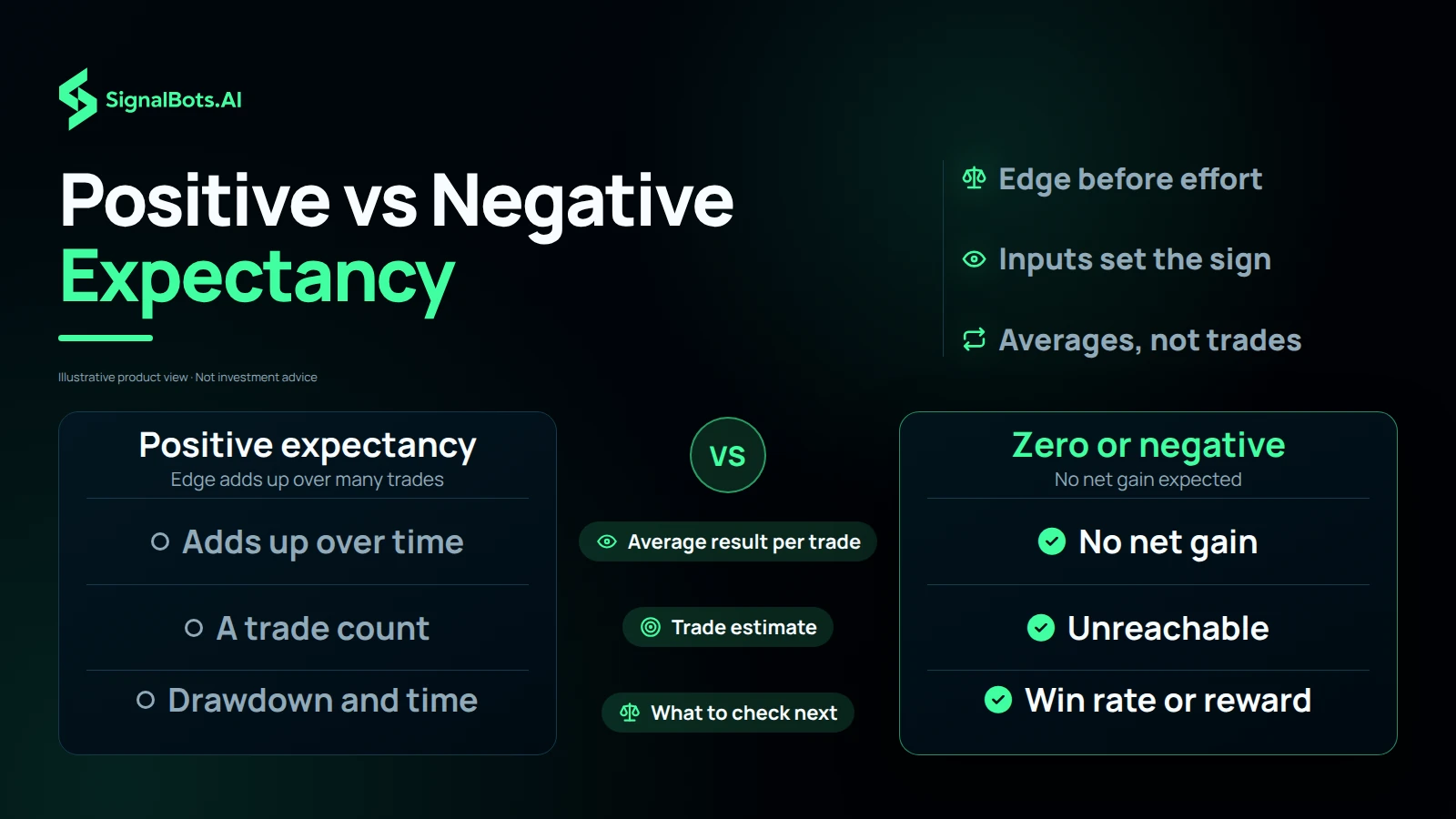
A two-column comparison of positive expectancy against zero or negative expectancy, with rows for the average result per trade, the trade estimate and what to check next.

Expectancy check

Positive vs Negative Expectancy Per Trade in a Prop Firm Challenge

Expectancy per trade is your average result per trade, and its sign decides whether the calculator can reach your profit target at all. When it is positive, your edge tends to add up over many trades, so dividing the target by it gives a trade count. When it is zero or negative, the math expects no net gain, no number of trades reaches the target, and the tool reads unreachable. The fix sits in your inputs: a higher win rate or a better reward-to-risk moves expectancy positive. A positive figure still describes averages rather than your next trade, and trading carries risk of loss.

Plan your path

Plan a Realistic Path to a Funded Prop Firm Account

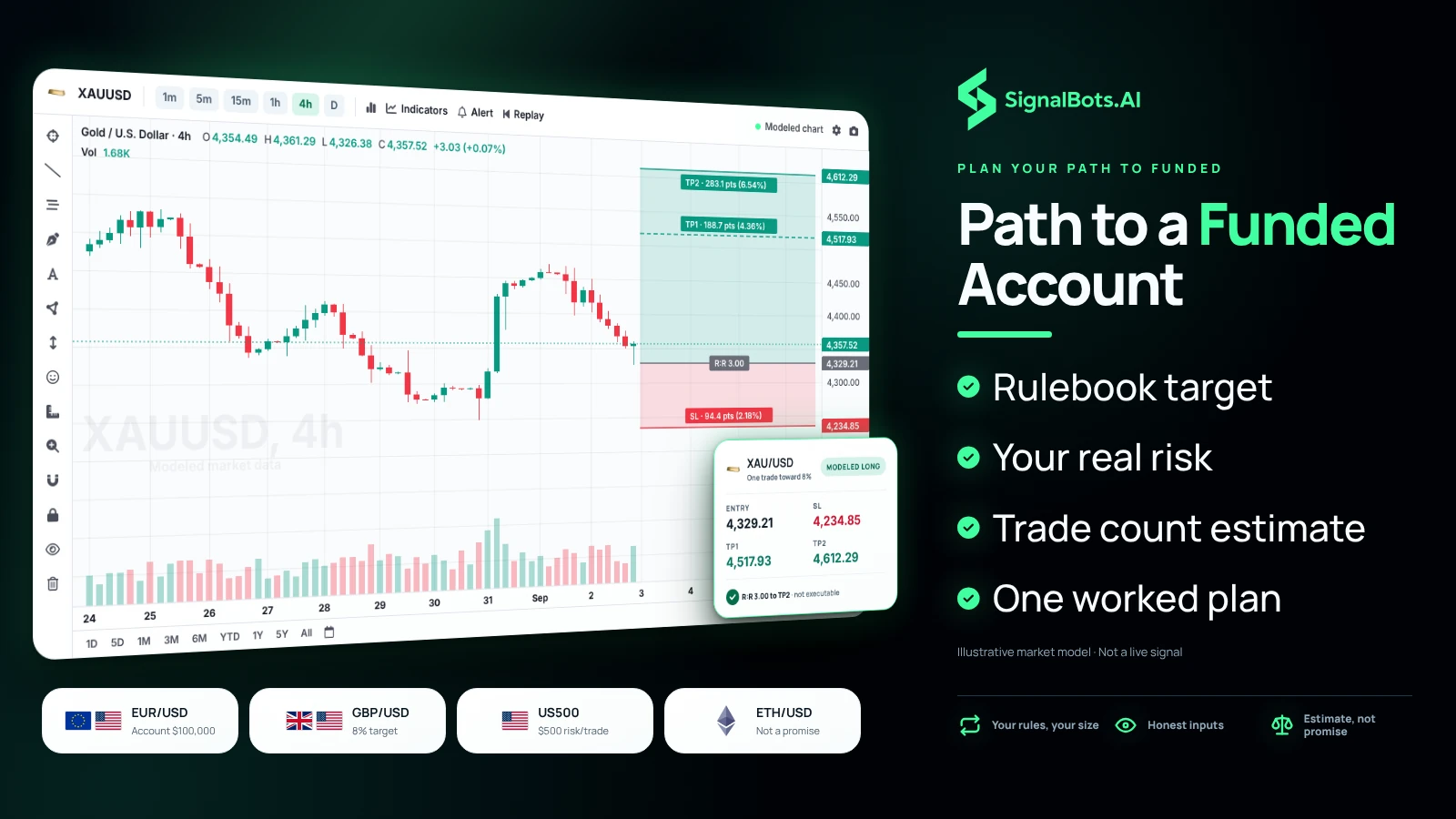
Use the calculator to plan a realistic path to a funded prop firm account before you start a challenge or open the next trade inside one. Take the account size and profit target from your firm's rulebook, the risk per trade you actually use, and the win rate and reward-to-risk your own trading record shows rather than hopeful ones. If the trade count looks long for the time your phase allows, or the target reads unreachable, change the plan first. It suits traders preparing for an evaluation and traders already in one. The estimate cannot see your firm's drawdown or time rules, and trading carries risk of loss.

A worked XAU/USD 4h long plan titled one trade toward 8%, beside four instrument cards carrying the calculator's account size, target, risk-per-trade and estimate-only inputs.
Built for your broker

Keep your broker. Keep your edge.

No switching accounts, no relearning a platform. Whichever Prop Firm broker you already trust, SignalBots plugs straight in with extensions, robots, connectors and live signals tuned to it.