You found one signal source and you trade two platforms. The call lands: EUR/USD OTC, 5 minutes, CALL. Binomo is open in one tab, Quotex in another, and there is no obvious reason the same instruction should not work in both.
That assumption is where the trouble starts. Search for binomo quotex trading signals and you will find channels that publish a single feed addressed to both platforms at once, which quietly implies the two are interchangeable. They are not — and the reason has nothing to do with whether the analysis was any good. A binary call is only half an instruction. The other half is the execution context: which asset menu it lands in, which price series that asset is quoted from, which expiry durations the trade panel actually offers, and what time the platform thinks it is.
So this is a compatibility problem, not a signal-quality problem. Below: what genuinely breaks when you port a call between these two brokers, a checklist you can run against any source you already follow, a side-by-side of the fields that diverge, and a demo procedure that settles it before real money is involved.
Key Takeaways
A binary call's content (asset, direction, expiry) is portable; the execution context around it - asset menu, OTC price series, expiry ladder and platform clock - is not.
The biggest silent break is the weekend OTC book: identically named OTC assets are separately generated price series on each platform, so a setup read on one is untested on the other.
Plain directional calls that state the expiry as a duration travel between brokers; anything tied to one platform's terminal does not port at all.
Test on a demo at each broker and log compatibility mismatches separately from losing trades, or the two failures become indistinguishable.
Table of Contents (20 min read)Contents
Does the Same Signal Really Work the Same on Binomo and Quotex?
The short answer: the content of a signal travels, the execution context does not.
A binary options signal is three facts — an asset, a direction, and an expiry. Nothing in those three facts belongs to a particular broker, which is exactly why one channel can serve two audiences without lying about it. It is also why broker-side signal tools are usually generic: Binomo's in-platform signal widget surfaces standard technical-analysis output rather than anything proprietary to Binomo, and the same output would read identically on any chart. The call is identical on both platforms. What it becomes after it passes through each one is not.
What does belong to a particular broker is everything between reading the call and having a position open:
the exact asset name on that platform's menu, and whether the asset is listed there at all;
for weekend and off-hours trading, which synthetic book the price comes from;
the expiry durations the trade panel will let you select;
the clock the platform runs on, and how far behind the call you are when you click.
Miss one of those and you have not placed the signal. You have placed something adjacent to it and then judged the source on the result.
What Actually Breaks When You Port a Signal Between the Two Brokers
Four failure points do nearly all the damage, and only one of them is obvious.
1. Asset names and asset coverage. The same currency pair can be labelled differently on two terminals — a slash here, a suffix there, an (OTC) tag appended in one place and folded into a separate tab in the other. This is ordinary symbol mapping, and it is survivable once you have written the translation down. Coverage is the harder half: Quotex carries a long tail of exotic OTC currency crosses that simply has no counterpart on Binomo's list. A call on one of those is not a mismatch you can round off — there is nothing to place.
2. The two OTC books are not the same market. This is the one that quietly ruins cross-broker testing. Both platforms keep trading alive at the weekend through an OTC market, and both quote familiar-looking names like EUR/USD OTC. But an OTC instrument is priced by the platform's own engine, not by an exchange or an interbank feed. Two brokers running weekend OTC trading are therefore running two separate synthetic series that happen to share a label. A setup read off one broker's OTC chart is not a claim about the other broker's OTC chart. Identical name, different instrument.
One call, checked against both brokers in parallel: two checkpoints pass, two fail identically.
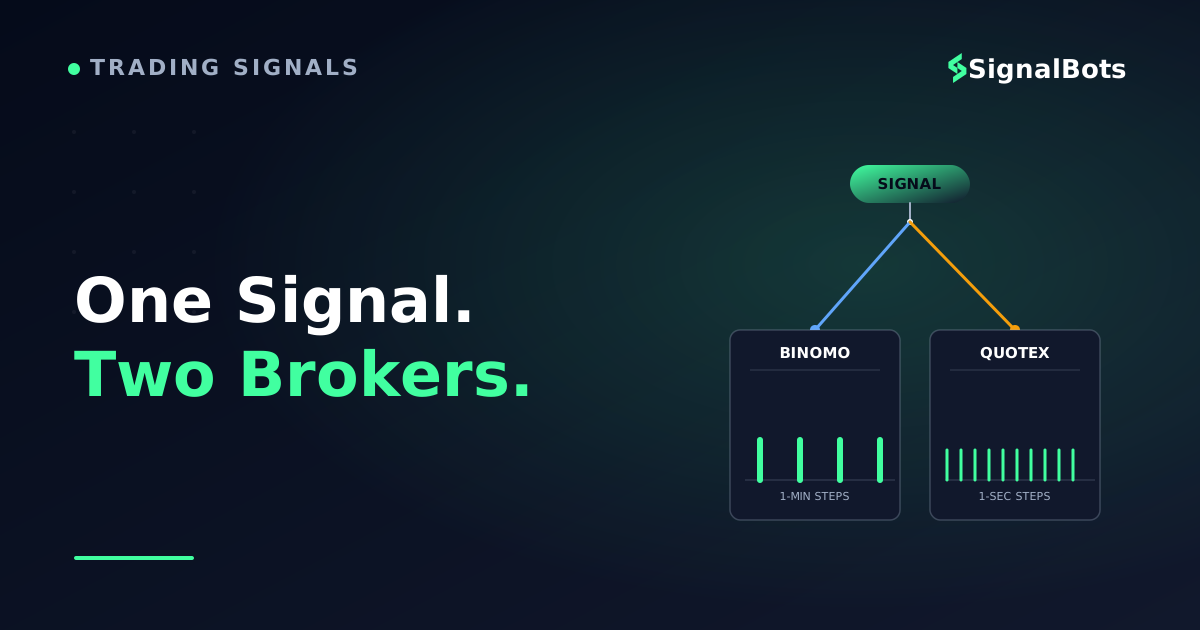
3. Expiry menus have different shapes. Quotex lets you set an expiry time with fine granularity — down to a few seconds, adjustable to the exact second. Binomo works from a coarser ladder of durations that starts around the one-minute mark. A source that publishes 30-second calls is not portable to a platform whose shortest slot is longer, and "rounding up to the nearest available expiry" is not a small accommodation: on a sub-minute horizon it is a different trade with a different distribution of outcomes.
There is a related trap that costs people more than it should. The chart interval and the trade expiry are two different settings. Switching a chart to 5-minute candles does not make your trade a 5-minute trade — the trade panel decides that, independently. A source that publishes "M5" without saying whether it means the analysis timeframe or the trade duration is ambiguous on both platforms, not just one.
4. Clocks and lag. Each terminal displays its own time reference, and a channel that posts "enter at 14:30" without naming a zone has handed you a coin flip. Worse, the gap between a call being published and you finding the asset on the second platform is dead time. Beyond a certain delay a call is simply a stale signal — the entry it described no longer exists, and the loss that follows tells you nothing about the source.
And one that does not break, but changes the maths. Payout percentage is set per asset and per expiry by each platform, so the same call with the same outcome pays differently on each. That moves the win rate you need just to break even — worth running through a break-even win rate calculator for each broker's quoted payout before you conclude that a source "works better" on one of them. Binary trading carries real risk of losing your stake regardless of which platform you place it on; our risk warning sets out what that means.
Check yourself
Knowledge check
A channel posts: EUR/USD OTC - M5 - CALL. You open the platform, switch the chart to 5-minute candles and click CALL. Have you placed the trade the signal described?
Why
The chart interval only changes how price is drawn. Your expiry is whatever the trade panel is set to when you click, which is why a source should publish the expiry as a duration and not as a timeframe label. Ambiguous 'M5' calls are a portability problem before they are ever a signal-quality problem.
The most common way a ported call becomes a different trade.
A Compatibility Checklist for Any Signal Source
The four failure points above turn into a short, reusable test. Run it against a source before you decide whether it can serve both brokers — most of it can be answered from a week of past posts without placing a single trade.
The checklist applied to one real-looking call
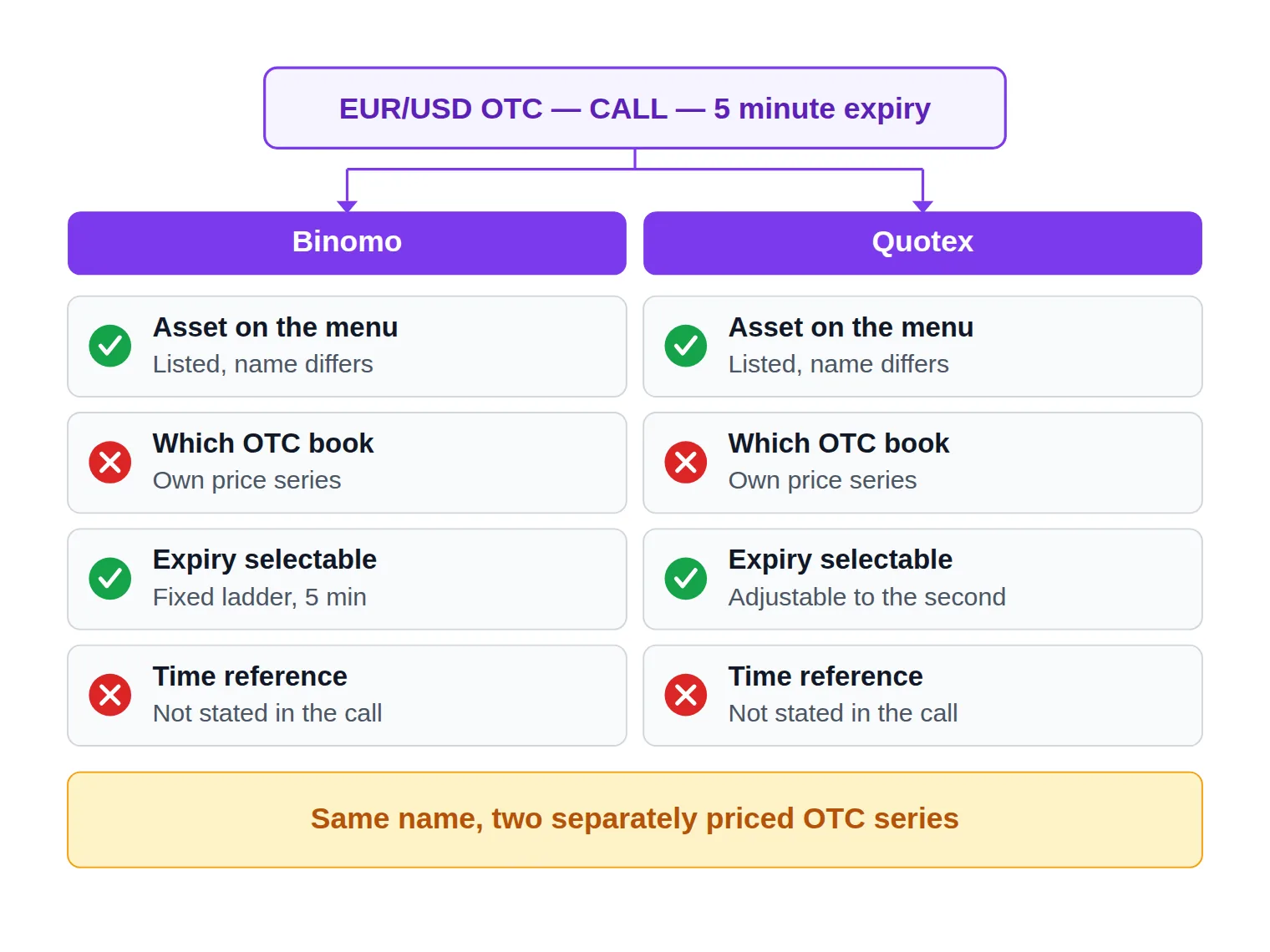
Take a typical published call: "EUR/USD OTC — 5 min — CALL — enter now." Four lines, and it half-fails.
Asset named in a findable form — passes. EUR/USD exists on both platforms, and the OTC flag tells you which tab to be in.
Which OTC book — fails, silently. "EUR/USD OTC" identifies a tab, not an instrument. If the analysis came from one broker's synthetic series, it is evidence about that series only, and the same call sent to the other platform is an untested transfer. A source that never says which chart it read is a source you can only validate one broker at a time.
Expiry as a duration — passes, narrowly. "5 min" is a duration rather than a timeframe label, and a five-minute slot is selectable on both. Had it read "30 sec" or "M5", one of those two things would have failed.
Timing reference — fails. "Enter now" is only meaningful if you are watching the moment it posts. There is no valid-until stamp, so a call you open four minutes late is indistinguishable from a call that was wrong.
Two passes and two fails is a normal score, and it is not a verdict on the analyst. It tells you precisely what to demand — or what to reconstruct yourself — before the same feed can drive trades on two platforms.
Run this first
Cross-broker portability check for a signal source
0 / 8
Every call names an asset I can locate on both platforms' menus, in a form I have already written a translation for.
Every call states plainly whether it refers to the OTC book or the live-market instrument.
The expiry is published as a duration (e.g. 5 minutes), never as a bare chart-timeframe label like M5 or M1.
That exact duration is selectable on both platforms without rounding up or down.
Every call carries a time reference or a valid-until stamp, so a late entry is identifiable as late.
For OTC calls, the source says which platform's chart the setup was read from.
Following it does not require me to sit inside one broker's terminal or run one broker's automation.
I have re-checked at least a few of its recent calls against each broker's own chart before trusting either.
★
Checklist complete — you’re cleared to proceed.
A source that fails the OTC-book and time-reference items can still be usable - but only on one broker at a time.
Binomo vs Quotex: Assets, OTC Coverage and Expiry Windows Side by Side
Here is where the two platforms actually diverge, field by field. Treat this as the list of things to check, not a frozen specification — asset menus, expiry ladders and payouts vary by region, by account type and over time, which is precisely why the checklist above is written to be re-run rather than memorised.
Currency pairs, commodities, indices and stock-linked assets
Currency pairs including a long tail of exotic crosses, plus crypto, commodities and stock-linked assets
Weekend availability
Live-market assets close; a separate OTC list stays open
Live-market assets close; a broad OTC list stays open, weighted toward currency pairs
Where OTC prices come from
The platform's own pricing engine
The platform's own pricing engine - a separate series from any other broker's
Expiry granularity
Chosen from a fixed ladder of durations
Adjustable to the exact second
Shortest expiry commonly available
Around a minute
A few seconds
Longest expiry commonly available
Around an hour
Several hours
Chart interval vs trade expiry
Two independent settings
Two independent settings
Payout quoted before entry
Shown per asset and expiry
Shown per asset and expiry, and moves with conditions
The rows that break a ported signal are the OTC price source and the expiry ladder - not the asset list.
Read the table for its shape rather than its numbers. Two rows do the real damage. The OTC row means a weekend call is only ever evidence about the platform it was read on. The expiry-granularity row means portability runs in one direction more easily than the other: a duration that exists on the coarser ladder almost always exists on the finer one, while a sub-minute call published for the finer platform has nowhere to go on the coarser one.
Which Signal Source Formats Travel Best Between Brokers
Sources fall into four rough shapes, and their portability is decided by format long before quality enters the picture.
Plain directional calls travel best. A text call that names the asset, the direction, the expiry as a duration and a time reference makes no assumption about your terminal. You translate it once per broker and place it by hand. Everything in this article's checklist is really a demand that a source be written in this shape.
Chart-screenshot calls travel poorly on OTC assets. On live-market instruments a marked-up chart is broadly transferable, because both platforms are tracking the same underlying market. On a weekend OTC asset it is close to meaningless across brokers, because the screenshot shows a price series the other platform never produced. If you want the mechanics of how those weekend books are priced, that belongs in a dedicated look at OTC market signals rather than here.
Automation tied to one broker does not travel at all. An extension or automated signal bot that reads one platform's page and clicks its buttons is an execution layer, not a signal format — there is nothing to port, and rebuilding it for the second broker is a separate project. That is a legitimate way to trade one platform; it is just not a shared source. The mechanics of automated signal bots for a specific broker are their own topic.
Copy or auto-execution arrangements are locked to the account they run on. Same reasoning, one level up: what is being shared is fills, not instructions.
Format decides
Which format survives the move between brokers
Winner
Plain directional call
Names the asset, the direction and the expiry as a duration you can find on any menu
You translate it once per broker, then place it by hand
Survives a broker switch because it assumes nothing about the terminal
Weakest on OTC assets, where each broker prices its own separate book
Portable, provided you still verify asset and expiry per broker
VS
Broker-tied automation
Runs inside one platform's terminal and operates its controls for you
Breaks when the page, the asset list or the account changes
Nothing to port: it is an execution layer, not a signal format
Useful on the platform it was built for, useless as a shared source
Fast on its home platform, but locked to it
Portability is a property of the format, not of the analyst behind it.
If you are still deciding whether a given source is worth following at all — separately from whether it ports — that is the general question of how to judge a Quotex signal provider, and it is worth settling first. A source that fails on its own merits does not become useful by being portable.
Testing a Signal Source on Both Brokers Before You Trade It Live
Everything above is preparation. The test itself is a fortnight of unglamorous bookkeeping, run on a demo account at each broker, and it answers a question no review can answer for you: does this specific source survive contact with your two terminals?
The procedure
Testing one signal source across both brokers
1
Open a demo on each platform
Fund nothing. Set both terminals to the same time zone and the same chart interval so you are comparing like with like.
2
Translate every call before placing it
Write the asset name, the OTC flag and the expiry exactly as each platform lists them. Anything you cannot translate is a mismatch, not a loss.
3
Log the mismatches, not just results
Two columns per call: what you actually placed on each broker, and every field you had to rename, round or skip to place it.
4
Cover a weekday and a weekend window
Weekdays test the live-market assets. Weekends test the two separate OTC books, which is where cross-broker divergence shows up.
5
Score each broker separately
A source can be worth following on one platform and unusable on the other. One combined score hides exactly the thing you are testing.
The mismatch column is the output that matters - the win column only becomes readable once it is empty.
Three details decide whether the test is worth anything.
Sync the clocks before the first call, not after the tenth. Set both platforms and your own log to one time reference — UTC is the least ambiguous choice — and note how long it takes you, in practice, to go from reading a call to having it placed on the second platform. Cross-broker tests fail more often on unsynced clocks and entry lag than on bad analysis, and the failure looks identical to a bad source from the outside.
Separate mismatches from misses. A call you could not place because the asset was absent, or because the expiry did not exist, is a compatibility data point. A call you placed correctly that went against you is a false signal or simply ordinary variance. Mixing the two produces a number that means nothing. Keep them in separate columns and count them separately.
Give it a real sample. A handful of calls tells you almost nothing about a historical win rate on either platform — short runs are dominated by luck in both directions. Decide your sample size up front, cover at least one weekend, and resist re-judging the source every afternoon. The compatibility half of the test resolves much faster than the performance half: after a week you will usually know whether the source is placeable on both, even while the question of whether it is good is still open.
What a Broker-Agnostic Signal Feed Actually Looks Like
It helps to see the format the checklist keeps asking for, written out by someone who has to publish it consistently.
Our own binary options signal feed is published in exactly that shape: each call names the asset, the direction and the expiry as a duration, in a broker-neutral form, and it is free to view without an account. Read a few calls against the checklist above and the difference is easy to see — there is no step where you have to guess what "M5" meant or which terminal the setup was read on, because the expiry is stated as the trade's duration rather than as a chart interval.
Be clear about what that is and is not. It is a directional feed, not an auto-execution tool wired into Binomo or Quotex. Nothing places the trade for you, and nothing checks the call against your platform's menu on your behalf — you still run the same asset and expiry verification described above, on each broker, before you act. Use it as a reference for what a portable call should contain as much as for the calls themselves.
Deciding Whether One Source Can Serve Both
Go back to that EUR/USD OTC call from the opening. Nothing about it was wrong. It was simply underspecified for the job you wanted it to do — feeding two platforms whose asset menus, weekend price series, expiry ladders and clocks were never designed to agree with each other.
That is the whole answer to the cross-platform question. You do not need two subscriptions, and you do not need to abandon a source because you changed brokers. You need a source written in a portable format, a translation you have made once and written down, an honest separation of could not place from placed and lost, and a demo run on both platforms long enough to tell the two apart. Run that, and the decision makes itself — including the perfectly reasonable outcome that one good source turns out to serve one broker well and the other not at all.
FAQ
Do I need two separate signal subscriptions if I trade on both brokers?
Usually not. A source that publishes plain directional calls — asset, direction, expiry as a duration, plus a time reference — can drive trades on both platforms, because none of those four fields belongs to a specific broker. What you do need is a translation step for asset names and expiry slots, and the discipline to treat weekend OTC calls as evidence about one platform only. Paying twice is rarely the fix; specifying the calls better usually is.
Is "EUR/USD OTC" the same asset on both platforms?
No. The name refers to a category, not a shared instrument. Each broker generates its own weekend OTC series from its own pricing engine, so two identically labelled OTC assets are two different price histories. The practical consequence is narrow but important: a setup read from one broker's OTC chart has not been tested on the other's, no matter how similar the two look.
What should I do when a signal's expiry does not exist on one broker's menu?
Treat it as a skip, not a rounding exercise — and log it as a mismatch. Nudging a 30-second call up to the nearest available minute changes the trade materially, and if you count the result you have contaminated your test with an outcome the source never called. If a source publishes durations that one of your platforms cannot select at all, that source is only portable to the other one.
Does a higher payout on one broker mean the same signal performs better there?
It means the same sequence of wins and losses converts into a different result, which is not the same as the signal being better. A lower payout raises the win rate you need simply to break even, so two brokers can turn an identical set of calls into opposite outcomes. Compare the quoted payout for the specific asset and expiry you actually trade — payouts differ by instrument and duration, not just by platform.
How long should I test before trusting a source on both platforms?
Long enough to separate the two questions. Placeability usually resolves within a week: either the assets and expiries translate cleanly on both platforms or they do not. Whether the calls are any good takes considerably longer and needs a sample big enough that a run of luck cannot carry it. Cover at least one weekend in the window, since weekend OTC calls are where cross-broker divergence is most likely to appear.
The Binary Options Desk is the SignalBots editorial team for fixed-time and OTC trading coverage. We research and write the guides that explain expiry timing, payout structure and disciplined entry across the major brokers.



Discussions 0
Leave a comment