It is Saturday morning. You open Quotex, go looking for the pair you traded all week, and it is not on the board. In its place sits a column of names with three extra letters bolted on: EUR/USD (OTC), GBP/JPY (OTC), USD/BRL (OTC). The charts look normal. The expiry buttons look normal. Your signal source is still posting calls.
So the reasonable question is whether anything has actually changed. If you have gone looking for Quotex OTC market signals, you have probably noticed the pattern: plenty of people will sell you weekend calls, almost nobody explains what a weekend asset is — and why a signal on it does not mean the same thing as the same signal on the live version.
That is the gap this page fills. You already know how to read a signal and how to weigh whether a source deserves your trust. This is about the variable underneath all of that, the one the weekend quietly swaps out: where the price comes from. OTC assets are not the weekday market with the lights dimmed. They are a different instrument wearing a familiar ticker, and that difference lands in your results whether or not you account for it.
Key Takeaways
An OTC price is generated inside the platform, not routed from banks and liquidity providers — so no outside chart can verify the series your contract settles against.
With the real market closed, news-based rationale stops applying, volatility loses its schedule, and a level that "holds" has no order flow defending it.
Payout sets the break-even win rate, so the identical call at two different payouts is two different trades — read the payout before you read the signal.
Treat each OTC symbol as a separate instrument: its own journal, a fresh sample, conservative sizing, and no accuracy claim you cannot audit.
Table of Contents (36 min read)Contents
Why Your Quotex Chart Only Shows OTC Pairs on the Weekend
The board changes because the market behind it closes.
Spot foreign exchange has no bell and no building. It is a rolling network of banks and dealers quoting each other continuously from the Sydney open on Sunday evening through to the New York close on Friday. When that last session shuts, the quoting stops. Nobody is making a two-way price in EUR/USD over the weekend, so there is no live price for a platform to pass on to you. Stock and index markets are stricter still — their exchanges close every night and stay shut until Monday.
That leaves any binary options platform with two choices for the weekend: close the shop, or list something it can price by itself. OTC listings are the second choice.
Two things are worth fixing in your head before you look at another weekend chart:
OTC assets are not weekend-only. They run around the clock, sitting alongside the live pairs during the week. Most traders simply never notice them until Saturday removes the alternative.
The OTC listing does not "replace" the live pair. The live pair has nothing to quote. Weekend OTC trading is the platform's own market staying open after the real one has gone home.
That distinction matters for one practical reason: nothing about the weekend forces you to trade. The asset list is shorter because the market is closed, not because an opportunity appeared.
The trading week
Weekday: both boards are live
Real markets are trading, so live pairs and OTC symbols sit side by side on the same asset list.
Friday close: live pairs go dark
The last real session shuts. With nobody quoting the underlying market, live listings stop being tradable.
Weekend: OTC is the whole board
Only the platform's own generated series keeps running, which is why every name on the weekend list ends in OTC.
Reopen: live pairs return
Once the first real session opens, live listings come back and the OTC symbols keep running beside them.
OTC assets do not appear on Saturday — they are simply the only thing left once the real market stops quoting.
What Actually Generates an OTC Price
Ask one question about any candle on your screen: where did that number come from? The answer splits the two boards cleanly.
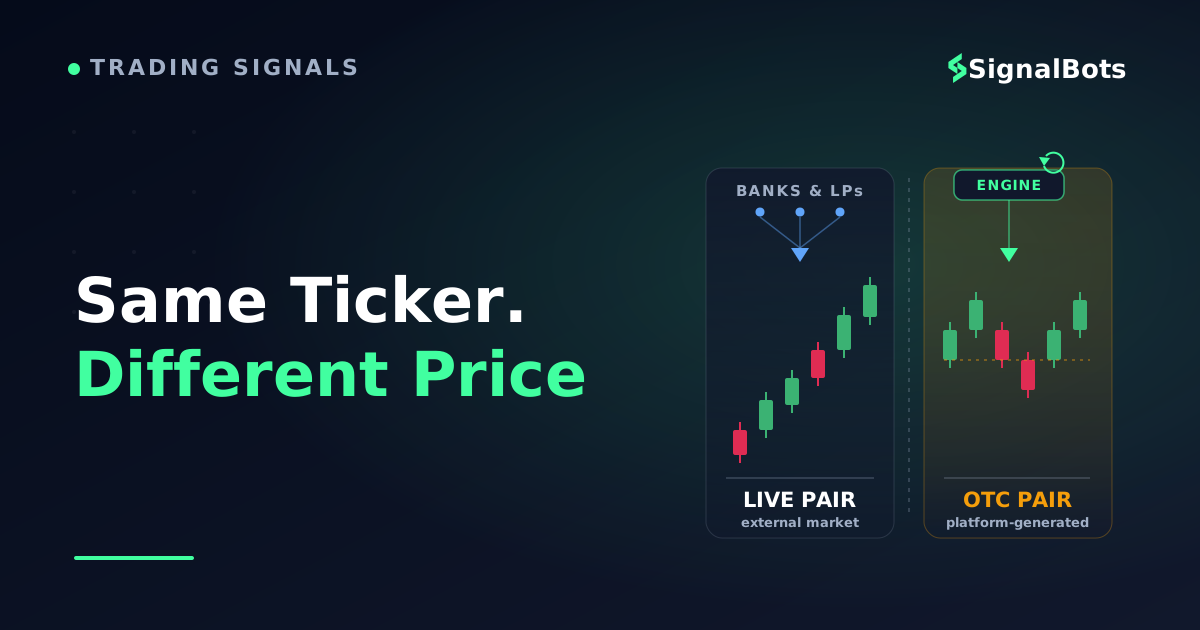
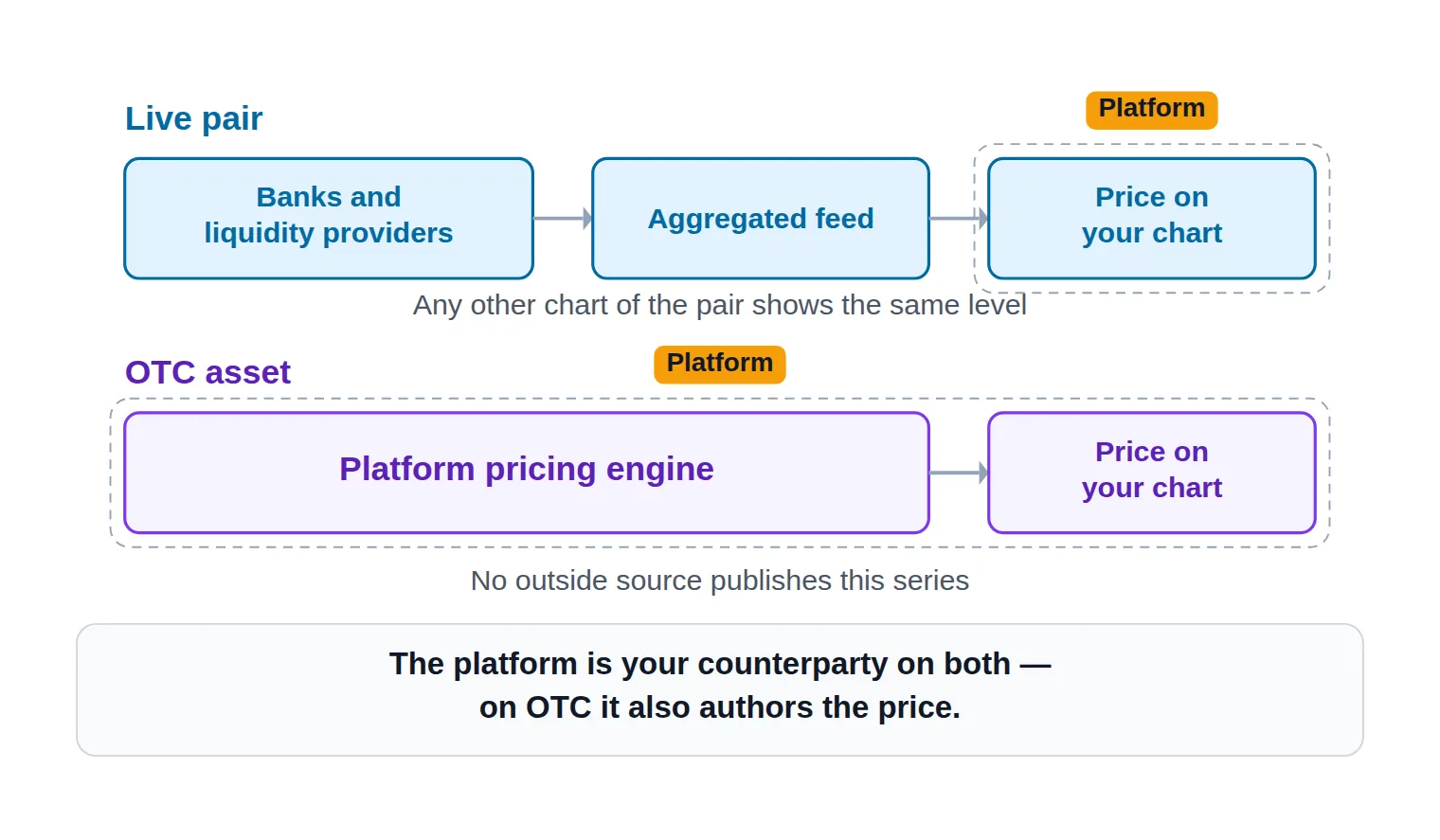
On a live pair, the quote originates outside the platform. Banks and liquidity providers post real prices at which they will trade real size, the platform aggregates those quotes into the feed you see, and the level on your chart is an echo of transactions happening elsewhere. You can pull up the same pair on any other chart in the world and see roughly the same number at the same second. The price is a shared fact, and every participant is arguing with the same evidence.
On an OTC asset, the platform is the source. The series is produced by its own pricing engine: an algorithm that emits a continuous stream of ticks with plausible volatility, drift and reversals, often anchored loosely to reference behaviour of the real instrument but not routed to it. There is no order book behind that candle. No second venue publishes the same series. If you close the platform, the price you were reading does not exist anywhere else.
Same-looking candle, two different origins: one routed in from the real market, one generated on the platform's own server.
This is not an accusation of foul play, and you should not read it as one. It is structure. On any binary contract the platform is already your counterparty — it takes the other side of the position, so your loss is its gain by design. On an OTC symbol it additionally authors the price that settles the contract. Both roles sit at one desk, with no external tape anyone can check the settlement against.
The useful response is not paranoia, it is calibration. A market-maker broker quoting a live pair is fenced in by the outside price: quote EUR/USD far from the interbank level and its own clients arbitrage it instantly. On a generated series that fence is internal. So a pattern you spot on an unverifiable feed deserves less confidence than the identical pattern on a price the whole market can see — not zero confidence, just less, and priced accordingly in how much you stake.
How OTC Conditions Change What a Signal Means
A signal is a compressed claim: this asset, this direction, this expiry. Underneath the claim sit assumptions about the market producing the price — that order flow moves it, that data releases move it, that a level holds because someone is defending it. Swap the generator and several of those assumptions quietly stop applying, while the signal itself looks exactly the same.
Here is the contrast in full, before we take the three consequences that matter most one at a time.
Live vs OTC
What you are relying on
Live-market pair
OTC asset
Where the price comes from
Aggregated quotes from banks and liquidity providers
Generated inside the platform by its own pricing engine
What moves it
Real buying and selling by real participants
The engine's model of movement, drift and volatility
News sensitivity
Reacts to scheduled data and headlines
No direct reaction — the underlying market is closed
Payout on a win
Set by the platform per symbol and expiry
Set by the platform too, and often advertised as the weekend draw
Independent verification
Any other chart of that pair shows the same level
No outside source publishes this series
When you can trade it
Only while the real market is open
Around the clock, weekends included
Who is on the other side
The platform, quoting a price it did not author
The platform, quoting a price it authored
Same ticker, same chart layout, same expiry buttons — and a different answer to almost every question that decides whether a signal is worth taking.
No News, No Fundamental Trigger
The economic calendar is blank on a Saturday, and it would be irrelevant to a generated series even if it were not. That single fact does three things to your signal reading.
First, it invalidates a whole class of rationale. Any call that arrives justified by a data release, a central-bank line, a session open or "momentum from Friday" is describing a market that is not running. The reasoning has nothing to attach to, which tells you something about the source that produced it.
Second, it disarms your protective tooling. A news filter that pauses a bot around high-impact events has nothing to pause for — but the volatility it was built to dodge has not disappeared, it has only lost its schedule. A generated series can produce a sharp burst at any minute of the weekend, and no calendar warns you.
Third, and this is the part traders under-rate: it also removes a risk. There is no surprise headline waiting to gap the price against you, no unexpected policy line at an odd hour. Weekend movement has no external cause, which cuts both ways — you cannot be blindsided by an announcement, and you cannot anticipate one either. Every edge you have has to come from the price behaviour itself.
Payout Percentages Run Differently
The payout percentage is a number the platform sets, not a market rate. It moves by symbol, by expiry, by time of day, and OTC symbols frequently carry the more attractive figures — which makes sense commercially, since they are the only board open when you are looking.
Treat that as arithmetic, not as generosity. On a binary contract you risk the entire stake to win a fraction of it, so the payout is the single term that fixes your break-even win rate: at a payout of p, you need 1 ÷ (1 + p) of your trades to win just to stand still. A more generous payout lowers that bar. A thinner one raises it, sometimes past where any honest signal source could carry you.
The consequence for signal reading is sharper than it first looks. The signal did not change — the contract did. Take the identical call at two different payouts and you have taken two different trades, one of which may be worth having and one of which is not. That is why an OTC signal cannot be evaluated in isolation from the symbol's payout at the moment you click.
Run your own numbers
What payout asks of your win rate
Move the payout slider and watch the bar you have to clear move with it. Same call, same direction — a different trade.
Payout on a win
Your measured win rate
Stake per trade
$
Trades in the sample
Break-even win rate
—
Edge over break-even
—
Expected result over the sample
—
Illustrative only. Drop the payout a few points and a win rate that was comfortably profitable can slide under the line without a single trade changing.
Price Behavior Clusters Around Round Levels
Traders who spend their weekends on OTC boards tend to come back with the same impressions: the series looks unusually tidy, it turns at round numbers, it reverts to its average more obediently than the live pair ever does. That is a reasonable hypothesis about an algorithmic feed, and it is worth testing on demo — but it is not a rule you should take on faith from anyone, including us.
What you can take from it are two disciplines.
Tidiness is not predictability. A generated series can print textbook structure and still be unforecastable from the chart alone. Clean-looking price action is exactly the condition under which traders over-commit, because the pattern feels obvious in hindsight and the next one is being drawn by the same engine that drew the last.
False signals mean something different here. On a live pair, a level breaks because real orders overwhelmed the ones defending it — the break itself is information about participants. On a generated series there is no defending order flow, so a break through a level carries none of that information. The candle looks like a breakout; the thing that usually makes a breakout meaningful is absent. Confirmation logic built for live markets is measuring something that is not there.
Illustrative series
An OTC series turning at a round number — with nothing behind itEUR/USD (OTC)5m
Illustrative, not recorded data. The point is what you cannot see: no order flow defended either level, so neither the hold nor the false break carries the meaning it would on a live pair.
Should You Trust a "High-Accuracy" OTC Signal Claim?
Go looking for weekend calls and you meet numbers fast. A bot advertises a probability per signal. A dashboard stamps a confidence score on each row and calls anything above a threshold "strong". The numbers are precise, prominently placed, and almost always unaccompanied by the record that would make them checkable.
Hold them loosely, for three reasons that are specific to OTC rather than general scepticism:
They are unverifiable in a way live claims are not. For a live pair, you could in principle rebuild a source's last hundred calls against an independent price record. For a generated series there is no public tape at all — nobody outside the platform holds the history, so nobody can audit the claim, including the person making it.
They do not travel. Even taken at face value, a result measured on one platform's OTC series says nothing about another platform's, and nothing about the live version of the same ticker. It is a claim about one private feed, which is the same reason running one signal source across two binary brokers needs checks of its own.
Accuracy alone is not an outcome. Without the payout it was earned at and the sample size behind it, a headline historical win rate is a number without a unit. Run it through the calculator above: the same accuracy is a good business at one payout and a slow bleed at another.
Whatever the source — a Telegram channel, a WhatsApp group, an automated signal bot, or a free public feed — the weekend does not make its claims easier to verify. It removes the only external evidence you had. This page is not the full takedown of "sure shot" and guaranteed-accuracy marketing, and it is not the general checklist for judging whether a signal source is reliable; both of those are jobs of their own. It is the reason those checks get harder the moment the ticker ends in OTC. Binary contracts put your whole stake at risk on every trade, so read our risk warning before you act on any performance claim, ours included.
Adjusting How You Trade Signals on OTC Assets
None of this makes the weekend board off-limits. It makes the settings you carried in from Wednesday the wrong settings, because they were calibrated on a different instrument. Five adjustments cover most of the gap.
Treat each OTC symbol as its own instrument. EUR/USD (OTC) is not EUR/USD with a suffix; it is a separate series that happens to be named after one. Journal it separately, and never let a weekend result flatter or damage the record you keep for the live pair.
Rebuild your expectations from a small sample. Your weekday win rate is evidence about a market that is currently closed. On OTC you are starting a new record with a handful of observations, which is exactly when position sizing should be at its most conservative — a thin sample and a full-size stake is how a bad weekend becomes a structural problem. The risk-of-ruin calculator is the fastest way to see what your stake size does to the odds of running the account down.
Separate the two clocks. The contract's expiry time and the signal expiry — how long the call itself stays valid — are different things, and the second one is harder to judge on a weekend. A live call goes stale visibly, because you can see the market has moved on. A forwarded OTC call from forty minutes ago looks identical to a fresh one, since there is no news flow and no session context to date it. Decide the expiry before you enter and discard anything you cannot timestamp.
Reject rationales the feed cannot support. If the reasoning behind a call depends on news, on session liquidity, on volume, or on a correlated instrument that is closed, the reasoning does not apply here. That single filter removes a surprising share of weekend signals before risk management ever has to.
Spend a weekend on a demo account first. Not to prove the feed is beatable, but to see how these specific symbols behave under your source's calls — how often it fires, how the payouts move, whether the tidy structure survives contact with real entries.
Pre-trade
Before you take a signal on an OTC asset
0 / 7
Confirm the symbol on the ticket is the OTC listing, not the live pair you journalled last week.
Check the payout on that exact symbol and expiry, and know the break-even win rate it implies.
Reject any call whose stated reason depends on news, volume or a correlated market that is closed.
Size for a record you have not built yet — treat your weekday win rate as unproven on this series.
Log the trade in a separate OTC column so the weekend sample never contaminates your live-market numbers.
Fix the expiry before entry rather than re-deciding after the first candle moves against you.
Set the session stop in advance: a trade count or a loss amount that ends your weekend either way.
★
Checklist complete — you’re cleared to proceed.
Seven checks that take under a minute and catch most of the ways a weekday routine misfires on a weekend contract.
FAQ
Is a Quotex OTC pair the same asset as the real currency pair?
No. It shares the name and it tends to move in a broadly similar style, but the price is generated by the platform rather than routed from the interbank market. Two charts with the same ticker, two different origins — which is why a strategy validated on the live pair has not been validated on the OTC one.
Are OTC assets only available at the weekend?
No — OTC symbols typically run around the clock, including through the trading week alongside the live pairs. The weekend is simply when they are the only option, which is why most traders first notice them on a Saturday.
Can I use my weekday signal source on OTC pairs?
You can, but treat it as an untested application rather than a continuation. Ask the source directly whether its calls are generated for OTC symbols specifically or simply relabelled from live-market analysis. If the answer is vague, that is your answer.
Does technical analysis still work on an OTC chart?
Indicators still compute — they only need a price series. What changes is the meaning of what they measure. A level that holds because real orders defended it is different evidence from a level that holds because an algorithm turned there, even when both look the same on the chart.
Is a higher OTC payout automatically a better deal?
A higher payout genuinely lowers the win rate you need to break even, so it helps in isolation. It says nothing about whether the signals you are taking clear that lower bar. Payout and signal quality are two independent terms in the same equation, and only the product of both decides the outcome.
Should expiries be shorter on OTC assets?
There is no universal answer, and be sceptical of anyone who offers one. What is defensible is the method: pick one expiry, keep it fixed while you gather a sample on demo, and change one variable at a time. Shorter expiries expose you to more of the series' own noise; longer ones give a generated trend more room to unwind.
See Live Signals for When Real Markets Reopen
Everything above exists because of one condition: the market that would normally set the price is closed. On Sunday evening that condition lifts, and the questions change back — you are reading a price the whole market can see, with order flow behind every level and a calendar telling you when it will get busy.
That is the environment our binary options signal feed is built for. It publishes live-market calls with direction, entry context and expiry, on the pairs and indices that trade during the week. Two limits worth stating plainly: it is a live-market feed, so it does not generate OTC or synthetic-market signals — if you trade exclusively at weekends, you will not find coverage of that board there — and it does not replace your own judgement about how a weekend feed behaves. It is the other half of the picture, not a substitute for reading this one carefully.
The Short Version: OTC Isn't Worse, It's a Different Game
Back to Saturday morning. The board in front of you is not a degraded version of the weekday market; it is a different product with its own price source, its own payout structure and its own answer to "why did it turn there". A signal that assumed the first market can be badly wrong about the second while looking perfectly reasonable on screen.
So the adjustment is not to avoid OTC or to fear it. It is to stop importing conclusions. Rebuild the record for these symbols, read the payout before you read the call, discount any accuracy claim you cannot audit, and stake accordingly while your sample is thin.
Do that and the weekend becomes what it should be: a smaller, stranger market you understand well enough to trade deliberately — or to sit out, which on a quiet Saturday is also a decision worth making.
Sources & Further Reading
Want to go deeper? These independent, authoritative sources shaped this guide — each one is worth reading in full:
The Binary Options Desk is the SignalBots editorial team for fixed-time and OTC trading coverage. We research and write the guides that explain expiry timing, payout structure and disciplined entry across the major brokers.



Discussions 0
Leave a comment