You searched for a Quotex signal WhatsApp group and the internet delivered exactly what you asked for: pages of invite links stacked into tables, re-stamped with the current year, and covered by a single line of legal cover — join at your own risk. Not one of them tells you how to judge the risk you are being told to accept.
That is the real problem with the WhatsApp route. Finding a link takes ten seconds. Working out whether the room behind it is run by someone with a record, or by someone who wanted your phone number, takes a method — and the directories that list these links have no incentive to give you one.
This guide is that method. It will not hand you an invite link, and the reason matters: these links rot, get resold, and get renamed within weeks, so any list published here would be stale and irresponsible by the time you read it. What it gives you instead is a set of checks you can run on any Quotex WhatsApp group link you find, before you tap it and after you are inside.
Key Takeaways
A WhatsApp group gives you no scrollable archive and shows your phone number to every member, so the evidence you would normally use to judge a signal source does not exist — you have to collect it yourself.
The directories listing these invite links accept submissions from anyone and re-check nothing; treat every entry as an unverified classified ad and match the invite preview against what it claimed.
Give any group you join two days as a spectator: log every call yourself before expiry, settle them on a demo account, and decide on your own record rather than the accuracy the group advertises.
Table of Contents (23 min read)Contents
Why a WhatsApp Group Is Harder to Vet Than a Telegram Channel
Signal groups on WhatsApp are not the same product as a Telegram signal channel with a different app icon. The difference is not tone or culture — it is what evidence exists for you to inspect.
Start with history. When you join a WhatsApp group through an invite link, the room effectively begins the moment you arrive. WhatsApp has added a way for a member to pass along a slice of recent messages when they add someone directly, but that is an action a person chooses to take, it covers only the recent tail of the conversation, and it does not turn a link-join into a scrollable archive. You cannot read six months of calls and see how they aged. In a public Telegram channel, you can.
Then there is your number. In a WhatsApp group, every participant sees every other participant's phone number, including yours, and including the participants who joined for reasons unrelated to trading. WhatsApp usernames — the feature that lets your handle stand in for your number — have been rolling out region by region rather than switching on everywhere at once, and they do not hide your number from anyone who already has it saved. Treat number exposure as the default until you have confirmed otherwise on your own account.
The invite link itself is the third weakness. It is a bearer pass: whoever holds the string can join, and can pass it to anyone else. Admins can reset it, which quietly kills every listing that ever published it, and a link that still works can point at a group that has since been renamed, resold, or repurposed. The listing you read and the room you enter are only loosely connected.
Discovery surface
What you can actually inspect before you commit
WhatsApp signal group
No public archive — join by link and the room starts the day you arrive.
Every member sees your phone number, and you see theirs.
The invite link is a bearer pass; anyone holding it can pass it on.
Name, picture and description can change after you join, without notice.
Messages can be deleted for everyone, or set to disappear on a timer.
You are judging a claim with no record to check it against.
VS
Telegram signal channel
Public channels keep a scrollable post history you can read before subscribing.
Subscribers are hidden, and joining does not put your number in a list.
Edited posts carry an edited marker, so late rewrites are visible.
Forwarded posts travel with the name of the channel they came from.
More of the evidence is on the table before you commit.
A comparison of auditability, not of trustworthiness — a Telegram channel with a readable history can still be worthless. The point is that on WhatsApp, the evidence is not there to read.
None of this makes WhatsApp groups fraudulent by nature. Plenty of them are ordinary rooms where a person posts their calls and other people discuss them. It makes them unfalsifiable, which is a different problem: the normal way you check a signal provider — read their past calls, count how many were losers, see whether they published the losers at all — is unavailable to you here. Everything you learn, you have to collect yourself, starting the day you walk in.
What Those "Quotex Signal Group" Directories Actually Hand You
Spend a few minutes on the pages that rank for a Quotex signal WhatsApp group link and a pattern emerges quickly. They are all the same page.
Each one is a list of invite links with a short block of generic joining instructions, occasionally a table, occasionally an FAQ that answers questions nobody asked. Titles carry three years at once so the page reads as current whatever month you arrive. Some carry a line telling you to "vet the group's credibility" without a single sentence on how. One of them warns you never to share a verification code or financial information — good advice, immediately abandoned, with nothing following it.
The important detail is in the submission model. On several of these directories, anyone can add a group listing without asking permission from anyone. That is not a scandal; it is the business. The directory earns from listing volume, not from listing quality, so nothing in its economics rewards checking whether the group behind a link still exists, still does what the description says, or ever did. The directory hands you the key and nothing else — not who cut it, not what is behind the door, not whether the lock has since been changed.
So treat a directory entry as what it is — an unverified classified ad — and extract the little it can honestly give you. A listing tells you a destination exists, roughly what it claims to be, and, in the language it uses to sell itself, quite a lot about who wrote it. It cannot tell you the group is active, that the admin is the person described, or that anything posted inside has ever been true.
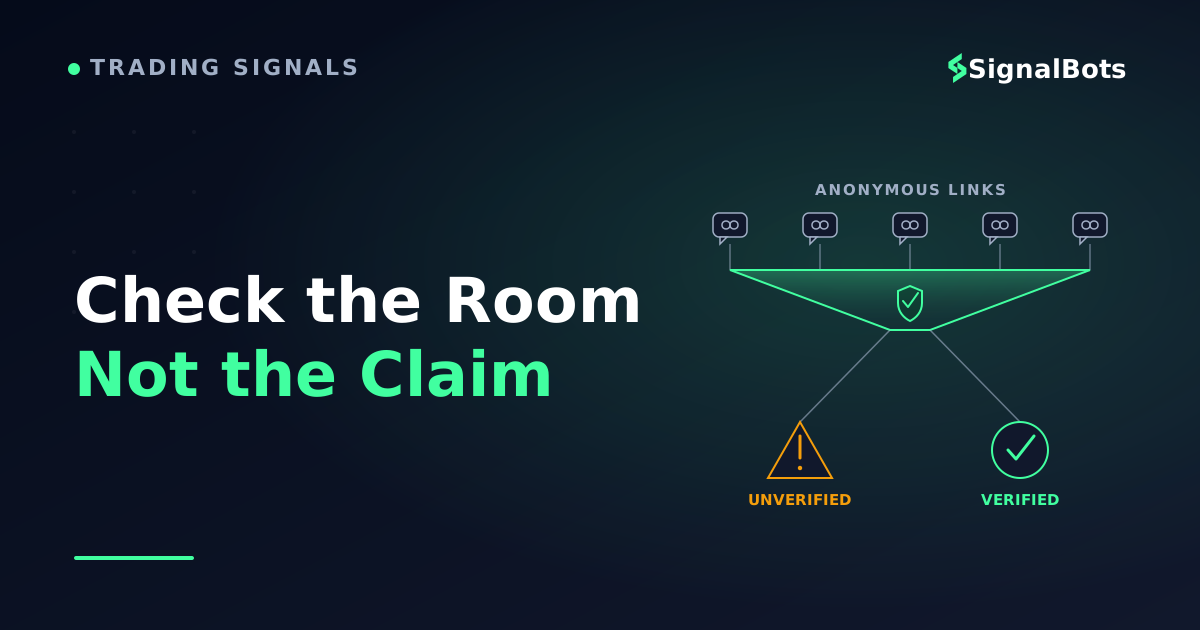
Everything after that is on you, and it runs in four stages.
The vetting path
The four stages of vetting a Quotex WhatsApp signal group
1
Trace the link to a named source
Find out who published this invite and whether that identity has a continuous, checkable history somewhere other than the directory page.
2
Read the destination before you tap
The invite preview shows the group's real name and picture. Check them against what the listing promised; a mismatch means a recycled link.
3
Join on your terms, not theirs
Lock your group-privacy setting, decide which number you are bringing, and post nothing that identifies you on arrival.
4
Observe for two days, log everything
Record every call yourself and settle it on a demo account before any real money follows a stranger's entry.
The first two stages happen before you tap the link; the last two decide whether you stay.
How Do You Vet a Quotex WhatsApp Signal Group Before Joining?
Every check below answers one question: if this group turns out to be worthless, what will I have lost, and will I be able to tell?
Trace the link back to a name. A directory entry is anonymous by construction. So look for the same group promoted somewhere with an identity attached — a site with an author, a YouTube account with a posting history, a public channel with dated archives. You are not looking for polish. You are looking for continuity: something that existed before last week and can be embarrassed by its own past.
Check the destination against the claim. WhatsApp shows you the group's real name and picture on the invite page before you commit to joining. If a listing sells "Quotex VIP daily signals" and the preview says something else entirely, you have found a recycled link — the same string pasted under a new headline, pointing at a room that moved on.
Weigh age and size — and know which of those numbers you can actually see. Listings advertise membership figures the way a poster advertises a crowd: the number was typed by whoever submitted the entry, nobody re-checked it, and members can be bulk-added from other rooms in any case. Treat a claimed member count as unverifiable, because it is. The checkable version arrives once you are inside — WhatsApp shows you the participant list and the dated system message recording when the group was created and by whom — so make both the first thing you look at on arrival. Read them as context rather than verdict: a room opened last week and already selling a paid tier has no history for anyone to judge, while one that has run for a year has at least been exposed long enough for disappointed members to leave. Neither number says the calls are any good. What they tell you is how much scrutiny the room has already survived — and a fresh link has survived none.
Look for a record that lives outside the chat. The single strongest signal is a dated, external archive of past calls that the admin cannot quietly edit — a published results page, a public channel with timestamps, a third-party tracking account. Its absence is not proof of fraud; most small groups have nothing. But its absence tells you that every claim about a historical win rate is unverifiable, and an unverifiable number should carry no weight in your decision. If a group does show results, be alert for a backdated track record: screenshots assembled after the fact, with the losers cropped out.
Read the sales language literally. "Sure shot", "guaranteed", "100% accurate", "recover all your losses" — this phrasing is copied verbatim across the directory listings, and it is disqualifying on its own. No one who has actually traded binary expiries writes like that, because everyone who has traded them has lost trades.
Decide what identity you are bringing. Before you tap, set your WhatsApp group privacy so that only your own contacts can add you to further groups; otherwise the first group can feed your number into a dozen more. Then decide, deliberately, whether you are joining with the number your bank texts you on. Many experienced traders keep a separate number purely for this.
Notice what is asked of you before you have seen anything. A deposit, a fee, a broker sign-up under their referral link, an ID photo, a one-time verification code — any of these requested before the group has shown you a single settled call is the tell. Legitimate KYC verification happens with the broker, on the broker's own platform, and never inside a chat group.
Run this before you tap a Quotex WhatsApp group link
0 / 9
I can name the person or brand behind this invite, and I found that identity somewhere other than the directory page that listed it.
The group name and picture on the invite preview match what the listing claimed the group is.
I am treating the listing's claimed member count as unverifiable, and I will check the group's real size and creation date the moment I am inside.
There is a dated record of past calls I can read without joining — or I have accepted that every performance claim here is unverifiable.
The listing avoids absolutes: no 'guaranteed', no 'sure shot', no promise to recover my losses.
My WhatsApp group-privacy setting is locked so strangers cannot pull me into further groups.
I have chosen which phone number I am bringing, knowing every member will see it.
Nothing is being asked of me before I have seen a single settled call — no deposit, no fee, no ID, no verification code.
I know whether this is a two-way group or a one-way channel, and I am comfortable with that trade-off.
★
Checklist complete — you’re cleared to proceed.
Eight checks, none of which requires you to trust anyone's word.
A composite listing, read line by line
Here is a listing assembled from the phrasing these directories reuse endlessly. It is not a real group — it is a portrait of the genre:
QUOTEX VIP SIGNALS 2024 2025 2026 🔥 — 100% Sure Shot
Join our free quotex trading signals whatsapp group and recover all your losses! Daily OTC signals, 95% accuracy, expert analysis. Open your account with our link and get VIP access free. New link — old group full.
Run the checks and it fails five of them before you reach the link:
Three years in the title. The page is not current; it is designed to look current forever.
"Recover all your losses." This is the recovery pitch, and it selects deliberately for people who have already lost money and are now in the worst possible frame of mind to evaluate an offer.
"Open your account with our link" as the price of access. Referral economics are not sinister in themselves — plenty of honest publishers, ours included, earn through partner links and say so plainly. The red flag is conditioning access on a fresh deposit through their link while refusing to show any record at all.
"New link — old group full." Sometimes true. Also the standard cover story for a link that was reset after the previous room was reported, or for a group that has changed hands.
Nothing here proves fraud. What it proves is that there is nothing to check, which is the same practical outcome: no basis on which to act on a single call.
Your First 48 Hours in the Group: Observe Before You Trade
Suppose you join. The temptation is the first signal — it usually arrives fast, it usually feels urgent, and binary expiries are short enough that hesitating feels like the expensive choice. Trade it and you have learned nothing except that you are compliant.
Give the group two days in which you are a spectator with a notebook. The purpose is not to establish whether the group is profitable; two days cannot do that, and no sample size that small can. The purpose is to establish whether the group tells the truth about its own results, which two days can do.
Observation window
0hArrival: record the room exactly as you found it Screenshot the group name, description, picture, admin list, participant count and the creation date the moment you join — that is the first time the size and age are real rather than advertised. If the group is later renamed or repurposed, that screenshot is your only evidence it changed. Post nothing about yourself, and skip the greeting: it tells the room your number is live.
D1Day one: keep your own signal log, in your own notes For every call, record the asset, direction, expiry and the timestamp it arrived — in your notes, not theirs, and before the expiry passes. Messages here can be deleted for everyone or set to disappear on a timer, so the group's own history is not a record. Log the calls that arrive too late to act on as well; those matter more than you would think.
D2Day two: settle every logged call on demo, then ask one question Run each logged signal on a demo account rather than live funds and settle it honestly, including the ones you would have talked yourself out of. Then ask the admin something specific and answerable — how expiry length is chosen, or what the rule is after two losses in a row. A real provider answers. A funnel deflects, redirects you to a paid tier, or removes you.
48hThe decision: judge the record you built, not the one they advertise Leave if any of it happened: your log contradicts the accuracy the group advertises, losing calls were deleted or edited, you were asked for money or a verification code, or the group changed identity while you were inside it. If none did, you have earned one conclusion — this group is honest about its own results so far — and that is the only basis on which a first small position belongs near it.
Two days does not test profitability. It tests honesty, which is the thing you can actually measure that fast.
Two details make or break this window. The first is that you log calls before the expiry resolves — a signal you record afterwards is a memory, and memory is generous to the group that made you feel clever. The second is that you settle every call, not the good ones. A room that posts twenty calls a day and celebrates the six that landed is not lying about the six; it is simply letting you do the arithmetic on the other fourteen, and most people never do.
Watch the timing, too. A call that lands with the entry window already closing is a stale signal no matter how good the analysis behind it was, and in a chat group with no delivery guarantees, stale is the normal condition rather than the exception. A group whose calls you could never actually have taken is worthless to you even if every one of them wins.
And be clear-eyed about what a good two-day window entitles you to. It says the group is honest about its results. It says nothing about whether those results will continue, whether the strategy behind them survives a change in conditions, or whether a run of false signals is about to start. Trading binary options carries a real risk of losing the money you put in — read our risk warning before any of this touches a funded account.
Red Flags That Belong to WhatsApp Specifically
The general scam patterns apply here as they do anywhere. These are the ones shaped by the app itself. Nothing about a phishing line looks different from the calls around it — that is the whole design.
The recovery pitch. "Recover all your losses", "get your money back", "we specialise in loss recovery." This targets people who already lost money, and regulators treat recovery offers as a scam category in their own right. Anyone approaching you privately after a losing run is doing so because losing runs are the moment judgment is worst.
A request for a verification code. No group, admin, or "account manager" ever needs the code your broker or WhatsApp itself just sent you. That request has exactly one purpose, and it is not signals.
Identity drift. The group you vetted becomes "Crypto Pumps Daily" one Tuesday. The membership stays, the trust transfers, the subject changes. This is cheap to do, invisible to anyone who did not record the original, and one of the main reasons the arrival screenshot matters.
Access conditioned on a fresh deposit. Free signals gated behind opening a new Quotex account under their link, with a minimum deposit, and no record shown at any point. The gate is the product.
The free room as a shop window. A free group that exists to sell a paid tier is a legitimate business model — the difference between free and VIP signals is a normal thing to charge for. It becomes a red flag when the free tier's numbers are unverifiable and the upgrade is pitched hardest right after a public loss.
Admin-only posting with deletions. Announcement-only mode plus disappearing messages gives you a broadcast with none of a channel's privacy benefits and none of a group's accountability. Nobody can question a call, and no call survives long enough to be counted.
A room where nobody can be distinguished from a shill. Enthusiastic confirmations from members you cannot verify, arriving seconds after each call, are the cheapest thing in the entire operation to manufacture.
Private contact after you join. A direct message offering personal mentoring, managed trading, or a special allocation is a different transaction from the one you signed up for, and it is where the actual losses in this ecosystem happen.
One pattern deserves separating from the rest, because it is not a scam at all and gets mistaken for one: a group that is simply mediocre. No fraud, no phishing, just an enthusiastic person posting calls with no method, no record and no risk framework. It will cost you money as efficiently as a scam will, and none of the red flags above will catch it. That is what the two-day log is for.
Reading Binary Signals Without an Invite Link
Step back from the checklist for a second and notice what makes all of it necessary. Every check exists because the source is anonymous, its record is unauditable, and the only way to learn anything is to spend your own time collecting evidence inside a room you did not choose to be legible.
A signal source that publishes openly removes that whole layer of work. That is what our binary options signals page is: live binary signals with their direction, timing and reward-to-risk context shown on the page, free to view, with no invite link, no admin to vet and no phone number exchanged to see them. Whether a given call suits you is still your judgment — that part never transfers to anyone else — but you are at least reading it in the open, in a place that cannot rename itself overnight.
It is worth being straight about the fit. This is a feed to read, not a room to belong to. If what you want from a Quotex signal WhatsApp group is the conversation — people reacting to a call, arguing about an expiry, sharing screenshots after the close — an open feed does not give you that, and you should keep looking for a community rather than pretend a page is one.
The Bottom Line on Quotex WhatsApp Signal Groups
You will find a Quotex signals WhatsApp group in about ten seconds, and you will find nothing at all about how to judge it, because the pages that list these links have never been in the business of judging them.
So bring your own standard. Before you tap: trace the link to a named source, match the invite preview against the claim, look for a record that lives outside the chat, and lock your privacy settings before your number becomes a permanent asset in somebody else's list. After you join: two days, no live trades, your own log, every call settled on a demo account, losers included. Then decide on the evidence you built rather than the accuracy the group advertises.
That process will not find you a great group. Nothing reliably does. What it does is make the cost of finding a bad one two days of attention instead of your account balance — and in a market where the discovery layer is a wall of anonymous links, that is the trade worth making.
FAQ
Are free Quotex signal WhatsApp groups actually free?
Access to the room usually is. The monetisation sits elsewhere: a referral link you are asked to register under, a paid VIP tier the free calls are advertising, or a private offer that arrives once you have been in the group a while. None of those is automatically dishonest. What matters is whether you can see the arrangement clearly and whether the group's results are verifiable independently of it.
Can joining a WhatsApp signal group expose my phone number?
In a WhatsApp group, yes — participants can see each other's numbers, which is why the number you join with is a real decision rather than a formality. WhatsApp usernames are changing this, but the rollout has been staged by region and a username does not hide your number from anyone who already has it. A one-way channel is different: followers are not visible to the owner or to each other.
What is the difference between a WhatsApp group and a WhatsApp channel for signals?
A group is two-way. Members can post, discuss and question a call, and everyone's number is visible to everyone. A channel is one-way broadcast: the owner posts, followers can react but not reply, and follower numbers stay hidden. For signals, a channel gives you better privacy and worse accountability — nobody can publicly challenge a call, and you cannot see who else is in the room.
Why do so many published Quotex WhatsApp group links not work?
Admins can reset a group's invite link at any time, which instantly breaks every copy of it that was ever published. Groups also fill, get reported, or are abandoned. Directory pages rarely re-check their listings, so a dead or redirected link can sit at the top of a page for years — which is exactly why an unverified link list is not a discovery method.
Does Quotex run an official WhatsApp signal group?
Treat any claim of official affiliation as unverified until you have confirmed it through the broker's own website or in-app support, not from inside the group making the claim. Borrowed authority is the easiest thing in this niche to fake: a logo as a group picture and the word "official" in the name cost nothing.
Is it safer to just use an automated bot instead of following a group?
It is a different set of risks rather than a smaller one — automation removes the emotional pressure of acting on someone else's call, and adds execution, configuration and strategy-decay risks of its own. It also does not solve the underlying question: how an automated signal bot generates its calls decides whether those calls have any edge behind them.
Sources & Further Reading
Want to go deeper? These independent, authoritative sources shaped this guide — each one is worth reading in full:
The Binary Options Desk is the SignalBots editorial team for fixed-time and OTC trading coverage. We research and write the guides that explain expiry timing, payout structure and disciplined entry across the major brokers.



Discussions 0
Leave a comment