Forex Risk

Forex Risk of Ruin Calculator

See the estimated chance of losing your whole account based on your win rate, reward-to-risk ratio, and how much you risk per trade. Tune the inputs to find a position size your strategy can actually survive.

45%

Share of trades you historically close in profit.

1.3

How many times your risk you make on a winning trade, from your usual stop-to-target distance.

10%

Percent of your account risked on a single trade's stop-loss.

Estimated risk of ruin 49.6%

At a 45% win rate with a 1.3 reward-to-risk ratio and 10% risk per trade, you have roughly a 1-in-2 chance of losing the full account over a long run of trades.

Per-trade edge+3.50%
Risk units in account10

For educational purposes only. Read our risk warning before trading.

The Math

How risk of ruin is estimated

First we find your per-trade edge from win rate (w) and reward-to-risk (R): a win adds R units of your risk, a loss costs your full risk amount. With a positive edge, we model the account as a fixed number of risk units and apply the classic gambler's-ruin formula. A negative or zero edge means ruin is effectively certain over enough trades.

Quick Reference

Break-even win rate by reward-to-risk

Reward-to-riskBreak-even win rateWhat a positive edge needs
1.050.0%Win more than 50.0% of trades
1.540.0%Win more than 40.0% of trades
2.033.3%Win more than 33.3% of trades
2.528.6%Win more than 28.6% of trades
3.025.0%Win more than 25.0% of trades

Unlike a fixed payout, a reward-to-risk ratio above 1 lowers the win rate you need to break even — the trade-off most trend and swing systems lean on instead of a high hit rate.

Frequently Asked Questions

What is risk of ruin?

It is the estimated probability of losing your entire account over a long sequence of trades, given your edge and bet size. It is a historical-style projection, not a prediction of any single session.

Why does this use a reward-to-risk ratio instead of a payout?

Forex trades don't have a fixed payout the way binary options or fixed-odds bets do — what a winner nets you depends entirely on where you placed your stop and your target. The reward-to-risk ratio (reward ÷ risk) plays exactly the role a payout plays in the ruin formula: it's how many units you gain on a win for the one unit you lose. A 2:1 target-to-stop distance is a reward-to-risk of 2, and the model treats it the same way either input would be treated.

Why does risk per trade matter so much?

Smaller stakes mean more risk units in your account, which the formula raises to a higher power. Even a real edge can be wiped out by a losing streak if each trade risks too much capital.

Why is my risk of ruin 100%?

If your win rate and reward-to-risk ratio produce a zero or negative per-trade edge, no position size can protect the account over time, so the model reports a 100% risk of ruin. A reward-to-risk above 1 lowers the win rate you need to clear that bar — the trade-off most trend and swing systems lean on.

What is a safe risk of ruin level?

Many traders aim to keep it in the low single digits by combining a real positive edge with small per-trade risk. There is no level that removes risk entirely from leveraged trading.

Account survival odds

Risk of Ruin Calculator Forex Traders Use to Test a Strategy

A risk of ruin calculator estimates the chance of losing your whole account over a long sequence of trades. You enter three numbers from your own trading: your win rate, the share of trades you historically close in profit; your reward-to-risk ratio, how many times your risk a winner makes, 1.3 by default; and your risk per trade. It returns the estimated risk of ruin, so you can tune the inputs and find a position size your strategy can actually survive. Forex trades have no fixed payout, which is why the ratio stands in for one. Trading carries risk of loss, and the result is an estimate, not a forecast.
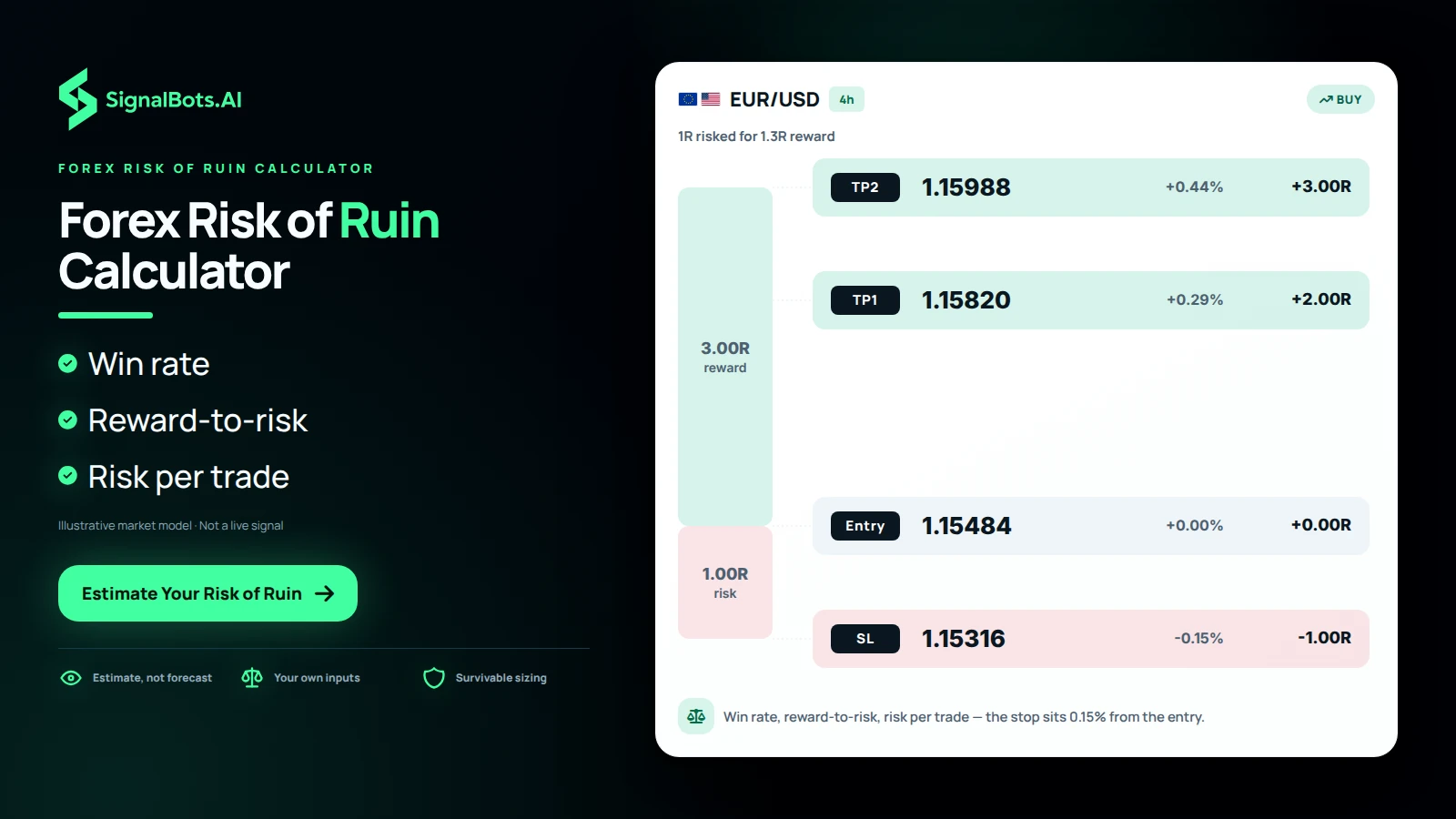
Risk ladder showing an EUR/USD 4h long trade plan with TP2, TP1, entry and stop-loss rungs drawn to true reward-to-risk scale, sized note naming win rate, reward-to-risk and risk per trade.
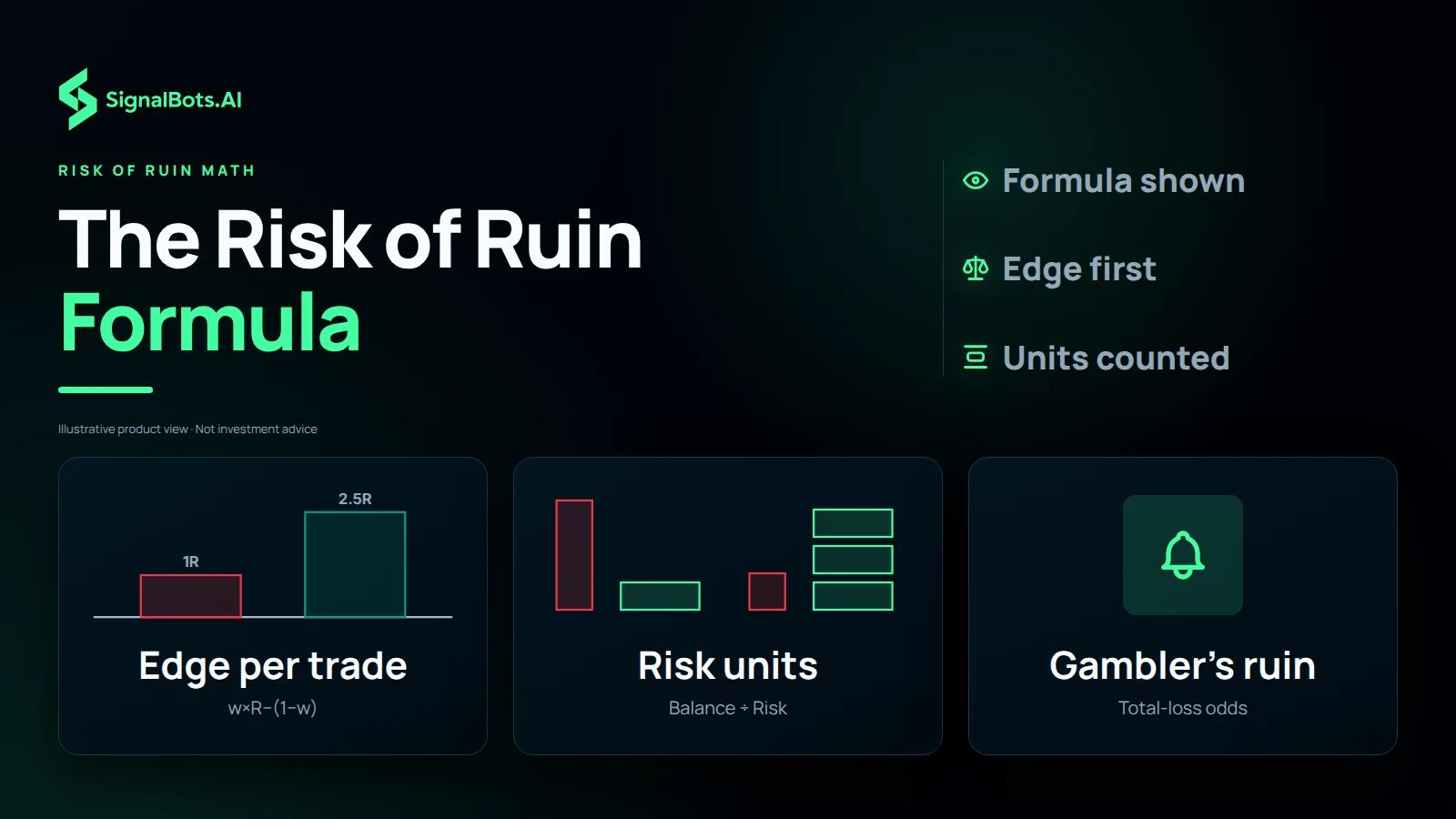
Three concept tiles naming the risk of ruin formula's terms: edge per trade as w times R minus one minus w, risk units as balance divided by risk, and gambler's ruin as total-loss odds.

The math behind it

Risk of Ruin Formula From Per-Trade Edge and Risk Units

The risk of ruin formula starts with your per-trade edge. A win adds R units of your risk and a loss costs one full unit, so edge = w × R − (1 − w), where w is your win rate and R your reward-to-risk ratio. With a positive edge, the account is modelled as a fixed number of risk units, your balance divided by what you risk on each trade, and the classic gambler's ruin formula is applied to that count. Smaller stakes mean more risk units, which the formula raises to a higher power, so a smaller stake pushes the estimate down. Trading still carries risk of loss.

Reading a 100% result

Why Risk of Ruin Reads 100% When Your Edge Is Zero or Negative

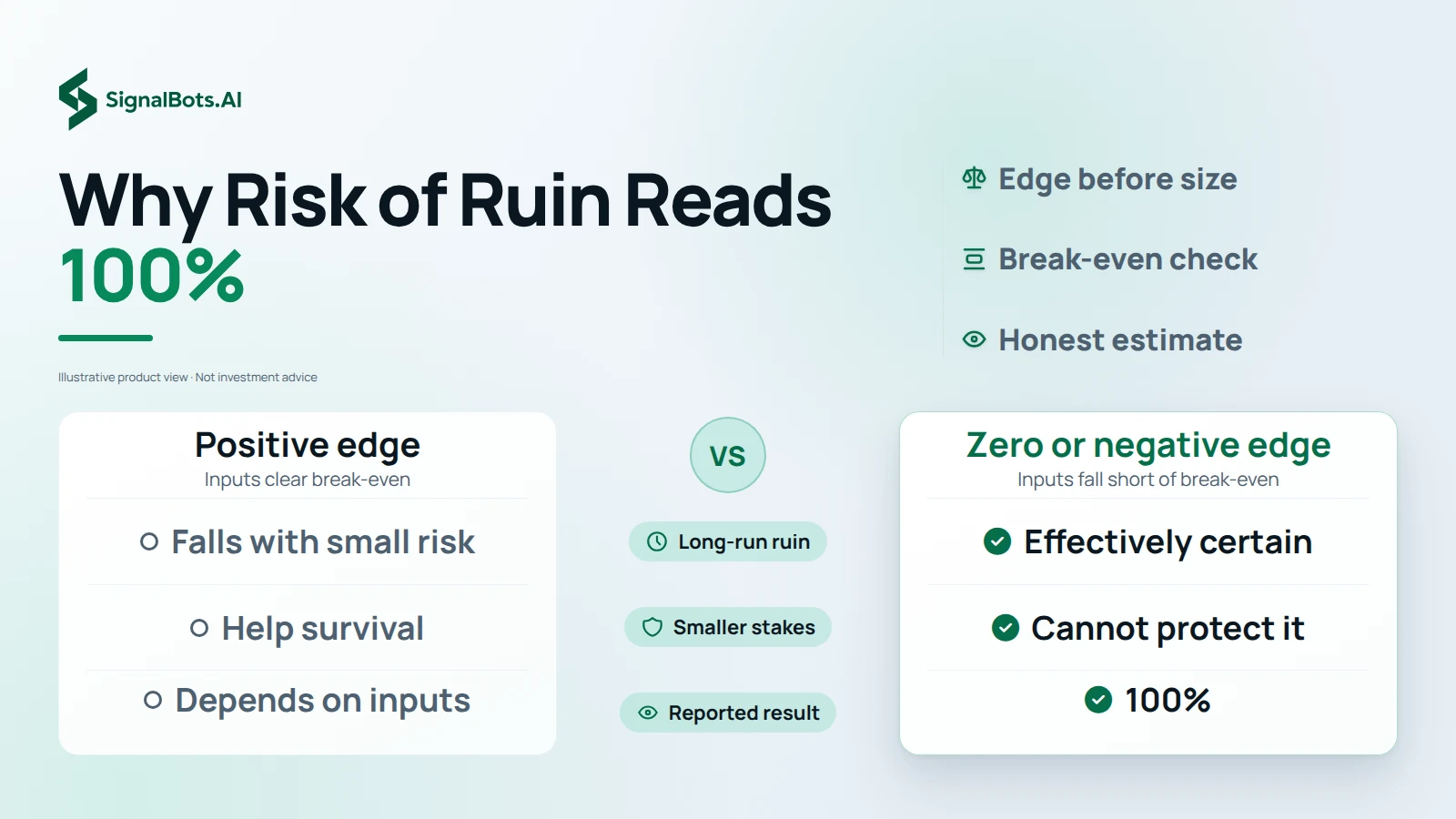
If the calculator reports a 100% risk of ruin, your inputs describe a zero or negative per-trade edge. When your win rate and reward-to-risk ratio do not combine into a positive expectancy, no position size can protect the account over time, so ruin is effectively certain over enough trades. The fix sits in the edge itself, not in the stake: a reward-to-risk above 1 lowers the win rate you need to break even, and the page's break-even table lays that out ratio by ratio. Treat a 100% reading as a warning to rework the strategy before you size it, because trading carries risk of loss.

Versus board contrasting a positive edge against a zero or negative edge across long-run ruin, smaller stakes and the reported result rows, ending in a 100% result on the right column.
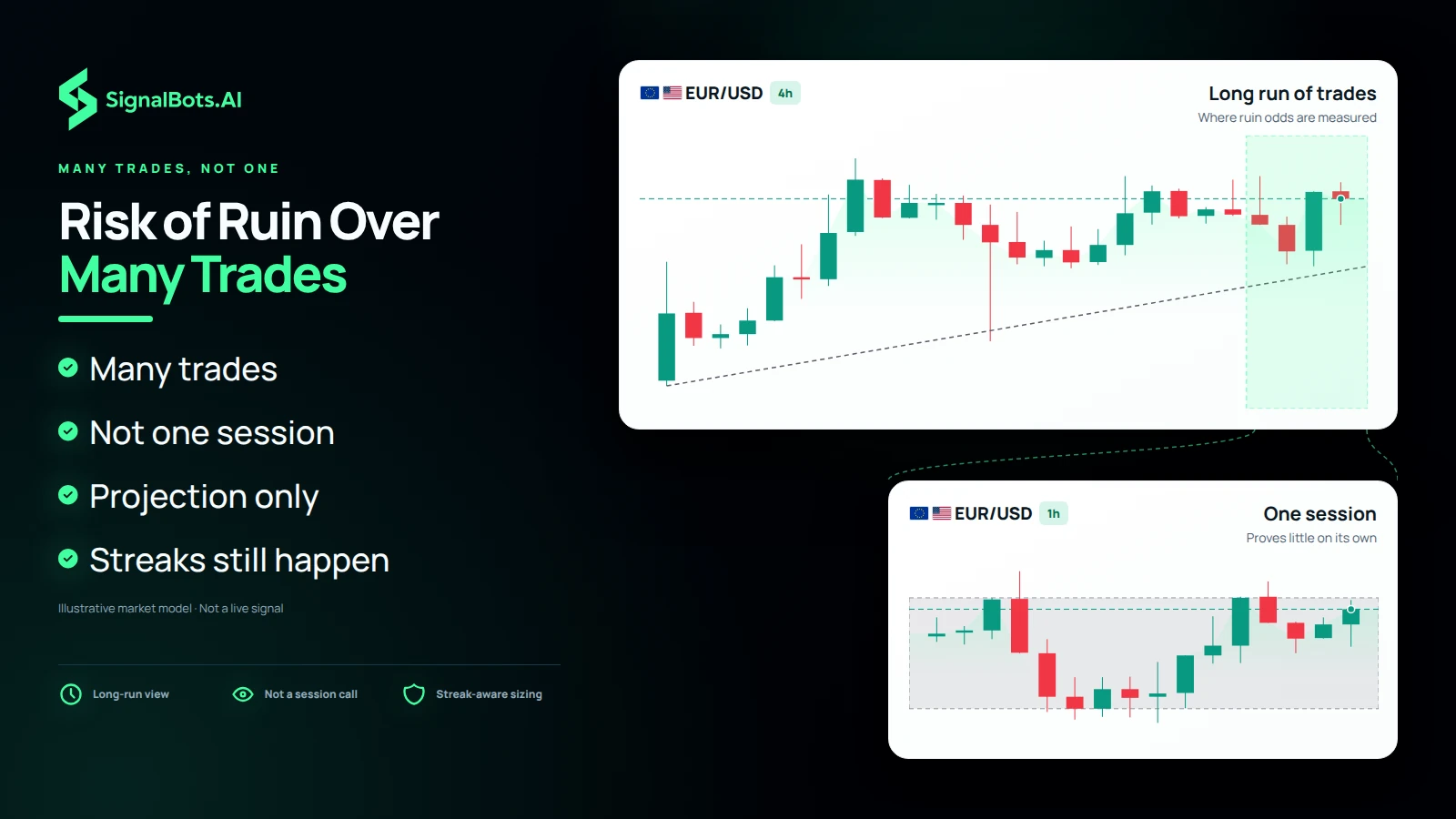
Zoom from a 4h EUR/USD pane labelled the long run of trades where ruin odds are measured, magnified into a 1h pane labelled one session that proves little on its own.

Long-run projection

Risk of Ruin Over Many Trades Rather Than One Session

Risk of ruin is measured across a long sequence of trades, not across tomorrow morning. It is a historical-style projection built from your edge and bet size, not a prediction of any single session, so one winning or losing day tells you little about it. What counts is how your win rate and reward-to-risk ratio hold up over many trades, and how deep a losing streak your stake lets the account absorb. Even a real edge can be wiped out by a losing streak if each trade risks too much capital. Judge the number against a long record, and remember that trading carries risk of loss.

Survive the streak

Lower Risk per Trade Until Your Account Can Survive a Streak

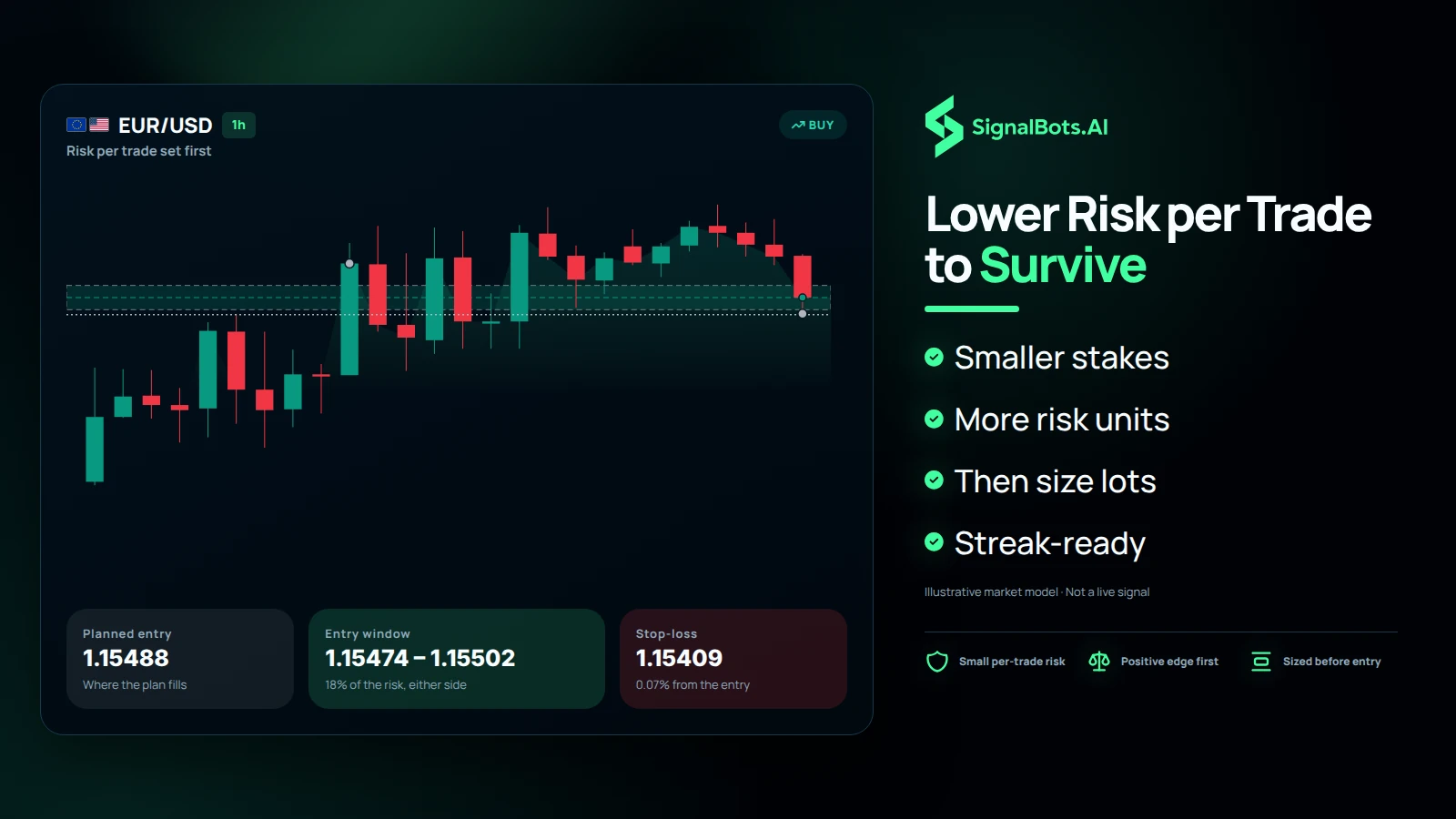
Before you trade a strategy, run it through the calculator and adjust the one input you control today: risk per trade. Smaller stakes give the account more risk units, so with a positive edge the estimate falls as you cut them. Many traders aim to keep risk of ruin in the low single digits by combining a real positive edge with small per-trade risk, but no level removes risk entirely from leveraged trading, and every trade can still lose. Once the stake looks survivable, turn it into an actual lot with the position size calculator and your stop-loss in pips.

One long EUR/USD 1h plan with the entry window band marked around the planned entry, plus planned entry, entry window and stop-loss cards, plan title reading risk per trade set first.
Related Products

Put These Numbers to Work

You've run the math — now trade it. Take signals you can act on the moment they fire: in Telegram, your browser, MT5, or live on the site.

Built for your broker

Keep your broker. Keep your edge.

No switching accounts, no relearning a platform. Whichever Forex broker you already trust, SignalBots plugs straight in with extensions, robots, connectors and live signals tuned to it.