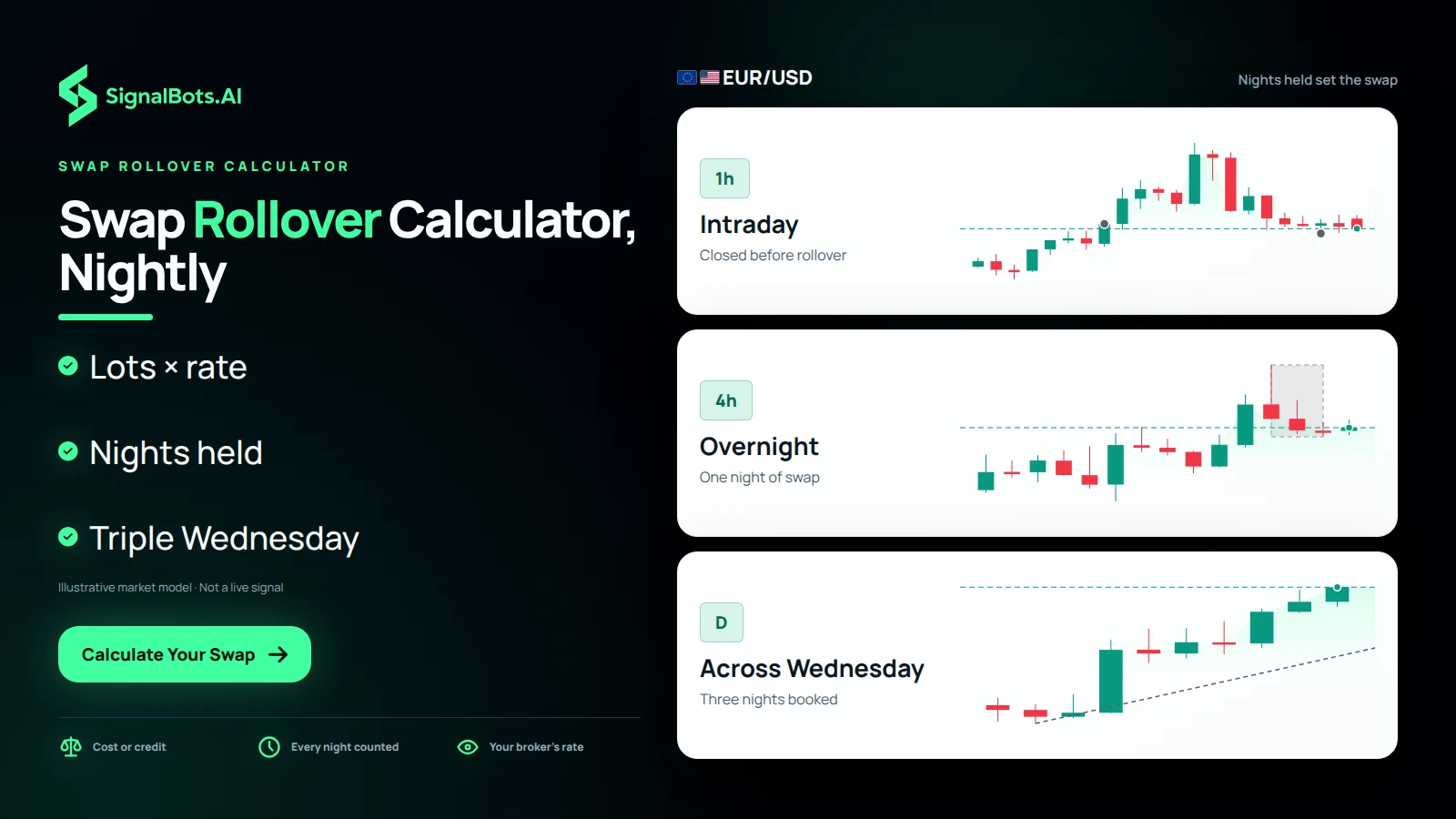
See what holding a position overnight really costs you. Enter your lot size, your broker's swap rate, and how many nights you'll hold, and get the total swap you'll pay or earn.
The size of your trade in standard lots.
From your broker: negative means you pay, positive means you earn.
How many nights the position stays open.
Most brokers charge ~3x on Wednesday for weekend settlement.
Total Swap / Rollover-$17.50
You'd pay $17.50 to hold this position for 7 nights.
A guided tour: what each setting does to your swap bill
Four inputs, four outputs. Change one input at a time and watch which of the four follow it. Swap is the one trading cost that arrives while you are doing nothing, so knowing which setting drives it is worth more than reading the headline.
It answers one question before you leave a position open: what does the next night, week or month of holding cost me, before the trade has moved at all? Traders reach for it at three moments.
Before you hold over a weekendTo price the extra nights a weekend adds before deciding to carry the trade past Friday.
Before you size up a swing tradeA nightly charge you barely notice on a small position becomes a real number at full size.
When a hold runs longer than plannedTo check what another few weeks of carry takes out of the move you are waiting for.
The screenshots below are this page’s own calculator, captured at the settings each step names. Every other input stays at the page default: one standard lot, a −$2.50 nightly rate, seven nights held, and no triple-swap Wednesday. Four marks tell you what to look at.
The one setting this step changes
An output that moves because of it
An output that stays put, which is worth knowing too
In step 1, a numbered output, explained in the list under the picture
1
Before you touch anything
Read the four numbers, and notice that two of them ignore your size
The default run: one standard lot at a −$2.50 nightly rate, held for seven nights, with no triple-swap night inside the hold. The numbers match the list below.
Each output answers a different question, and the headline is not the one you compare positions with.
Total swap / rollover (−$17.50). What the whole hold costs at these settings. The minus sign means you pay it, and the sentence under it repeats that in words.
Per night (−$2.50). The rate multiplied by your position size, charged each time the position rolls over. Read it when you decide whether to hold one more night.
Per lot (−$17.50). What the whole hold costs for a single standard lot: the unit price of carry, and the number to compare one idea against another with.
Effective nights (7). How many nights are actually charged, which is not always how many you were in the trade. The last step shows where the gap comes from.
What this means for you: read per night first and the headline last. Per night tells you what tomorrow costs, which is the decision in front of you. The headline only totals a hold you have not finished yet.
2
Setting: swap per lot per night
Change the sign of the rate, and the position pays you instead
Swap rate moved from −$2.50 to +$0.80 per lot per night. Nothing else changed.
Total swap / rollover
−$17.50$5.60
Per night
−$2.50$0.80
Effective nights
7unchanged
What it is. The amount your broker applies to one standard lot each time that pair rolls over. It is published per pair and per direction, so the long and short sides carry different figures, and it is revised over time.
What moving it does. It drives every money output and touches nothing else. Move the rate from −$2.50 to +$0.80 and the headline turns from a −$17.50 bill into $5.60 of income over the same week, per night goes from −$2.50 to $0.80, and per lot follows from −$17.50 to $5.60. Effective nights stays at 7, because the rate has no say in how many nights are charged.
Walk it the other way and the week gets expensive fast: at −$7.50 a night the total reads −$52.50. At exactly zero it prints $0.00 and says there is no swap on this position.
What this means for you: copy the rate off your own platform for the exact pair and direction you are taking, never from memory and never from the other side of the trade. Without it you do not know what the position costs.
3
Setting: position size
Raise the size, and one output refuses to follow
Position size moved from 1.00 to 5.00 lots. The headline and the nightly charge scale with it. Per lot does not move at all.
Total swap / rollover
−$17.50−$87.50
Per night
−$2.50−$12.50
Per lot
−$17.50unchanged
What it is. How big the trade is, in standard lots. Enter the size you will actually place, fractions included: a tenth of a lot is 0.10 here.
What moving it does. Five times the size gives five times the bill. The headline goes from −$17.50 to −$87.50 and the nightly charge from −$2.50 to −$12.50. Per lot sits still at −$17.50, because it prices one lot for the whole hold and never asks how many lots you took. Shrink the trade to 0.10 lots instead and the week costs −$1.75, at −$0.25 a night, with per lot still −$17.50.
That stubborn tile is the useful one: carry costs the same per lot at any size, so you judge an idea once and apply it to whatever size you settle on.
What this means for you: decide whether the carry is acceptable from per lot, then set the size from your risk plan rather than from the swap. If the only way to make the nightly charge comfortable is to trade below your plan, you are paying for time you did not intend to buy.
4
Setting: nights held
Stretch the hold, and the bill grows in a straight line
Nights held moved from 7 to 30. The totals move with it; the nightly charge does not.
Total swap / rollover
−$17.50−$75.00
Per lot
−$17.50−$75.00
Per night
−$2.50unchanged
What it is. The number of rollovers the position sits through, not the days on the calendar. A trade opened and closed inside one session pays none of it, so a day trader enters 0 here.
What moving it does. It multiplies the totals and leaves the nightly charge where it was. Thirty nights instead of seven take the headline from −$17.50 to −$75.00 and per lot from −$17.50 to −$75.00, while per night stays at −$2.50. Effective nights follows the input straight to 30.
The line stays straight in both directions: one night costs −$2.50, sixty nights cost −$150.00. Nothing compounds and nothing tapers, which is what makes a long hold expensive in a quiet way. The charge never gets louder, it just keeps arriving.
What this means for you: enter the hold you are honestly planning, then enter double it. If the larger figure eats a meaningful share of the move you are trading for, the idea needs a faster exit or a pair whose carry runs the other way.
5
Setting: triple-swap Wednesday
Switch on the triple night, and two nights appear that you never held
Triple-swap Wednesday moved from No to Yes. Seven nights held become nine nights charged.
Effective nights
79
Total swap / rollover
−$17.50−$22.50
Per night
−$2.50unchanged
What it is. Spot positions settle two business days forward, so the weekend is paid for on a weekday night. Brokers collect it midweek, charging about three nights of swap on that one rollover. The switch asks whether such a night falls inside your hold.
What moving it does. It adds two nights to the count and leaves the rate alone. Effective nights goes from 7 to 9 although you held it for seven, the headline goes from −$17.50 to −$22.50, and per lot follows to −$22.50. Per night does not move, because neither the rate nor your size changed.
On a longer hold it matters less in proportion and more in money. Thirty nights with a triple night inside them are charged as 32, and the total reads −$80.00 against the −$75.00 the same hold costs without it.
What this means for you: set this to Yes whenever your hold crosses the midweek rollover, which is almost any position carried across a full week. Check which night your own platform uses, because the convention is the broker’s.
A one-minute routine before you leave a position open
Put the five steps together and the calculator becomes a pre-trade check.
Read the rate off your own platform
Find the swap figure for the exact pair and direction you are taking, and type it in with its sign.
Enter the size you will really place
Use the lot size from your risk plan, not a round number, then read what one more rollover costs at that size.
Count nights, not days
Count the rollovers between your entry and the exit you are planning for, and switch on the triple-swap night if the hold crosses it.
Judge it against the move you are trading for
Compare the per-lot figure with the move you expect. Carry that takes a visible bite out of the target is a reason to shorten the hold.
Re-run it when the trade outlives the plan
Enter the nights you have held plus the nights you still expect, and read the headline again. That is the check: the cost of staying in, priced before you decide to stay.
Every figure here is a scenario built from the rate you typed and the nights you entered, not a quote and not a forecast. Your broker sets the rate, revises it, and applies its own rollover schedule, so treat this as a check you run before carrying a position.
The Math
How the Swap Cost Is Calculated
Each night your position is open, the broker applies its swap rate per lot. Multiply that rate by your lot size and the number of nights to get the running total. If a triple-swap Wednesday falls inside your hold, two extra nights are added to cover the weekend.
Total Swap = Swap Rate × Lots × Nights | Nights += 2 if triple-swap WednesdayExample: −$2.50 × 1 lot × 7 nights = −$17.50 (you pay $17.50 to hold for the week).
Quick Reference
How Swap Works on Your Position
Concept
What it means
Long position
Whether you pay or earn depends on the sign of your broker's swap rate.
Short position
The swap is typically the opposite sign of the long side on the same pair.
Wednesday
Most brokers charge about 3x the usual swap to settle over the weekend.
Frequently Asked Questions
What is a swap or rollover fee?
It is the interest adjustment your broker applies for holding a forex position overnight. Because every pair involves two currencies with different interest rates, you either pay or receive the difference each night the trade stays open past the daily rollover time.
Why is Wednesday charged triple?
Forex trades settle two business days after they open. A position held over Wednesday night settles on the weekend when markets are closed, so most brokers book three nights of swap on Wednesday to cover Saturday and Sunday in advance.
Can a swap be positive?
Yes. When the currency you buy pays more interest than the one you sell, the swap can credit your account instead of charging it. Enter a positive rate to model that, but note brokers add a markup, so a paid credit is often smaller than the raw rate difference.
Where do I find my swap rate?
Your broker publishes per-lot swap rates in the contract or symbol specifications, often split into long and short values. In MT4 or MT5 you can right-click the symbol and open Specification to read the exact figures, then enter the one for your direction here.
Overnight holding cost
Swap Rollover Calculator for Every Night You Hold a Trade
A swap rollover calculator shows what holding a forex position overnight really costs you, or pays you. Swap is the interest adjustment your broker applies because every pair involves two currencies with different interest rates, and it is booked each night the trade stays open past the daily rollover time. You enter your position size in lots, your broker's swap per lot per night, set at −$2.50 by default, and the nights you plan to hold. The calculator returns the total swap you pay or earn, adding the extra nights when a triple-swap Wednesday falls inside the hold.
Swap formula worked
How to Calculate Swap in Forex Across a Week With Wednesday
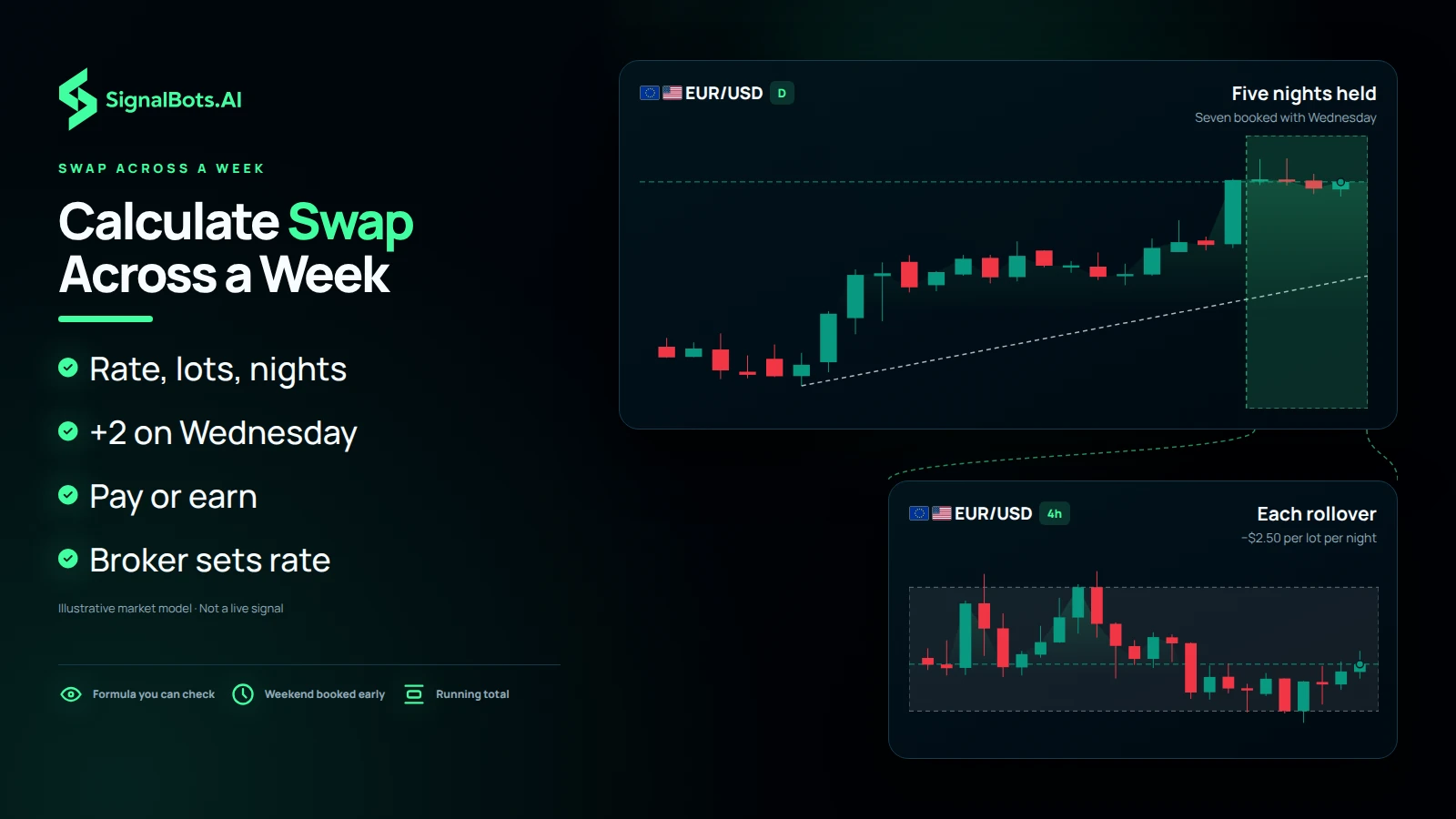
To calculate swap in forex, multiply your broker's swap rate by your lot size and by the number of nights, then add two extra nights if a triple-swap Wednesday falls inside the hold: Total Swap = Swap Rate × Lots × Nights. Forex trades settle two business days after they open, so a position held over Wednesday night settles on the weekend, and most brokers book Saturday and Sunday in advance that night. Hold 1 lot for five nights that include a Wednesday at the default −$2.50 per lot per night, and seven nights are booked: −$2.50 × 1 × 7 = −$17.50 in total.
Finding your swap rate
Where to Find Your Broker's Swap Rate in MT4 or MT5
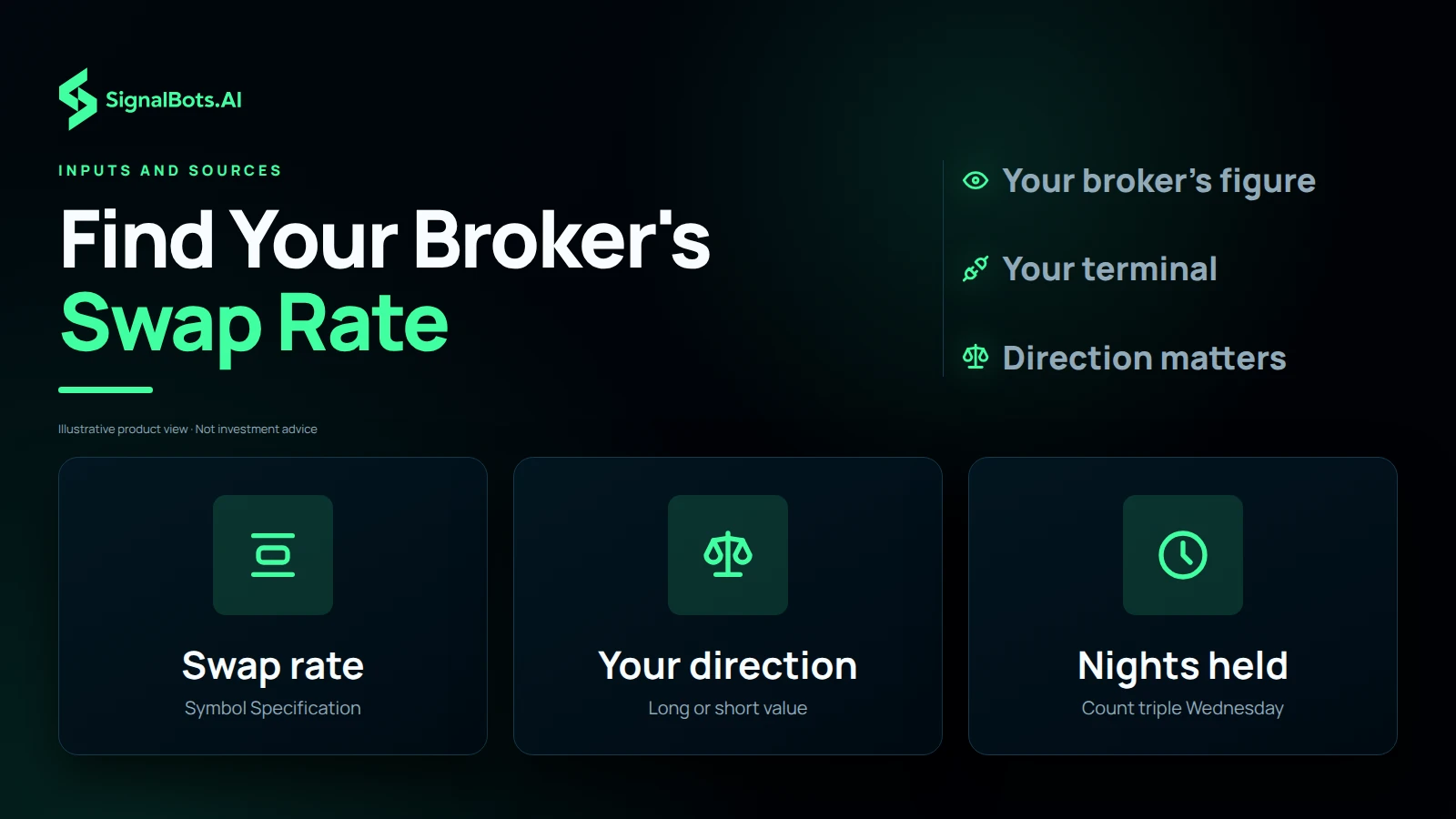
The calculator works from the figure you give it, so the first job is finding your broker's swap rate. Brokers publish per-lot rates in the contract or symbol specifications, often split into a long value and a short value. In MT4 or MT5, right-click the symbol, open Specification and read the exact figures, then enter the one for your direction, with a negative number when you pay and a positive one when you earn. Add your position size in standard lots and the nights you plan to hold, counting a triple-swap Wednesday if one falls inside. Taking the number from your own terminal keeps the total tied to your actual account.
Credit or charge
Positive Swap Credits Your Account, Negative Swap Charges It
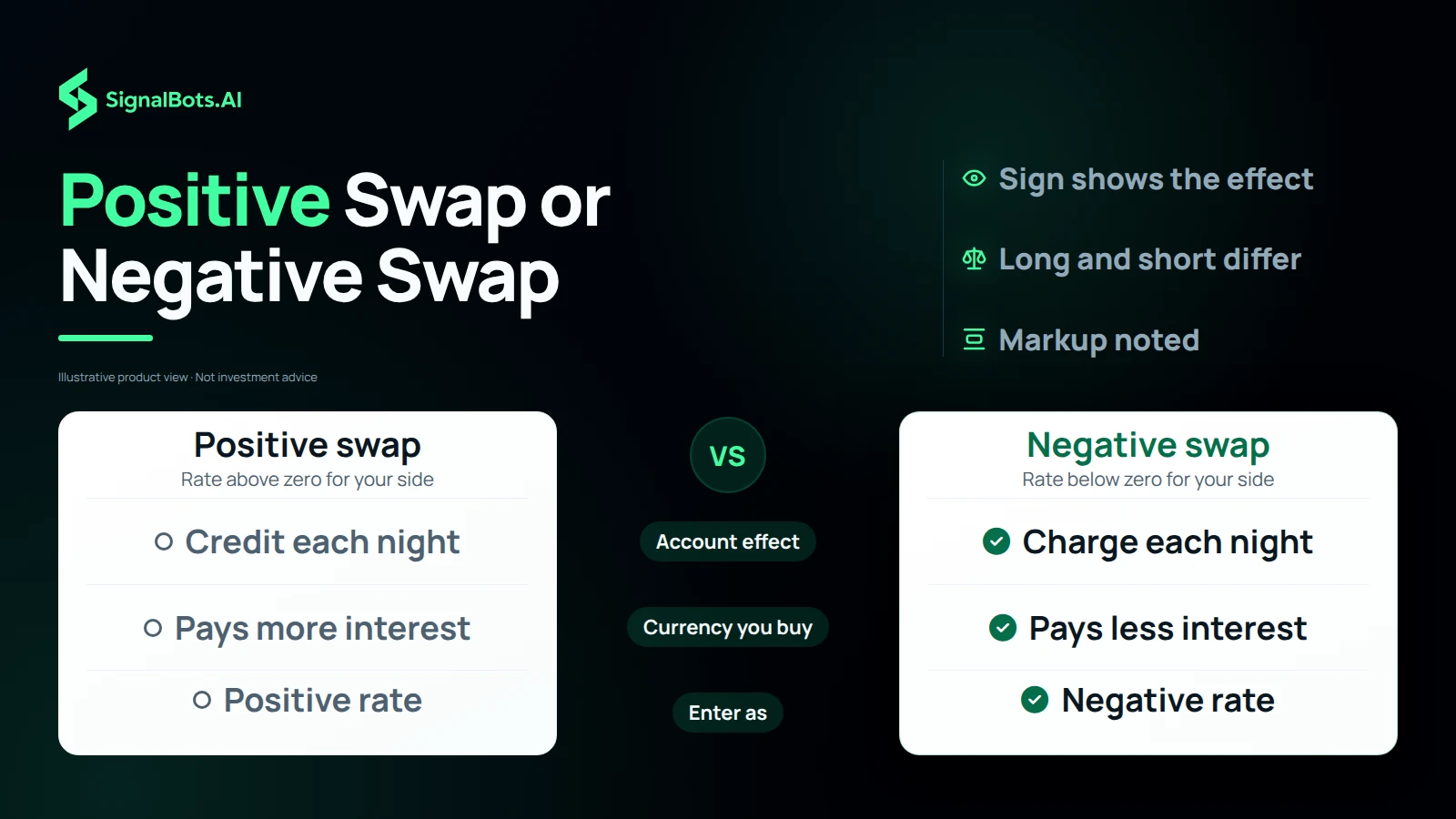
Whether swap costs you or pays you depends on the sign of your broker's rate for your side of the trade. On a long position you pay when the rate is negative and earn when it is positive, and the short side of the same pair typically carries the opposite sign. A positive swap appears when the currency you buy pays more interest than the one you sell, and a charge when it pays less. Enter a positive rate to model a credit, but keep in mind that brokers add a markup, so a paid credit is often smaller than the interest gap alone suggests.
Before a swing hold
Weigh the Total Swap on a Multi-Night Swing Trade
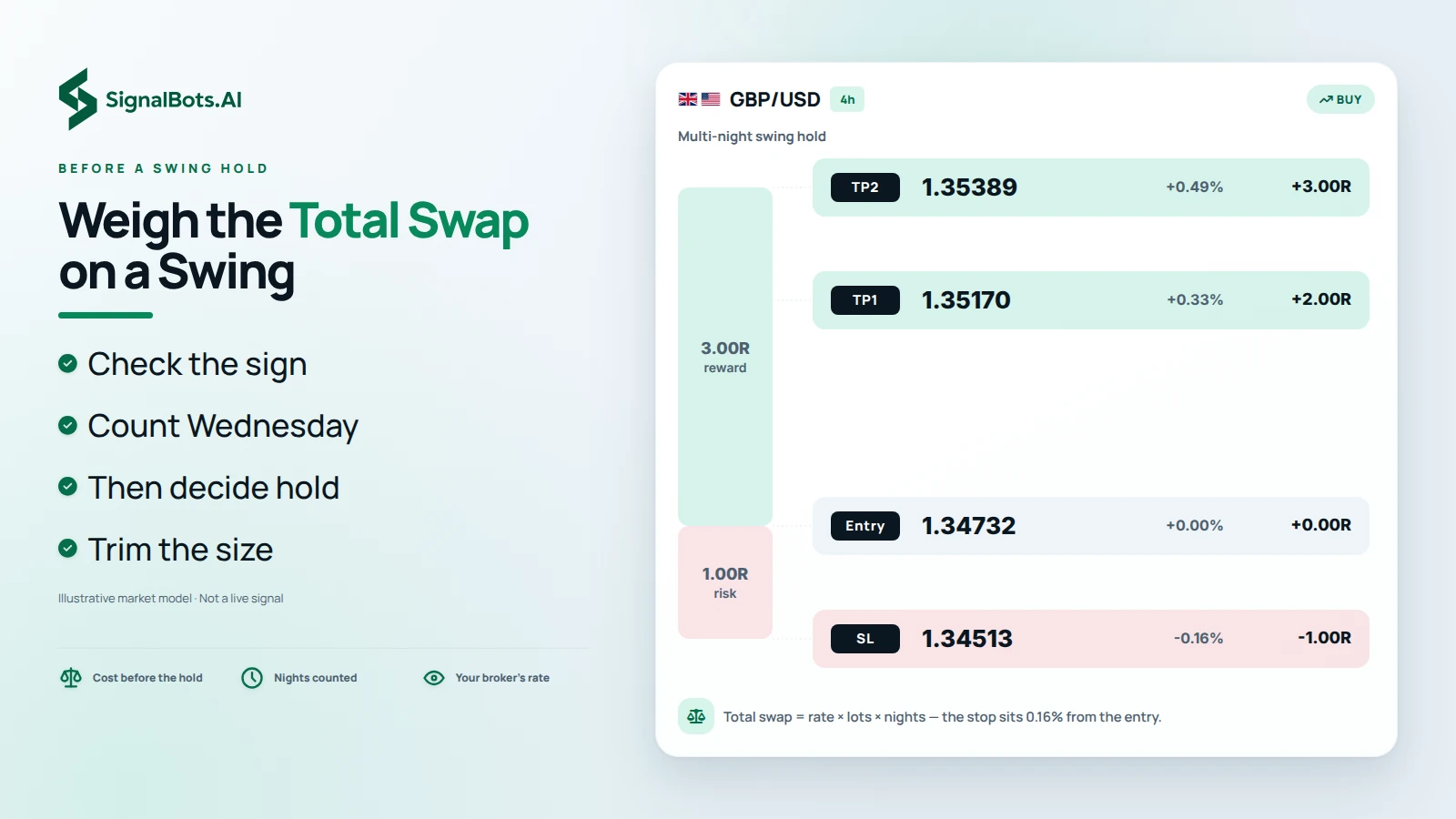
An intraday trade closed before the daily rollover books no swap, but on a swing trade held for several nights the total swap becomes part of what the trade costs or returns. Before you hold, check the sign of your broker's rate for your direction, count the nights including any triple-swap Wednesday, and run the figures through the forex swap calculator. Set that total against the move you are planning for, because a negative rate charged night after night eats into it, and a small credit does not change the trade's risk. Trading carries risk of loss, so then decide whether to hold through Wednesday, trim the size or close earlier.
Related Tools
More Calculators for Your Trading
Free, instant, and browser-based. Keep planning the rest of your trade with these.
No switching accounts, no relearning a platform. Whichever Forex broker you already trust, SignalBots plugs straight in with extensions, robots, connectors and live signals tuned to it.