Prop Firm Tool

Prop Firm Payout Calculator

See exactly what lands in your pocket after the profit split. Enter the gross profit on your funded account and your split percentage to break the payout into your take-home share and the firm's share.

$10,000

Total profit earned on the funded account before the split is applied.

80%

The share of profit the firm pays you. Most prop firms pay between 70% and 90%.

Monthly

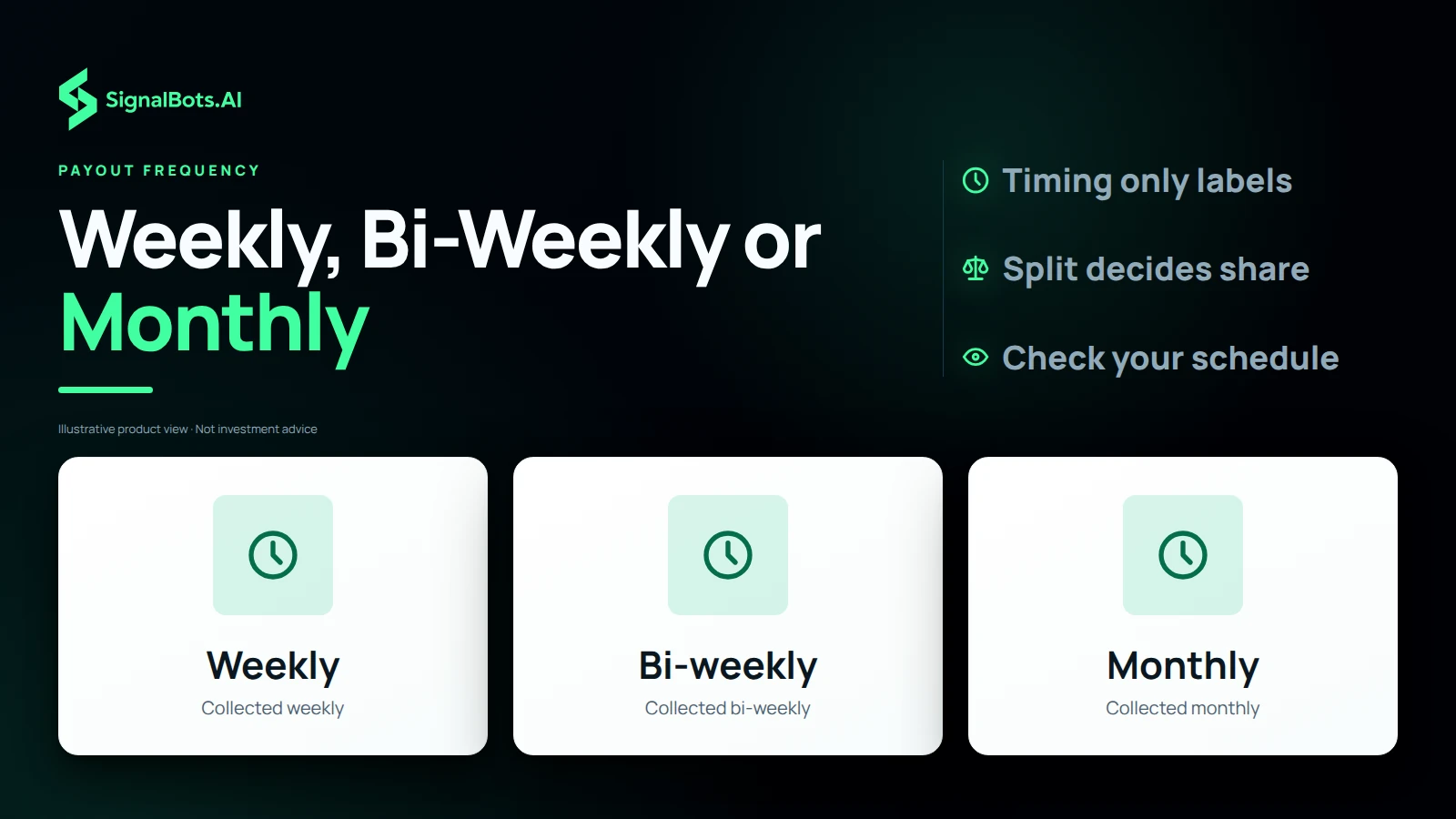
How often the firm releases payouts. This labels your take-home, it does not change the split math.

Your take-home payout $8,000.00

On $10,000.00 gross profit at an 80% split, you keep $8,000.00 this monthly payout.

Your share$8,000.00
Firm's share$2,000.00

For educational purposes only. Read our risk warning before trading.

The Math

How the profit split works

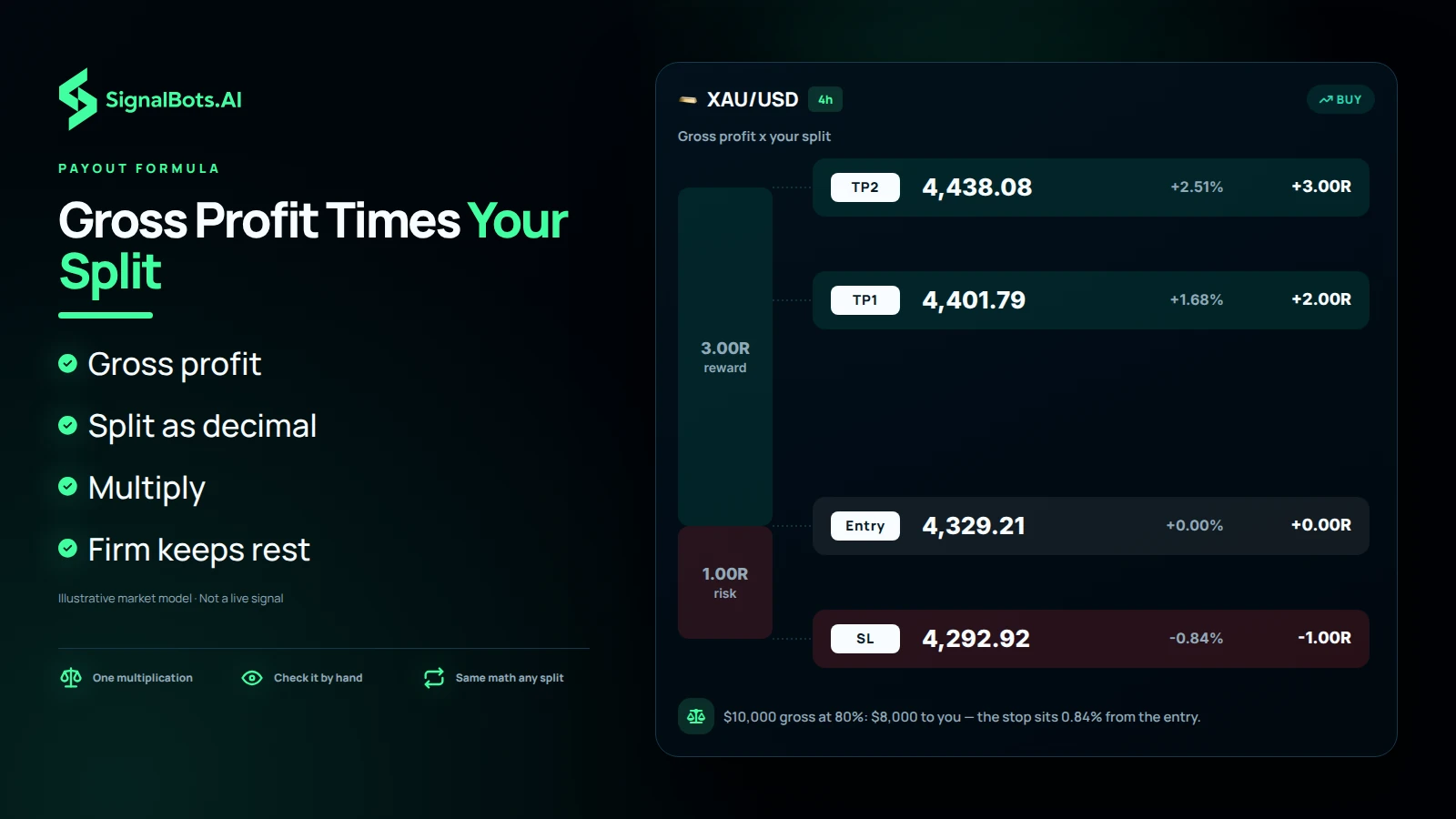
A prop firm funds the account and keeps part of the profit in exchange. Your take-home is simply the gross profit multiplied by your split percentage; whatever remains is the firm's share. The payout frequency only labels when you collect it.

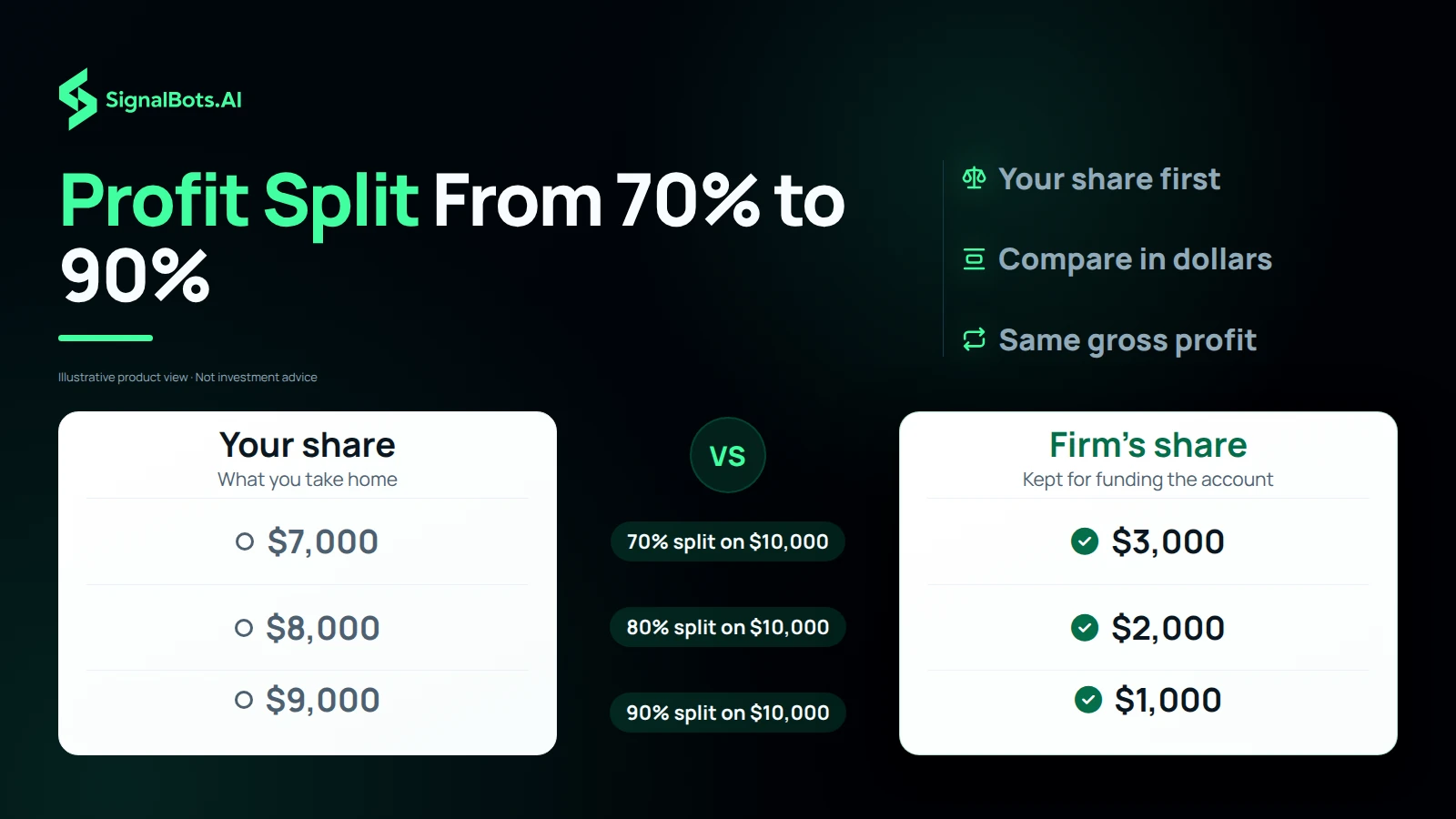
The higher your split, the more of each winning month you keep. Moving from a 70% to a 90% split on the same $10,000 lifts your take-home from $7,000 to $9,000 — the same trading, a very different paycheck.

Quick Reference

Take-home by split on $10,000 profit

Common prop firm profit splits and what each one leaves you on a $10,000 gross profit.

Profit split Your share Firm's share
70%$7,000.00$3,000.00
75%$7,500.00$2,500.00
80%$8,000.00$2,000.00
85%$8,500.00$1,500.00
90%$9,000.00$1,000.00
100%$10,000.00$0.00

Frequently Asked Questions

What is a prop firm profit split?

It is the share of trading profit a prop firm pays you for trading their funded capital. An 80% split means you keep 80% of the gross profit and the firm keeps the other 20% for providing the account.

How is my take-home payout found?

Multiply the gross profit by your split written as a decimal. On $5,000 profit at a 90% split that is 5,000 × 0.90 = $4,500 to you, leaving $500 as the firm's share.

Does payout frequency change the math?

No. Weekly, bi-weekly, or monthly only describes when you collect a payout. The split percentage decides how much of each period's gross profit is yours; the timing simply labels it.

Are fees or drawdown included here?

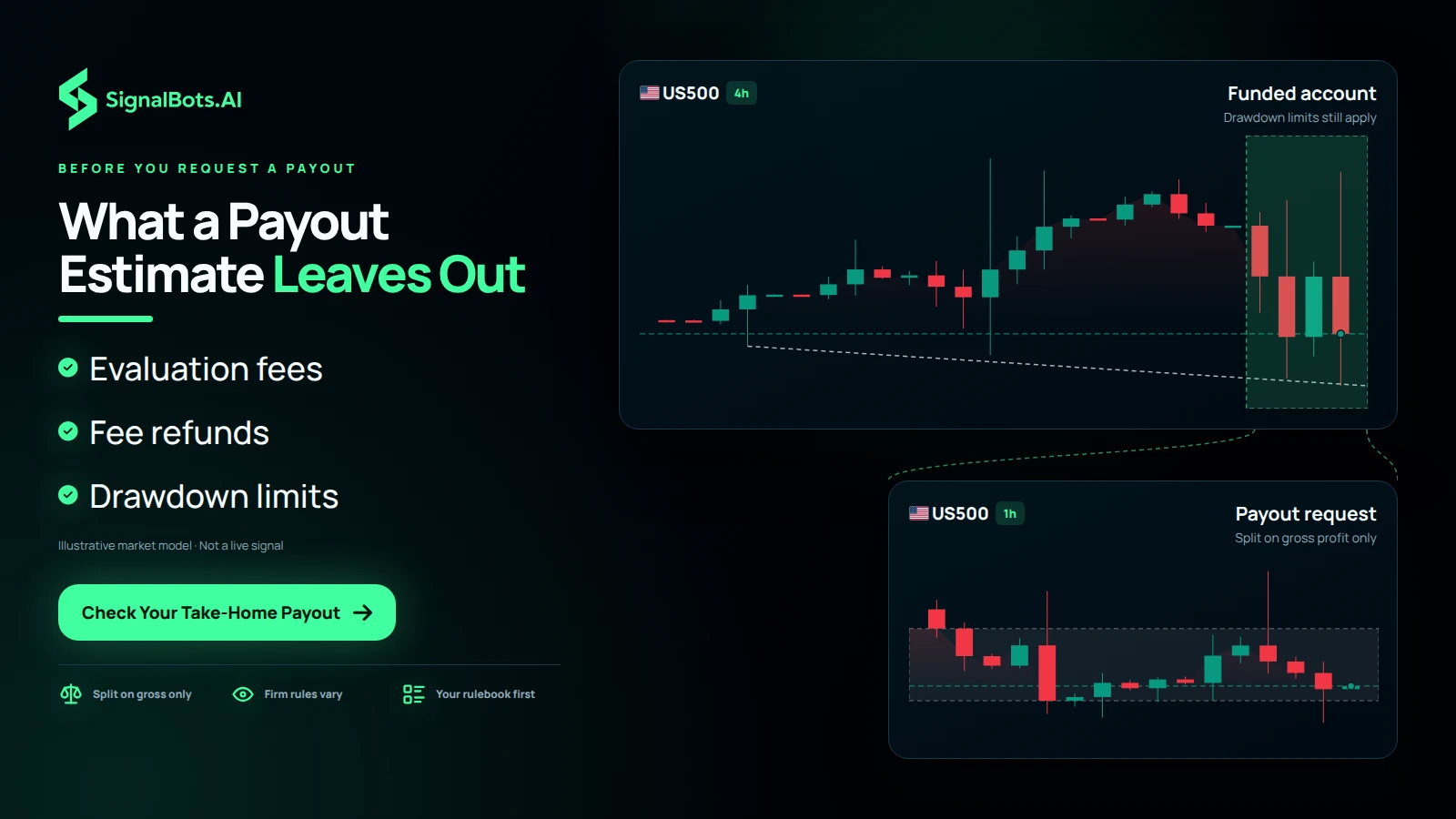
This tool shows the split on gross profit only. Evaluation fees, refunds, and any drawdown limits vary by firm and are not deducted here. Funded trading carries substantial risk of loss.
From the Blog

Related Reading

Go deeper on the market behind these numbers — strategy, risk and setup guides from our desks.

Trading Automation Can You Use an EA on FTMO? ICT Inside the Rules FTMO permits EAs — the restrictions are behaviour-based. Here is each rule an automated ICT model can trip, and a self-audit to check your … 28 min read Read article Trading Automation How to Pass a Prop Firm Challenge With an ICT EA An ICT expert advisor that performs on your own account still has to survive a prop firm's rule set. Here is the phase-by-phase path, … 26 min read Read article Trading Automation Market Structure Shifts an EA Can Actually Trade An EA cannot see a market structure shift - it needs swing points that do not repaint, a stored bias and a closed-bar break … 39 min read Read article Trading Automation ICT vs Smart Money Concepts: What's the Difference? Order block or demand zone? Fair value gap or imbalance? A term-by-term translation between ICT and SMC, the places they genuinely diverge, and which … 29 min read Read article Trading Automation Power of Three: Automating the AMD Daily Cycle Your sweep, killzone and structure modules all work alone. The missing layer is the AMD state machine that sequences them into one trade per … 43 min read Read article Trading Automation ICT Killzone EA: DST-Safe Session Timing in MQL5 Which MQL5 clock to trust, how to get from published New York killzone hours to your broker's server time, why TimeGMT() lies in the … 38 min read Read article Trading Automation Coding Liquidity Sweeps in MQL5: BSL/SSL Detection You can spot a sweep by eye in a second. Here is that read written as MQL5 an EA runs on every closed bar: … 45 min read Read article Trading Automation Optimal Trade Entry EA: Coding the OTE Zone in MQL5 Swing and break-of-structure detection, programmatic Fibonacci anchoring, an order-block confluence filter and coded exits - the OTE logic an MT5 EA can run with … 37 min read Read article Trading Automation How Code Detects Order Blocks and Fair Value Gaps "The last down candle before the breakout" is not code. Here is the deterministic rule-set - displacement thresholds, the three-candle test, mitigation - that … 37 min read Read article
Built for your broker

Keep your broker. Keep your edge.

No switching accounts, no relearning a platform. Whichever Prop Firm broker you already trust, SignalBots plugs straight in with extensions, robots, connectors and live signals tuned to it.

Pass the eval · keep it funded 9 supported
E8 Markets
FundedNext
For Traders
Funding Pips
Maven
Blue Guardian
The 5%ers
Alpha Capital
FTMO
Add SignalBots as a preferred source on Google Add SignalBots as a preferred source on Google