A guided tour: what each setting does to your result
Four inputs, two of which only appear when your pair needs them, and four outputs. Move one input at a time and watch which outputs follow it. That habit teaches you more about your own sizing than any single run can.
This calculator answers one question before you place a trade: what does one pip actually cost me on this position? Until you know that, a stop distance is not money. Most traders reach for it at one of three moments.
Before you set a stopTo turn a stop distance in pips into the dollar loss it would really take out of the account.
When you switch pairsA JPY-quoted pair counts pips at a different decimal, so the same 50 pips is not the same money.
When you resize a positionTo see what a smaller or larger lot does to the cost of being wrong, before the order goes in.
The screenshots below are the calculator on this page, captured at the settings named in each step. Every other input stays at the page default: a USD-quoted pair at a standard lot of 100,000 units, with no rate needed. Four marks tell you what to look at.
The one setting this step changes
An output that moves because of it
An output that stays put, which is worth knowing too
In step 1, a numbered output, explained in the list under the picture
1
Before you touch anything
Read the result panel from top to bottom
The default run: a USD-quoted pair at a standard lot of 100,000 units. The numbers match the list below.
Four outputs, four different questions. Knowing which one answers yours is most of the skill of using the tool.
Value of one pip ($10.00). What a single pip of movement is worth on the position you described. The sentence under it names the size it applies to, so you can check at a glance that your inputs were read the way you meant them.
10-pip move ($100.00). The same figure multiplied out to a tight stop or a quick target, which is the fastest way to price a scalp in money rather than in pips.
50-pip move ($500.00). A wide stop, or a full swing target. On a standard lot that is $500.00 riding on one decision, and it is the number most traders have never actually put in front of themselves.
Pip size used (0.0001). The decimal the calculator is treating as one pip. It is the only tile that tells you the pair was read correctly, and every money figure above it depends on that.
What this means for you: read the 50-pip tile before the headline. One pip is too small to feel, so it never changes anyone’s mind. A realistic stop priced in dollars does.
2
Setting: lot size
Change the lot, and the whole cost scale moves with it
Lot size moved from Standard (100,000 units) to Micro (1,000 units). Nothing else changed.
Value of one pip
$10.00$0.10
50-pip move
$500.00$5.00
Pip size used
0.0001unchanged
What it is. How many currency units the position holds: 100,000 for a standard lot, 10,000 for a mini and 1,000 for a micro, which most order tickets write as 1.00, 0.10 and 0.01 lots.
What moving it does. Pip value follows the unit count in a straight line, so a hundredth of the size costs a hundredth per pip. Dropping from a standard lot to a micro lot takes one pip from $10.00 to $0.10, ten pips from $100.00 to $1.00 and fifty pips from $500.00 to $5.00. The pip size tile still reads 0.0001, because the pair is the same pair. One notch up, at a mini lot, one pip is worth $1.00 and fifty pips cost $50.00.
What this means for you: choose the lot from the loss you will accept on the stop you plan, not the other way round. If a 50-pip stop reads $500.00 at a standard lot and you would not accept losing $500.00 here, the lot is wrong.
3
Setting: currency pair type
Tell it the pair is JPY-quoted, and one pip stops meaning 0.0001
Pair type moved from USD-quoted to JPY-quoted. Choosing it reveals the rate field, typed here as 151.00.
Pip size used
0.00010.01
Value of one pip
$10.00$6.62
50-pip move
$500.00$331.13
What it is. How the pair is quoted, which decides which decimal counts as one pip. Most pairs are quoted to four decimals, so a pip is 0.0001. A JPY-quoted pair is quoted to two, so a pip is 0.01. Choosing JPY-quoted, or a cross, also reveals the rate field, because a pip earned outside the dollar has to be converted first.
What moving it does. Two things at once, pulling opposite ways. The pip grows a hundredfold, then the result is divided by the rate you type. At 151.00 those effects mostly cancel and land below the starting point: one pip on a standard lot is worth $6.62 instead of $10.00, ten pips $66.23 and the 50-pip stop that cost $500.00 now costs $331.13.
What this means for you: set this field first, then check that the pip size tile shows the decimal your platform quotes. Leave a JPY pair on the USD-quoted setting and the panel prints $10.00 where the position is really worth $6.62 a pip, and a stop sized from the wrong panel is the wrong stop.
4
Setting: quote-to-USD rate
Move the rate, and the same position quietly changes price
Rate moved from 151.00 to 161.00, with the pair still JPY-quoted. This step compares with step 3, because the field does not exist at the page default.
Value of one pip
$6.62$6.21
10-pip move
$66.23$62.11
Pip size used
0.01unchanged
What it is. The rate the calculator divides by to bring the pip back into dollars. Read it off the quote on your own ticket as you size the trade, not from a figure you remember from last week.
What moving it does. It scales every money output and touches nothing else. Raise it from 151.00 to 161.00 and one pip falls from $6.62 to $6.21, ten pips from $66.23 to $62.11 and fifty pips from $331.13 to $310.56. Lower it to 141.00 and one pip rises to $7.09. The pip size tile reads 0.01 throughout, because the rate has no say in which decimal counts as a pip.
The field does the same work on a cross, where pip size stays at 0.0001: at 1.10 a standard lot is worth $9.09 a pip, at 1.30 it is $7.69 and at 0.90 it is $11.11.
What this means for you: retype the rate every session instead of leaving yesterday’s number in the field. It changes neither your stop nor your lot, but it changes what that stop is worth, and it is the one input here that moves on its own.
5
Setting: custom units
Type the real unit count, and part-lot positions stop being guesswork
Lot size set to Custom units, with the count typed as 25,000. The pair is unchanged.
Value of one pip
$10.00$2.50
10-pip move
$100.00$25.00
Pip size used
0.0001unchanged
What it is. The exact number of currency units in the position, for every size that is not one of the three presets. It appears only once the lot size selector is set to Custom units. A count of 25,000 is a quarter of a standard lot, the kind of awkward number a risk rule actually produces.
What moving it does. It replaces the preset and scales everything from your own count. At 25,000 units one pip is worth $2.50, ten pips $25.00 and fifty pips $125.00. Type 250,000 instead and one pip is $25.00, with fifty pips at $1,250.00. Type 5,000 and one pip is $0.50. Pip size sits at 0.0001 throughout.
What this means for you: when your risk rule hands you a unit count rather than a round lot, type the count. Rounding up to the nearest familiar lot moves the cost of the stop by the same proportion, and that difference lands on the trades that lose.
A two-minute routine before you send the order
Put the steps together and the calculator becomes a pre-trade check rather than a curiosity.
Name the pair correctly
Set the pair type first, then confirm the pip size tile shows the decimal your platform quotes: 0.0001 for most pairs, 0.01 for a JPY-quoted one. Type today’s rate if the pair asks for one.
Enter the size you intend to send
Use a preset lot when that is what the ticket will carry, or Custom units when you have an exact count.
Price the stop, not the pip
Read your planned stop distance off the 10-pip and 50-pip tiles as the money the trade can take out of the account.
Compare it with your own limit
If that loss is larger than the amount you allow a single trade, shrink the units here until it is not. This comparison is what the calculator exists for.
Verify on the ticket
Enter the order with the stop where you planned it and check the platform’s own loss estimate agrees before you send. The position size calculator runs the same check from the other end.
These outputs are arithmetic on three numbers you typed: a pip size, a unit count and a rate. They are not a forecast, and they say nothing about which way the next 50 pips will go.
The Math
How pip value is calculated
One pip is the smallest standard price move in a pair. Its money value depends only on the pip size and how many units you trade, then a conversion to your account currency when the pair is not quoted in USD.
Pip value (USD) = (pip size × lot units) ÷ quote-to-USD rateEUR/USD, 1 standard lot: (0.0001 × 100,000) ÷ 1 = $10.00 per pip.
Quick Reference
Pip value per pip for USD-quoted pairs
Lot type
Units
Pip size
Value per pip
Standard
100,000
0.0001
$10.00
Mini
10,000
0.0001
$1.00
Micro
1,000
0.0001
$0.10
Standard (JPY)
100,000
0.01
≈ $6.60 at 151.00
Frequently Asked Questions
What is one pip in forex?
A pip is the smallest standard price move in a pair. For most pairs it is the fourth decimal (0.0001); for JPY pairs it is the second decimal (0.01).
Why is a standard lot $10 per pip?
A standard lot is 100,000 units. On a USD-quoted pair, 0.0001 × 100,000 = $10, so each pip moves your position by ten dollars.
How do JPY pairs differ?
JPY pairs use a 0.01 pip size and are quoted in yen, so the calculator divides by the USD/JPY rate to express the pip value in dollars.
Why enter an exchange rate?
When the pair is not quoted in USD, the raw pip value is in another currency. The rate converts it back to USD so the number matches your account.
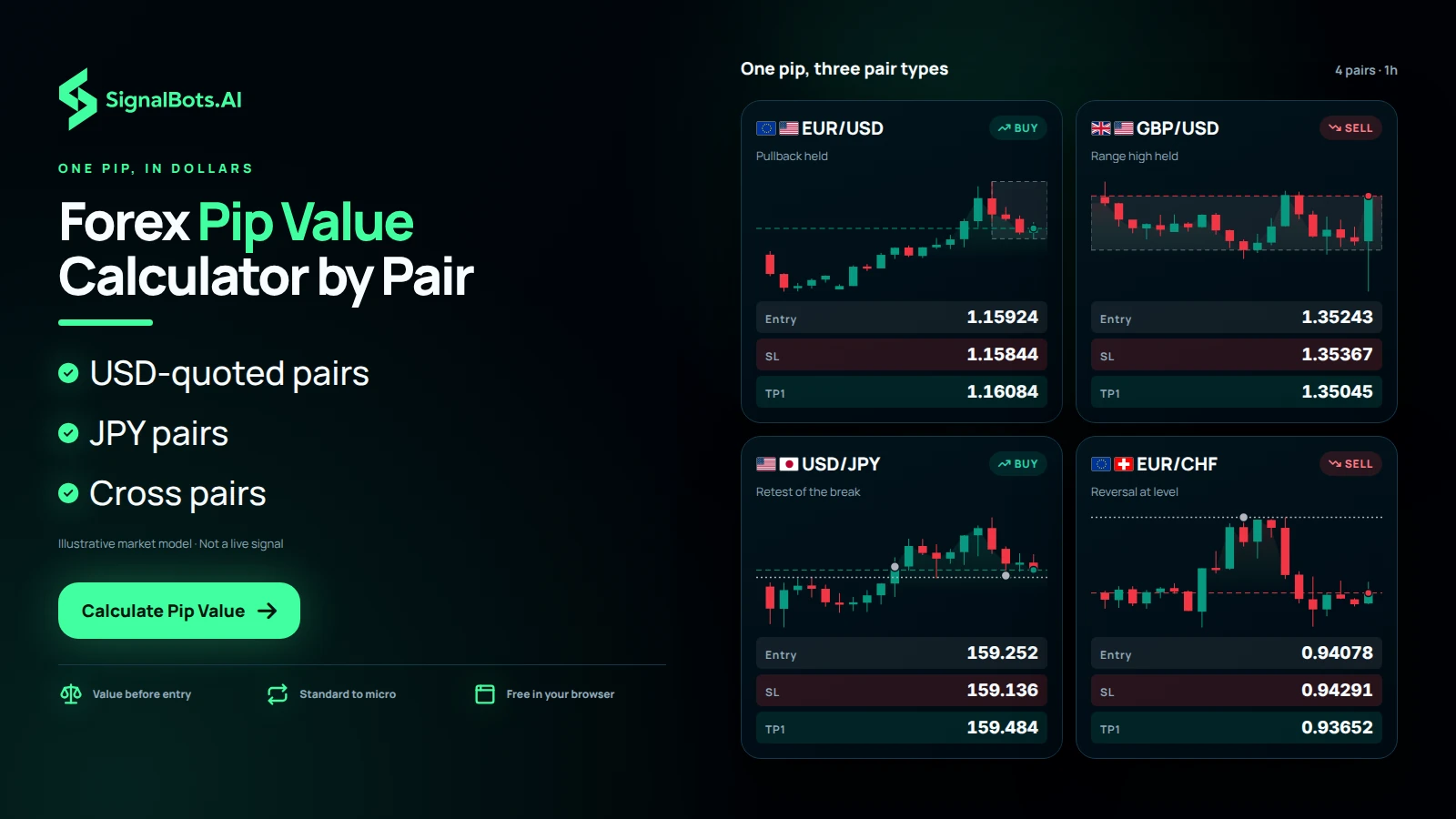
ONE PIP, IN DOLLARS
What One Pip Is Worth: Forex Pip Value Calculator by Pair
A forex pip value calculator tells you what one pip is worth in money before you place the trade, so your stops and position sizes rest on real numbers instead of guesswork. You pick how the currency pair is quoted, USD-quoted like EUR/USD, a JPY pair or a cross pair, choose a standard, mini or micro lot, and add the exchange rate when the pair needs converting. It returns the pip value in USD for that position: a standard lot on EUR/USD works out to $10.00 per pip, a mini lot to $1.00 and a micro lot to $0.10. The tool is free and runs in your browser.
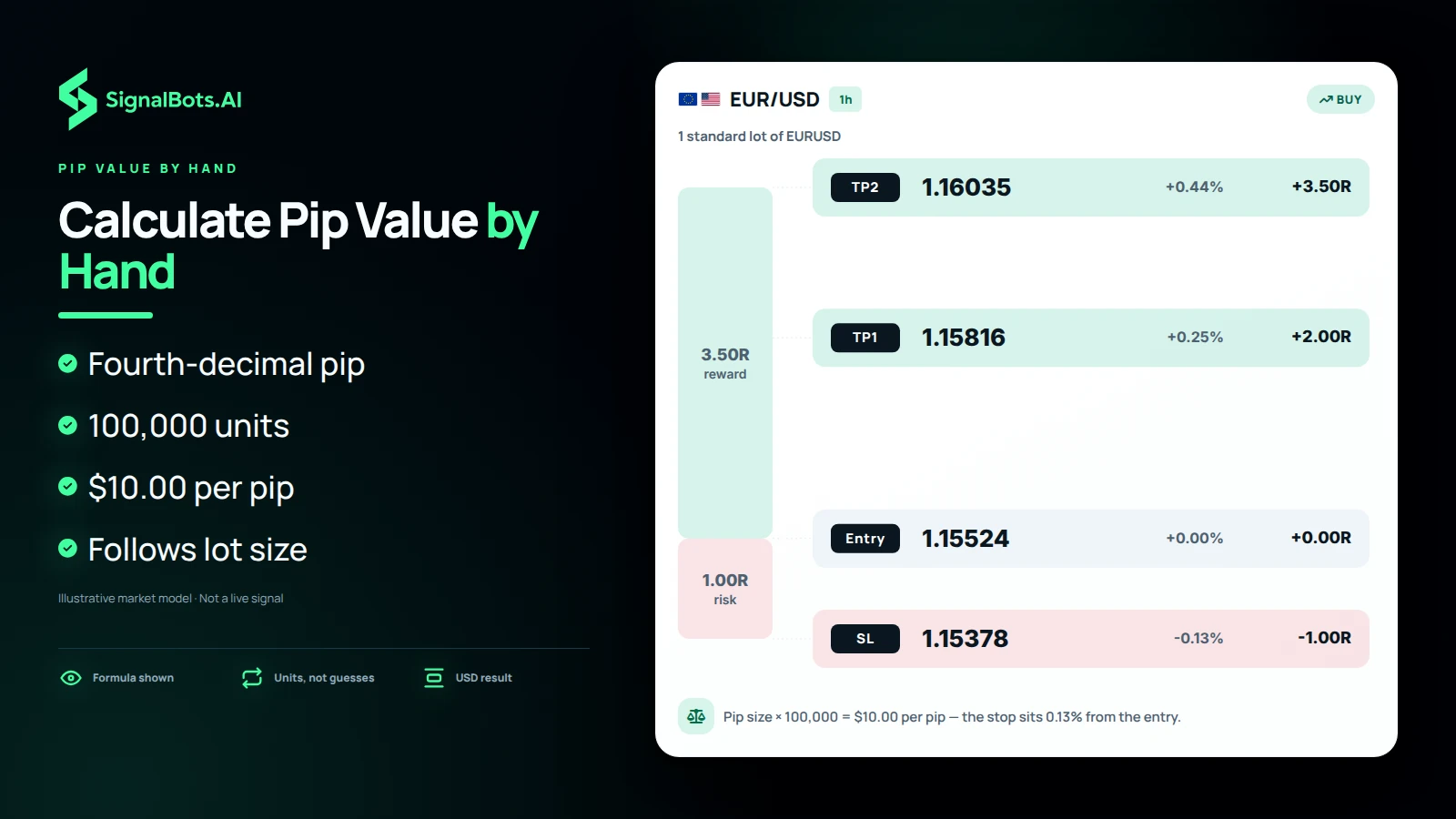
PIP VALUE BY HAND
How to Calculate Forex Pip Value by Hand From Pip Size and Units
Pip value comes from two numbers and one conversion. Multiply the pip size by the units in your position, then divide by the quote-to-USD rate: pip value (USD) = (pip size × lot units) ÷ quote-to-USD rate. On EUR/USD the pip size is 0.0001 and a standard lot is 100,000 units of the base currency, and because the pair is already quoted in dollars the rate is 1, so (0.0001 × 100,000) ÷ 1 = $10.00 per pip. Scale the units down and the value follows: 10,000 units give $1.00 and 1,000 units give $0.10, which is why lot size moves pip value in step.
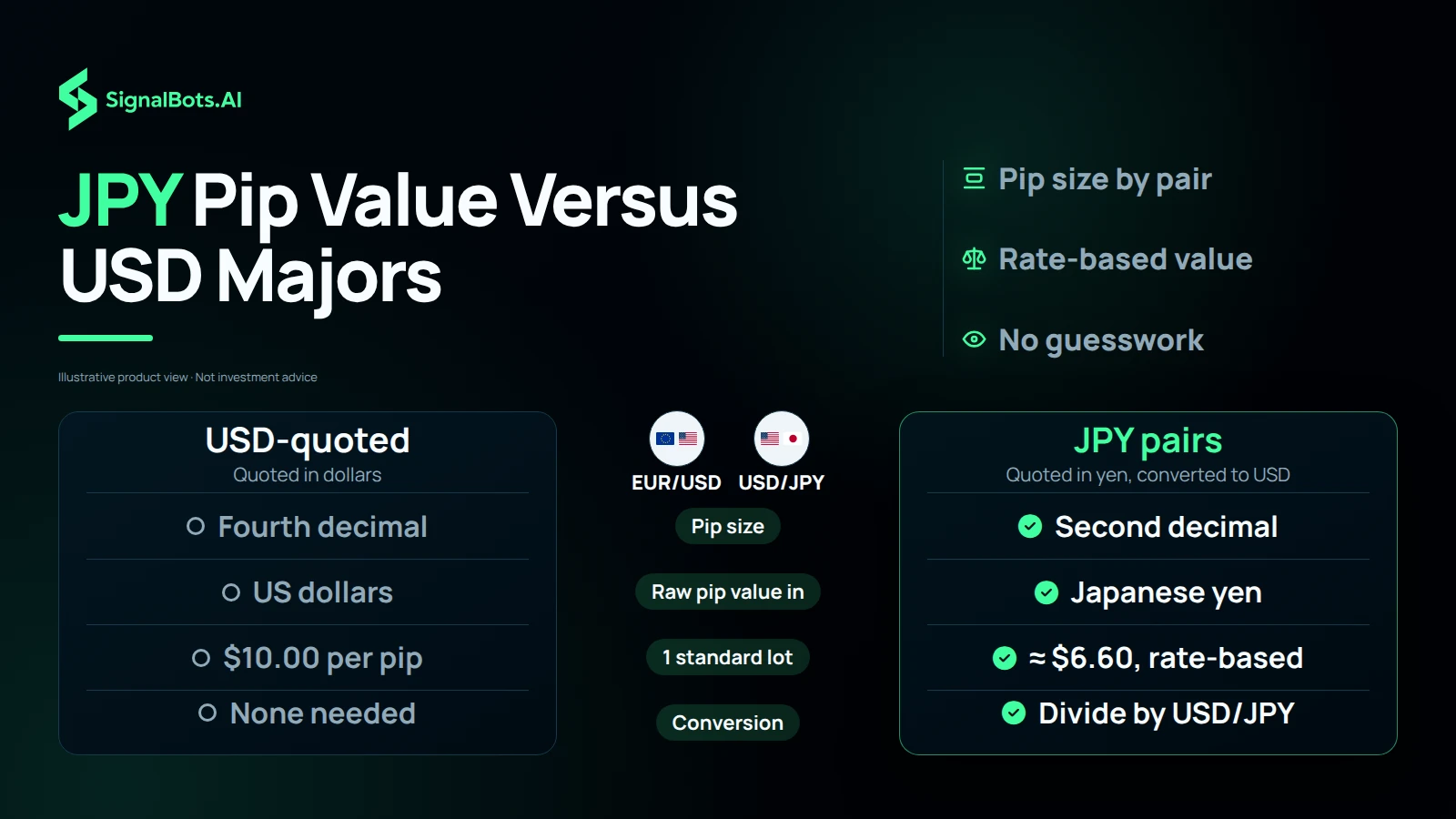
JPY Pair Pip Value Versus USD-Quoted Majors
JPY pairs differ in two ways. Their pip size is the second decimal, 0.01, rather than the fourth decimal, 0.0001, used by most pairs, and they are quoted in yen, so the raw pip value comes out in yen rather than dollars. The calculator divides by the USD/JPY rate to express it in USD. On one standard lot of 100,000 units that gives about $6.60 per pip at a rate of 151.00, against a flat $10.00 on a USD-quoted major such as EUR/USD, where no conversion is needed. Because the JPY figure moves with that rate, recheck it before you size a trade.
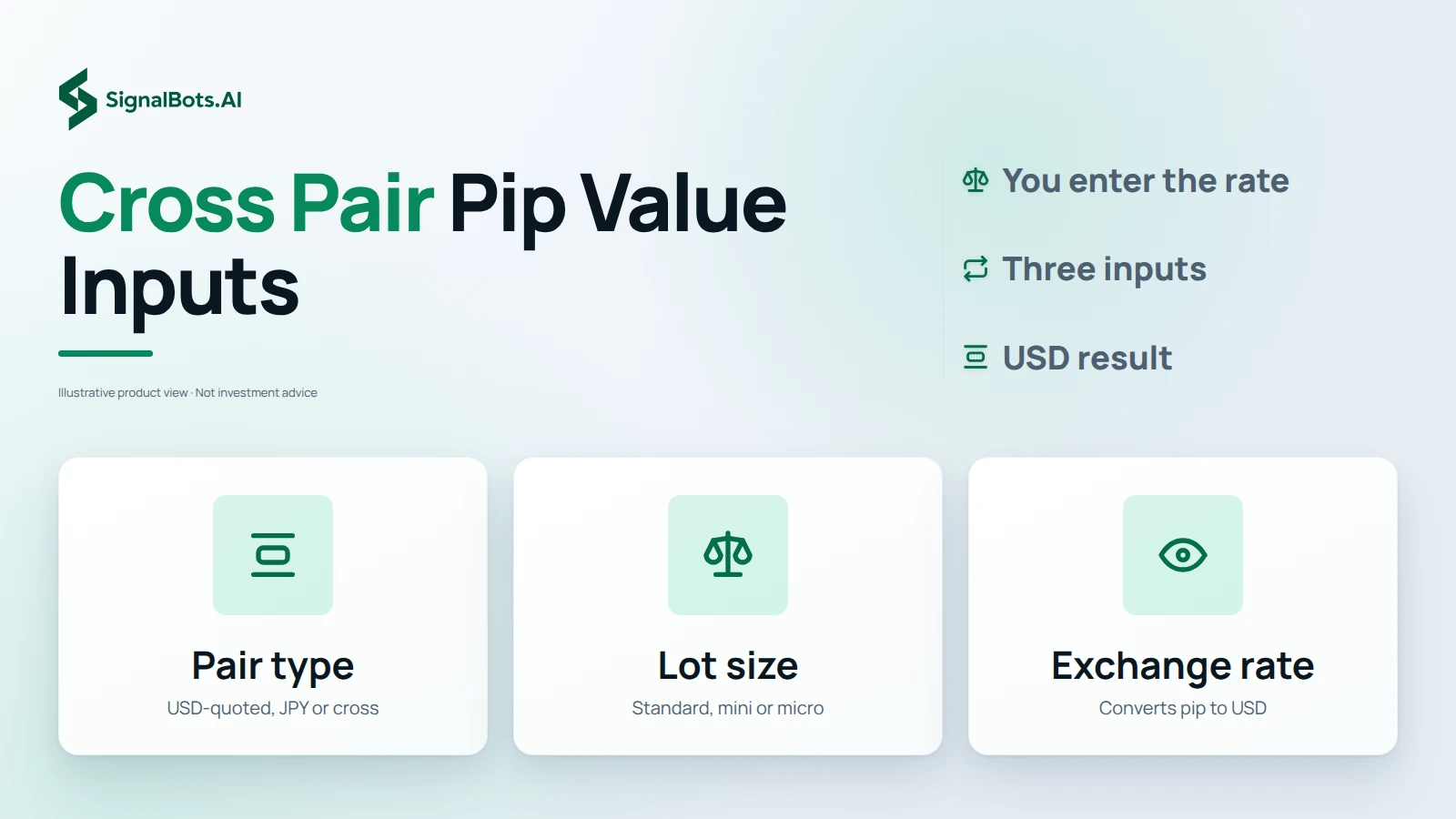
Why a Cross Pair Needs an Exchange Rate for Pip Value
When a pair is not quoted in USD, its raw pip value comes out in another currency, and the rate you enter converts it back to USD so the number matches your account. That is the third input, after the pair type and the lot size. A cross pair such as EUR/GBP has no dollar in it at all, so without the current rate the calculator cannot turn a pip into dollars. You supply that figure yourself: read the current rate from your trading platform at the moment you calculate, then pair it with a standard, mini or micro lot to get a pip value you can use.
FROM PIPS TO MONEY
Use Pip Value to Price the Stop and Size the Position
Pip value is the bridge between a stop in pips and a stop in money. Multiply your stop distance in pips by the pip value for your lot size and you know what a stop-out costs before you enter; on a standard lot of EUR/USD every pip of that distance is $10.00. If that cost is more than you want to risk, the lot size is what changes, not the stop. Take the pip value into the position size or max lot calculator to get the exact lot, check that it matches your account, and keep in mind that trading carries risk of loss.
Related Tools
More Calculators for Your Trading
Free, instant, and browser-based. Keep planning the rest of your trade with these.
No switching accounts, no relearning a platform. Whichever Forex broker you already trust, SignalBots plugs straight in with extensions, robots, connectors and live signals tuned to it.