Grouped by automation style, not a single leaderboard.See the full shortlist →
There is no single best broker for automation — only the best one for the way you automate. This page groups the shortlist by style so you pick on fit, not hype.
You searched for the best broker for automated trading, and every list you opened ranked the same thing: the mobile app, the welcome bonus, the number of markets. None of that matters to an Expert Advisor. Your bot never taps a screen. It needs a platform it can run on, an execution model that fills its orders honestly, and a broker that actually permitsalgorithmic trading — three things most "best broker" pages barely mention.
So this page is built differently. Instead of a single leaderboard, it groups brokers by automation style — because the right broker for someone running an off-the-shelf MetaTrader EA is not the right broker for someone writing a Python algo against a REST endpoint. Find your style first, then the shortlist narrows itself. (For the deeper how-to-choose checklist and the silent deal-breakers that quietly wreck a good strategy, that's its own topic — this page hands you the shortlist and the routing.)
Key Takeaways
The "best" automated-trading broker is the one whose platform and execution model match how you automate — a MetaTrader EA, a cTrader cBot, a REST/FIX API algo, or a signal-to-broker bridge.
Prioritize brokers with a true ECN/STP execution model, explicit permission to run automated strategies, and a matching platform — a slick app means nothing to a bot.
For most EA and cBot traders, IC Markets, Pepperstone, and FP Markets are the strongest all-round options; OANDA and FOREX.com lead when you want a first-class REST API.
Pair any broker with a VPS so your automation runs 24/5 with low latency — home Wi-Fi is where good strategies quietly die.
Table of Contents (16 min read)Contents
First decide how you automate, not who you trade with
Every automated-trading setup falls into one of four styles, and the style — not the broker's marketing — decides which platform and account you need. Pick the wrong platform and even a great broker becomes useless: a broker with a beautiful REST API is worthless to a trader who only wants to run a downloaded .ex5 file.
The four styles are:
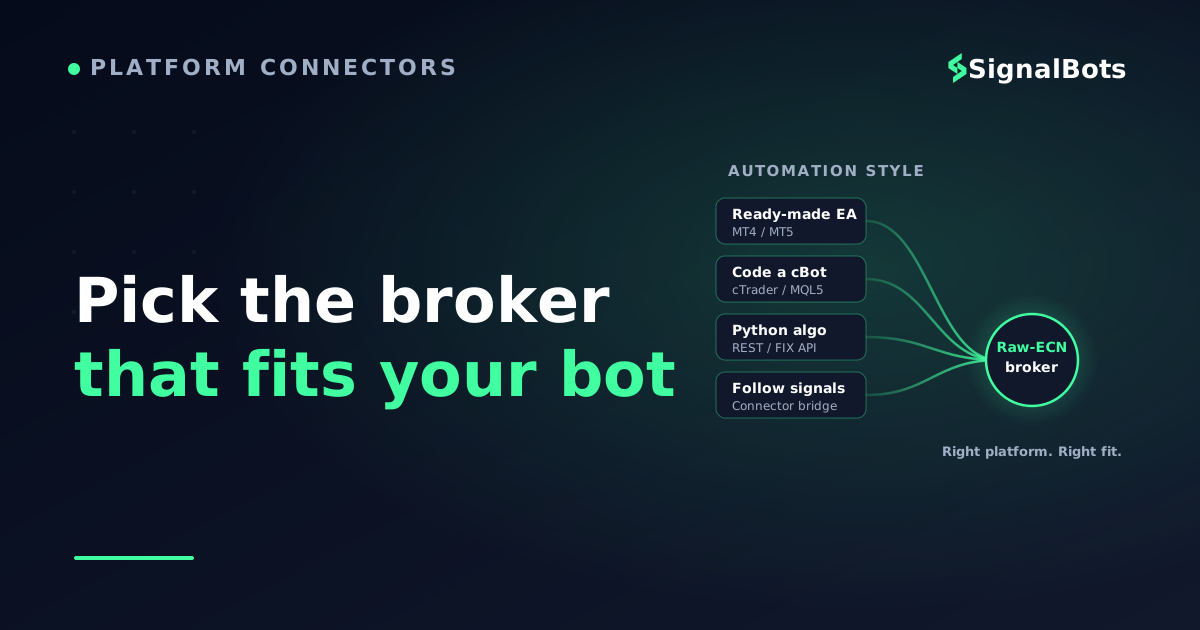
Buy or download a ready-made EA — you want a plug-and-play robot. You live in MetaTrader, so you need either a broker with the MT4 platform for an off-the-shelf MQL4 robot or an MT5 broker for algo trading if your EA is newer — and, either way, one that doesn't block EAs.
Code your own strategy — you write the logic yourself. cTrader Automate (C# cBots) or MT5's MQL5 both fit; cTrader suits scalping and cleaner order control.
Run a custom or Python algo — you want to bypass the platform entirely and talk to the broker directly. You need a first-class REST or FIX API.
The tree below routes each style to the broker archetype that serves it. Start at the top with the question how do you want to automate? and follow the branch.
Route yourself
How do you want to automate?
Take itProceed with careSkip / stand aside
Your automation style decides the platform and account model — the broker name comes second.
Follow your style down to the broker archetype that serves it.
Notice that three of the four paths land on the same small set of raw-ECN, multi-platform brokers. That's not a coincidence — it's the point. A broker that does execution and automation permissions right serves EA runners, cBot coders, and API traders alike. The signal-follower path is the outlier: it needs a broker plus a bridge, which is exactly where a connector comes in.
What actually makes a broker good for automation
Before the shortlist, understand the four properties that separate a genuinely automation-friendly broker from one that just happens to offer MetaTrader. These are qualitative facts you can verify on any broker's own site — not ratings we invented.
Execution model. A bot's edge is fragile; a dealing desk that re-quotes or delays your fills can erase it silently. You want a true ECN or STP broker that routes orders to real liquidity providers rather than taking the other side of your trade. Raw spreads plus a fixed commission is the honest pricing structure for high-frequency and scalping automation.
Platform support. The platform is the runtime your strategy lives in. MT4 and MT5 carry the largest EA ecosystem and the deepest strategy tester; cTrader is the cleaner environment for coding your own cBots in C#; a REST/FIX API lets you skip the platform entirely. Match the platform to your style from the tree above, or start from the dedicated shortlist of TradingView-compatible brokers if your chart alerts are already the strategy.
Automation permission. This is the trap most lists ignore. Some brokers technically offer MT5 but restrict algo-trading permission, ban certain strategy types, or forbid hedging on their account model. Read the account terms: you want EAs, scalping, and hedging explicitly allowed, not merely "supported" in a marketing bullet.
Infrastructure — the VPS. For any live bot, a VPS for your EA is not optional. The gap between 100 ms of home-broadband latency and 1 ms from a co-located VPS is the difference between capturing your backtested edge and leaking it to network delay. The strongest automation brokers offer a free VPS once you trade a modest monthly volume.
How an automated order actually reaches the market
If you've never watched what happens between your bot's decision and a filled trade, this is why execution model and infrastructure matter so much. Every millisecond and every hop below is a place your edge can survive or die.
Under the hood
From bot decision to a filled trade
1
Strategy fires
Your EA, cBot, or API algo detects its entry condition and builds an order.
2
Order leaves the VPS
A low-latency VPS sends it in ~1 ms instead of 100+ ms over home Wi-Fi.
3
Broker routes it
An ECN/STP broker forwards it to liquidity providers; a dealing desk may re-quote.
4
Fill comes back
You get a fill price. Slippage here is the tax on slow routing and thin liquidity.
Two of these four steps — the VPS hop and the broker's routing — are exactly what a good automation broker gets right.
The first and last steps are yours to optimize through code and strategy design. The middle two belong to your broker and your infrastructure — and they're precisely the reason picking on execution model beats picking on app design.
The automated-trading broker shortlist
Here are the brokers worth shortlisting, grouped by the automation style each serves best. Every one is a genuinely automation-friendly forex/CFD broker; the columns describe what each offers, all verifiable from the broker's own documentation. There are no performance numbers here — spreads, commissions, and latency change constantly, so treat any specific figure you see elsewhere as a starting point to confirm, not a fact.
Grouped by fit, not ranked 1-10. Match the 'best-fit style' column to your row in the decision tree above.
A few notes on reading this table honestly:
IC Markets, Pepperstone, and FP Markets cluster at the top for a reason — they combine raw ECN pricing, the full MetaTrader-plus-cTrader platform set, and no hostility toward automation. If you're unsure, any of the three is a defensible default.
OANDA and FOREX.com are here specifically for the API path. Their execution model is more market-maker-leaning, which matters less when you're running a slower, longer-horizon algo than when you're scalping — but it's the honest trade-off for their excellent, well-documented REST APIs.
Eightcap earns its slot on infrastructure: ECN execution with a free VPS aimed at exactly the scalping-EA crowd that lives or dies on latency.
The brokers you don't see here — the ones every generic list features for their app polish or deposit bonus — are missing because none of that reaches your bot. That's the whole thesis of this page.
Where SignalBots fits your automated setup
The shortlist above is your execution layer — the broker that fills your trades. The other half of an automated setup is the signal layer: what tells the bot when to trade. That's where SignalBots slots in, and it maps cleanly onto the four styles.
If you're the signal-follower from the decision tree — you don't want to code, but you do want hands-free entries — you pair any EA-friendly broker with a bridge that pushes signals straight into MetaTrader. Our forex signals feed and the MT4/MT5 connectors are built for exactly that: the broker handles execution, the connector handles delivery, and you're automated without writing a line of MQL5. If you'd rather receive alerts and pull the trigger yourself first, the same feed streams to forex Telegram signals.
And if you're a coder or API trader, our signals are still the input to your own logic — you keep your cBot or Python algo, and simply feed it a cleaner, lower-latency signal than you'd generate alone. Either way, the broker you picked above stays the same; SignalBots changes what flows into it, not who executes it.
FAQ
What is the best broker for automated trading?
There isn't a single one — it depends on how you automate. For running MetaTrader EAs or cTrader cBots, IC Markets, Pepperstone, and FP Markets are the strongest all-round choices thanks to raw ECN execution and full platform support. If you want to code a custom Python or REST algo, OANDA and FOREX.com lead on API quality instead. Match the broker to your automation style using the decision tree above rather than chasing a universal "#1".
Do I need an ECN broker to run an Expert Advisor?
Not strictly, but it's strongly preferred for active strategies. An ECN broker routes your orders to real liquidity providers instead of taking the other side, which means fewer re-quotes and more honest fills — exactly what a fast EA or scalping bot depends on. For slower, longer-horizon strategies the execution model matters less, so a well-regulated STP or even market-maker broker can be fine.
MetaTrader EA, cTrader cBot, or broker API — which should I use?
Use a MetaTrader EA if you want plug-and-play robots and the largest existing library. Use cTrader Automate (cBots, written in C#) if you code your own strategies and want cleaner order control and strong scalping execution. Use a broker's REST or FIX API if you want to write algos in any language and bypass the platform entirely. Beginners usually start with MetaTrader; developers gravitate to cTrader or a direct API.
Why does a VPS matter for automated trading?
Because latency and uptime decide whether your backtested edge survives in the real world. A VPS keeps your EA running 24/5 even when your computer is off, and a co-located VPS shaves order round-trips from ~100 ms on home broadband down to ~1 ms. Many top automation brokers offer a free VPS once you trade a modest monthly volume, so factor that into your choice.
Can I run automated strategies on any broker's account?
No — and this is the trap to check before you deposit. Some brokers technically offer MetaTrader but restrict algo-trading permission, ban scalping or news trading, or forbid hedging on certain account types. Always confirm in the account terms that EAs, your specific strategy type, and hedging (if you need it) are explicitly permitted before funding the account.
Does SignalBots replace my broker?
No — SignalBots is the signal layer, not the execution layer. You still pick a broker from the shortlist above to actually fill your trades; SignalBots supplies the signals and, through the MT4/MT5 connectors, delivers them into your platform automatically. Think of it as what tells your automated setup when to trade, while your broker handles how the trade gets executed.
The move
You came in asking
“which broker is best for automated trading”
and the honest answer is
the one that fits how you automate.
Pick on fit, then wire in the signals
SB
Your broker + SignalBots
Choose a raw-ECN, EA-friendly broker for execution — IC Markets, Pepperstone or FP Markets for most traders — then let a connector push signals straight into MT4/MT5 so the whole loop runs hands-free.
The Cross-Market Desk is the SignalBots editorial team for topics that span every market — platform connectors, copy trading, partnership and IB programs, and the general mechanics of trading automation. We research and write the guides that apply no matter what you trade.



Discussions 0
Leave a comment