You saw the pitch. Maybe it was a Telegram invite promising "sure shot" entries at a win rate in the high nineties. Maybe a short video captioned Quotex sure shot signal — 100% accurate. Maybe a free PDF of "sure shot patterns" that someone dropped into a group chat. And something about it made you close the tab and look for a second opinion instead of tapping join.
That instinct is worth more than the signal was. What follows is the check the pitch never runs on itself: put a number on the claim, then see whether that number can exist.
Key Takeaways
In binary options you risk 100 to make roughly 85, so break-even sits above 50% — around 54% at an 85% payout. A real edge is a few points above that line, not a claim of near-certainty.
Every "sure shot" offer we worked through put its certainty in the title and ordinary technical analysis in the body — one even carried a disclaimer contradicting its own cover.
Screenshots are selected; a track record is complete. Ask for the denominator, log the calls yourself on a demo account, and judge the result against break-even rather than zero.
Table of Contents (23 min read)Contents
What "Sure Shot" Actually Means in Quotex Signal Marketing
"Sure shot" is not a trading term. It appears in no broker's documentation, no execution report, and no description of how a binary options signal is actually produced. It is a marketing phrase, bolted onto the front of an ordinary product.
That matters, because certainty is the one thing a signal cannot describe. An honest signal states four facts: which asset, which direction, when to enter, and when it expires. It may add a confidence level. It does not say this one wins, because whoever sent it does not know — the outcome depends on where price happens to sit at one specific second in the future.
So when a "sure shot" claim shows up, something has been added that the product underneath cannot support. It nearly always takes one of three forms:
Absolute language — "sure shot", "guaranteed accuracy", "no loss", "100% winning" — attached to a signal, a strategy or a channel.
A near-perfect number — 95%, 98%, 99% accuracy — stated without ever saying across how many trades it was measured.
Both stacked in one title, each making the other look substantiated, with nothing behind either.
We quote those phrases throughout this article because you cannot examine a claim without naming it. Every appearance is a flag being raised, never a description of anything we or any signal provider can deliver. In these offers the guarantee lives in the packaging; the content behind it is ordinary technical analysis.
Can a Quotex Signal Ever Guarantee a Win? The Payout Math Says No
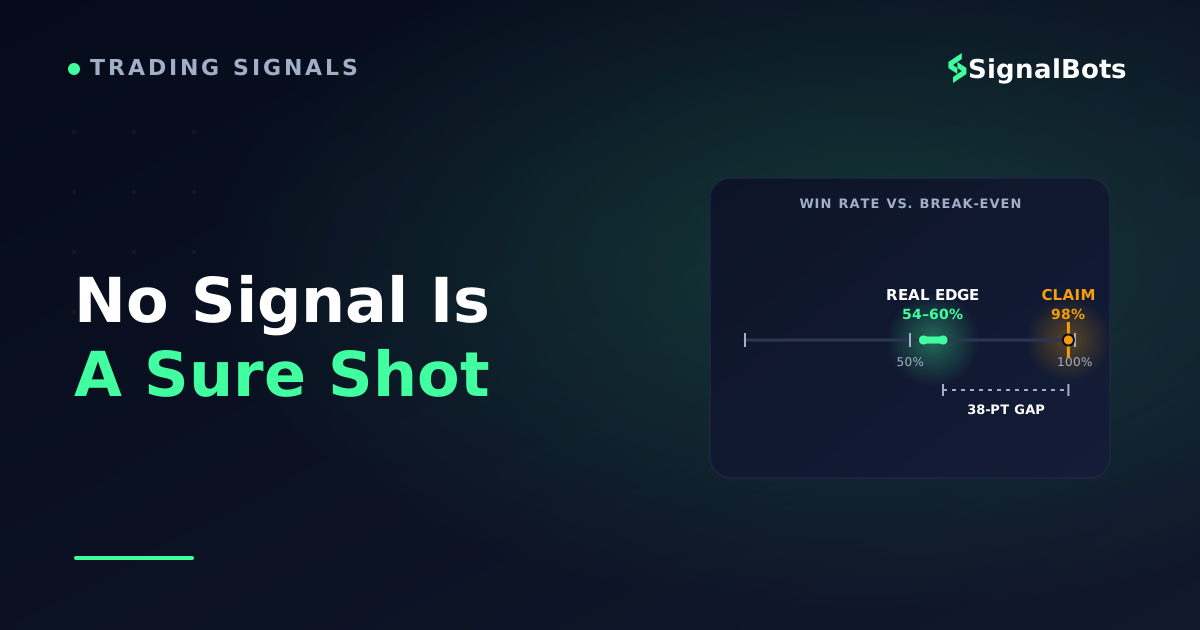
The whole argument in one view
Three accuracy claims, one 85% payout — where each one lands
The "sure shot" claim: 98%
Unprovable, and never sampled
Sold as near-certainty, evidenced by winning screenshots rather than a dated, complete trade log
Never states how many trades the number was measured across, which is the only figure that matters
Would require short-expiry price noise to stop existing at the moment of expiry
A genuinely strong source
Around 60% — quietly profitable
Sits a few points above the ~54% break-even an 85% payout implies, and that gap is the entire edge
Publishes losing trades beside the winners, timestamped, across hundreds of resolved signals
Still produces losing days, losing weeks and losing streaks you have to sit through
The coin flip
50% — loses money at any payout
Half right is not break-even here: you risk 100 to make 85, and the asymmetry eats the difference
A short winning run at this rate looks identical to skill and proves nothing at all
Break-even sits above 50% because a losing binary trade costs more than a winning one pays.
An honest edge lives a few points above break-even. Near-certainty is not a better version of that — it is a different kind of statement.
Here is where those numbers come from.
Binary options pay you asymmetrically, and the asymmetry is the entire argument. When a trade wins you receive the payout percentage on your stake: at an 85% payout, a $10 trade returns your $10 plus $8.50. When it loses, the full $10 is gone. You are risking 100 to make 85.
Take 85% as a working example throughout — put in whatever your own screen quotes. The arithmetic behaves the same way at every payout below 100%.
That gap creates a floor. The break-even win rate is the accuracy you need simply to finish where you started:
break-even win rate = 100 ÷ (100 + payout)
At an 85% payout that is 100 ÷ 185 — about 54.1%. Watch it play out across a hundred $10 trades:
50 wins, 50 losses → $425 collected against $500 paid. -$75, from a coin flip.
Read the middle line twice. Sixty percent accuracy — a number so unremarkable that almost no channel advertises it — makes a hundred trades genuinely profitable. That is the real shape of an edge in this market: a small tilt applied across a large number of trades, not a switch that converts outcomes to certain.
Now set a "sure shot" figure beside it. A claimed 98% is not the same thing, only better. It is a claim to have removed the part of the market that makes it a market.
Run it on the offer in front of you
Check a claimed win rate against break-even
Enter the payout your trade pays on a win and the accuracy the offer claims. You get the win rate actually needed to break even — and what the claim would be worth if it happened to be true.
Payout on a winning trade
Win rate the offer claims
Stake per trade
$
Trades in the sample
Break-even win rate
—
Claim's margin over break-even
—
Result if the claim were true
—
Result if it is 10 points lower
—
Drag the claimed rate down by ten points and watch the fourth figure move. That is how much of the promise is doing the work.
Two mechanical reasons a claimed rate in the nineties cannot survive contact with reality:
Short expiries live inside the noise. A binary trade resolves on where price sits at a single instant. On a one- or five-minute expiry, that instant is dominated by the spread, last-second order flow, and whatever prints mid-candle. Any method, however sound, produces a false signal when the noise runs the wrong way at the wrong second. A source claiming that never happens to them is claiming the noise stopped existing.
A perfect run is what small samples look like. Twelve wins in a row is not evidence of a 100% method. It is a fairly ordinary stretch for a decent method and an unremarkable one for a coin. Without a stated sample size, an accuracy figure is not a measurement at all — it is a sentence.
Whatever number you are eventually shown — a channel's, a bot's, or ours — it is a historical win rate: a record of trades that already resolved, not a property of the next one. Read our risk warning before you size a position on any of them.
What "Sure Shot" Offers Actually Contain Once You Open Them
For this article we worked through the material circulating under these keywords — strategy PDFs, short videos, group posts, channel invites. None of it is named or linked here; we read it for the pattern, not to review one seller, and pointing you at any of it would defeat the purpose. The pattern turned out to be remarkably consistent, and it has two halves.
The Gap Between the Title and the Content
Open a document titled 10 Sure Shot Strategies and you find ten ordinary technical setups: trade the colour of the previous candle, buy the bounce off support, enter when RSI leaves oversold, take the MACD cross. There is nothing wrong with any of those as setups. What is missing is any basis whatsoever for the word on the cover — no win rate, no trade log, no test window, no sample size, not even a note on which expiry they were tested against.
The sharpest version of this pattern is a "sure shot patterns" guide whose own description concedes that no strategy guarantees success. The certainty is on the cover, the disclaimer is in the body, the same person wrote both, and only one of them was ever meant to be load-bearing.
Videos do it in fewer words. A title stacks "free signals" and "sure shot"; the description explains nothing about method; the footage is an indicator being dragged onto a chart. The claim never reappears inside the content, because inside the content there is nothing to attach it to.
That gives you a working rule: read the promise and the product as two separate documents. When the certainty exists only in the title, the thumbnail and the pinned message — and evaporates the moment you reach the actual teaching — you have the whole story already.
Screenshot Proof vs. a Verifiable Track Record
The standard proof offered for quotex sureshot signals is images: winning trade cards, a rising balance, a payout notification, a wall of member testimonials. None of it is evidence, for one structural reason — a screenshot is selected. It shows the trades someone chose to photograph, drawn from a population only they can see.
A verified track record is the opposite kind of object. It is complete by construction: every signal issued, in the order it happened, with the losses sitting in the same list as the wins.
What to ask for, and what you usually get
What you are checking
A "sure shot" pitch shows
A verifiable record shows
Form of the proof
Cropped screenshots of winning trades
A timestamped log of every signal issued
Losing trades
Absent, or deleted from the channel
Present, and counted in the rate
Sample size
Unstated — a percentage with no denominator
A stated number of resolved trades, over stated dates
Who can check it
Only the seller, and only after you pay
Anyone, before paying anything
Payout assumed
Never mentioned, so break-even stays invisible
Stated, so the rate can be judged against break-even
What is being promised
An outcome — "this one wins"
A record — "this is what already happened"
The left column is a selection someone made. The right column is everything that happened, including what nobody wanted to post.
A screenshot is a selection. A track record is everything that happened, including what nobody wanted to post.
Red Flags That Mark a "Sure Shot" Claim as Marketing
You will meet these claims again, so the useful thing to carry away is the pattern rather than a verdict on one offer. Seven flags cover almost every version in circulation:
Absolute language anywhere in the offer. "Sure shot", "no loss", "guaranteed accuracy", "100% winning". This one is close to definitive: a source that understands its own product does not need to describe it in language the product cannot support.
An accuracy number with no denominator. "95% accurate" across ten trades and across two thousand are different claims wearing the same figure. When the denominator is missing, it is missing on purpose.
Proof that consists only of images. Selection is doing all the work, and you never see what was left out.
A record with no losing trades in it. That is not a good record, it is an incomplete one. Every real edge produces losing streaks, and it is worth knowing what a run of them would do to your balance before you meet one — the risk-of-ruin calculator prices that in about a minute.
Urgency and scarcity. "Ten slots left", "closing tonight", "price doubles tomorrow". Performance data does not decay at midnight; a sales window does.
Access gated behind a deposit through one specific link. When entry requires registering under a particular referral, the seller is paid whether or not you win — which is precisely the arrangement a loud accuracy claim is built to produce. The real difference between VIP and free signals is that payment model, not the accuracy.
The number moves. 95% in the bio, 99% in the pinned post, "never lost a trade" in the direct message. A measurement has one value; a slogan takes whichever value fits the sentence.
One flag is a reason to slow down. Two is a reason to walk.
How to Check a Provider's Real Win Rate Before You Pay
The broad question — how reliable Quotex trading signals are as a category, and what separates a workable source from a weak one — is a bigger subject than this page. What follows is the narrow version, aimed squarely at an accuracy claim: how to convert "98% accurate" into a number you produced yourself. It costs two weeks and no money.
Every step in the routine below exists to defeat one of two specific failure modes, and knowing which is which is what keeps you from quietly skipping the inconvenient parts.
The first is selection. A claim built on screenshots is built on a sample somebody else chose, so the whole point of logging a source yourself is to take that choice away from them: capture the calls as they are posted, before a channel can edit or delete them, and trade all of them on a demo account at one fixed stake and one fixed expiry. The moment you start skipping the ones that look weak, you have rebuilt the seller's bias with your own hands.
The second is the benchmark. Most people judge a logged result against zero — did I finish ahead? — when the line that decides it is break-even for the payout they were actually quoted, trade by trade, rather than the headline number on the platform's marketing page. A logged 52% at an 85% payout is a losing system that feels like a winning one, and only the comparison exposes that.
Run it in this order, and ask for the denominator before you spend a day on any of it:
Two weeks, no deposit
Turn an accuracy claim into a number you can check
0 / 7
Ask how many resolved trades the claimed win rate is measured across, and over what dates.
Save or export the channel's calls yourself, so edited or deleted messages cannot quietly leave the record.
Paper-trade every call on a demo account at one fixed stake and one fixed expiry — including the ones that look weak.
Note the payout you were actually quoted on each trade, not the headline payout in the marketing.
Compare your logged win rate against the break-even rate for that payout, not against zero.
Count the losing trades in the provider's own published record; if there are none, the record is incomplete, not perfect.
Check that the accuracy figure is the same in the bio, the pinned post and the sales message.
★
Checklist complete — you’re cleared to proceed.
Work through it once and you never have to take an accuracy claim on trust again.
If a provider's real rate lands a few points above break-even and their published record contains losses, you have found something ordinary and potentially useful. That is what a good result genuinely looks like.
Where These Claims Usually Come From
It helps to see why the phrasing is so uniform. Almost every quotex sure shot signal telegram pitch reaches you through one of four surfaces: a channel invite, a short-video discovery feed, a free PDF used as a lead magnet, or a post in a large group. All four share a property — they carry a claim beautifully and carry a record badly. There is nowhere in a fifteen-second video to publish two thousand timestamped trades, and nobody in that feed is asking for them.
The seller is monetised in one of two ways: a subscription, or a referral commission when you register and deposit through their link. In both cases the accuracy number's job is not to describe performance. Its job is to convert a viewer into a member. It is priced like advertising and it should be read like advertising.
That also explains the concentration on Telegram, where an invite link, a claim and a payment button fit inside one message. Vetting a Quotex Telegram signal channel is its own task with its own steps — what a healthy Telegram signal channel looks like, and how to test one before subscribing, needs more room than a paragraph here.
Where to See Binary Options Signals You Can Actually Check
Everything above reduces to one question: can I see the record? It is worth knowing what a "yes" looks like in practice.
On our binary options signals page, each signal is published the way the checks above ask for — the asset, the direction, the expiry, and the time it was issued — with the historical performance behind those signals visible on the same page. It is free to view and needs no account to read, which is the part that matters here: you can apply the break-even comparison from this article to a live feed before you commit to anything. The same signals run through our binary options Telegram channel for readers who would rather receive them where they already are.
Now the limits, stated plainly, because this whole article has been about claims that skip them. That page is a signal feed to inform your trades, not an accuracy guarantee. What it shows is historical — trades that already resolved — and no historical record is a promise about the next one. It does not replace your own position sizing, your own risk rules, or the verification habit this article is trying to hand you. If you would rather log a source for two weeks before trusting anybody's published numbers, ours included, that is the better instinct and we would rather you kept it.
Bottom Line: Should You Trust a Sure Shot Quotex Signal?
No — and not necessarily because the seller is lying about the setups. Usually the setups are real and unremarkable. It is the claim bolted to them that fails: at any payout below 100%, break-even already sits above half, an honest edge lives a few points north of that, and nothing about short-expiry price movement permits certainty at either end.
You do not have to settle whether a particular sure shot quotex signals pitch is a scam or an exaggeration. You only have to ask for the denominator, log the calls yourself, and measure the answer against break-even. Claims that survive that are rare and quiet. Claims that do not were never worth the deposit.
FAQ
What win rate should I expect from a good Quotex signal source?
Something unglamorous. At a typical payout, break-even sits in the mid-fifties, so a source running consistently a few points above that — measured across hundreds of resolved trades, with losses included — is doing genuinely well. Sources advertising the nineties are, in our reading of this market, advertising rather than reporting.
Does a higher payout make a high-accuracy claim more believable?
It lowers the bar, but nowhere near far enough. A 90% payout drops break-even to roughly 52.6%, and a 95% payout to about 51.3% — helpful, and still above half, and still nowhere near a claimed 98%. The asymmetry shrinks as the payout improves; it never disappears while the payout is under 100%.
Is a free "sure shot" Telegram channel safer than a paid one?
Not automatically, and sometimes less so. Free channels are usually monetised through broker referrals, so the incentive is to maximise your deposits and your trade volume rather than your results. A paid channel at least sells something you can cancel. In both cases the question is identical: where is the complete, timestamped record?
How many signals do I need to log before the number means anything?
More than most people log. A dozen trades tells you close to nothing, because a fair coin produces long runs routinely. A few hundred resolved trades at a fixed stake and expiry starts to separate an edge from a streak — which is exactly why the offers making the loudest accuracy claims never state their sample size.
Can I check a sure shot claim without depositing money?
Yes, and it is the correct first move. Record every call the channel posts, execute them all on a demo account at a fixed stake and expiry, then compare your logged win rate to break-even for the payout you were quoted. Two weeks of that is worth more than any screenshot you will ever be sent.
Sources & Further Reading
Want to go deeper? These independent, authoritative sources shaped this guide — each one is worth reading in full:
The Binary Options Desk is the SignalBots editorial team for fixed-time and OTC trading coverage. We research and write the guides that explain expiry timing, payout structure and disciplined entry across the major brokers.



Discussions 0
Leave a comment