You've watched a lead trader's equity curve climb for weeks and you're ready to ride along. The problem isn't finding someone to copy — every platform floods you with leaderboards. The problem is that the leaderboard is the last thing that should decide where you put your money, and most "best platform" lists never tell you that. This guide fixes the order: first how copying actually moves money into your account, then what to check before you click Copy, and only then which platforms fit which kind of copier.
Editor's pick
A top leaderboard rank tells you nothing about how a trader behaves in a drawdown — which is exactly when your copied capital is on the line.
BG
Bitget— strongest all-round copier
Deepest pool of active lead traders to filter
Filter leaders by drawdown and longevity, not hype
Ranked by what a copier controls, not by leaderboard fame.See the full comparison →
Our pick leads on copier controls and lead-trader transparency — the two things that actually protect your capital.
Key Takeaways
Copy trading mirrors a lead trader's positions onto your account proportionally to your balance, not one-for-one — you copy their execution, never their outcome.
Choose a platform on what a copier actually controls: minimum capital, position-sizing modes, lead-trader transparency, and stop-copying / max-allocation risk limits — not on a flashy leaderboard.
Vet a lead trader by drawdown depth and track-record length, not headline return; a two-year winner can blow up when the market regime changes.
Bitget, Binance, Bybit, OKX, BingX and eToro each lean a different way (derivatives depth, asset breadth, or beginner-friendly social) — match the platform to how you want to copy.
Table of Contents (17 min read)Contents
How Does Crypto Copy Trading Actually Work?
Copy trading links your account to a lead trader (sometimes called a master trader or signal provider) so that when they open or close a position, the platform opens or closes the matching position on your account automatically. You never place the trade yourself — you subscribe once, and every future move is mirrored.
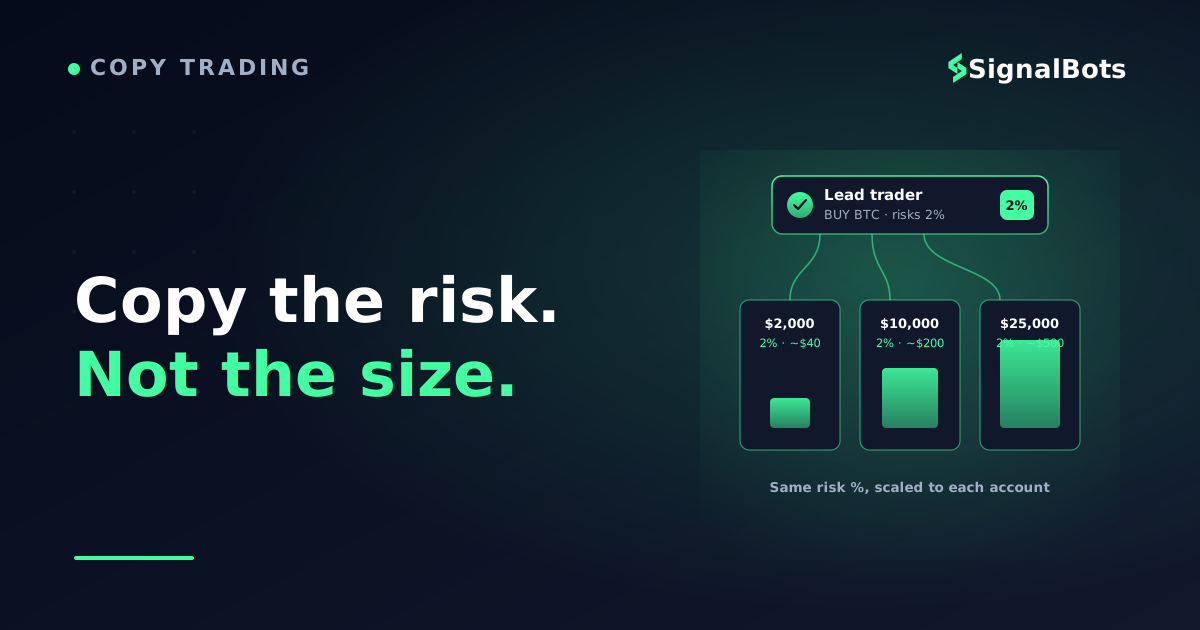
The part that trips up new copiers is sizing. Copying is proportional, not identical. If a lead trader risks 2% of their $500,000 account on a Bitcoin long, the platform doesn't put a $10,000 position on your $2,000 account — it scales that same 2% risk down to your balance. You mirror their execution and their risk percentage, not their dollar size, and never their result: the market still moves for or against your own allocated capital.
The core mechanic
One master trade, scaled to each follower's balance
Lead traderBUY BTC — risks 2% on a $500,000 account
Mirrored proportionally to each copier
Copier — $2,000~$40 at risk — same 2% of balance
Copier — $10,000~$200 at risk — same 2% of balance
Copier — $25,000~$500 at risk — same 2% of balance
Each copier takes the same trade at the same risk percentage — scaled to their own account, not the leader's.
Proportional allocation: you copy the leader's risk profile, sized to your capital.
This is why the mechanic is often called mirror trading — your account becomes a scaled mirror of the leader's. It's the same idea whether the platform calls it copy trading, social trading, or a strategy vault. Under the hood it is algorithmic trading in the plain sense: software, not you, executes the entries and exits the moment the leader acts.
What a copier actually controls
Here's the reframe that changes how you pick a platform. When you copy, you are not buying a trader — you are renting a set of controls over how that trader's activity lands on your account. A good platform gives you tight controls; a weak one hands you a leaderboard and a Copy button and hopes for the best. Five controls decide almost everything:
Minimum capital to copy — the smallest balance you can allocate to one leader. Too high and you can't diversify across several; too low and position sizes round down to noise.
Position-sizing mode — whether you mirror the leader's risk proportionally, copy at a fixed multiple (e.g. half their size), or set a flat amount per trade. More modes means more ways to tune the copy to your risk appetite.
Per-leader allocation cap — how much of your capital any single leader can command, so one blow-up can't sink the whole account.
Stop-copy and stop-loss controls — whether you can auto-detach from a leader at a set drawdown, or halt copying instantly by hand when their behaviour changes.
Leader transparency — how much verifiable history the platform shows: maximum drawdown, track-record length, trade count, and whether the numbers are a verified track record or a self-reported screenshot.
Notice what's not on that list: the leader's headline return. A big number at the top of a leaderboard is the marketing, not the product. The product is your ability to control your downside while the leader trades.
Vet the lead trader before the platform
The single most expensive mistake in copy trading is picking a leader by their return. A trader who compounded through a bull run has a beautiful curve — right up until the regime flips and the same aggressive style that made the gains hands back 80% of the account. You are copying behaviour, and behaviour is only revealed by how a trader handles losing periods.
So read the boring metrics first. A leader's drawdown — the deepest peak-to-trough fall in their equity — tells you the worst pain you'd have sat through, and by extension whether you could stomach it without panic-detaching at the bottom. Longevity matters just as much: a track record spanning multiple market conditions is worth more than a spectacular three-month sprint. And check profit factor (gross wins over gross losses) rather than a raw win-rate — a trader can win most trades and still bleed if the losers are huge.
The copier's mindset is closer to hiring than to gambling: you want a track record you can interrogate, not a number to chase.
Do this first
Pre-copy checklist: vet a lead trader before you allocate
0 / 7
Track record spans at least one full down-move, not just a bull run
Maximum drawdown is a number you could actually sit through
Trade count is high enough to be a pattern, not a lucky streak
Position sizing looks consistent — no sudden all-in bets
Metrics are platform-verified, not self-reported screenshots
You've set a per-leader allocation cap and a stop-copy drawdown
★
Checklist complete — you’re cleared to proceed.
Tick every box before you allocate. If you can't verify a line, treat the leader as unproven.
The major crypto copy trading platforms
With the mechanic and the vetting straight, the platform choice gets simpler — it comes down to which kind of copier you are. Below are the venues most crypto copiers actually use, compared on the controls that matter rather than on marketing — if you want platforms that copy across markets rather than crypto alone, that is a separate comparison. (No affiliate links here; this is a copier's map, not a referral list.)
Bitget built its name on dedicated copy trading and carries one of the largest pools of active lead traders, with strong derivatives and futures coverage. The deep leader pool is a double edge — more choice, but you must filter by drawdown and longevity or you'll drown in leaderboard hype.
Binance folds copy trading into the largest exchange by asset breadth, so almost any pair you'd want to copy is available. It suits copiers who want spot and a wide instrument menu in one account.
Bybit leans hard into futures-based copy trading — a fit for copiers comfortable with leverage who specifically want to mirror derivatives strategies.
OKX offers spot and futures copying with per-order copy sizing, giving granular control over how much goes into each mirrored trade.
BingX is built around the social-trading experience across spot and futures, with a large follower base and an approachable interface for people new to copying.
eToro is the original social-trading brand; its CopyTrader has run since 2010 across many asset classes with a curated crypto list — the friendliest on-ramp for beginners, though its crypto menu is narrower than a native exchange.
The table below lines them up on what a copier decides on. Read it as "which lever do I care about most," then pick the column that wins on your lever.
Match the platform to the lever you care about most — leader depth, asset breadth, futures, sizing control, social feel, or a gentle on-ramp.
Copying is automation — treat it like a system
Step back and copy trading is really a hands-off form of automated trading: a strategy runs, and your account executes it without you watching the chart. That framing is useful because it borrows the discipline of running any trading system — you size positions deliberately, you cap what any one strategy can lose you, and you judge the strategy on a historical win rate and drawdown across many trades, not on the last flashy week.
It also means the same failure modes apply. Blindly following a leader through a strategy change is the copy-trading version of leaving a bot running after its edge has decayed. The fix is the same in both worlds: set your risk limits up front, review the strategy's behaviour on a schedule, and be willing to detach the moment the numbers stop looking like the track record you signed up for.
If you'd rather see live, on-chart entries and exits for crypto pairs before you commit capital to a copier, our crypto trading signals let you watch the setups directly. And if your endgame is running copied or algorithmic strategies inside MetaTrader, our crypto MT5 connectors bridge major exchanges into one execution platform.
Where Does Automation-First Fit Next to a Copy-Trading Platform?
Everything above assumes you want to ride a person — subscribe to a lead trader and let their live decisions land on your account. That is one way to automate. There is a second worth reviewing honestly against those platforms, because it answers a different question: instead of mirroring a stranger, you automate your own rules on a real exchange feed. This is where our approach at SignalBots sits, and it is fairest to judge it side by side with pure copy trading, not as a replacement for it.
Signal-plus-connector automation vs mirroring a leader
A copy-trading platform hands you a leaderboard and a Copy button; the strategy is the leader's, and your control ends at the allocation caps we covered earlier. A signal-plus-connector setup inverts that. Our live crypto trading signals read entries and exits directly on the chart so you see the setup before any capital moves, and our crypto MT5 connectors bridge exchanges like Binance, Bybit, or OKX into MetaTrader so you can run or automate a system on that feed yourself. The trade-off is plain: you carry the decision about which rules run, instead of outsourcing it to a leaderboard rank.
The honest verdict — what it is best for
Judged as one option among the platforms above, an automation-first approach is best for the trader who wants to own the strategy: someone building or running their own system, who wants to watch signals form before committing, and who is comfortable loading and supervising a connector inside MetaTrader. It is not for the reader who came here to click Copy on a named lead trader and walk away with zero setup — for pure, hands-off mirroring of one person's book, a dedicated copy-trading exchange fits that intent better, and we would send you there first. Treat either path like a system, not a shortcut: copied or self-run, a crypto strategy carries real market risk, and past results never promise future ones. Size every position deliberately and read the full risk warning before you allocate.
Your next step
If mirroring a leader is genuinely what you want, pick the platform from the comparison above whose copier controls fit you, and vet the trader before you allocate. If instead you would rather see the signals yourself and automate your own rules on a real exchange feed, bridge one into MetaTrader with our connectors and activate the tooling with a free lifetime license — no subscription, funded through our broker partnership.
Conclusion
The leaderboard is the loudest part of every copy trading platform and the least important to your decision. Get the order right — understand that copying scales a leader's risk onto your balance, vet the leader on drawdown and longevity instead of headline return, then pick the platform whose controls fit how you want to copy — and copy trading becomes a disciplined, hands-off system rather than a bet on a stranger's hot streak.
The one move to make
You came in
“trusting a rising leaderboard rank to pick where your money goes”
and you leave
choosing on copier controls and a verifiable lead-trader track record.
The deepest pool of lead traders to filter, transparency on drawdown and longevity, and granular per-leader allocation and stop-copy caps — the controls that actually protect your capital. Vet the leader before you allocate.
Brand-new to copying and want the gentlest on-ramp? A curated multi-asset platform like eToro is friendlier to start on — or bridge an exchange into MetaTrader with our crypto MT5 connectors.
Choose on controls and transparency, not on a leaderboard — then vet the leader before you copy.
FAQ
Is crypto copy trading a good idea for beginners?
It can be a lower-effort way to get exposure to active crypto trading without placing every trade yourself — but only if you treat the leader selection seriously. A beginner who picks a lead trader by their biggest return, with no allocation cap or stop-copy limit, is taking more risk than someone trading a small size by hand. Start on a beginner-friendly platform, allocate a small amount you can afford to lose, and vet the leader on drawdown before you copy.
How is copy trading different from a trading bot?
Both are forms of automated execution, but the source of the decisions differs. A trading bot runs a coded strategy — rules you (or the vendor) defined. Copy trading mirrors a human lead trader's live discretionary or systematic decisions onto your account. In both cases software does the clicking; the question is whether you trust a ruleset or a person's ongoing judgement.
Do I need the same balance as the trader I'm copying?
No. Copying is proportional: the platform scales the leader's position to your balance and their risk percentage, not their dollar size. A leader risking 2% of a large account is mirrored as roughly 2% of yours, so a small account can copy a large one — just at correspondingly smaller position sizes.
What's the biggest risk in copy trading?
Copying a leader through a strategy or market-regime change. A trader who thrived in a bull run can hand back most of the gains when conditions flip, and copiers who blindly follow ride that all the way down. The defense is a per-leader allocation cap and an automatic stop-copy at a drawdown level you set in advance — so one leader's collapse can't take your whole account with it.
Can I copy trade crypto and still run my own strategies?
Yes. Many traders copy one or two leaders for hands-off exposure while trading their own setups on the side, or bridge an exchange into MetaTrader to run algorithmic strategies alongside a copied one. Just size each independently and cap what any single strategy — copied or your own — can lose you.
Sources & Further Reading
Want to go deeper? These independent, authoritative sources shaped this guide — each one is worth reading in full:
The Crypto Desk is the SignalBots editorial team behind our digital-asset coverage. We research and write the guides and explainers on spot and perpetuals, exchange mechanics, funding rates and the 24/7 structure that sets crypto apart from every other market.
Want to use the bot without paying? Message our 24/7 support team via Telegram or Viber. Our experts will guide you step-by-step on how to unlock your free lifetime license through our exclusive broker partnership program.



Discussions 0
Leave a comment