Search quotex signal telegram and Telegram hands you a wall of rooms that all look identical: the same green banner, the same bold accuracy claim, the same countdown to the next VIP slot. Nothing in that list tells you which channel is run by someone who actually trades and which one is a deposit funnel wearing a signals costume.
That is a Telegram-specific problem, and general advice does not solve it. You may already know what a Quotex trading signal is and what "reliable" means in the abstract — that knowledge does not survive contact with a channel list, because on Telegram the only evidence you get is whatever the admin chose to leave visible. Everything else is a claim.
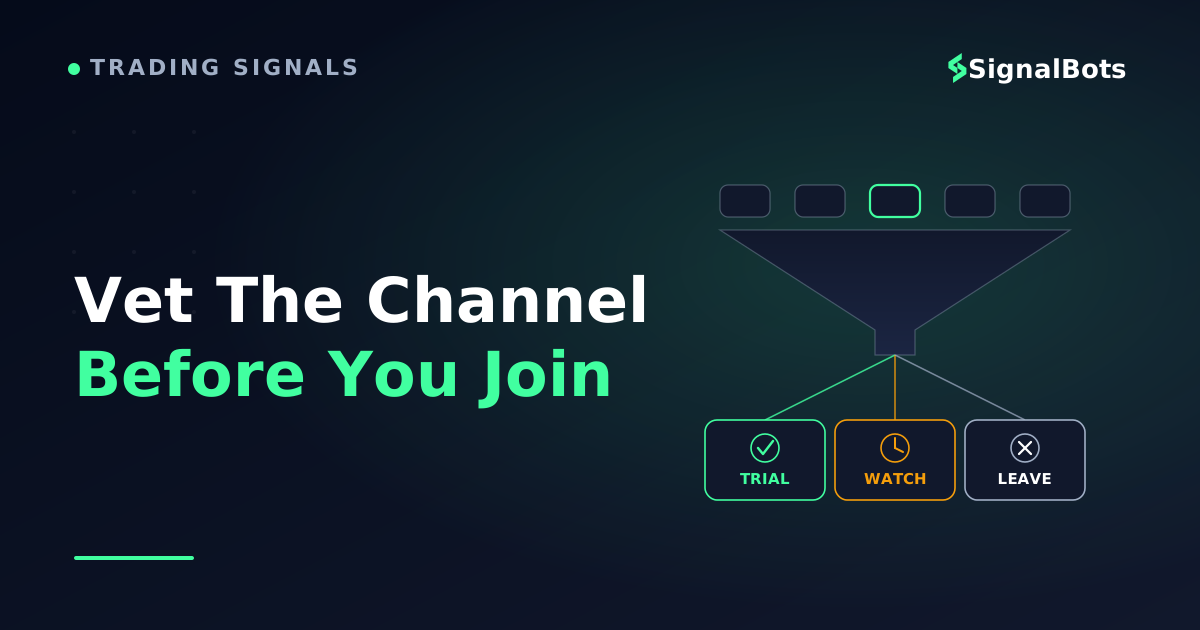
So this guide is narrow on purpose: a repeatable way to open any Quotex trading signals Telegram channel cold and sort it into one of three buckets — worth a monitored trial, needs more evidence, or leave now — before it touches real money. You will notice we never name "the best" handles. Rooms go stale within months, and any win rate we quoted for someone else's channel would be a number we cannot verify. A method survives; a list rots.
Key Takeaways
A claimed win rate is the least verifiable thing about a channel. Judge how the number is proven — an unedited post history with every outcome attached — not how big it is.
Four checks sort almost any room: who the admin is, whether the history is complete and unedited, what the paywall gates, and what happens to a post after a losing trade.
Walk away on anonymity behind a paywall, deleted losses, countdown pressure, or an admin steering you to a deposit link that is not the broker's own.
Run 15-20 signals on a demo account, logged as they arrive, before any real money is involved — enough to catch a fraud, never enough to prove an edge.
Table of Contents (26 min read)Contents
Where Quotex Telegram Signal Channels Actually Come From
Before you can judge a room, you need to know what kind of thing you are looking at. Almost every Telegram signal channel aimed at Quotex traders traces back to one of four origins, and each one leaves visible fingerprints in the feed.
Every channel looks credible from the outside — the difference only shows once you inspect one.
Channel typology
Where the channel comes from
How you can tell from the feed
What it usually wants from you
A solo analyst posting their own calls
Irregular timing that clusters around sessions; chart images; commentary that reacts to what price actually did
Subscribers for a paid tier, or credit for referring you to a broker
A resold or rebranded feed
The same calls, to the second, appear in several unrelated channels; generic branding; the admin never discusses method
A monthly fee for a feed they did not create and cannot explain
A bot posting automatically
Machine-regular cadence, one rigid template per post, no commentary, no reaction to news or a bad streak
Installs, an unlock code, or a paid tier for higher-frequency alerts
A directory or aggregator listing
A site or channel that ranks other rooms and prints an accuracy figure next to each one
Clicks — to the channels it lists, or straight to a broker sign-up
Four origins, four different sets of questions. Classify the channel first; judge it second.
None of these four is automatically a scam, and the typology is not a verdict. It only tells you which questions matter. You interrogate a solo analyst about method and identity. You interrogate a resold feed about where the calls originate. You interrogate a bot channel about its rules and whether every fire gets published. And you treat a directory's accuracy table as advertising, because that is what it is — the ranking usually reflects who paid for the slot, not who was measured.
One more origin deserves its own note, because it is the one people mistake for a credential.
Is There an Official Quotex Telegram Channel?
The broker does run its own Telegram presence, and it is not a signal room. Official broker channels are marketing and operations surfaces: platform announcements, tournament results, promo codes, maintenance and holiday notices. They tell you the platform will be down on Monday. They do not tell you to buy EUR/USD in the next two minutes.
Two things follow from that, and both matter more than they sound.
First, never take the handle from a search result or a forwarded message. Impersonating a broker's official channel or its support account is a standing business model — the fake looks better than the real one, because the fake has a design budget. Open the broker's own website or app and follow the social link from there. That is the only path where the handle is self-verifying.
Second, "official Quotex signals" is a claim the broker itself does not make. When a room brands itself as the platform's own signal service, you have already learned something: it is willing to borrow authority it does not have. Related tell — a support account that messages you first, asks for a deposit, offers to trade the account for you, or wants your login is not a broker employee, whatever the profile picture says.
The Vetting Checklist: What a Trustworthy Channel Shows You
Four checks. All four are observable from inside the channel, in a few minutes, before you pay anything or place a single trade.
Admin transparency and identity
Start with the person. Is there one? A channel run by a named human with a face, a history and work you can find elsewhere is accountable in a way an anonymous handle is not — not because names are magic, but because an anonymous admin loses nothing by burning the room and reopening under a new one next week.
Anonymity is not automatically disqualifying. It is a ceiling on how far you can reasonably go, and the ceiling is low: you cannot check anything they tell you.
Two cheap tests:
Scroll to the very first post. Channel age is public, and the earliest messages usually reveal what the room was before it was a signals room. A channel created six weeks ago that claims years of results is telling on itself. So is a room whose first hundred posts were about a different broker, or a different market entirely.
Ask one specific method question. Not "is it accurate" — ask what conditions invalidate a call, or why the expiry is set the way it is. Someone who trades has an immediate, boring, technical answer. A reseller changes the subject to the price of the VIP tier.
How performance is proven: screenshots vs a checkable record
Every channel claims a number. What separates them is the form the proof takes, and the forms are not equal.
A screenshot is the weakest evidence in the stack. It can be cropped, taken from a demo balance, edited in a minute, or lifted from someone else's account entirely. A grid of screenshots proves that someone can produce screenshots. Stronger evidence, in order:
Signals that stand unedited in the channel's own history, with Telegram's timestamps on them, in the order they were posted.
A daily or weekly recap that reconciles against that history — every call posted, including the ones that lost, not a highlight reel.
A verified track record you can open yourself, hosted somewhere the channel does not control.
The test that costs you nothing: pick a random day two months back and count. Every signal posted that day should have a visible outcome attached to it. The gaps are the finding — a call with no follow-up is almost never a winner nobody bothered to mention. Check for edit markers too, and treat a suspiciously clean early history as backdating a track record until proven otherwise.
Format is evidence as well. A post that gives you the asset, the direction, the entry window and the expiry is a call you can check afterwards. "GO UP NOW 🚀" is not a signal, it is a mood — and it is unfalsifiable by design. Watch the clock too: a one-minute expiry broadcast to a room of forty thousand people is a stale signal for almost everyone who receives it, which conveniently makes the channel's own result impossible to reproduce.
Free access, VIP tiers, and what the paywall tells you
A free channel with a paid upsell is a normal business model, not a red flag. The difference between free and VIP signals only becomes diagnostic when you ask what the paywall gates.
Healthy structure: the free feed carries real, complete, checkable calls, and the paid tier adds frequency, more assets, or earlier delivery. You can evaluate the product before buying it, because the free tier is the product at lower volume.
Unhealthy structure: the free feed exists only to display wins, and every actual call is behind the payment. You are asked to buy the evidence. A "quotex vip signals telegram group" that shows you results but never a live call in advance has arranged things so that you can never test the claim without paying first — and that arrangement is the point.
Then watch the currency. Some rooms do not want your subscription money at all; they want you to open an account through their referral link, and their revenue arrives whether you win or lose. That is the tier where "free" is most expensive, because the incentive quietly inverts: more trades from you means more revenue for them, regardless of the outcome. And notice what happens when you do not buy. Escalating direct messages, discount timers and personal pressure describe a sales operation, not an analyst.
What the channel does after a losing trade
This is the most informative behaviour in the entire checklist, and observing it costs nothing but a week of watching without trading.
Losses are structural. Any honest room posts losers, because a false signal is a normal part of any method, not evidence of fraud. What you are grading is the reaction:
Healthy: the losing post stays up, gets marked as a loss, and sometimes gets a short explanation. Tomorrow's cadence looks like yesterday's.
Deleted: posts vanish and the count resets. If a room edits its history, nothing else in the room is evidence.
Retroactively re-labelled: the call becomes "educational only" after it goes wrong, or "we said wait for confirmation" appears in a message that was not there before.
Blamed on you: you entered late, you used the wrong expiry, you were on the wrong asset. Sometimes true. As a standing policy, it is a way of never being wrong.
Recovered with size: the room tells everyone to double the next stake to win it back. A martingale strategy does not fix a losing sequence, it concentrates it — and it converts a bad week into an account-ending one.
Red Flags That Mean Walk Away — Even When the Win Rate Looks Great
There is a piece of advice circulating on almost every page that ranks for this topic: a channel is trustworthy if it shows above 80% accuracy. Invert it. An unverifiable number costs nothing to type, and the bigger it is, the more extraordinary the claim it makes — so a huge accuracy figure with no checkable record behind it is a red flag in itself, not a credential.
It also helps to know what the number would have to beat. A binary trade does not pay one-to-one: a winner returns the payout percentage printed on the ticket, while a loser costs the whole stake. That asymmetry sets a break-even win rate well above 50%, and it is the floor any channel's claim should be measured against.
Interrogate the number
Reality-check a channel's claimed win rate
Enter the payout shown on the trade ticket for the asset the channel trades, and the accuracy it claims. The gap between the claim and the break-even line is the size of the edge you are being asked to believe.
Payout on a winning trade
Win rate the channel claims
Signals you track in the trial
Stake per signal
$
Break-even win rate
—
Claimed edge over break-even
—
Wins needed to break even
—
Trial result at the claimed rate
—
Move the payout slider: the break-even line moves with it, and the claimed edge is the extraordinary part of the claim.
Drag the payout down and watch the break-even line climb. That is the real bar. A room claiming twenty or thirty points above it is claiming an edge that would be remarkable in any market — which is exactly why the claim needs a checkable record, and why the number alone tells you nothing. Treat it as a hypothesis to test, never as a credential. Binary trades can lose the entire stake, and no channel changes that; our risk warning covers what that means for your account.
Beyond the number, these patterns are the ones worth leaving over:
An anonymous admin behind a paid tier. You are being asked to pay someone who has arranged to be unfindable if it goes wrong.
A history with no losses in it. Either the room deletes them or it does not publish every call. Both make the visible record meaningless.
Urgency and scarcity language. "Three slots left", "closing in one hour", "risk-free entry today" — the phrase risk-free is itself the tell, because nothing in binary options is. Time pressure exists to stop you from running the checks on this page.
A deposit link that is not the broker's own. An admin steering you to a specific sign-up link with a bonus code, or telling you a minimum deposit is required for signals to "work" on your account, is being paid for the deposit. Their income event is your funding, not your result.
Results you cannot reproduce. Entry prices that never printed at the posted time, or a claimed run on weekend OTC assets where independent price history is hard to check. If nobody can verify a result, nobody can falsify it either.
Anyone offering to trade your account for you. That is not a signal channel, and handing over credentials ends badly in a way no checklist can undo.
How to Test a Channel Before You Risk Real Money
Nobody can tell you from the outside whether a channel is worth following, and no amount of reading replaces the measurement. The good news is that the measurement is cheap: you can run it on a demo account while the room has no idea it is being graded.
The 15-20 signal trial
The monitored trial: 15-20 signals before a single funded trade
1
Freeze the claim first
Note what the channel says it delivers: accuracy, assets, expiries, how many calls per day. You are testing this specific claim.
2
Trade it on demo, sized realistically
Use a demo balance close to the account you would actually fund, and the stake you would actually risk. Not ten times bigger.
3
Log every signal, not the good ones
Record each call as posted: asset, direction, expiry, the minute it arrived, and the outcome. Your log, not their recap.
4
Enter on the delay you really have
Only take a call if you saw it in time to act. Rewinding the chart afterwards measures a trader who does not exist.
5
Reconcile your log against theirs
Count the calls in your log with no outcome in the channel. Unreconciled calls are the number that matters most.
6
Decide with the two records side by side
Fund only if the observed result and the claim agree, and start at the smallest stake the platform allows.
The trial is not there to prove the channel is profitable — it is there to catch the channel that is lying.
Be honest about what this buys you. Fifteen to twenty calls is a small sample size: it is plenty to catch a room that deletes losers, posts untradable entries or claims results that never happened, and nowhere near enough to prove an edge exists. A channel that survives the trial has earned a small, cautious position — not your confidence.
Four things you are actually measuring, in order of how much they tell you:
Publication completeness — did every call you logged get an outcome, or did some quietly disappear?
Tradability — could a normal person acting on the post have entered in time, at a sane price?
Observed versus claimed — not whether the two match exactly, but whether they are in the same neighbourhood.
Behaviour under pressure — what the room did during its worst stretch of the trial.
If you decide to fund after that, size the first weeks around how much of your balance a losing run can consume — our risk-of-ruin calculator makes that concrete faster than intuition does.
Telegram Bots vs Human-Run Channels — What's the Difference?
Half the rooms you find are not written by anyone. A binary options bot generates calls from a rule set and posts them into the channel automatically, which is why a "quotex free signal bot telegram" search returns as many results as a search for analysts. Both types can be worth following and both can be worthless — but the questions you ask them are different.
Who is posting
Two different things to judge
Human-run channel
Posts arrive when the analyst sees a setup, so timing is irregular and clusters around sessions
Calls carry context: why this asset, why this expiry, what would invalidate the idea
A losing streak shows up as a mood change, an explanation, or an unusual silence
You can ask a specific question and tell from the answer whether anyone is home
Judge the person: identity, method, and how they behave after a loss.
VS
Bot-fed channel
Fires on a fixed cadence and posts an identical template every time
The logic is a fixed rule set: it cannot read news and it never changes its mind
High volume makes wins easy to cherry-pick and losses easy to bury
The admin may not have written the strategy, or understand it, at all
Judge the rules and the sample: what triggers it, and does every fire get posted?
Same feed, different evidence: one is a person you can question, the other is a rule set you have to reverse-engineer.
For a bot-fed room, one extra check does most of the work: ask what triggers a call. A channel that can describe the trigger — an indicator condition, a session filter, an expiry rule — has something you can evaluate. A channel that answers "AI" and moves on does not. How automated Quotex signal bots actually generate their calls is a topic of its own; the vetting question here is narrower, and it is the same one as always: is every fire published, or only the ones that worked?
See What a Transparent Signals Feed Looks Like
Checklists are easier to apply once you have seen a feed that already passes them, so use ours as a formatting benchmark. SignalBots runs a binary options Telegram channel where each posted signal shows the asset, the direction and the expiry openly, free to view, with no paywall gate on the basic feed. Open it next to whichever room you are evaluating and compare the shape of the posts: what a complete call contains, whether the outcome window is stated up front, whether a reader could check the call afterwards without asking anyone's permission.
Be clear about what that comparison is and is not. It is our own channel, not a verification service for anybody else's room — a Quotex Telegram group you are set on still has to survive the same checklist on its own evidence. And it is a Telegram feed, not automated execution: the entry, the stake and the decision to sit a call out all remain yours.
Quick Recap: Your Pre-Join Checklist
Back to that wall of identical channels. The difference between the room worth a trial and the funnel wearing a signals costume is almost never visible in the banner — it is visible in the history, the format, the paywall and the behaviour after a loss. Run these seven checks before you tap Join, and the wall sorts itself.
Pre-join checklist
Run this before you join any Quotex signal channel
0 / 7
I can identify who runs the channel, or I have accepted that I cannot verify anything they claim.
I scrolled to the first post and the channel's age matches the track record it advertises.
Signals are posted in advance with asset, direction and expiry — not vague 'go up now' calls.
I picked a random day months back and every signal from that day has a visible outcome.
Losing trades are still in the history, marked as losses, and not re-labelled or blamed on subscribers.
Nobody is pressuring me with slot counts, countdowns or a deposit link that is not the broker's own.
I have a demo trial planned: 15-20 logged signals before any real money is involved.
★
Checklist complete — you’re cleared to proceed.
Seven checks, under a minute. Anything you cannot tick is the thing to investigate before you pay.
Three buckets, one rule each. Worth a monitored trial: you can tick most of the list and nothing on the red-flag list is present. Needs more evidence: the room is plausible but something is unverifiable — watch it for a week without trading before deciding. Leave now: the history is edited, the admin is anonymous behind a paywall, or someone is pushing you toward a deposit link. The last bucket is the only one that needs an instant decision, and the decision is always the same.
FAQ
Are free Quotex signal Telegram channels worth following?
Free is a pricing decision, not a quality signal. A free room can be an analyst building an audience, and a paid room can be a resold feed with a logo on it. What matters is how the room is funded: if the revenue comes from a referral link tied to your deposit, the incentive is your trading volume rather than your results — worth knowing before you decide how much weight to give the calls. The full cost comparison between free Quotex signals and paid tiers is a separate question from the vetting one this page answers.
How many signals should I track before I trust a channel?
Fifteen to twenty logged calls is the practical minimum, and it answers a smaller question than most people think. That sample is enough to expose a channel that deletes losers, posts entries nobody could reach in time, or publishes only its winners. It is not enough to establish a genuine edge — a run of good luck fits comfortably inside twenty trades. Treat a passed trial as permission to start small, not as proof.
Should I follow a channel if I cannot tell whether a person or a bot is posting?
Not until you find out, because the two require completely different checks. Ask the admin what triggers a call. A person will describe conditions, an expiry rule, an invalidation. A bot-fed room run by someone who did not build the strategy usually cannot answer at all — and an admin who does not know why their own channel fires cannot tell you when it should be ignored.
What should I do if an admin asks me to deposit through their link?
Recognise it as a revenue event for them and price it accordingly. Referral arrangements are legal and common, and a link on its own is not proof of bad faith — but pressure is. Being told a minimum deposit is required for signals to "work", being pushed toward a bonus code, or receiving follow-up messages about your funding all point to a room whose income depends on your deposit rather than your outcomes. If you want an account, open it from the broker's own site.
Can I verify a channel's win rate myself?
Only partially, and that limitation is the whole point. You can verify the parts the channel cannot edit around: whether every call has a published outcome, whether the timestamps allow a real person to enter, whether the claimed prices existed on the chart. What you cannot verify is a bare accuracy figure with no post history behind it — and a channel that offers only that number has told you something important about what it is willing to show.
Sources & Further Reading
Want to go deeper? These independent, authoritative sources shaped this guide — each one is worth reading in full:
The Binary Options Desk is the SignalBots editorial team for fixed-time and OTC trading coverage. We research and write the guides that explain expiry timing, payout structure and disciplined entry across the major brokers.



Discussions 0
Leave a comment