Your signal feed does not ask which market you are comfortable in. It fires on EUR/USD before the London open, on the US500 twenty minutes after the New York cash bell, and on a single US tech name somewhere in the middle of the afternoon. Follow a bit of each for a month and you end up with a blended record that tells you nothing useful: you cannot say whether the source is any good, whether your entries are any good, or whether you simply pointed your attention at the wrong symbols.
Asset class is the decision that sits above all of that. It sets when your alerts can arrive at all, what kind of move they are trying to catch, how many of them you will see in a week, and what the board pays you when the call lands. Search for asset binary options signals and most pages will name the asset classes once in a sentence and then treat them as interchangeable for the rest of the article. They are not interchangeable, and this page puts the three that matter most — currency pairs, individual stocks, and the US500 index — next to each other so you can choose one deliberately and go deep on it rather than sampling all three badly.
Nothing below re-teaches what a binary contract is or how to trade an alert once it arrives. The question here is narrower and comes first: which underlying should your feed be pointed at?
Key Takeaways
The binary contract never changes with the asset; what the asset decides is the availability window, the volatility driver, how often signals fire, and the payout the board prints.
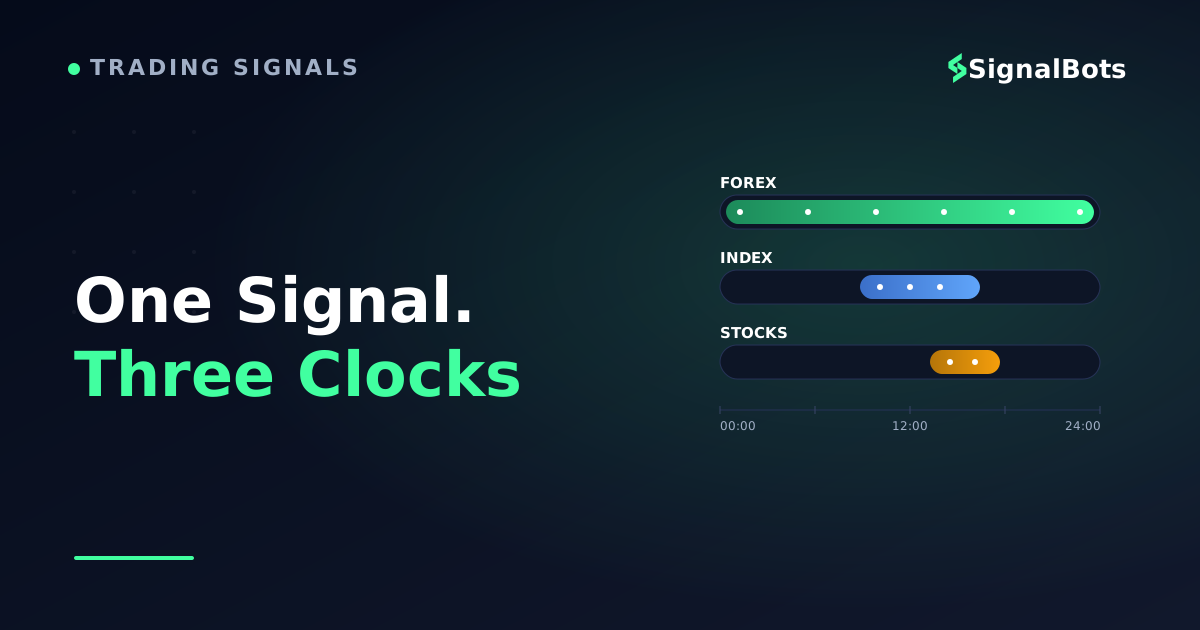
Forex is quotable almost continuously and produces the most alerts, the US500 clusters around the New York cash open (and may or may not quote overnight, depending on whether your broker references the cash index or the future), and single stocks exist only inside one exchange session.
Choose on your own available hours first, single-headline risk tolerance second, and payout arithmetic third — a lower payout demands a higher hit rate for the same expectancy.
Bucket your record by asset class from the first trade; a blended win rate across three classes mixes incompatible payouts and pace into a number that describes nothing.
Table of Contents (26 min read)Contents
What "Binary Options Signals by Asset Class" Actually Means
The contract does not change with the asset. A binary options signal names a symbol, a direction and an expiry, and the position behind it resolves the same way no matter what is underneath: price is above or below the strike when the clock stops, and the return was fixed before you clicked. Swapping EUR/USD for Apple does not give you a different product.
What changes is everything the underlying drags along with it. Four variables move together, and the asset class decides all four for you before you have made a single trading decision:
Availability window — the hours the symbol is quotable at all. This is set by the market that prices the underlying, not by your willingness to trade.
Volatility driver — what actually makes the price move. A currency pair answers to two central banks; a stock answers to one company; an index averages hundreds of companies into something that reacts mostly to macro.
Signal pace — how many alerts a source produces per session, and how they cluster. Pace determines how quickly you accumulate enough trades to judge the source at all.
Payout and board depth — the payout percentage printed next to the symbol, and how many symbols in that class your broker actually lists. Payout is not cosmetic: it sets the hit rate you need before the maths works.
One caveat before the survey, because it trips up more traders than any of the above. Your broker's asset board is the real gate, not the underlying market. Binary brokers quote their own prices against their own hours. Two platforms can both list "US500" and mean different reference prices with different closing times; one can offer synthetic weekend variants of a pair while another goes dark on Friday evening. Everything below describes how these asset classes behave structurally. Confirm the specifics against the board you actually trade on.
The three asset classes covered in depth here are forex pairs, individual stocks and the US500 index. Most boards also carry metals, oil and a handful of crypto symbols, which get their own short section further down.
Forex Binary Options Signals
Forex is the default asset class for binary signals, and the reason is structural rather than fashionable: it is the only one of the three that is quotable almost all the time. Currency trading rolls continuously from the Sunday-evening open in Asia-Pacific to the Friday close in New York, so a feed pointed at the majors can fire in your morning, your lunch break or your evening without you rearranging your life around one exchange's bell.
Coverage on a typical board runs from the majors through the crosses and out to a thinner tail of exotics — the major, cross and exotic pairs distinction matters here because signal quality tends to thin out with liquidity. A source that alerts on EUR/USD, GBP/USD and USD/JPY is working with deep, continuously priced markets. The same logic applied to an exotic pair produces alerts on a symbol that can move erratically on very little flow, and where your broker's payout is often lower to compensate.
What actually drives a forex signal is the interest-rate story on both sides of the quote. Every pair is a ratio of two economies, so it reacts to two central-bank calendars, two inflation prints and two sets of employment data. That gives forex a rhythm the other asset classes do not have: activity concentrates around the handovers between the Asia-Pacific, European and North American trading sessions, with the European-to-North-American overlap the busiest stretch of the day for the majors. The exact hour-by-hour map of those sessions belongs to the forex-specific guides; what matters at survey level is simply that the ribbon thins overnight without ever fully closing.
For signal pace, that adds up to the highest alert frequency of the three classes. The market is open longest, the short timeframes binary traders live on generate the most setups, and the biggest boards list the most currency symbols. If your problem is that you cannot get enough trades to judge a feed, forex is the class that solves it. If your problem is that you take too many marginal trades, forex is the class that makes it worse.
One practical note before moving on. Forex is also where synthetic and over-the-counter variants are most common, so it is the class most likely to keep producing signals when every real exchange is shut. When you want the full asset-class treatment — session-by-session timing, spread behaviour, which pairs suit which expiry — that belongs to the dedicated guide on forex binary options signals rather than this survey.
Stock Binary Options Signals
Individual equities behave almost nothing like currencies on a binary board, and the differences all trace back to one fact: a stock only exists while its listing exchange is open.
Start with coverage, because it surprises people. A binary broker does not list the stock market; it lists a shortlist. You will typically find a few dozen large, heavily traded names — the household US technology and consumer companies, sometimes a handful of European or Asian blue chips — and nothing else. There is no mid-cap tail, no sector you can rotate into, no way to follow a signal on a name your broker has not chosen to quote. The board is short by design, because the broker has to price and hedge every symbol it prints.
The availability window is the harder constraint. US equities trade in one block during the New York day, which lands in the afternoon and evening for most of Europe, Africa and the Middle East, and overnight for Asia-Pacific. Binary brokers rarely quote the pre-market and post-market extensions that exchanges themselves run, so in practice a stock signal reaches you inside a single narrow slice of the twenty-four hours. If that slice is when you are at work, stock signals are not a preference you are declining — they are structurally unavailable to you.
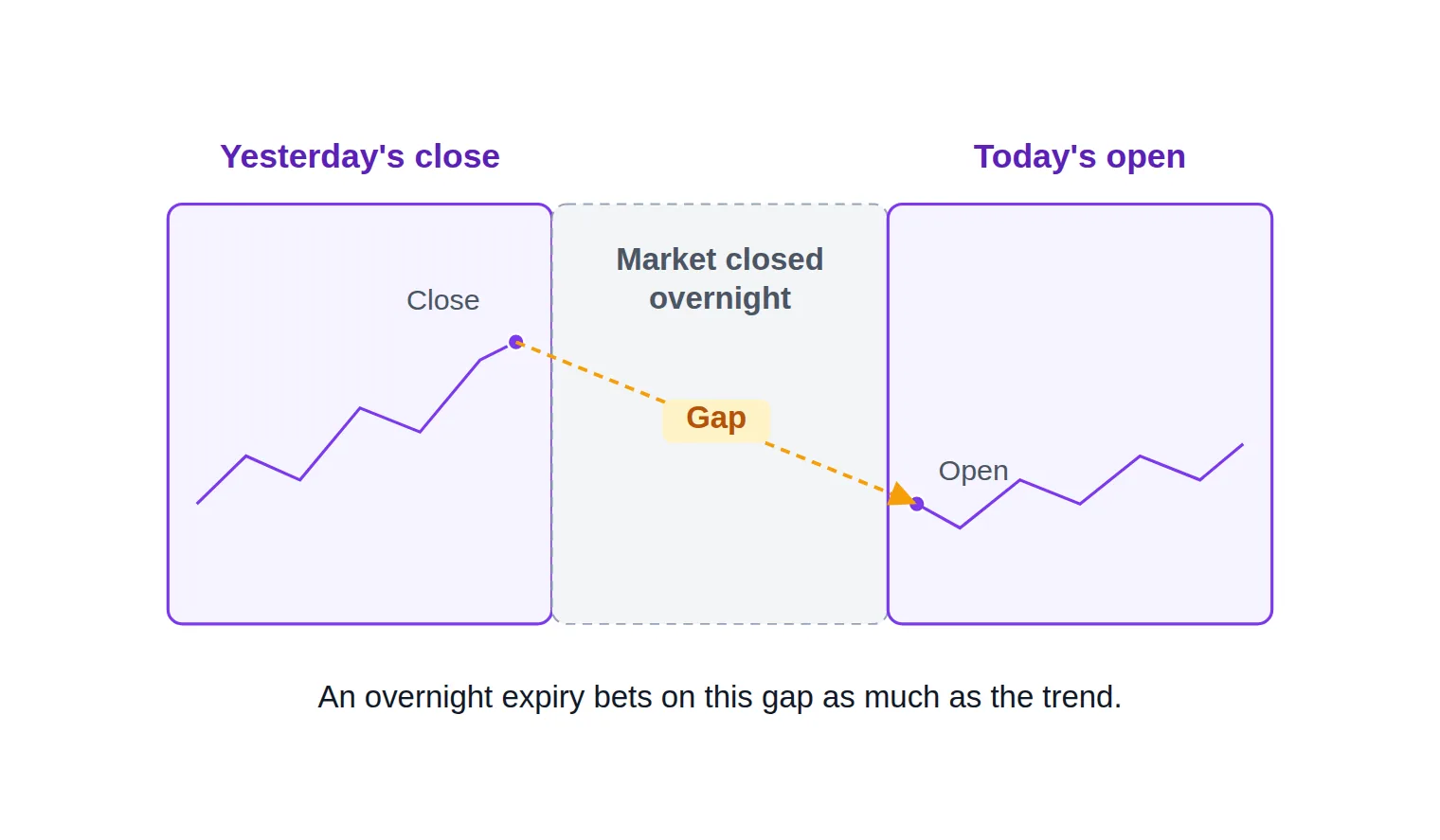
What moves a stock is company-specific news layered on top of the market's general direction: earnings, guidance, a product announcement, a regulatory decision, an analyst downgrade. This is a genuinely different risk shape from forex. A currency pair rarely reprices by a large step on one headline; a single stock does it routinely, and it does it outside trading hours. That creates the defining hazard of the class — the price gap. A position that looks fine at yesterday's close can open somewhere entirely different the next morning, and an overnight expiry time on a single name is a bet on a gap as much as on a trend.
Overnight, a single stock can jump straight past yesterday's close — a gap forex and the index rarely produce.
Signal pace is correspondingly low and lumpy. Alerts cluster in the first hour after the open and again into the close, thin out through the middle of the session, and stop completely for the rest of the day. Payouts on single names are also often set below what the same broker prints on the majors, reflecting the thinner book the broker is hedging. That combination — fewer trades, lower payout, event-driven gaps — makes stocks the least forgiving of the three classes to learn on, and the most rewarding once you have a reason to be in a specific name. The dedicated guide to stock binary options signals is where the earnings calendar, the open-and-close pattern and single-name selection get worked through properly.
Index Binary Options Signals (US500 / S&P 500)
The index sits between the other two, and it is the class where a definitional question has to be answered before anything else makes sense.
When your broker lists "US500", it is quoting a derivative of the S&P 500 — the benchmark that tracks the largest US listed companies — but not necessarily the same derivative your neighbour's broker is quoting. Some platforms reference the cash index, which is only calculated while the underlying shares are trading, so the symbol goes dark outside the New York session. Others reference the index future, which trades nearly around the clock on weekdays, so the same ticker keeps producing prices overnight. The difference between a cash index and a futures-based index instrument is the single most useful thing to check before you follow index binary options signals, because it decides whether your feed can reach you at all outside the afternoon.
Same ticker, different clock
Cash-referenced US500 vs futures-referenced US500
Cash-referenced US500
Prices only while the New York cash session is open
Goes dark for the rest of the day
Mirrors the S&P 500's own close-to-close moves
Live for one afternoon window
VS
Futures-referenced US500
Keeps quoting through nearly the full weekday clock
Still prices during the European morning and Asian evening
Can still gap around the cash open even though it never stopped
Live most of the weekday
Two brokers can both quote "US500" and mean two different trading clocks — confirm which one before you trust the hours.
Behaviourally, an index is an average, and averaging is the whole point. One company's disaster is diluted by hundreds of others, so the index does not gap on a single earnings report the way its constituents do. It responds instead to macro: rate decisions, inflation prints, employment data, broad risk sentiment. The result is price action that tends to be smoother and more persistent than a single stock, without the two-sided central-bank tug-of-war that gives currency pairs their choppiness. For a binary trader, smoother matters — a fixed expiry needs the move to still be in place when the clock stops, and an index gives a directional push more room to hold.
Pace is moderate and heavily concentrated. The hour around the New York cash open is where index signals cluster, with a secondary burst into the close; on a futures-referenced symbol, the European morning produces a thinner but real stream. Payouts on the main index symbols usually sit closer to forex majors than to single stocks, because the underlying is liquid and the broker's hedge is straightforward. Getting those alerts delivered into a charting platform rather than read on a page is a separate job with its own setup guide, and the deeper treatment of US500 binary options signals — expiry selection, index-specific news handling, cash-versus-futures behaviour — lives in that asset's own article.
Where Do Commodities and Crypto Fit?
Three asset classes is not the whole board, and pretending otherwise would misdescribe what you will actually see when you log in. Most binary brokers also quote gold and silver, crude oil, and a handful of crypto pairs, and each has a distinct availability profile: metals and oil follow their futures markets with a short daily maintenance break, while crypto is the only underlying on the board that prices genuinely seven days a week.
Crypto's weekend availability is worth one extra sentence, because it explains why some feeds go quiet on Saturday and others do not. Weekend coverage otherwise depends on whether your broker offers synthetic instruments — weekend OTC trading products are broker-generated series designed to keep a board live when the underlying markets are closed, and they behave differently from the weekday symbol of the same name.
This cluster goes deep on forex, stocks and the index because that is where the comparison question actually gets asked. Metals, oil and crypto appear here as an honest inventory of what else is on the board, not as sections this page can serve properly.
Comparing Asset Classes at a Glance
Set the three side by side on the four variables that actually differ, and the choice starts making itself.
Asset class comparison
Dimension
Forex majors
US500 index
Single stocks
Availability window
Near-continuous, Sunday evening to Friday close
Cash hours only, or near-24h if futures-referenced
One weekday session, roughly 13:30-20:00 UTC
Volatility driver
Two-economy interest-rate story
Macro data and broad risk sentiment
Company-specific news and earnings
Signal pace
Highest, spread across the full day
Moderate, clustered around the cash open
Lowest, bunched at the open and close
Payout and board depth
High, deepest symbol list
High on the main index tickers
Lower, thin symbol shortlist
Same binary contract, four structurally different environments — match the row to your week before you match a strategy to it.
Two things the cells cannot say are worth adding, because they decide how much weight each row should carry.
The first is that only availability can rule a class out. The other three rows describe what an asset class is like to trade; that one decides whether you can trade it at all. The index row hides a useful split — a cash-referenced US500 keeps stock hours while a futures-referenced one runs close to the full weekday clock — but single stocks offer no such escape hatch, so if your free hours never reach the New York afternoon, that column is closed to you however attractive the rest of it looks. Pace, by contrast, is easy to over-weight: a feed that fires constantly is not better than one that fires selectively, it just gets you to a readable signal frequency and hit-rate picture sooner.
The second is that the payout row quietly rewrites the arithmetic of every other row. Because the payout fixes what a winning trade returns, a lower one raises the hit rate you need simply to break even — so a stock feed and a forex feed with the same strike rate are not equally good outcomes, and comparing them as though they were is where self-assessment usually goes wrong. A blended historical win rate across three asset classes is close to meaningless for the same reason: it folds different payouts, different pace and different volatility regimes into one number that describes no situation you will ever be in again. Bucket your record by asset class from the first trade, or you will spend months unable to tell which part of your approach is working — and when you compare the moves themselves, a stock's average daily range only means something next to a currency pair's once you normalise for what a "normal" move is on each.
Which Asset Class Should You Follow First?
Pick with three questions, in this order. The first one is a hard filter; the other two are preferences.
1. When can you actually be at the screen? This eliminates more options than anything else. If your available hours fall outside the New York afternoon, individual stocks are off the table — not a bad choice, an impossible one, because the symbols are not quotable when you are free. If your window is the European morning, forex is the obvious fit and a futures-referenced index symbol is the second. If your window is the New York afternoon, all three are open to you and you can choose on the next two questions instead.
2. How much single-event risk do you want to carry? A fixed-expiry position cannot be adjusted once it is open — there is no stop to trail and no size to reduce mid-flight. That makes the shape of a bad outcome more important than usual. A single stock can be reset by one announcement; an index absorbs the same announcement into an average; a currency pair reprices on scheduled macro events you can see coming on a calendar. If you would rather manage a knowable calendar than an unknowable headline, the index and the majors are the calmer places to start.
3. Does the payout maths work at the hit rate you can realistically sustain? Binary payouts translate directly into a break-even threshold, and the reward-to-risk ratio on a fixed-return contract is set by the board, not by where you place a stop. Take the payout your broker prints on the symbol you are considering, put it into the calculator below alongside a hit rate you have actually sustained, and read the threshold it returns before you follow a single alert on it. A class that pays less needs you to be right more often for the same expectancy, and that is a fact about the instrument rather than a fact about the signal source.
Payout math
Break-even win rate by payout
Enter the payout your board prints on the asset class you're considering, then compare it with a win rate you can realistically sustain.
Payout on a winning trade
Win rate you expect to sustain
Break-even win rate needed
—
Margin above break-even
—
A lower payout demands a higher hit rate for the same result — check the threshold before you follow the next alert.
The figure it returns is a floor rather than a target: it is what you have to clear simply to come out level, and it shifts every time the payout does. The same arithmetic sits on its own break-even win rate calculator page if you would rather keep it open beside your broker's board.
For most people arriving at this page, the honest default is a currency major. Not because forex is superior, but because it removes the two obstacles that stop new signal-followers from learning anything: it is available when you are, and it generates enough trades that you reach a usable sample size in weeks rather than quarters. The index is the natural second, especially if you can be at the screen for the New York open. Single stocks are worth adding when you have a specific reason to be in a specific name and can be present for its session.
Whichever you pick, commit to one class and a small number of symbols for a fixed run of trades before you judge anything, and keep the stake per trade small enough that the run itself is survivable. Every asset class on the board can lose money, and a fixed-return contract loses the whole stake when it finishes out of the money — read the risk warning before you put real capital behind any signal feed.
See Live Binary Options Signals Across Asset Classes
The differences above are much easier to believe once you have watched them. If you sit with a live feed for one full session, the pace gap between a currency major and an index symbol is visible without any analysis: one keeps producing alerts through the European morning while the other stays quiet until New York wakes up, and both go silent at points where a stock symbol would not even be quoted.
Our binary options signals page is where you can do that in one place. It shows current signals across currency pairs, index symbols and commodities — the same signal object, direction, expiry and symbol, pointed at different underlyings — and it is free to view without an account, so you can compare the behaviour of two asset classes side by side over a session before committing your attention to either.
Two boundaries worth stating plainly. It is a feed for watching and reading, not a platform setup guide: if what you want is index or forex alerts delivered into MetaTrader rather than displayed on a page, that is the binary options connector's job, not this page's. And it does not replace the per-asset guides linked throughout this article — watching a symbol tells you its pace, but not its news calendar, its expiry conventions or its session quirks.
The Comparison, Boiled Down
Binary signals cover the same contract on every underlying; what the asset class decides is when the alert can reach you, what kind of move it is chasing, how many of them you will see, and what a correct call pays. Forex gives you availability and volume, the index gives you smoother macro-driven moves in a concentrated window, and single stocks give you event-driven opportunity inside one session with the least room for error.
Choose on your own trading hours first, your tolerance for single-headline risk second, and the payout arithmetic third. Then stay in that one class long enough to have a record worth reading — and follow the asset-specific guide for whichever class you picked, because everything this page deliberately left out lives there.
FAQ
Does a binary options signal mean the same thing on every asset class?
The signal object is identical — symbol, direction, expiry — and the contract settles the same way whether the underlying is a currency pair, a stock or an index. What differs is the context you must read it in. A five-minute call on a major during the European–North American overlap sits in continuous, deep liquidity; the same five-minute call on a single stock ten minutes before its exchange closes is a very different proposition, because the market that prices it is about to stop. Same alert format, different surrounding conditions.
Can I follow stock binary signals outside US market hours?
Generally no. Binary brokers quote individual equities while the listing exchange's main session is running, and most do not extend into pre-market or post-market trading even where the exchange itself does. Some platforms offer synthetic weekend or off-hours instruments, but those are broker-generated series rather than the real stock, and they do not behave like the weekday symbol. If your available hours never overlap the New York session, plan around forex and index symbols instead of trying to force stock coverage.
Is the US500 on my broker the same as the S&P 500 index?
It tracks it, but it is not it. You are trading your broker's quoted instrument, which references either the cash index or the index future. That choice determines the symbol's trading hours, whether it prices overnight, and how it behaves around the New York open and close. Check which reference your platform uses before you assume a signal will reach you outside the cash session — it is the difference between a symbol that is live for most of the weekday and one that is dark for two-thirds of it.
Which asset class has the best payouts for binary options?
Boards vary too much for a universal answer, but the pattern is consistent: the most liquid symbols — the currency majors and the headline index tickers — usually carry the highest payouts, and single stocks and thin exotic pairs usually carry lower ones. The useful move is not to hunt the highest number, but to take the payout on the symbol you actually want to trade and calculate the hit rate it requires. A higher payout on a class you cannot watch is worth less than a slightly lower one on a class you can.
Should I follow signals on more than one asset class at once?
Not at the start. Following two or three classes simultaneously spreads a fixed number of trades across incompatible payout structures, session windows and volatility regimes, which leaves you with a blended record that cannot be interpreted. Run one class until you have a meaningful sample, keep the record bucketed by symbol, and only add a second when you can state clearly how the first one performs. Diversification across asset classes is a portfolio idea; on a fixed-return contract with a short expiry, it mostly just delays your learning.
Do all binary brokers offer the same asset classes?
No, and the gaps are wider than most comparison pages suggest. Symbol lists, quoting hours, weekend availability and payout schedules are set by each platform, and regulation shapes them further — several jurisdictions restrict or prohibit the sale of binary options to retail clients entirely, so what is available to you depends on where you are as well as who you sign up with. Read the asset board of the specific platform you use rather than assuming the general picture applies to it.
Sources & Further Reading
Want to go deeper? These independent, authoritative sources shaped this guide — each one is worth reading in full:
The Binary Options Desk is the SignalBots editorial team for fixed-time and OTC trading coverage. We research and write the guides that explain expiry timing, payout structure and disciplined entry across the major brokers.



Discussions 0
Leave a comment