A message lands on your phone: GBP/USD, PUT, five minutes. Nothing else. Do you take it? A forex binary signal is a live countdown, not a standing recommendation — every second between issue and read shortens the trade you're actually taking.
Most guides to binary signals answer that question for "assets" in general, with currencies as one bullet somewhere between stocks and crypto. Currencies do not behave like one bullet. They trade around the clock five days a week, they price one economy against another rather than one company against its market, and their liquidity arrives in waves that follow which financial centres happen to be awake. Those three facts change what a currency signal is actually claiming — and when it is still worth acting on.
This is the forex layer of the subject: what binary options forex signals are, how they get built, which pairs you will genuinely see in a feed, and how to read one field by field before the clock runs out on you.
Key Takeaways
A forex binary signal is three fields — pair, direction, expiry — and the expiry timestamp matters more than the direction call, because a signal read late is a shorter contract than the one that was analysed.
Currencies trade 24/5 in session waves, so the same five-minute expiry is a different bet in a quiet Asian hour than in the London–New York overlap.
The payout sets the win rate you need: at an 80% payout you must win better than five of every nine trades just to break even, so judge a feed over a sample, never over one trade.
Table of Contents (26 min read)Contents
What Are Binary Options Forex Signals?
A binary options forex signal is an alert that names three things — a currency pair, a direction, and a deadline. "USD/JPY, call, expires 13:45 UTC" is a complete signal. Everything else a provider adds is helpful context, not the signal itself.
Notice what is missing compared with a spot forex signal: no lot size, no stop loss, no take profit, no price target. A binary contract resolves into one of two outcomes at a fixed moment, so the analysis behind it only has to be right about which side of a reference price the pair sits on when the clock hits zero. That is why the whole thing compresses into a call or put plus an expiry time.
Four traits separate a currency signal from a stock, index or crypto one:
The market runs 24 hours, five days a week. There is no opening auction and no closing bell to anchor the day — just a continuous tape whose character changes by the hour. A signal issued at 02:00 UTC and one issued at 14:00 UTC are drawn from two very different markets, even on the same pair.
Every quote is a relationship, not a price. EUR/USD is the euro measured in dollars. A dollar story moves every USD pair at once, so a signal on one pair is implicitly a statement about two economies, and often about a whole basket of look-alike pairs.
The catalysts arrive on a published schedule. Rate decisions, inflation prints and employment reports land at minutes everyone knows in advance, which you can read off an economic calendar before the session starts. An index binary reacts to earnings you cannot time to the second; a currency binary reacts to a timetable.
Weekends are a different instrument. When the interbank market closes, platforms that keep quoting currencies do it from a synthetic weekend OTC feed with its own behaviour. A model tuned on weekday sessions does not automatically transfer to it.
Nearly everything you will see on a currency feed is a plain high-low contract: does the pair finish above or below the reference price. One-touch variants exist — price only has to trade through a level once before expiry — and they change the analysis enough that they are their own topic. This page stays on what makes the forex flavour distinct rather than re-teaching contract mechanics. One practical note before anything else: retail access to binary options is restricted or prohibited in several jurisdictions, the EU and the UK among them, so what you can trade depends on where you live and which venue is quoting you.
How Forex Binary Signals Get Generated
A spot forex model asks two questions: which way, and how far. A binary model asks a narrower one: which side of this reference price will the pair be on at 14:35? Distance only matters through the odds it changes. That single difference is why volatility enters a currency binary model through time — how much ground this pair can plausibly cover before the deadline — rather than through a profit target.
Three families of logic produce the signals you see, and most live feeds blend them:
Rule-based technical models. A defined condition set fires the direction call: a rejection at the prior session high, a stretch beyond a volatility band, a momentum flip on the working timeframe. Transparent, easy to audit, brittle when the market's character changes.
Statistically trained models. Trained on how a pair has behaved in comparable conditions, these output a probability that it closes on one side at a given horizon, and publish only when the probability clears a threshold. This is where a confidence score on a signal usually comes from.
Discretionary analyst calls. A human reads the session and publishes a view. Slower, fewer signals, and the reasoning is often the most instructive part.
What makes the forex version distinct is the inputs those engines weigh. The pair's typical movement in this hour of the day matters far more than its average daily range, because a Tokyo hour and a London–New York hour are not interchangeable units of the same day. So does the distance to the nearest level that has recently held, whether today's move is a dollar story or a cross story, and how close the expiry sits to a scheduled release.
You cannot audit anyone's model, so judge the output instead. A meaningful claim states a historical win ratealongside the payout it was measured at, over a sample large enough to mean something. A win rate quoted with no payout context is half a number, and a backtest whose rules differ from the live feed is a different product being described.
Which Currency Pairs Show Up in Forex Signal Feeds
Majors carry most of the traffic: EUR/USD, GBP/USD, USD/JPY, USD/CHF, AUD/USD, USD/CAD and NZD/USD. They are quoted continuously through every session, their reference prices agree closely across venues, and platforms usually post their best payout tables on them. The major, cross and exotic split is worth internalising, because it maps almost directly onto how reliable a short-expiry signal on that pair tends to be.
EUR/USD is the pair most feeds publish most often, and it behaves specifically enough that EUR/USD-specific signal timing deserves separate treatment. Here it is simply the reference case: the deepest book, the most orderly reaction to dollar news, and the pair against which the others look either faster or thinner.
Crosses — EUR/JPY, GBP/JPY, EUR/GBP, AUD/JPY — pair two non-dollar economies, so they can trend while the dollar itself goes nowhere. That makes them useful during the Tokyo-to-London hand-off, when European desks price overnight Asian news. Yen crosses in particular carry the widest ranges, which cuts both ways: more room for a directional call to work, and more room for it to be stopped out by noise it never had time to recover from.
Exotics show up rarely, and usually should. Thinner quoting, wider disagreement between venues on where the reference price is, lower payouts, and moves that gap rather than travel — a five-minute contract on a thin exotic is closer to a coin toss with a fee attached than to a trade.
Set the three categories side by side and the pattern is hard to miss: everything a five-minute contract depends on thins out as you move away from the majors.
Pair by pair
Pair type
Liquidity
Price agreement across venues
Short-expiry fit
Majors (EUR/USD, GBP/USD…)
Deepest, continuous every session
Very close
Best fit
Crosses (EUR/JPY, GBP/JPY…)
Solid, thinner than majors
Close, small hand-off gaps
Workable — wide ranges cut both ways
Exotics
Thin, gaps rather than travels
Venues disagree more
Avoid on short expiries
Majors keep the reference price close enough across venues for a five-minute contract to mean something. Exotics rarely do.
One caution the pair list makes obvious: three signals arriving together on EUR/USD, GBP/USD and AUD/USD are frequently the same dollar bet wearing three costumes. Treat them as one position for sizing purposes, which is exactly what a correlated exposure cap is for.
Anatomy of a Forex Binary Signal, Field by Field
Formats differ by provider, but the useful fields do not. Here is one written out the way a feed would publish it — an illustrative example, not a live call:
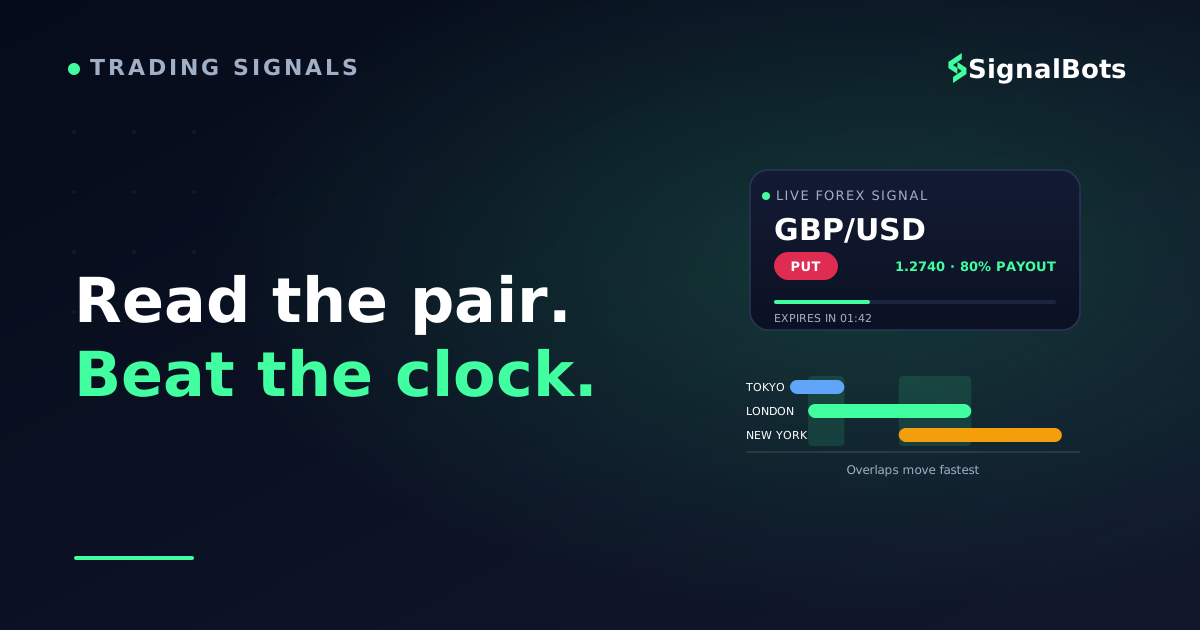
Pair: GBP/USD
Direction: PUT
Reference price: 1.2740
Issued: 14:28 UTC
Expiry: 14:35 UTC
Payout quoted on the platform: 80%
Reason tag: rejection at prior session high, London–New York overlap
Read field by field, that compact block says a great deal — and the anatomy of a signal is where most avoidable mistakes get made.
Pair. Confirm your platform quotes the same symbol from a comparable source. Broker feeds disagree by fractions of a pip during the week, and by more than that on weekend OTC pricing, which matters when the whole trade hinges on one side of one number.
Direction. A PUT is a claim about position at expiry, not about a collapse. The contract finishes in the money if the pair sits a single pip below the reference at 14:35 and nowhere near it in between. Judging a binary signal by how far price moved is judging the wrong thing.
Reference price. This is the number the outcome is measured against. If you enter at 1.2733 instead of 1.2740, you have not taken the signalled trade — seven pips of your margin for error are already gone, and on a five-minute contract that margin was the whole edge.
Issued and expiry — two timestamps, not one duration. "Five minutes" counted from the provider's issue time is not five minutes from the moment you read it. If four of the seven minutes are already spent, you are taking a three-minute contract on a seven-minute thesis. This is the single most common way a good feed produces bad trades, and why a stale signal should be skipped rather than salvaged.
Payout. The payout percentage decides how often you have to be right, and it moves by pair, hour and expiry length. It belongs in the read, not in the fine print.
Reason tag. Optional, and the most educational field on the card. Logged over time it tells you which conditions this feed reads well and which it does not — information no aggregate win rate can give you.
That payout field deserves its own arithmetic. An 80% payout means a $100 stake returns $80 on a win and costs $100 on a loss: you are risking a full stake to win a fraction of it, a reward-to-risk ratio below 1:1, so the win rate has to carry the account by itself.
Breaking even at 80% takes slightly better than five wins in every nine; at a 70% payout it moves towards three in five. Put your own platform's number into the calculator below — the break-even threshold it returns is the bar any feed you follow has to clear before it has done anything for you at all.
Do the math
Break-even win rate calculator
Enter your platform's payout to see exactly how often you need to win just to break even.
Platform payout
Stake per trade
$
Break-even win rate
—
Reward-to-risk ratio
—
Payout on a win
—
Move the slider to your own platform's payout — the win rate readout is the bar that feed has to clear before it has done anything for you.
Each field also prompts one specific action, which is the field-read in six lines: the pair tells you which symbol and feed to verify; the direction asks whether you agree with the side, never the size; the reference price must be compared with your live quote before you click; the expiry must have enough time left to still fit the thesis; the payout converts into the win rate you would need; and the reason tag goes in your log so the next hundred signals teach you something.
Why Session Overlaps Change Forex Signal Timing
The forex week opens as Asia-Pacific desks arrive and closes at the New York close on Friday. In between, four trading sessions hand the book to one another — Sydney, Tokyo, London, New York — and the two places where they overlap are where short-expiry currency signals change character.
Session timing
FX sessions and their overlaps (UTC)24-hour clock · times in UTC
UTC timeline
SydneyAEDTTokyoJSTLondonGMT/BSTNew YorkEST/EDT
21:00–24:0021:0000:00–6:00–6:00
0:00–9:000:00
7:00–16:007:00
12:00–21:0012:00
000306091215182124
Tokyo + London7:00–9:00 UTC · Europe prices Asia's overnight news
London + New York12:00–16:00 UTC · Heaviest order flow of the day
Sydney
Tokyo
London
New York
Overlap (peak liquidity)
The London-New York overlap (12:00-16:00 UTC) is the busiest window of the day; the short Tokyo-London hand-off before it is where yen crosses wake up.
The Tokyo-to-London hand-off is the first. Asian ranges are often narrow, and European desks arriving with the overnight news are the ones who break them. Yen crosses wake up here.
The London–New York overlap is the big one: both centres active at once, the heaviest order flow of the day, and price that both travels further and reverses faster than at any other hour.
Here is why that matters more for binaries than for spot trading. A binary contract only needs price on one side at one instant, so calm hours and busy hours favour opposite signals. In a quiet Sydney hour, a pair pinned inside a narrow band makes "still above the reference in five minutes" a comparatively easy call and "breaks away from here" a hard one. During the overlap, the same five minutes can cover enough ground for either outcome — good for momentum calls, unkind to anything that needs price to sit still.
The practical translation: expiry length is not a personal preference, it is a function of how much ground the pair typically covers in that hour. A one-minute contract in a dead hour is mostly noise around the reference. The same one minute after a London fix or a data release is a different instrument entirely.
Scheduled releases deserve their own rule. A signal issued two minutes before a rate decision is an opinion about a coin flip everybody could see coming, which is why serious feeds pause around events — a news blackout window is a feature, not a gap in coverage.
Finally, mind the clocks. Signal timestamps come in the provider's timezone, and London and New York shift for daylight saving on different weekends, so the overlap moves by an hour in local terms twice a year while staying put in UTC. Work in UTC and the ambiguity disappears.
It is worth knowing how this compares with the rest of the board, because the rhythm is the forex-specific part. An index binary is bound to its exchange's hours and thins out into the close; a crypto binary never closes but never reliably calms down either; a stock binary lives on scheduled corporate events. Currencies sit in between — always open, with a rhythm you can anticipate. How binary options signals by asset class differ beyond that is a map of its own.
How Do You Read and Act on a Forex Binary Signal?
The distance between a good signal and a good trade is about a minute of checking, and everything you are checking answers one of three questions.
Is this still the trade that was signalled? Start with the clock rather than the stated duration: subtract the time already spent since the signal was issued, and if what remains no longer fits the reason it fired, this is a different contract wearing the same label. Then confirm you and the provider are watching the same market — your platform's GBP/USD and theirs are close cousins rather than twins, and on weekend OTC pricing they can be genuinely different animals. Last, hold the live price against the reference. Price that has already travelled in the signalled direction has spent part of the edge before you arrived; price that has moved the other way is a decision to take deliberately, not reflexively.
What does this contract have to clear to pay for itself? Read the payout for that exact pair at that exact expiry, because payouts shift by hour and by contract length and the break-even rate you worked out for one combination does not carry over to another. Then set the stake by a rule that existed before the signal did — a fixed small fraction of the account per contract. Runs of consecutive losses are normal at any honest win rate, and a money-management calculator will show you what such a run does to a stake plan far more convincingly than a paragraph can.
What could overrule the setup before it settles? Scan the calendar for anything landing inside the window: if a release prints before expiry, you are no longer trading the setup, you are trading the release. Then, whichever way it resolves, log it and judge the stream instead of the trade. A single contract tells you nothing about a feed — only a real sample size, measured against the break-even rate its payout implies, tells you whether following it is rational. Every contract can lose its full stake, so read our risk warning before putting real money behind any feed.
Compressed to the seconds you actually have before clicking, those three questions come down to seven checks.
Field checklist
Before you take a forex binary signal
0 / 7
Check what's left of the clock, not the stated duration.
Match the symbol and quote source to your platform.
Compare the live price against the signal's reference price.
Read the payout for this exact pair and expiry.
Size the stake by a fixed rule, not by conviction.
Scan the calendar for any release landing before expiry.
Log the outcome once it settles.
★
Checklist complete — you’re cleared to proceed.
Run it in the seconds before you click — skipping a stale or unchecked signal costs nothing; taking one costs a full stake.
One habit separates disciplined signal-followers from the rest: skipping is free. Letting a signal expire unused costs nothing at all. Taking a stale one, on a pair your platform prices differently, at a payout you did not check, costs a full stake — and it will keep costing one until the habit changes.
Seeing Real Forex Binary Signals Live
All of this reads more easily on a live feed than on a page. Our binary options signals publish each entry with the same fields the worked example used — asset, direction and expiry, laid out the same way — including the major currency pairs, and they are free to view. Watch a handful of currency signals appear and the timestamp lesson lands immediately: the clock is already running the moment a signal exists.
Be clear about the fit. That feed covers every binary-eligible asset class, not currencies alone, so you will be filtering it down to the pairs you actually trade. And it is a feed to read and act on yourself — not an auto-execution tool that places contracts on your behalf.
Where to Go Next for Deeper Forex Signal Coverage
A forex binary signal is a small object — pair, direction, expiry — sitting on top of a market whose behaviour changes by the hour. Read the clock first, the reference price second, the payout third, and the direction call turns out to be the part that needs the least of your attention. Get those three habits right and you can evaluate any currency feed on the market without taking a single trade on faith.
From here, three routes make sense depending on what you are trying to settle. EUR/USD-specific signal timing goes deep on the single most-signalled pair. Free forex binary options signals is the question of what no-cost sources actually hand you before you pay for anything. And binary options signals by asset class is where to go if you are still deciding whether currencies are the right market for the way you trade at all.
FAQ
Are forex binary signals the same as regular forex signals?
No. A spot forex signal has to give you an entry, a stop loss, a take profit and a position size, because your exit determines your result. A binary signal gives a direction and a deadline; the contract itself caps the loss at your stake and fixes the win at the quoted payout, so there is nothing for a stop loss to do.
Which currency pairs suit short expiries best?
Majors, generally — they are quoted continuously through every session and venues agree closely on the reference price, which is what a one-pip outcome depends on. Beyond that, it is more of an hour question than a pair question: the same major behaves very differently in a quiet Asian hour than in the London–New York overlap.
Do forex binary signals work at the weekend?
The interbank market is closed, so any weekend currency quoting on a binary platform is synthetic OTC pricing produced by the venue itself. Signals modelled on weekday session behaviour do not transfer to it automatically, and reference prices can differ more between venues than they ever do midweek.
What win rate does a forex binary feed need before it is worth following?
Whatever its payout implies, plus a margin for costs and mistakes. At an 80% payout, break-even sits slightly above five wins in nine; at 70% it moves towards three in five. Judge that over a large sample of trades and treat any figure a provider quotes as a historical result, never a forecast.
How long should the expiry be?
Long enough for the pair to express the idea in the hour you are actually trading, short enough that the reason for the signal is still true when it settles. A useful test: name what would have to happen for the call to be wrong, then ask whether there is time for that to happen before expiry.
Can I tell whether a signal fired for a good reason?
Only if the feed publishes a reason tag or an equivalent note. Feeds that publish direction and nothing else can still be evaluated, but only statistically, across enough trades to separate skill from a run of luck — which is a slower and more expensive way to learn the same thing.
Sources & Further Reading
Want to go deeper? These independent, authoritative sources shaped this guide — each one is worth reading in full:
The Binary Options Desk is the SignalBots editorial team for fixed-time and OTC trading coverage. We research and write the guides that explain expiry timing, payout structure and disciplined entry across the major brokers.



Discussions 0
Leave a comment