Ten minutes of searching gets you five Telegram channels, two "free VIP" bots and a signals app, all promising more winners than losers, and none of them asking for money. That is exactly what makes the decision hard. When nothing is being charged, there is no price to compare — so there is no obvious way to tell a genuinely useful feed from one that exists to walk you into a broker account.
Free forex binary options signals are not a scam by default. Plenty are honest, a few are genuinely good, and almost all of them are funded by something. That funding is the part nobody explains, and it is what decides how fast the signal reaches you, which instruments it covers, and whether anyone ever admits to a losing call.
This page maps where free signals actually come from, what you trade away by taking them, how to check one specific source before you risk money on it, and how to tell when free has stopped being enough for the way you trade.
Key Takeaways
Every free feed is funded by someone — usually broker referral commissions, a paid upgrade tier, or ads — and that funder shapes the delay, the coverage and the incentives you inherit.
The cost of "free" is paid in timing, silence about losing calls, a narrow instrument list, and no leverage when the channel goes quiet.
Vet one specific source before trusting it: intact timestamped history, outcomes posted for every call, no deposit steering, and 20-30 calls logged on demo first.
Free is genuinely enough while you are learning or trading occasionally; frequency, auditability and automation are what push you to upgrade.
Table of Contents (19 min read)Contents
What "Free" Actually Means for Forex and Binary Options Signals
Start with the uncomfortable question: if a source has something worth having, why is it being handed to strangers?
There is almost always a good answer, and it is rarely charity. Someone pays for every free feed, and who pays shapes what you receive. There are four funding models in circulation, plus one honest outlier.
Who actually pays
Who funds the free feed
What it needs from you
Where the bias shows up
Broker referral commission
Open an account through their link and trade
Rewards your activity, not your results
Free tier of a paid service
Join, get hooked, then upgrade
The free half is deliberately the weaker one
Ads and app installs
Attention, installs, personal data
Volume of alerts beats quality of alerts
The trading platform itself
Keep trading on that platform
Built to sustain engagement, not to be audited
A trader building a reputation
Attention and credit
Genuine, but fragile and easy to abandon
Free is a business model, not an absence of one. Identify the funder and most of the trade-offs become predictable.
The referral model dominates. The provider is an affiliate or introducing broker, paid when you register through their link and trade; their income tracks your volume, not your profit. That does not make the calls bad, but it explains why a free channel can be enthusiastic about frequency and quiet about whether last week's run of trades netted out positive.
The funnel model is the second most common. The free room is the shop window for a paid one, which is the entire premise behind VIP versus free signal tiers: the free calls arrive later, cover fewer instruments, or skip the higher-conviction setups — not through malice, but because a free tier that performed identically to the paid one would have no business existing.
So before you join anything, answer one question: who pays for this, and what do they need me to keep doing? That single answer predicts most of what follows in this article.
Where Free Forex & Binary Options Signals Actually Come From
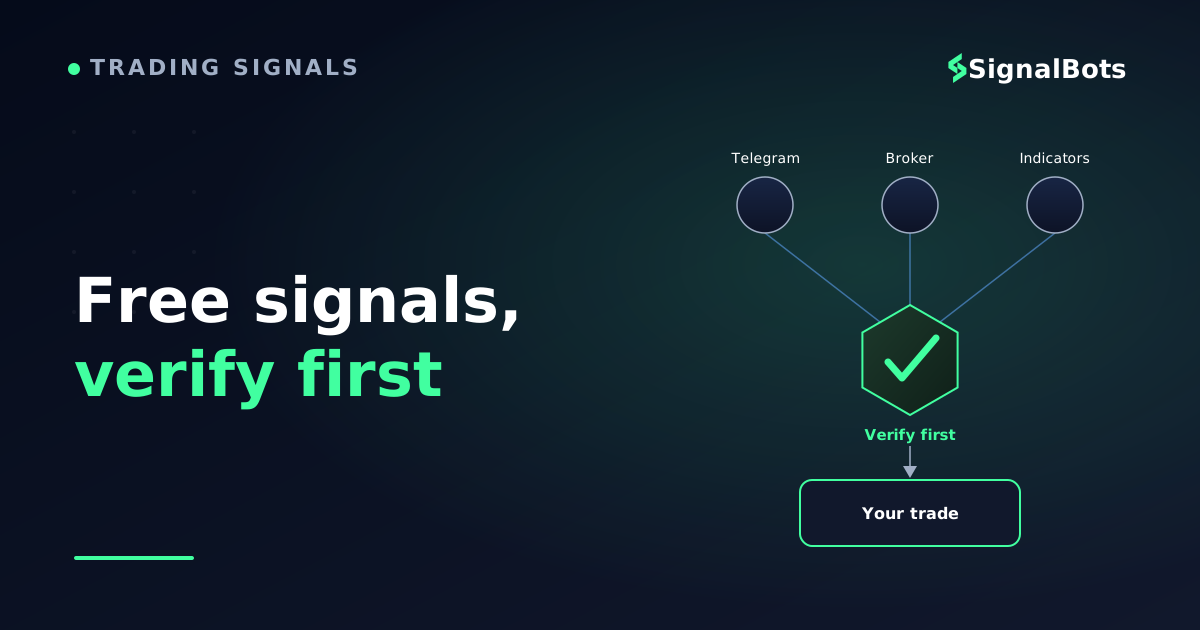
"Free signals" is not one thing. It is three structurally different supply routes that happen to end in the same inbox, and each one fails in its own way. Channels, platform tools and free indicators all end up on the same screen — but they fail in completely different ways.
Telegram and Discord signal channels
This is where most people land first. A Telegram signal channel costs the operator nothing to run, pushes instantly to a phone, and takes one tap to join — which is precisely why it is the default distribution layer for free calls in both forex and binary options.
Quality inside this category spans everything from one disciplined trader posting their own calls with the reasoning attached, to an automated relay firing dozens of alerts a day across whatever instruments pay the best referral rate. A typical post gives you an asset, a direction and an expiry; a good one adds the reference price and the time it was published, which is the minimum needed to reconstruct the trade afterwards.
Two habits are worth noticing before you trust any of them. First, whether the channel posts outcomes at all, or only setups. Second, whether the history is intact — a channel whose losing calls quietly disappear is not a track record, it is a highlight reel. Free binary channels also lean heavily on the OTC market, because those instruments stay open when the interbank market is closed and the price series comes from the platform rather than an exchange.
Discord rooms work the same way with more conversation around each call. The extra chat is genuinely useful for understanding why a call was made — and genuinely dangerous when a room's consensus turns into a pile-on.
Broker-native signal and analysis tools
Trading platforms increasingly give analysis away themselves. Deriv publishes a free market-intelligence view with AI-generated trade ideas, live price context and an economic calendar, open without an account. Most binary platforms ship indicator alerts or a sentiment widget inside the terminal, and MetaTrader carries a built-in signals directory where free providers sit alongside paid ones with their equity curve on display.
These tools are the least deceptive category on this page: nothing is hidden, and the funding is obvious — the platform earns from your trading, so it invests in keeping you engaged and informed. Treat them accordingly. A broker-native tool is a scanning aid built into the environment where you already trade, not an independent verdict on the trade. Nobody is accountable for the outcome, and the instrument list will only ever be the instruments that platform offers.
Free MT4/MT5 indicators and signal apps
The third route hands you the generator instead of the signal. Free MetaTrader 4 and MT5 indicators draw arrows on the chart and fire an alert when their conditions fire; free TradingView community scripts do the same, with the advantage that many are open source so you can actually read the logic.
The trap here has a name: repainting. An indicator that redraws its own history will show a flawless arrow on every past turn and something much less convincing in real time. "Non-repaint" is a claim, not a property — the only way to confirm it is to watch the indicator on live bars and record what it said before the candle closed.
Free signal apps are the weakest link in this group. Many are ad-funded, none explain their logic, and some are distributed as sideloaded APKs outside official stores, which turns a quality question into a security one. No signal is worth granting an unknown app broad permissions on the phone you bank with.
What You Give Up With Free Signals: The Real Trade-offs
Nothing above says free is bad. It says free is conditional. Here is what actually changes when you take the free path, dimension by dimension.
Free vs paid, honestly
What changes when the signal costs nothing
A free source
Often delayed, sometimes deliberately, because the delay is the product difference
Publishes what it chooses to publish, including nothing at all after a loss
Narrower instrument list, usually shaped by the affiliated platform
No leverage if it goes quiet, rebrands or disappears overnight
Costs nothing to test, so you can run several in parallel
Fine to trade on once you have verified it yourself.
VS
A paid source
Charges a fee, which gives it a churn incentive to publish honestly
Usually broader coverage across sessions, pairs and expiries
You can cancel, which is the only real leverage a subscriber has
A fee proves nothing on its own about accuracy or method
Costs money before you know whether it suits your schedule
Worth it when frequency, coverage or auditability is your bottleneck.
Neither column wins outright. The right choice depends on what your trading actually needs from a feed.
Timing is the first cost. A binary contract is judged against a reference price and an expiry window, so a call that reaches you ninety seconds late is frequently a different trade with different odds — a stale signal rather than a late one. Free tiers are commonly delayed on purpose, because that delay is what makes the paid tier worth buying. You can measure this: note the time each call arrives, the price you could genuinely have entered at, and how far that sits from the reference the sender quoted. Two weeks of that log tells you more than any review.
The record is the second cost. Paying gives a subscriber one blunt but real lever — cancellation — and it gives the provider a reason to publish losses, since a member who discovers a hidden losing streak leaves. A free channel has neither pressure. That is why a verified track record is rare among free sources, and why results announced after the fact are worth so little: backdated results are indistinguishable from good storytelling.
Coverage and fit are the third. Free feeds tend to be narrow, and their instrument list bends toward whatever the funding broker offers. If you trade the London open on major pairs and the channel fires mostly during Asian hours on OTC instruments, the feed and your schedule never actually meet — no matter how good the calls are.
And the headline claim is worth almost nothing without context. A historical win rate quoted on its own is not a claim you can evaluate, because in binary options the payout percentage decides how high that rate has to be before the arithmetic works at all.
Break-even win rate — the number any signal claim must clearfx
WBE = 1 ÷ (1 + P)
whereWBE is the win rate you must beat just to stay flat; P is your platform's payout as a decimal. At an 80% payout, P = 0.8, so you need better than roughly 55.6% of contracts to finish in the money. Drop the payout to 70% and the bar rises to about 58.8% — the signals did not change, the maths did.
The same feed can be profitable on one instrument and unprofitable on another purely because the payout differs.
Run your own platform's payout through the break-even win rate calculator before you judge any provider's numbers. On the forex side of the same question, the equivalent context is the reward-to-risk ratio: a free forex signal that wins often but hands back more on each loss than it takes on each win is not the bargain its hit rate suggests.
Finally, there is continuity. A free channel owes you nothing. It can go silent for a month, change its name, sell the audience, or pivot to a different market — and if you built a routine around it, that routine breaks with no notice and nobody to ask.
Is a Free Signal Source Trustworthy? Run These Checks First
Warnings about scams are easy to write and hard to use. What you actually need is a way to sit in front of one specific channel and decide, today, whether it is worth your demo time. Vetting is something you do to one named channel, not a general mood of suspicion.
Do this first
Vetting a free signal source before you follow it
0 / 9
You can name who funds the channel — broker partnership, paid upgrade tier, ads — and it is stated openly rather than hidden.
The history is intact: old calls are still visible, in order, with timestamps.
Outcomes are posted for every call, after expiry, and losing trades are still there weeks later.
Each signal names the asset, direction, reference price and expiry, so you can reconstruct the trade afterwards.
No 'guaranteed', 'risk-free' or 'never loses' language appears in the channel, the pinned post or the bio.
Nobody tells you a specific amount to deposit, and access does not depend on funding one named account.
You have compared its claimed win rate against the break-even rate your own platform's payout requires.
Any companion app comes from an official store, and nothing ever asks for your broker or wallet password.
You have logged 20 to 30 of its calls on demo, at your own execution speed, before staking real money.
★
Checklist complete — you’re cleared to proceed.
Nine checks you can complete before risking a cent. A source that fails several is telling you what it is.
Three failures should end the evaluation immediately rather than lower your rating.
Impossible language. Any channel advertising "risk-free" entries or a "guaranteed" win rate is describing something that cannot exist where the outcome is genuinely unknown. Treat the phrase itself as the finding.
Deposit steering. A referral relationship is normal and not automatically a problem. Being told how much to deposit, or losing access unless you fund a specific account, is a different thing: at that point the deposit, not the signal, is the product.
An uninspectable history. Screenshots instead of posts, edited messages, a channel wiped clean each month — all of it exists to stop you doing arithmetic on the record.
Then do the boring thing that beats every review: forward-test the source for two weeks on a demo account. Log the arrival time, the price you could realistically have entered at, the expiry, and the result. Twenty to thirty calls will not make you certain, but they will show you whether the feed fits your hours, your platform's payout and your reaction speed — three things no third-party rating can answer for you.
When Free Signals Are Enough — and When It's Time to Upgrade
The honest answer to "are free signals good enough" is that it depends far less on the signals than on how you trade. Find yourself below.
Self-classify
Which of these is actually you?
Learning and demo phase
Free is genuinely enough
You are still testing whether signal-following suits your temperament at all.
A wrong call costs you data, not money.
Free volume gives you setups to practise reading and timing.
Your bottleneck is your own process, not the feed's quality.
Occasional live trading
Free, but only after logging
A handful of trades a week on one or two instruments.
One vetted free source, logged personally, can carry this comfortably.
A bad signal costs real money, but the exposure is contained.
Upgrade only when your own log shows the source is the weak link.
Frequent or automated
Free becomes the bottleneck
You need coverage across sessions and instruments, not one burst a day.
Position sizing needs an auditable record, not a claimed one.
Automation needs a structured, timestamped, machine-readable feed.
Silent gaps and delay now cost more than a subscription would.
The upgrade trigger is a change in what your trading needs — not a change in how the free signals feel.
Four things push a trader out of the free tier, and none of them is disappointment. Frequency: you need setups across the sessions you can actually trade, not whenever the channel wakes up. Auditability: you want to size positions against a record you can inspect, not a claim. Coverage: your instruments stopped overlapping with the channel's. Automation: a feed you want to route into a bot or a copier has to be structured and timestamped, which most free channels are not.
Notice that "upgrade" does not have to mean "pay". Sometimes the upgrade is simply moving to a free source that publishes what the last one hid.
Seeing a Free, Transparent Signal Channel in Practice
The abstract point — transparency beats confidence — gets concrete fast when you put two posts side by side. Same instrument, same direction, entirely different accountability.
The opaque version:
🔥🔥 EUR/USD CALL — 5 MIN — SURE SHOT 🔥🔥 90%+ ACCURACY, ENTER NOW
Nothing there can be checked later. No reference price, no publication time, and no follow-up when the contract expires. If it wins, the channel screenshots it; if it loses, the message can quietly disappear.
The second post is not a better prediction. It is a checkable one: you can line the reference price up against your own chart, see whether your fill was realistic, and — crucially — count the losing ones, because they are still on the page next month.
That is the standard we hold our own free channel to. Our binary options Telegram channel is free to join and posts each signal's outcome, so the running record is there to inspect rather than to take on trust. And to be straight about the first question this article asked you to ask: we are funded through broker partnerships, like most free channels are. What differs is not the funding model, it is what gets published afterwards.
Be clear about what that is and is not. It is a delivery channel where you can watch signals and their results accumulate — not an accuracy guarantee, and not automated execution. If you want trades placed hands-off on MT4 or MT5, that is a connector's job, not a channel's. And if your real question is which forex pairs and sessions suit binary signals best, that asset-class picture is a different page from this one.
Bottom Line: Choosing Your Free Signal Source
Free binary options forex signals are a sourcing decision, not a verdict on quality. There are honest free channels and expensive bad ones, and the price tag tells you almost nothing about which is which.
What does tell you something is three questions you can answer in an afternoon: who funds this feed and what do they need from me, can I inspect the record including the losses, and does the timing fit the hours I can actually trade? A source that passes all three is worth two weeks of demo logging. A source that fails the first two is worth nothing, at any price.
If the underlying routine is what you are still building — reading a signal's fields, timing entry against the expiry window, sizing the trade — that is a separate skill from sourcing it, and it deserves its own study. Sourcing is what this page is for: pick carefully, log relentlessly, and let your own record, not a pinned message, decide whether a free feed earns a place in your trading.
FAQ
Are free forex and binary options signals accurate?
There is no single answer, because "free" describes the funding, not the method. Accuracy is a property of the underlying analysis, and the only number that matters is whether the source's real hit rate clears the break-even rate your platform's payout demands. Judge it from a log you kept yourself, over twenty to thirty calls, rather than from a claim in a pinned post — and remember that no source removes the underlying exposure, which is why our risk warning applies to free and paid signals alike.
Why would anyone give away trading signals for free?
Because the signal is not the product. Most free feeds earn a referral commission when you open and fund a broker account through their link, some use the free room as the entrance to a paid tier, and some are ad-funded apps monetising attention. A trading platform's own free analysis is marketing for the platform. All of those are legitimate business models; they simply mean the provider's incentive is your activity, not your outcome.
Do free signals arrive later than paid ones?
Often, and frequently by design — the delay is what makes a paid tier worth buying. For a five-minute binary contract, even a short lag changes the trade you are actually taking, because the reference price has moved. Test it directly: record the arrival time of each call and the price you could genuinely have entered at, then compare that against the reference the sender quoted.
Is it safe to join a free channel that requires a broker deposit?
A referral link on its own is ordinary. Being instructed how much to deposit, or being locked out of the signals until you fund one specific named account, is where it turns: the deposit has become the product. Never let someone else set your deposit size, never fund an unregulated platform, and check that you can walk away from the arrangement without losing anything.
Can I automate a free signal channel?
Technically yes — a Telegram-to-platform relay such as a Telegram-to-MT5 copier can parse structured messages and place trades. Practically, automating a source you have not verified multiplies whatever is wrong with it, because you remove the one filter that was catching the obviously bad calls: you. Verify the feed manually first, confirm every message follows a consistent structure, then automate.
Sources & Further Reading
Want to go deeper? These independent, authoritative sources shaped this guide — each one is worth reading in full:
The Binary Options Desk is the SignalBots editorial team for fixed-time and OTC trading coverage. We research and write the guides that explain expiry timing, payout structure and disciplined entry across the major brokers.



Discussions 0
Leave a comment