The ticket is open, the signal says buy, and two fields are blank. One wants a target price you have never had to name before. The other wants an expiry. On an up/down (high-low) contract, neither question exists — you pick a direction, pick a duration, and the platform does the rest. On a one-touch contract, those two fields are the trade.
That is the gap most one touch binary options signals leave open. A call tells you direction, and sometimes the conviction behind it. It rarely tells you how far price has to travel, or how long you should give it — yet those two choices decide whether a correct directional read actually pays anything.
This page closes that loop. It assumes you already know what a binary contract is and how a signal reads, and it spends its time on the part nobody explains: turning one signal into a specific barrier price, a specific expiry, and a stake you can survive being wrong on.
Key Takeaways
A one-touch contract pays the moment price tags your barrier, so it needs a magnitude and timing read on top of direction — a directional call alone only answers a third of the ticket.
Barrier distance and payout are the same dial: convert any quoted payout into the touch rate it must clear to break even, then decide whether your read on the market honestly beats that rate.
Pick expiry from how long the instrument normally needs to travel that distance, then roughly double it — and check what sits inside the window before you commit.
Wider barriers mean longer losing streaks, so set the stake from the streak you must survive, never from the size of the payout on offer.
Table of Contents (41 min read)Contents
What Makes a One-Touch Contract Different?
A direction-only contract asks one question about one moment: where is price when the clock runs out? A one-touch contract asks a question about the whole path: does price ever trade at a named level, at any point before expiry?
That single change rewrites three things:
You get paid on the touch, not on the close. The instant the barrier prints, the contract is settled in your favour. Price can collapse thirty seconds later and it makes no difference.
Being right is no longer enough. Direction correct, magnitude short — price drifts your way but stops five pips shy of the barrier — is a full loss, identical to being wrong.
You now set three variables, not two. Direction, distance, and time. The platform prices the contract off the last two.
That third point is why a plain directional binary options signal feels incomplete the first time you open a one-touch ticket. It answers one of the three.
The quick self-test before you go further: if your read is "higher by the close" with no view on how far, you want an up/down (high-low) contract. If your read is "this level gets tagged", you want a one-touch. Platforms label it differently — touch/no-touch is common, and many express the barrier as an offset from the current price (+0.0050) rather than as an absolute number — but the mechanic underneath is the same everywhere.
What a One-Touch Signal Needs to Tell You
Before you fill in anything, read the signal for four things rather than one. Most feeds give you the first and imply the rest; the anatomy of a signal is where you find out which.
Direction. Which side of spot the barrier belongs on. This is the only part a directional call gives you outright.
Expected magnitude. How big a move the setup implies — a range breakout that projects the height of the range, a reaction to a level, a continuation leg. This becomes barrier distance.
Volatility context. What this instrument currently covers in a normal session. This is the unit you shop in. A 40-pip barrier is a formality on one instrument and a stretch on another, and only the current volatility reading tells you which.
Timing. Is there a catalyst — a scheduled release, a session open, a level about to be tested — and when does it land? This becomes expiry.
If your signal only carries direction, you supply the other three from the chart. The average true range on the timeframe you are trading is the workhorse here: one ATR is a rough, honest answer to "how far does this thing normally travel in one bar?", and everything below is easier if you express barrier distance in those units instead of in raw pips.
How Barrier Distance Trades Off Against Payout
Here is the mechanic that governs the whole decision. Move the barrier closer to the current price and the payout percentage drops. Push it further away and the payout climbs, sometimes dramatically.
That is not the platform rewarding boldness. It is the platform pricing likelihood. A barrier sitting inside the noise of the last hour will get tagged by accident; a barrier two normal sessions away needs a genuine trend leg. The quoted payout is, in effect, someone else's estimate of how improbable your touch is — and your job is to decide whether you disagree with that estimate.
There is a clean way to make that judgment concrete. Any payout implies a minimum hit rate below which the trade loses money over a long run of attempts. If a payout is quoted as profit on your stake — 150% meaning your stake back plus one-and-a-half times it — then the touch must happen on 100 ÷ (100 + 150) of your attempts, or 40%, just to break even. That is the break-even win rate of a barrier trade, and it is the number the headline payout is hiding.
Check how your platform quotes payout before you use any of these numbers. Some quote profit on stake, some quote total return including the stake. The same headline figure means two different trades.
Barrier reference
Barrier distance
Payout you are quoted
Chance of a touch
The read that justifies it
Close — inside a normal session's range
Lowest
Highest — noise alone can tag it
A directional read on its own is enough
Moderate — about one session's range
Middling
Realistic if the move starts promptly
Direction plus a catalyst, or a level price keeps testing
Far — two or more sessions' range
Highest
Lowest — it needs a full trend leg
Only a volatility expansion you can name and time
Payout and probability move in opposite directions on the same dial. The right column is the price of admission for each row.
Where your barrier lands on that scale decides everything downstream — the payout, the expiry it will need, and the streak of misses you should expect. Put your own numbers against it:
Run your own numbers
What touch rate does this payout need?
Enter the payout the platform quotes for your barrier and expiry, then read the touch rate that payout has to clear before the trade is worth taking.
Quoted payout (profit on stake)
Stake on the contract
$
Account balance
$
Max risk per trade
Break-even touch rate
—
Profit if the barrier is touched
—
Loss if it is never touched
—
Stake your risk cap allows
—
The payout sets the bar; your read on the market has to clear it. A tempting payout is usually a correctly priced improbability.
Now the honest part. The calculator gives you the bar; it cannot tell you whether you clear it. That estimate comes from your signal and the chart: is the barrier inside a distance this instrument routinely covers in the time you are giving it, and is there a reason today should be at least as active as normal? If you cannot articulate why the touch is more likely than the break-even rate, the payout is not generous — it is accurate, and you are the one paying for it.
This is a reward-to-risk ratio decision with the risk fixed. Your downside is the stake, always, whatever barrier you pick. The only thing you are adjusting is how much upside you are demanding and how unlikely you are willing to make yourself.
How to Pick an Expiry Window for the Barrier You Chose
Expiry is not a second, independent field. It is the other half of the same decision, and the question it answers is arithmetic: how long does this instrument normally need to travel the distance I just set?
Work it in three steps.
Convert the barrier distance into range units. If the barrier sits 60 pips away and the instrument's average daily range is roughly 80 pips, you are asking for about three-quarters of a normal day's travel.
Convert range units into time. Three-quarters of a day's range needs, at minimum, most of a session — and only if the move starts promptly and goes one way.
Then roughly double it. Price does not travel in straight lines. It stalls, retraces, and takes half a session to decide. The expiry time you actually want is the minimum travel time plus room for the market to wander on the way.
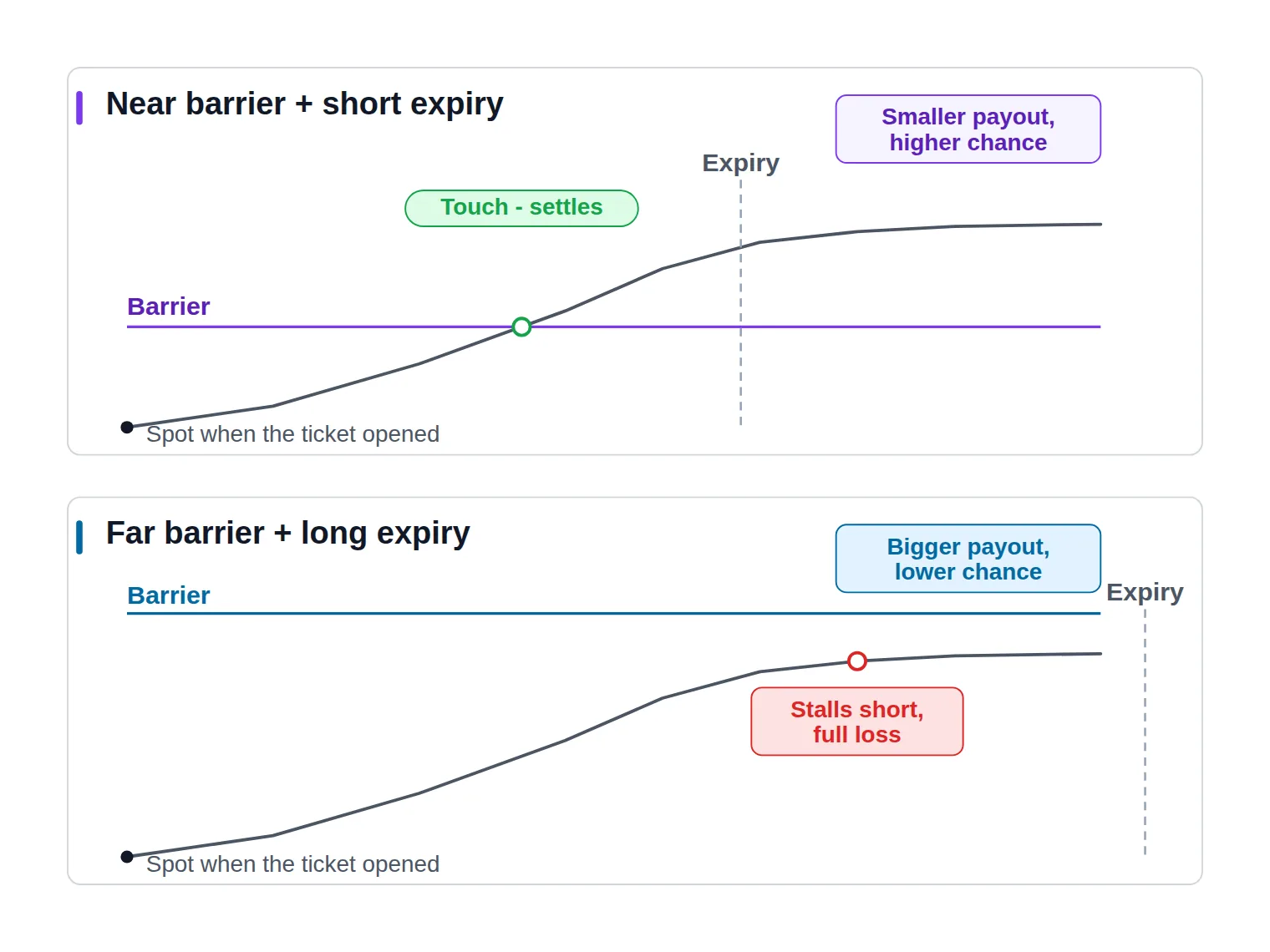
The doubling is not free, and it is worth knowing why. More time means more chances to touch, so the platform prices a longer expiry at a lower payout for the same barrier. Time is the cheapest way to raise your hit rate, and you pay for it in the quote.
One price move, two tickets: the barrier you choose sets the expiry you need, and the payout you are quoted follows both.
Both failure modes are common enough to name:
Expiry too short. The read was right, the move started late, and the contract expired mid-journey. This is the most frustrating one because nothing about the analysis was wrong.
Expiry too long. You paid away payout for hours you did not need, and you left the position exposed to a session or a release you never intended to trade.
Two practical constraints override the arithmetic. Platforms enforce minimum and sometimes maximum durations on touch contracts, so the expiry you want may not exist — in which case adjust the barrier, not your patience. And check what your window actually contains: a session close, a weekend, or a rollover inside the window changes the character of the trade completely, because the hours you are counting on may be hours in which almost nothing trades.
Which Market Conditions Actually Suit One-Touch Signals?
A one-touch contract needs travel. That makes the condition filter simpler than it looks: the setups that suit it are the ones that produce distance in a known direction within a known window, and everything else is better expressed as a direction-only trade.
A dated catalyst on the calendar — the friendliest case, because the move has a start time you can plan an expiry around.
A confirmed breakout with expanding range — expansion is the whole thesis, and the pattern itself projects a distance.
An established trend with steady momentum — workable, but take the modest barrier and the smaller payout; trends deliver ground slowly.
A quiet range, or the contraction that follows a big event — no. There is no travel to buy, and any barrier far enough to pay well is out of reach.
Two conditions deserve extra care.
Scheduled news. A release on the economic calendar is the friendliest case a one-touch trade gets, because it supplies a start time for the move. The trap is the pricing: everyone can see the same calendar, so barriers get more expensive in payout terms as the event approaches, and the volatility that made the trade attractive collapses within minutes of the print. Choose the expiry so that the contract lives through the reaction, not only through the spike.
Breakouts. A breakout strategy fits one-touch naturally, because a genuine breakout has a projected distance built into it — the height of the range, the size of the base. Set the barrier inside that projection rather than past it, and remember that a failed breakout usually reverses before your barrier gets anywhere near.
The same filter holds whichever asset class the signal covers. A major FX pair, an index and gold have completely different range units, so the pip numbers change — the test does not.
Worked Example: From Signal to Strike and Expiry
Take a hypothetical, with illustrative numbers chosen to make the arithmetic visible rather than to describe any real session.
The signal. A bullish call on EUR/USD arrives ahead of a scheduled data release at the London open. Spot is 1.0850. The recent daily range on the pair has been running near 60 pips, and there is a prior swing high at 1.0893 that price has already tested twice.
The barrier read. A barrier at 1.0900 sits 50 pips out — a little under one recent range unit — and, more usefully, it sits just above a level that price is already attracted to. Levels that have been tested twice tend to be tested again, and the touch does not need a new trend, only a third attempt that carries seven pips further than the last two.
The payout read. Suppose the platform quotes 118% for 1.0900 with a next-day expiry. That implies a break-even touch rate near 46%. The wider barrier at 1.0950 quotes 260% — a break-even near 28%, which sounds far more forgiving until you notice it needs 100 pips, nearly two range units, in a single day with no help from structure.
The choice. Take 1.0900, with the expiry set to the following session's close. That is roughly double the time the move needs if it starts on the release, and it covers the possibility that the reaction takes a few hours to resolve.
EUR/USD — barrier at 1.0900 versus the wider 1.0950EUR/USD4H
Illustrative prices. The closer barrier paid on a third test of a known level; the wider barrier, with its far larger payout, was never reached.
What the outcome teaches. The touch happened, the contract settled the moment 1.0900 printed, and the pullback that followed changed nothing — that is the one genuine advantage of a barrier contract over an at-expiry one. The 1.0950 barrier, with more than double the payout, spent the day out of reach. Bigger payout, same stake, nothing back.
And the other branch matters just as much: if the release had gone the other way, the entire stake would be gone with no partial credit. Some platforms let you sell the contract back early at whatever it is currently worth, which recovers a fraction when a trade is clearly not working. Find out whether yours does before you need it, not after.
Sizing Risk for One-Touch's Lower Win Rate
Here is the part that decides whether any of the above survives contact with a real account. A barrier trade at a meaningful distance simply wins less often than a direction-only trade. That is the whole point — you are being paid more precisely because the outcome is less likely — but it means your historical win rate on one-touch tickets will look alarming next to your up/down record, even when the method is working.
At a touch rate around four in ten, a run of six misses is unremarkable. It is not evidence that the market changed or that your read broke. If your stake is sized for a 60% strategy, that ordinary run takes a large bite out of the account, and the damage arrives before the arithmetic has a chance to work.
So size from the streak, not from the payout:
Fix the stake as a small percentage of balance, and let the trade stake fall out of that rather than out of how attractive the payout looks. The more tempting the payout, the further the barrier, the longer the streaks.
Never scale up after a miss. Doubling into a low-probability contract is the fastest version of the same mistake — run the numbers on a risk-of-ruin calculator before you convince yourself otherwise.
Judge the method over a block of trades, not over the last three. A framework with a real edge and a 35% hit rate produces stretches that feel identical to one with no edge at all.
The same one-touch edge, 200 possible sequences
10th–90th percentile bandMedian pathBreak-even
Median return
—
final equity, all paths
Profitable paths
—
finished above start
Worst drawdown
—
deepest peak-to-trough
Risk of ruin
—
hit −25% equity
One edge, many futures. Set the touch rate near 40% and the payout near 1.6x stake, then watch the spread: the median path is mildly profitable while individual runs go deeply underwater first. Size the stake for the band, not for the median.
Drag the risk-per-trade slider and watch what changes: the median outcome barely moves, and the worst paths change enormously. That asymmetry is the entire argument for a small, fixed stake. Binary contracts carry the full loss of the stake on every miss — read our risk warning before trading them with money you need.
See Live Binary Options Signals to Apply This
A framework needs something to practise on, and the most common blocker at this point is not the method — it is having a real, current call in front of you to run it against.
Our live binary options signals feed publishes calls with the direction and the volatility context behind each one, free to view. Take a fresh call, do the work yourself before you touch a ticket: convert the recent range into a barrier distance, read the payout your platform quotes for that exact barrier and expiry pair, and check whether the break-even touch rate is one you honestly clear. Do it on a demo ticket a dozen times and the two blank fields stop being blank.
Be clear about what it is and is not. It is a general binary options signal feed, not a one-touch tool: it does not set your barrier and it does not set your expiry. That judgment — and the ticket itself — stays with you on your own platform. If you want a feed that fills in the barrier for you, no honest feed does that, because the barrier depends on the payout your platform is quoting you at that moment.
Quick Checklist Before You Set a One-Touch Trade
Back to the two blank fields you started with. Barrier distance comes from the signal's magnitude read measured in the instrument's own range units; expiry comes from how long that distance normally takes, doubled; and the stake comes from the losing streak the touch rate implies, never from the payout on offer. Run this before you commit.
Before you press buy
One-touch pre-trade checklist
0 / 8
Confirm the signal gives you a direction AND some read on the size of the expected move, not direction alone.
Measure the instrument's recent typical range on your timeframe and express the barrier distance in those units.
Set the barrier just beyond a level price is already attracted to, rather than at a round number you picked for its payout.
Read the payout quoted for that exact barrier and expiry pair, and convert it into the touch rate it needs to break even.
State out loud why your read clears that touch rate. If you cannot, move the barrier closer or skip the trade.
Give the expiry at least twice the time the move needs, and check what sits inside the window — a session close, a weekend, a release you did not plan for.
Set the stake from your risk cap and your worst plausible losing streak, not from the size of the payout.
Write down what would prove you wrong before you commit: a level that should not break, or a time by which the move should have started.
★
Checklist complete — you’re cleared to proceed.
Eight checks, in the order the decision actually happens.
FAQ
How far from the current price should a one-touch barrier sit?
Far enough that the payout is worth the risk, close enough that your read on the market genuinely supports the touch — and both are measured in the instrument's own range units, not in pips. A useful default when you are starting out is around one normal session's range, on the side the signal favours, placed just beyond a level price has already been testing. Then check the implied break-even touch rate before you accept it.
Does a longer expiry always make a one-touch trade better?
No, and the quote tells you why. More time means more chances to touch, so the platform lowers the payout for the same barrier. You are buying probability with payout. A longer expiry is right when the move genuinely needs the hours; it is wrong when you are using time to rescue a barrier you set too far away.
Can I use the same signal for a one-touch and an up/down contract?
Sometimes, but not automatically. A directional call with no magnitude read is fine for an up/down (high-low) contract and incomplete for a one-touch, which needs a view on how far price travels and by when. If the signal cannot support that second judgment, take the directional contract instead of forcing the barrier one.
What payout should make me refuse a one-touch trade?
Any payout whose implied break-even touch rate is higher than the rate you can honestly argue for. A 300% payout looks generous and needs the touch to happen on one attempt in four; if the barrier is two full sessions of travel away in a quiet market, one in four is optimistic and the trade is a donation. The payout is never the reason to take the trade — it is the bar the trade has to clear.
Do one-touch contracts really pay the moment price touches the barrier?
On most platforms, yes: the contract settles as soon as the barrier trades, and later price action is irrelevant. It is worth confirming in your platform's contract terms, because a few variants only check the barrier at set intervals or at expiry, which is a materially different trade.
Sources & Further Reading
Want to go deeper? These independent, authoritative sources shaped this guide — each one is worth reading in full:
The Binary Options Desk is the SignalBots editorial team for fixed-time and OTC trading coverage. We research and write the guides that explain expiry timing, payout structure and disciplined entry across the major brokers.



Discussions 0
Leave a comment