A high-low signal is the easiest kind to act on, and the easiest kind to waste. The direction call is one word — up or down — so there is nothing to interpret, and that is exactly the trap. With nothing to interpret, most traders jump straight from reading the alert to clicking the button, and then lose trades whose direction was perfectly correct.
If you have already committed to the up/down contract — the plain one that asks whether price finishes above or below a strike level at a fixed moment — the thing that decides your results is rarely which provider you follow. It is whether the up down binary options signals you already receive actually fit the contract you are about to open. Has price drifted away from the level the call was computed at? Does an expiry exist that covers the horizon the call was made for? Does the quoted payout clear the win rate you can honestly claim?
This guide answers those three questions and everything that follows from them: expiry matching, position sizing on a contract that gives you no exit, and the handful of execution mistakes that turn a correct call into a debit. It assumes you already know what a binary options signal is and how the instrument works in general — that ground is covered elsewhere, and repeating it here would waste your time.
Key Takeaways
A high-low contract pays the same for one tick as for forty pips, so a signal's projected magnitude is irrelevant — only the sign of the move at the expiry instant reaches your P&L.
Run three checks before acting on any up/down call: drift from the signal's reference price, whether an available expiry covers its horizon, and whether the payout clears your break-even win rate.
Break-even win rate is 1 / (1 + payout), so a payout cut of a few points can turn a comfortable-looking win rate negative on the same feed.
With no stop loss to size against, risk control is one advance decision: a small fixed stake, a daily cap counted in losing trades, and never scaling up to recover.
Table of Contents (34 min read)Contents
What Makes a High-Low (Up/Down) Contract Different
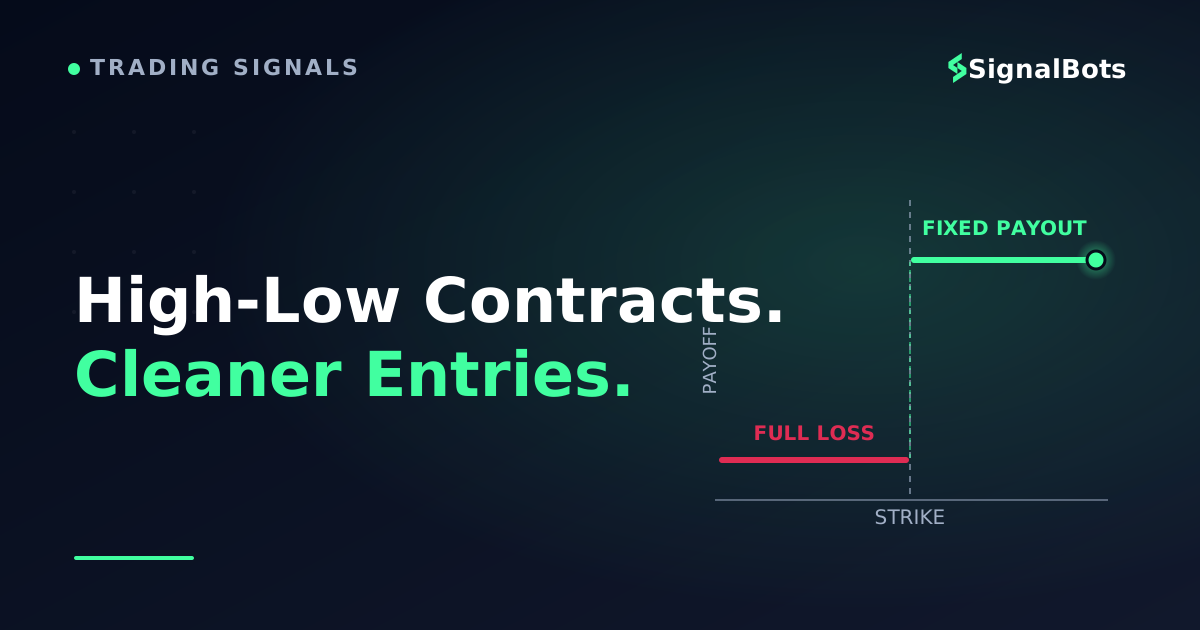
A high-low contract settles on a single comparison. At the expiry moment, the market's price is either above the strike or below it, and that comparison alone decides whether you receive the payout or lose the stake. Four numbers define the whole position: the strike, the expiry time, the direction you took — a call or a put — and the payout percentage attached to it. A high-low contract asks one question at one instant: above the line, or below it.
Three consequences fall out of that shape, and every one of them changes how you should read a signal.
Distance does not pay. Finishing one tick on the right side of the strike pays exactly what finishing forty pips away pays. A signal's target, its projected magnitude, its "expected move" — none of it reaches your P&L. Only the sign of the difference at one instant does.
There is no stop loss and no scaling out. Your entire risk is committed the moment the position opens, and the position is the stake. Some platforms offer an early-close feature at a reduced value, but you cannot manage a high-low trade the way you manage a spot position. Risk control happens before entry or not at all.
Time is the adversary, not the trend. A spot trader who is right about direction but early can wait. You cannot. A correct call that plays out ninety seconds after your contract has settled is a full loss, recorded as if the analysis had been wrong.
Contract shape
High-low payoff at expiry: call vs put
━ Call payoff━ Put payoffx-axis: underlying price at expiry • y-axis: P&L per $25 staked
The step is the whole instrument: a flat loss on one side of the strike, a flat gain on the other, with nothing in between to manage.
One mechanical detail decides a lot of what follows. On most retail platforms the strike is not something you choose — it is the market price at the instant your order fills, which means every trade opens exactly at the money and the contract is a pure direction bet. Other platforms let you shift the barrier above or below the current price, which turns the same contract into a bet on direction and distance. Know which one you are trading before you evaluate a single signal, because the two versions reward completely different calls.
Is This Up/Down Signal Worth Taking?
Here is the gap in almost every high/low binary options strategy guide you will read: they teach the contract, then hand you an indicator setup, and never address the situation you are actually in — a direction call arrived from somewhere else, and you have a few seconds to decide whether to act on it.
Three checks answer that. Run them in order, because the first one is the cheapest and disqualifies the most trades.
Check 1 — drift from the reference price. Every signal is computed against a price that existed when it fired. The trade you can open now uses the price that exists now. If those two have separated by any meaningful fraction of the move the signal expected, the setup that produced the call has already partly happened. You would be buying the same direction at a worse strike, which is a different trade with worse odds. Read the anatomy of the signal for its reference level and treat a drift beyond your own tolerance as a hard skip, not a discount.
Check 2 — expiry coverage. A signal is always computed for a horizon, whether or not it says so out loud. Your platform offers a fixed menu of expiries. The trade only works if an available expiry ends after the expected move has had time to happen, and not so long after that unrelated flow gets a vote. When your platform's nearest expiry is materially shorter than the signal's horizon, you are not taking the signal — you are taking a coin flip with a spread attached.
Check 3 — payout against break-even. The payout on offer implies a minimum win rate below which a correct-direction habit still loses money. If the payout is short of the rate your feed has actually held over a real sample — not its best week — the trade is negative before you click. This is the check most traders skip, and the only one that can be settled with arithmetic instead of judgement.
Signal triage
Should you take this up/down signal?
Take itProceed with careSkip / stand aside
A signal that fails any one check is not a weaker version of the same trade — it is a different trade the signal never described.
Three gates, cheapest first — most rejected signals never reach the payout check.
Notice what is not on that list: how confident the provider sounds, how many indicators agreed, or how the last three calls went. Those are provider-selection questions. Once you are following a feed, the only variables you still control are drift, expiry and payout.
Near-the-Money vs. Far-Strike Signals
If your platform lets you offset the barrier, you face a trade-off that a fixed-strike platform makes for you. A far strike quotes a higher payout precisely because it is harder to reach, and it converts the contract from a direction question into a distance question. That is only a good deal when the signal carries a defensible view on how far price should travel — and most published up/down calls do not.
Strike selection
Near-the-money vs. far-strike up/down signals
Near-the-money strike
Strike sits at or beside spot, so the signal only has to be right about direction
Standard payout — there is no bonus, because there is no extra hurdle
Highest realistic hit rate at short expiries; ties are settled by noise
The default wherever the platform fixes the strike at your fill price
Where a plain direction signal is meant to be traded.
VS
Far strike (offset barrier)
You place the barrier away from spot, so price must travel a real distance
Higher quoted payout, because the contract is genuinely harder to win
Needs a signal that implies magnitude, not just an up or down label
One volatility misjudgement leaves the barrier unreachable inside the expiry
Worth it only when the signal implies a move larger than the offset.
The higher payout on a far strike is not free money — it is the price of a second, harder prediction.
Matching Signal Timing to Your Expiration Window
Expiry choice is where most up down binary option strategy discipline is won or lost, because it is the one setting that turns the same correct call into a win or a loss. The right way to choose is not by preference or by which expiry "feels" right — it is by asking what the signal has to be right about at that length.
Expiry fit
Expiry window
What the signal has to be right about
Where it breaks
The signal source it suits
30–60 seconds
The next handful of ticks, entered within a second or two of the alert
Spread and fill delay consume the edge; one spike settles it against you
Only a feed you receive and act on inside the same minute
5–15 minutes
The direction of the current swing, not the next tick
A data release or session open inside the window overrules the setup
Most published signal feeds — the horizon they are usually computed on
End of day / several hours
The session bias, plus the level surviving every intraday shake-out
You are exposed to every scheduled event before settlement
Daily-bias and outlook calls, not intraday triggers
Pick the expiry that matches what the signal actually claims — the shorter the window, the more of the outcome belongs to noise rather than to the call.
Two practical rules follow.
The shorter the expiry, the more your own signal latency matters. At a one-minute window, the seconds between the alert reaching your phone and your order filling are a large share of the contract's whole life. At a fifteen-minute window they are a rounding error. If your delivery path is slow, do not compensate by trading faster — trade longer expiries.
Let volatility set the floor on your expiry, not your patience. When the average range of the recent bars — the kind of read an average true range gives you — is wide relative to the distance between spot and your barrier, a short expiry is a lottery even on a good call. When the market is dead quiet and you are trading an offset strike, the opposite problem appears: the barrier may simply be out of reach in the time available. You do not need to build an indicator for this; you need to glance at how far this market has been moving per bar and ask whether the contract you are about to open is asking for more than that.
The Payout Math Behind a Winning Signal Streak
A high-low contract pays less than it risks. Stake an amount, and a win returns a fraction of it while a loss takes all of it — which means the contract is a sub-1:1 reward-to-risk ratio trade, and the only thing that can rescue it is a win rate high enough to cover the shortfall.
That threshold is the break-even win rate, and it comes from one line of arithmetic:
Payout math
Break-even win rate for a high-low payoutfx
Wbe = 1 ÷ (1 + P)
whereP = the quoted payout as a decimal (an 80% payout is P = 0.8). Worked example: Wbe = 1 ÷ 1.8 ≈ 55.6% — below that rate a correct-direction habit still bleeds, because every win has to pay for a full loss plus a slice of the next one.
Run your own numbers through it before you accept any feed's direction record. A provider quoting a historical win rate that sits a couple of points above break-even has no margin at all: a normal run of bad luck, a slightly worse fill, or a payout cut on your asset erases it entirely.
Run your own numbers
High-low payout: break-even, edge and expectancy
Set the payout your platform quotes and the win rate you can actually defend. The gap between them is your entire edge.
Quoted payout
Win rate you can defend
Stake per contract
$
Contracts in the sample
Break-even win rate
—
Edge over break-even
—
Expected value per contract
—
Expected result over the sample
—
Drag the payout down a few points and watch a comfortable-looking win rate turn negative — that is how thin the margin on a high-low contract really is.
Two things this makes obvious. A payout cut of a few points demands a materially higher win rate to stay level, so the same signal is worth taking on one asset and not on another. And a win rate that sits just above break-even produces an expected value so small that ordinary variance will bury it inside any sample you can actually trade.
Sizing Risk for Short-Expiry High-Low Trades
Sizing a spot trade is a question of how much you lose if the stop is hit. On a high-low contract there is no stop — the loss is always the full stake — so sizing collapses into one decision made in advance: what fraction of the balance goes into each contract, and when do you stop for the day. A fixed stake and a hard daily cap are the barrier that keeps an ordinary losing run from becoming a terminal one.
Short expiries make this urgent rather than academic. A trader taking one swing position a day meets a run of five losses over a week and has time to think in between. Taking five-minute contracts, you can meet the same run inside half an hour, while still inside the emotional wake of the last one. Consecutive losses are not evidence that the feed broke; they are what a sub-1:1 payout with a real edge looks like from the inside, and they arrive far more often than intuition expects.
Four rules cover it:
Fix the stake as a small, constant percentage of the current balance — recalculated occasionally, not after every trade. A constant fraction means a losing run shrinks your absolute risk automatically, which is the only self-correction this instrument gives you.
Set a daily loss cap in contracts, not in currency. Three or four losses in a session and you are done, regardless of what the feed prints afterwards. A cap counted in trades is one you can enforce without doing arithmetic while tilted.
Never scale a stake up to recover a loss. Doubling after a loss — the martingale reflex — feels like it converts a losing streak into a delayed win, and it does, right up to the streak that clears the account. The fast settlement of high-low contracts is what makes it so dangerous: a sequence that would take a spot trader a month arrives in an afternoon.
Size against the streak, not the average. Ask what a bad run of consecutive losses does to your balance at your chosen stake, and pick the stake that leaves that survivable. The risk-of-ruin calculator turns that question into a number, and the money-management calculator turns the answer into a per-trade stake.
Variance, visualised
One edge, 200 different lives
10th–90th percentile bandMedian pathBreak-even
Median return
—
final equity, all paths
Profitable paths
—
finished above start
Worst drawdown
—
deepest peak-to-trough
Risk of ruin
—
hit −25% equity
Every path below runs the same win rate and the same payout — the spread between them is pure variance. Size for the bottom of the band, because that is a version you may well live through.
Press Run a few times. The median path and the worst path share an identical edge; only the order of the wins and losses differs. That is the honest case for a small fixed stake — trading results vary and losing runs are part of any real record, which is why our risk warning is worth reading before you size anything.
A Worked Up/Down Signal Walkthrough
Take a hypothetical to see the checks run end to end. Suppose your feed publishes an up call on EUR/USD at 14:02 UTC: direction up, reference price 1.0840, horizon roughly five minutes. Your balance is $2,000, your fixed stake is 1% of balance, and the platform quotes an 80% payout on the pair with expiry buckets at 1, 5 and 15 minutes.
Drift check. You open the ticket at 14:03 and spot is 1.0842. The move the call anticipated is measured in tens of pips over five minutes, so two pips of drift is a small fraction of it. The strike you would be filled at is still essentially the strike the call assumed. Pass.
Expiry check. The horizon is five minutes and a five-minute contract exists, so the position settles around 14:08 — after the expected move has had its time, and not so far beyond it that unrelated flow decides the outcome. Had the platform offered only a one-minute bucket, the correct action would be to skip, not to shorten the thesis to fit the menu. Pass.
Payout check. An 80% payout implies a break-even rate near 55.6%. Your feed's record across a sample large enough to mean something sits above that with a few points to spare. Thin, but positive. Pass.
Sizing. One percent of $2,000 is a $20 stake. A win returns $16; a loss costs $20. That asymmetry is the whole reason the win rate has to carry the position, and the reason a $200 "conviction" stake on the same signal is a different strategy, not a bolder version of this one.
Outcome. Price finishes at 1.0851 and the contract settles in the money for a $16 profit. Now the part that matters more: the identical signal read at 14:06, with spot already at 1.0855, fails the drift check outright. Same feed, same direction, same asset, same payout — and a skip, because the price the call was built on no longer exists. Refusing the second one is the discipline that makes taking the first one worth anything.
Mistakes That Turn a Correct Signal Into a Losing Trade
The failure mode for signal-followers is almost never picking bad signals. It is mishandling good ones. These are the ones that cost the most.
Trading a stale signal. You saw the alert late, the move already started, and taking it anyway feels like catching up. It is not — it is entering a trade with the reward already partly spent and the same full stake at risk.
Fitting the expiry to the menu instead of the thesis. Choosing a one-minute contract because the five-minute bucket has just closed is the most common way a good call becomes a coin flip.
Treating every asset's payout as equal. The break-even rate moves with the payout. A feed that is comfortably profitable on one instrument can be underwater on another purely because the quoted return is lower, with nothing about the analysis having changed.
Raising the stake after a loss. Covered above, and worth repeating, because it is the mistake that ends accounts rather than merely draining them.
Trading through a scheduled release. A five-minute contract that spans a major data print is not a trade on your signal; it is a trade on the print. If the event lands inside the window, either skip it or wait for the window to clear.
Counting outcomes instead of decisions. A won trade that failed the drift check is still a bad decision, and treating it as a good one guarantees you will take the next twenty like it. Score the process, then let the sample size do its work.
See Real Up/Down Signals in Action
Checks like these only become second nature against live output, where the drift is real, the clock is running, and the expiry buckets are the ones your platform actually offers. Our live binary options signals feed publishes each up/down call with its direction, the expiry window it was computed for, and reward-to-risk context, in real time and free to view. Open it beside your platform and run the three checks on the next call that appears — reference price against current spot, stated horizon against the expiry menu, quoted payout against your break-even rate — before any money is involved.
One boundary worth stating plainly: it is a feed for informing entries you place yourself, not an auto-execution or account-management service. If what you want is the trade placed without you judging it, that is a different tool — the binary options MT4/MT5 connector or Telegram delivery fit that job, and this article's checklist is not what you would be buying.
Putting It Together
The high-low contract is the simplest instrument in binary options and the least forgiving, because everything that would normally rescue a trade — a stop, a scale-out, a bit more time — has been removed. What is left is the quality of the decision you make in the seconds before you click.
That decision has three parts, and none of them is about the signal's authorship. Is the price still where the call assumed it was? Does an available expiry cover the horizon the call was made for? Does the payout clear the win rate you can honestly defend? Get those right, keep the stake fixed and small, stop at your daily cap, and a mediocre feed becomes tradeable. Get them wrong, and the best feed you can find will still hand you a losing month full of correct direction calls.
FAQ
Can the same signal be traded on both a 60-second and a 5-minute contract?
Rarely. A signal is computed for a horizon, and the expiry has to cover that horizon rather than merely exist near it. A call built on a five-minute swing forced into a sixty-second contract is being judged on the next few ticks — a question the analysis never asked. If your platform lacks a bucket that matches, skipping costs you nothing and preserves the record you use to evaluate the feed.
What payout is high enough to make an up/down signal worth taking?
Any payout whose implied break-even win rate sits meaningfully below the rate your feed has held over a real sample — not a couple of points below, because a couple of points is inside normal variance. Work the break-even out from the payout first, then compare. That order matters: it stops an impressive-sounding win rate from distracting you from a payout that quietly cancels it out.
Does the strike price move after a high-low trade is open?
No. The strike is locked when the contract opens, and settlement compares it with the price at expiry whatever happened in between. This is why entering late is so costly — you are not accepting a worse price temporarily, you are permanently fixing the reference level the trade is judged against.
How many up/down signals a day should you actually trade?
Fewer than your feed publishes. Every signal that fails the drift, expiry or payout check should be dropped, and on a fast feed that removes a large share of them. A daily cap on losing trades matters more than a target number of trades: it bounds the damage from a bad session without requiring you to judge, mid-session, whether the feed has stopped working.
Is a high win rate enough to be profitable on high-low contracts?
Not on its own, because the payout is smaller than the stake at risk. A win rate has to be read against the break-even rate that payout implies, and the same rate can be profitable on one asset and negative on another. The number that matters is the gap between your defensible win rate and the break-even rate — not the win rate itself.
Sources & Further Reading
Want to go deeper? These independent, authoritative sources shaped this guide — each one is worth reading in full:
The Binary Options Desk is the SignalBots editorial team for fixed-time and OTC trading coverage. We research and write the guides that explain expiry timing, payout structure and disciplined entry across the major brokers.





Discussions 0
Leave a comment