You found a name. Maybe it came from a forum thread where three people swore by it, maybe from an ad in your feed, maybe from a PAMM listing whose equity chart only went one direction. Now you are sitting in front of MT4 on your Alpari account with the file in your downloads folder, wondering whether to attach it to a live chart.
That question — is this robot real? — is what this guide answers. It does not re-teach you how to install an Expert Advisor; you already know how to drop one into a chart. It gives you two things you probably do not have: a repeatable way to separate an EA with a genuine edge from a marketing story wrapped around a pretty backtest, and the Alpari-specific checks that decide whether even a legitimate EA will behave on your account the way it did on the vendor's.
We will take them in that order — what "Alpari-compatible" actually means, then the vetting framework, then the framework applied live to the exact robot names people type into Google.
Key Takeaways
Judge the evidence, not the strategy: an independently verified live record on real money outranks any backtest a seller can regenerate until it looks good.
Account fit is half the decision — platform build, pricing tier, hedging vs netting mode and symbol naming decide whether a legitimate EA behaves the same on your Alpari account.
Grid and martingale sizing produce beautiful curves and unbounded tails; price the worst losing streak before you accept the average.
Named robots are not durable products — run the five-search name check and the two-minute gate on the specific file in front of you.
Table of Contents (34 min read)Contents
What Makes an EA "Alpari-Compatible"?
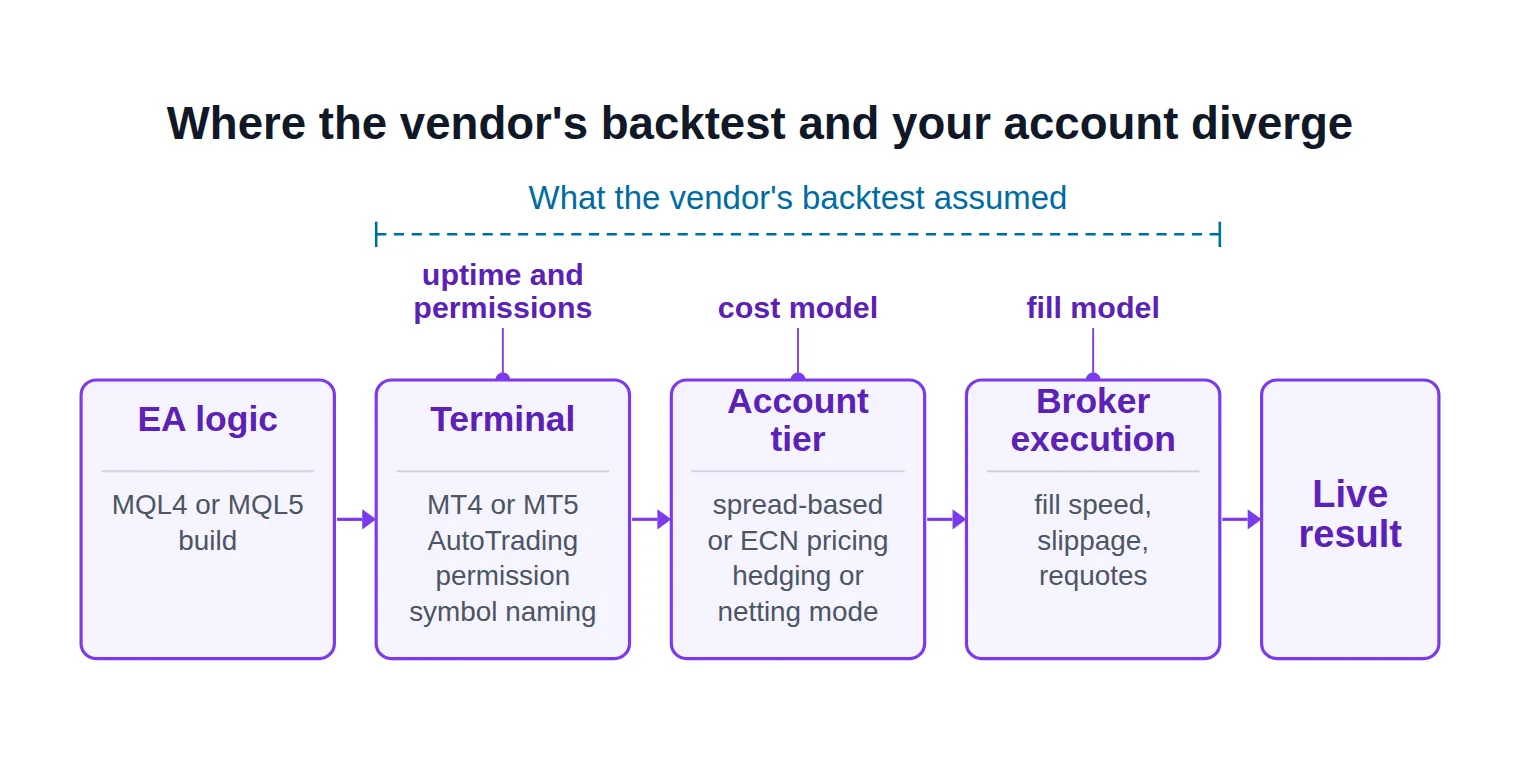
An EA is never a standalone product. It is one link in a chain: your strategy logic, the terminal it runs in, the account tier that prices your trades, and the execution you actually receive. A vendor's results were produced on their link-chain. Yours will differ, and the gap between the two is where most disappointment lives.
An EA never trades in isolation — the terminal, the account tier and the broker's execution each reshape the result the vendor advertised.
Start with the platform build. MT4 and MT5 are separate products with separate programming languages, and an MQL4 or MQL5 file compiled for one will not load in the other. A .ex4 belongs in MT4, a .ex5 in MT5. If a seller offers "both versions", ask whether the MT5 build was genuinely rewritten and re-tested or machine-converted — a converted grid EA in particular tends to inherit assumptions that no longer hold.
Then the account tier, because it changes the arithmetic of every trade the robot takes. At the time of writing Alpari's live range spans a Micro tier, a Standard tier, an ECN tier and a Pro ECN tier, split across MT4 and MT5. A strategy holding trades for days barely notices the difference. A scalping EA that opens dozens of positions a session lives or dies on it, because its edge per trade is thin enough that the pricing model alone can flip the result from positive to negative.
Best used for a first live forward test at minimal size
Standard
MT4 and MT5
Spread-based, no separate commission
Workable for slower logic; the cost sits inside the spread
ECN
MT4
ECN pricing plus commission
Suits cost-sensitive logic that needs raw pricing
Pro ECN
MT4 and MT5
ECN pricing, high-volume tier
Closest match for scalping or high-frequency logic
Account availability and specification differ by Alpari entity and region — confirm the current terms on your own account page before you commit an EA to one tier.
An ECN-style account splits your cost into a tighter spread plus an explicit commission, while a spread-based account bundles everything into one number. Neither is automatically better for automation. What matters is that you compare them on the all-in round-turn cost of the trades your specific EA takes, not on the headline spread — a robot averaging a handful of pips per trade cares enormously; one averaging a hundred does not.
Check the position-accounting mode next. MT4 accounts always hedge: the EA can hold a long and a short on the same symbol simultaneously. MT5 accounts can be configured as either hedging or netting, and on a netting account an opposing order closes or reduces the existing position instead of opening a second one. Any EA that layers positions — grid systems, basket recovery, anything that "averages in" — will behave in a completely different and usually broken way if you drop it onto a netting account. This is the most common "the robot is bugged" complaint that is not a bug at all.
Confirm three terminal-level details before you blame the EA for doing nothing:
AutoTrading permission. The terminal-wide algo-trading permission must be enabled, and the EA's own properties must allow live trading. A smiley face on the chart is not enough on its own.
Symbol naming. Brokers append suffixes to instrument names. An EA that hardcodes EURUSD silently finds nothing if your server lists EURUSD.m or similar, so check whether the robot exposes a symbol-mapping or suffix setting.
Outbound calls. EAs that phone home for licence validation or news filtering need their domain added to the terminal's WebRequest whitelist. If a vendor cannot tell you exactly which URL their product contacts and why, treat that as information you are entitled to and were refused.
Finally, accept that execution is part of the strategy.Slippage and execution speed are not rounding errors for an automated system — they are the difference between the backtest and the statement. A tester fills every order at the modelled price; a live server fills at the price available when your order arrives, which on a news spike may be several pips away. Any EA whose average win is small relative to its typical slippage does not have an edge you can capture, however clean its historical curve looks. Running it from a low-latency VPS close to the trade server narrows that gap, and that hosting question is a whole topic of its own once you have chosen something.
The Vetting Framework — How to Tell a Working EA From a Marketing Story
Here is the useful reframe: you are not evaluating a strategy, you are evaluating a claim and the evidence offered for it. You will almost never be able to read the code, and even if you could, source access would not tell you how the thing behaves in a regime it has never seen. So judge the evidence instead. That skill transfers to every robot you will ever be pitched. You will rarely read an EA's code — so judge the evidence the seller is willing to expose instead.
Three questions decide it, and they are ordered deliberately. Fail the first and the other two do not matter.
Verified Track Record vs. a Marketed Backtest
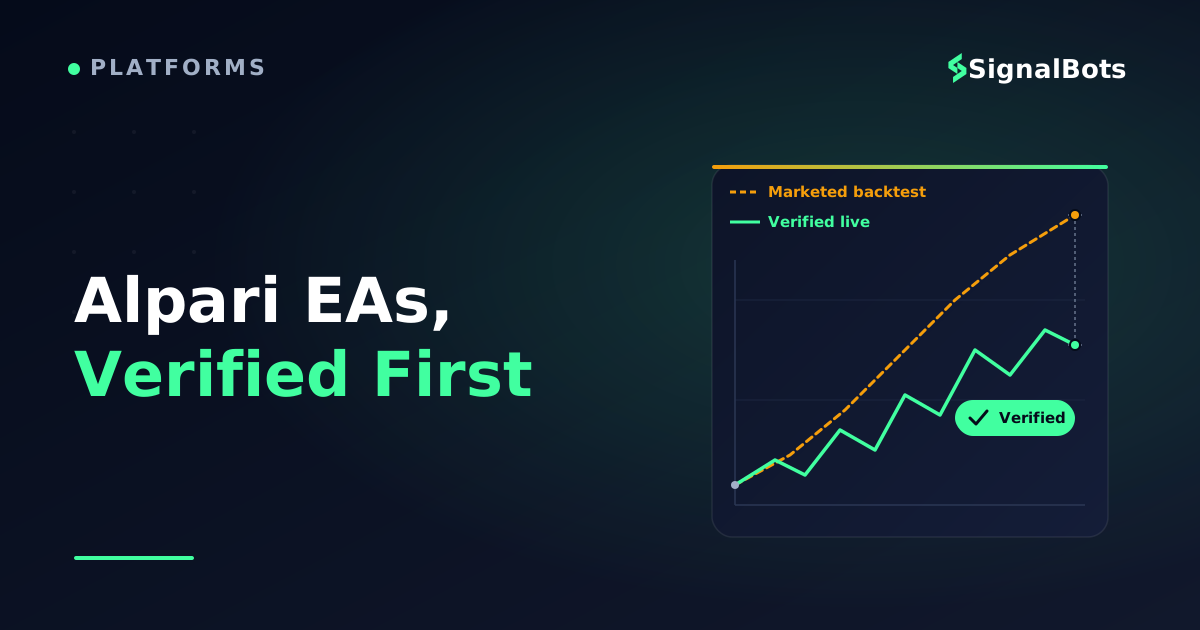
A backtest is a simulation of how a rule set would have behaved on stored price data. It is a legitimate research tool and a terrible sales document, because the person showing it to you also chose the settings, the date range and the symbol after seeing the results. A verified track record is a live account streaming its statement read-only to an independent analytics service, where the numbers arrive without the seller's hand on them.
Evidence test
Which kind of evidence are you actually being shown?
A marketed backtest
Parameters were chosen after the outcome was known
Fills, spread and slippage are modelled, not received
The losing variants and date ranges are not shown
Costs the vendor nothing to regenerate until it looks good
Evidence that a rule set can be fitted to the past.
VS
Winner
A verified live record
Real money, on a real server, streamed read-only
Fills and slippage are whatever the market gave
Deposits, withdrawals and account age are visible
Cannot be re-rolled after a bad month
Evidence it survived contact with a live account.
A backtest tells you the strategy fits history. Only a verified live record tells you it survived a market that had not happened yet.
When you are handed a verified link, open it and check four things rather than glancing at the headline gain:
Real or demo. Analytics services track demo accounts too, and a demo statement proves nothing about fills.
Age and continuity. A record that begins recently, or that shows a suspicious gap, may be the surviving account out of several that were started.
Deposit and withdrawal pattern. Repeated deposits during drawdowns turn a losing account into a rising balance curve while the strategy is quietly failing.
Whether the tracked account is the product. Plenty of pages link a verified record produced by a different version, a different settings file, or a different symbol than the one you are being sold.
Two backtest-specific traps are worth naming. Overfitting is a rule set tuned until it explains historical noise; it produces spectacular in-sample curves and no live edge. The defence is an out-of-sample test — a stretch of data the optimisation never touched — and a vendor who cannot describe theirs is telling you something. The second is a headline modelling-quality figure quoted from the strategy tester: it describes how densely the historical data was reconstructed, not how good the strategy is, and it is routinely presented as if it were a quality score for the robot.
Drawdown, Position Sizing and the Grid/Martingale Trap
Once evidence exists, ask what the EA does when it is wrong. Every robot answers this the same way in marketing ("advanced risk management") and very differently in code. The tell is in the position sizing.
A martingale system increases size after a loss so that a single winner recovers the sequence. A grid system opens additional positions at fixed intervals as price moves against it, usually with rising size. Both produce a beautiful equity curve for as long as price keeps reverting, and both hold an unbounded loss in the tail. The curve is not evidence of skill — it is a report on how long the market has gone without a sustained one-way move.
Run the arithmetic on your own numbers rather than taking the shape on faith:
Sizing stress test
What a losing streak costs a size-doubling EA
Set the starting size, the multiplier the robot applies after each loss, and how long the streak runs. The result is what that sequence takes out of your account.
Account balance
$
Opening position size
lots
Size multiplier after a loss
Consecutive losses in the streak
Loss per step
pips
Pip value per lot
$
Size on the final trade
—
Cumulative loss over the streak
—
Share of the account it consumes
—
Push the streak length up two or three notches and watch the loss stop being linear — that non-linearity is the entire risk profile of a martingale EA.
Notice what happens between eight losing steps and eleven: the loss does not grow by a third, it multiplies. That is why "it has never had a losing month" is a statement about sample size, not about safety. Feed the same logic into a risk-of-ruin view and the picture sharpens further.
For any EA, whatever its sizing model, three numbers belong on your sheet before it trades: the maximum drawdown on the verified record, the worst consecutive-loss run inside it, and the size the robot would be trading at the end of that run. If you would not place the final trade of the losing sequence by hand, do not let an EA place it for you. Run your intended risk through a forex position size calculator at the sizes the EA actually reaches rather than the size it starts at, and check how much gain a given drawdown demands back with a drawdown recovery calculator.
Red Flags That Should End the Conversation
Some signals are not "concerning", they are terminal. Any one of these is enough to stop:
Promises instead of ranges. Be wary of any robot advertised as "risk-free", "guaranteed" or unable to lose. Regulators publish standing warnings about internet-sold trading systems for exactly this reason, and serious developers talk in reward-to-risk ratio and historical win rate rather than certainties.
Monthly return targets stated as facts. A fixed percentage per month is a marketing figure, not an output of a strategy that depends on market conditions.
Testimonials as the only evidence. Screenshots and video praise carry no verification. They are the cheapest asset on the page to manufacture.
No drawdown discussion anywhere. A developer who understands their system volunteers its worst period. Silence about drawdown is a decision, not an oversight.
A black-box system with no describable logic. You do not need the source code, but you are entitled to a plain-language description of the entry condition, the exit condition and the sizing rule. "Proprietary AI" is not a description.
Pressure mechanics. Countdown timers, "only a few copies left", vanishing discounts. Nothing about a functioning trading system requires you to decide today.
Licensing you cannot audit. An account-bound licence is normal; a robot that will not say which server it contacts, or that stops working when the vendor's site goes down, is a dependency you did not agree to.
The vendor discourages demo testing. "It only works on live accounts" is occasionally true for latency-sensitive logic and far more often a way to get money at risk before the results arrive.
Turn all of it into a two-minute gate you can run against the next robot someone sends you:
Go / no-go
The two-minute EA gate — run it before anything touches a live account
0 / 8
An independently verified live record exists, on real money, covering a meaningful stretch of time
The tracked account is the same version, symbol and settings as the product being sold
The record's maximum drawdown and worst losing streak are both numbers you could sit through
The sizing rule is disclosed, and it is not a martingale or a grid you cannot cap
Entry, exit and sizing logic are described in plain language, without demanding source code
The page makes no promise of guaranteed, risk-free or fixed monthly returns
The robot runs on your platform build, account mode and symbol naming without edits
You have a demo or minimum-size forward test planned, with a written stop-the-test rule
★
Checklist complete — you’re cleared to proceed.
Anything that fails a line here is not 'a bit risky' — it is a robot you cannot evaluate, which is the same decision with extra steps.
A Cautionary Real Case — What Happened to the "Brick EA Grid System" PAMM
The grid warning above is not hypothetical, and you do not have to look far from Alpari to find it. A strategy called the Brick EA Grid System ran as a PAMM account — an arrangement where investors allocate capital to a manager's account and results are distributed proportionally — on Alpari's investment platform.
Be precise about what can and cannot be shown here, because this is exactly the standard the rest of this guide asks you to apply. We went to that listing's URL directly. The strategy page no longer serves performance data; the address now resolves to a general Alpari accounts overview, consistent with a delisted strategy. The only surviving trace we could find is the page title search engines still hold for that URL, and it advertises a deeply negative return — close to a wipe-out of what was invested. We could not fetch that record and we have not independently verified it. Treat it as a search-engine artefact of something that used to be published, not as an audited statement, and hold our claim to the same standard you would hold a vendor's.
What is not uncertain is the structure. A grid system compounds exposure while price trends against it. That produces a long stretch of small, regular gains, then a single move that removes them, and the shape looks like this:
Illustrative
An illustration of grid mechanics, not a record of any specific account: the months of steady progress and the single terminal month are the same behaviour, not two different phases.
The lesson is not "avoid PAMM" or "avoid Alpari" — a PAMM listing is a third-party manager's strategy hosted on a broker's platform, not a broker product, and the vetting job is identical whether you are allocating to a manager or attaching an EA to your own chart. The lesson is that a rising curve produced by an uncapped grid is not evidence of an edge, and that the evidence trail for a failed strategy tends to disappear along with the strategy. All automated trading carries the risk of losing the capital committed to it; our full risk warning sets out what that means before you deploy anything.
Are "Blind Sniper," "Brick EA" and Other Named Alpari Robots Legit?
Many readers arrive here having typed a specific product name rather than a general question, so here is a direct answer rather than a framework.
On "brick ea alpari". As above: a strategy under this name ran as a PAMM listing on Alpari's platform, that listing is gone, and the only surviving public trace we could find is an indexed page title describing a heavily negative return that we could not fetch or verify. There is no current, verifiable product page, no live verified record and no basis on which anyone could responsibly recommend it. Searching the name today mostly returns aggregator pages recycling the old listing.
On "blind sniper alpari". We looked for a product under this name with a verifiable connection to Alpari and did not find one — no vendor page, no independent verified track record, no broker listing. What surfaces instead is a crowded field of similarly named "sniper" robots sold across generic EA shops, which is a pattern in itself: the name is a marketing convention, not an identifier. If someone sent you a file or a link under this name, the name tells you nothing about what the file does, and the absence of any findable record is a finding rather than a gap in your search.
The general rule this illustrates. Robot names are not products in any durable sense. They are re-used, resold, rebranded and abandoned, and an EA with a following two years ago is frequently a different binary today. That is why this guide will not score or endorse a named EA: the honest answer for almost every branded robot is that the name is not the thing, so run the evidence check on the specific file in front of you.
Here is that name check, in the order that answers fastest:
Search the exact name plus "verified", or plus the name of a track-record service, and open only results that lead to a live statement rather than a review page.
Search the name plus "review" and discount every result on a site that also sells EAs — affiliate review pages are advertising with a rating attached.
Search the name plus "scam" or "refund" and read what the complaints actually allege; complaints about drawdown behaviour are far more informative than complaints about support.
Look for a discussion thread that runs for at least a year. A robot with real users generates a long, boring thread, not a burst of enthusiasm followed by silence.
Check whether the seller's claimed record and the product being sold are the same version, on the same symbol.
If those five searches produce nothing verifiable, you already have your answer, and no amount of further searching improves it.
Where to Source an EA — Marketplace, Builder or Custom Build
Once you can vet, sourcing gets simpler. There are three realistic routes, and each fails the checklist in its own characteristic way.
A platform marketplace. The MQL5 Market is the largest catalogue of MT4/MT5 robots, and its structural advantage is that products carry seller history, buyer reviews the seller cannot delete, and a free demo download you can run in the strategy tester before paying. The structural weakness is that a marketplace listing is still a marketed record: the signals and backtests attached to a product page are chosen by the seller. Marketplace hygiene replaces none of the checklist — it only makes the checklist cheaper to run, because you can test before you buy.
A no-code builder.Alpari has historically offered an EA Builder — a graphical tool that lets a live client assemble a rule set into a working MT4 robot without writing MQL. It has been an entity- and region-specific offering rather than a universal one, so confirm whether it is available on your account rather than planning around it. The wider category is healthy: several independent builders do the same job. The trade-off is real, though. A builder produces exactly the logic you specify, which removes the black-box problem entirely and replaces it with a different one — now you are the source of the edge, and the tool will happily compile a curve-fitted idea into an executable robot. A builder does not exempt you from out-of-sample testing; if anything it makes that discipline more important, because nothing external is checking your reasoning.
A custom build. Commissioning a developer, or writing it yourself in MQL, gives you full disclosure of the logic by definition, plus the ability to fix behaviour instead of filing a support ticket. It is also the slowest and most expensive route, and it moves the risk from "is this vendor honest" to "is my strategy actually an edge". If you go further and want a robot talking to Alpari programmatically outside the terminal, that is a separate build with its own authentication and connection concerns — the Alpari API route is documented in its own guide rather than here.
Whichever route you take, the same rule closes it: the source determines what evidence is available to you, never whether the evidence bar applies.
Can You Automate Binary Options Trading on Alpari Too?
Yes, and the vetting bar is higher rather than lower — which is the opposite of how these products are usually sold.
Alpari offers fixed-contract style trading alongside its forex range, and a whole category of binary options robots exists to place those contracts automatically. Read one of their sales pages and you will find the marketing pattern this guide has been describing, in its purest form: continuous round-the-clock growth, a wall of testimonials, no verified statement, no drawdown discussion, no risk disclosure. The vetting framework applies unchanged. What changes is the mathematics the robot has to beat.
A fixed-return contract pays a fixed fraction of your stake when it finishes in the money and takes the whole stake when it does not. That asymmetry sets a break-even win rate well above half before costs, and it is fixed by the payout percentage, not by the robot's cleverness:
Why the bar sits above half
Fixed-return payoff at expiry (illustrative)
━ Call payoff━ Put payoffx-axis: underlying price at expiry • y-axis: P&L per $100 staked
Suppose an 80% payout on a $100 stake: a win returns $80 while a loss costs the full $100, so the robot must win roughly five of every nine contracts merely to stand still.
Work that through and the implication is uncomfortable for anyone shopping for a binary robot. At the payout in the illustration, an automated system needs a sustained accuracy of around fifty-six in a hundred simply to break even, before any consideration of profit — and it must hold that accuracy across changing conditions, with no ability to run a winner or cut a loser early, because the contract's outcome is binary by construction. Put your own payout and target accuracy into a binary break-even win rate calculator before you evaluate any claim, so you know what the robot is actually being asked to do.
Two practical notes. First, be sceptical of any binary robot whose evidence is a balance screenshot — fixed-return contracts do not produce the kind of standard statement that third-party verification services parse, which conveniently removes the strongest evidence type from the conversation. Second, the mechanics of trading fixed contracts through MT4 at Alpari are a topic in their own right, covered separately; this section is only about whether an automated layer on top of them deserves your trust.
Before You Go Live — Demo Testing, Backtesting and Hosting
An EA that clears the checklist has earned a trial, not a live account. Three steps sit between the two, in this order.
Backtest it yourself, on your own terms. Running the tester against a vendor's settings tells you far more than their published curve, because you control the date range. Test a period they did not show. Test a different symbol. Test the year the market did something structurally unusual. This depends on decent historical data in your terminal, and importing quality historical data into MT4 or MT5 is a fiddly enough job to deserve its own walkthrough.
Forward test on demo, with a written stop rule. A forward test on a demo account is the only stage that exposes the robot to prices nobody has seen, and the discipline that makes it worth anything is deciding in advance what ends it: a drawdown level, a losing-streak length, a behaviour you will not tolerate. Write it down before you start, because you will renegotiate with yourself later. Then define the same thing for live trading as an explicit kill switch — the condition under which the EA gets detached, no discussion.
Solve uptime before you fund it. An EA only trades while its terminal is running and connected. A laptop that sleeps, a home connection that drops, or an operating-system update at 3am will each produce an unmanaged open position, which is a worse outcome than never having traded. This is what a VPS for EA hosting solves, and choosing and configuring VPS hosting for an Alpari account is its own setup guide — the point here is simply that hosting is a prerequisite, not an optimisation.
Only then, live — at the smallest size your account allows, for long enough that the sample means something. Live money changes fills, and it changes you.
See What a Transparently Verified Signal Looks Like
The thread running through everything above is that you should be able to inspect the reasoning, not just the outcome. It is worth seeing what that looks like when it is the default rather than something you have to extract from a seller.
Our live forex signals feed is free to view and publishes each call the way the vetting framework asks a robot to justify itself: the instrument, the direction, the entry, the stop, the target, and the reward-to-risk context that follows from them. Nothing is hidden behind a compiled file. You can watch a call, disagree with it, and see how it resolved — which is precisely the audit trail an unverified EA cannot give you, because its logic and its record are both the vendor's to present.
To be clear about what it is not: it is a signal feed you act on yourself, or route to your platform through a connector — not a plug-and-play robot that trades while you sleep. If hands-off automation is genuinely what you need, this does not replace an EA, and the EA you pick still has to survive the checklist above.
Your Next Steps to Run an EA on Alpari
You arrived with a name and a file. You can leave with a method, which is more durable — names change every season, and the method works on the next one too.
Concretely, from here:
Match the robot to your account — platform build, tier and pricing model, hedging or netting mode, symbol naming. A legitimate EA on the wrong account is still a broken EA.
Demand a verified live record and read it properly: real money, meaningful age, clean deposit pattern, same version as the product.
Interrogate the sizing rule. If it is a martingale or an uncapped grid, size it as though the worst streak in the record is not the worst streak that exists.
Run the two-minute gate. One failed line is a stop, not a discount.
Backtest on your own periods, forward test on demo with a written stop rule, then go live small — with hosting and a kill switch already in place.
The robot that survives all five is not certain to make money; nothing in algorithmic trading is. But it will be one whose behaviour you can predict, whose failure mode you have already priced, and whose claims you checked yourself rather than accepted. That is the difference between automating a strategy and outsourcing a hope.
FAQ
Does Alpari allow expert advisors on every account type?
Automated trading through MT4 and MT5 is supported across Alpari's live range, and hedging and scalping styles are accommodated. What differs between the tiers is the pricing model and platform availability, which affects whether a specific EA is viable, not whether it is permitted. Because terms differ by entity and region and change over time, confirm the current specification on your own account page before you commit a cost-sensitive robot to a tier.
Do I need a VPS to run an EA on my Alpari account?
For anything you intend to run continuously, yes in practice. The EA only trades while the terminal is open and connected, so a home machine introduces sleep, reboots and connection drops as unmanaged risks to open positions. Latency-sensitive strategies gain further from being hosted near the trade server. For an EA you only run during a session you are watching, a well-configured desktop is workable.
How long should I demo test an EA before risking real money?
Long enough for the market to change character at least once, and long enough that the number of trades means something — a high-frequency robot reaches that in weeks, a swing robot may need months. Elapsed time alone is a poor measure; the sample size and the variety of conditions are what matter. Set the exit criteria before you start rather than judging afterwards.
If an EA backtests well on Alpari data, will it work at another broker?
Not reliably. Results are tied to the spread and commission model, the fill behaviour, the server's price history and even the symbol specification of the account they were produced on. A strategy with a wide average win usually survives the move; a scalping strategy frequently does not. Re-test at the new broker before assuming the edge travels.
Is a paid EA more trustworthy than a free one?
Price says nothing about validity in either direction. A paid robot has a seller with an incentive to present its record favourably; a free one often has no record at all, and occasionally an undisclosed reason for being free, such as a broker referral embedded in it. Apply the identical evidence bar to both, and be equally sceptical of a free file from a forum and a premium listing with a polished page.
What maximum drawdown should I accept from a forex robot?
There is no universal figure, and any source quoting one is guessing on your behalf. The workable test is personal and practical: take the deepest drawdown on the verified record, assume the real one will be worse because the record has not seen every market, and ask whether you would keep the robot attached through it. If the honest answer is that you would intervene, either the position size is too large or the strategy is not for you.
Sources & Further Reading
Want to go deeper? These independent, authoritative sources shaped this guide — each one is worth reading in full:
The Forex Desk is the SignalBots editorial team responsible for our currency-market coverage. We research and write the guides, explainers and reference articles on how the majors, minors and crosses actually trade — sessions, spreads, swaps and the macro releases that move price.




Discussions 0
Leave a comment