It is Saturday morning. The extension that placed trades all week is sitting in your toolbar doing nothing, because every pair it watches went dark at the Friday close. Quotex itself is still live — still quoting prices, still accepting one-minute positions — on a list of assets with OTC stamped after the name.
So you go looking for a bot that trades those instead. What you find is a wall of near-identical forum posts, Telegram invites, short-form videos promising a robot that beats the OTC market, and GitHub repositories named "Quotex bot" whose entire contents are a marketing PDF and a signup link.
This page is not a ranking. It is the part that has to come before a ranking: what an OTC-capable bot genuinely has to do differently, which categories of Quotex OTC software actually exist, and how to check any specific one before you install it or point it at a funded account. Quotex OTC assets are priced by the broker's own engine, so they keep quoting straight through the weekend the real pairs sit out.
Key Takeaways
An OTC asset is a broker-generated synthetic instrument with its own symbol, its own payout and no reaction to news — so a weekday bot does not simply carry over to it.
Ready-made Quotex OTC automation splits into three capability levels: software that auto-executes, software that only reads the chart, and signals you execute yourself.
The binary payout sets a hard break-even win rate above 50%, so any advertised win rate is only meaningful with a trade count, date range, asset list and expiry attached.
Vet before you buy: demo across two full weekends, match the advertised OTC pairs against your account's real asset list, and never hand over broker credentials.
Table of Contents (34 min read)Contents
What Makes a Quotex OTC Bot Different From a Weekday Bot?
Start with the instrument, because everything else follows from it. An OTC asset on Quotex is not a real currency pair routed to an outside venue. It is a synthetic instrument whose price series the broker's own pricing engine generates, modelled on how the underlying tends to behave. That is why it keeps quoting after the interbank market shuts on Friday and through to the Monday reopen — the mechanics of weekend OTC trading in one sentence.
For a piece of auto-trading software, that difference is not cosmetic. It changes four concrete things.
The symbol string is different. "EUR/USD" and "EUR/USD (OTC)" are two separate entries in the asset list, and they do not swap in for each other. A bot that hardcoded the weekday symbol does not silently fall back to the OTC version on Saturday — it finds nothing, and either idles or throws an error. This is the single most common reason a perfectly good weekday bot "stops working on weekends."
The event calendar stops mattering. A broker-generated series does not gap on a central-bank release, because there is no order flow reacting to one. Every news filter and high-impact blackout window your weekday bot relies on is dead weight here. An OTC-aware bot needs a different set of guards — volatility and streak filters rather than calendar filters.
The statistical character shifts. Because the series is algorithmic, it can print smoother trends or sharper reversals than the real pair does at the same hour. Indicator periods, expiry lengths and entry thresholds tuned on the real instrument are not automatically valid on its OTC twin. A bot that offers one shared parameter set for both is telling you something about how carefully it was built.
The payout table is its own variable. Payout percentage differs per OTC asset and moves through the session, and on a binary instrument the payout — not the pip distance — is what decides whether a given win rate is worth anything. A bot that ignores the current payout when choosing which OTC pair to trade is optimising half the problem.
Illustrative
An OTC series keeps printing after the real pair stopsEUR/USD OTC1m
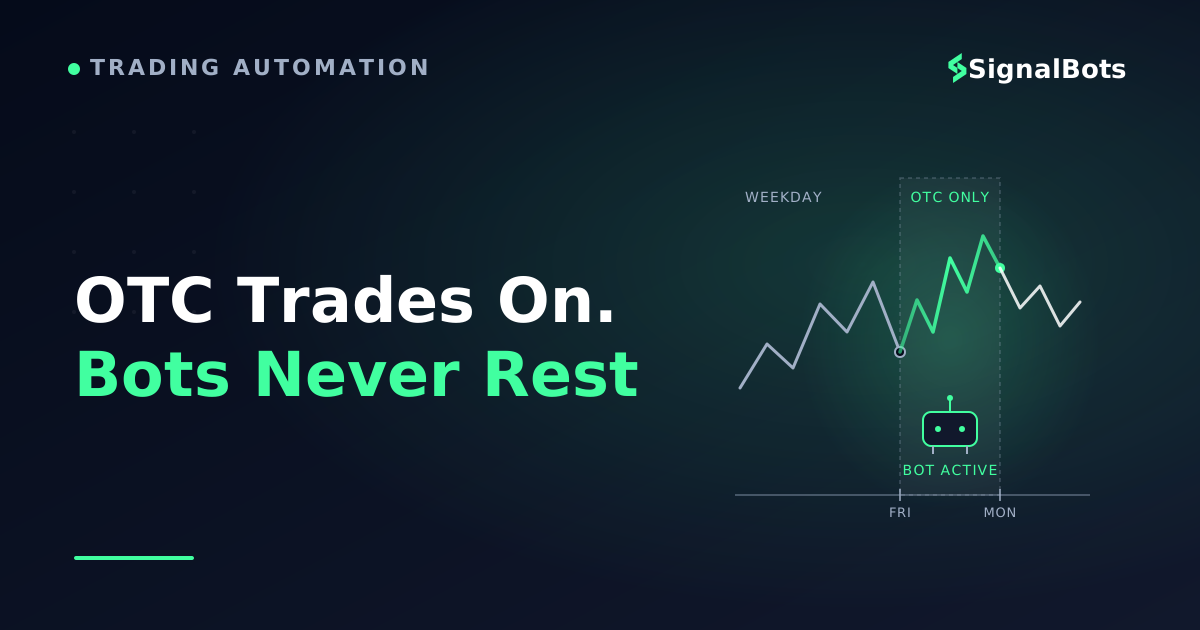
Illustrative synthetic series. The weekday bot's symbol list ends at the Friday close; an OTC-aware bot is watching a different instrument that never stops quoting.
The practical upshot: "supports OTC" is a claim you can test before you buy. Ask which OTC symbols specifically — a list, not the word "all". Ask whether strategy parameters are stored separately for OTC assets. Ask what the bot does at the Monday handover, when the real pairs come back and the OTC book usually thins out. A vendor who can answer those three has built for OTC. A vendor who answers with a win-rate screenshot has not.
The Ready-Made Ways to Automate Quotex OTC Trading Today
Before the categories, one distinction that vendors in this space blur constantly. The word "bot" gets used for three fundamentally different capability levels:
Auto-executes — the software places the trade on your account without you clicking.
Reads only — it analyses the OTC chart or mirrors it somewhere you prefer, and places nothing.
Signals you act on — a human or model publishes a call; execution is yours unless you bolt something on.
Everything marketed as Quotex OTC software falls into one of those three, and the failure mode you are exposed to depends entirely on which one you bought.
Four routes, three capability levels. Match the failure mode you can live with, not the marketing word on the page.
Browser-extension bots with built-in OTC strategies
This is the category that actually places trades. A trading browser extension injects a control panel into the Quotex page, reads the chart data the platform already renders, and clicks the CALL or PUT button for you. Because it drives the same interface you would, it needs no API key and no password — which is exactly why it is the dominant format for a broker with no public trading API.
The good ones ship a manual mode alongside auto-trade: signals stream into the panel, you decide which to take, and you can watch the logic behave for a few sessions before you let it fire on its own. The weak ones ship auto-trade only, with a strategy name and no description of the rule behind it — a black box you cannot audit.
Two structural weaknesses are worth knowing up front. First, extensions break when the broker redesigns its interface, so an abandoned project stops working with no warning and no error you would notice quickly. Second, the permissions an extension requests are the real security surface: page access limited to the broker's own domain is normal and necessary; access to all sites is not, and there is no OTC strategy that requires it.
AI chart-screenshot signal tools
A newer category, and the most misread. You upload a screenshot of your Quotex OTC chart to a web tool, a vision model looks at the candles, and it returns a direction and an expiry — typically for one-to-five-minute charts. Some blend that output with a human-curated feed sold as a premium tier.
These place nothing. They are analysis, not automation, and they inherit two problems that matter on OTC specifically. The model sees a picture, not the data series, so it has no access to the payout, the spread behaviour or the asset's own history — the very variables that decide whether an OTC entry is worth taking. And because the output is generated per screenshot, there is no standing record: you cannot go back and count how the last two hundred calls resolved, which is the only thing that would make the tool assessable at all.
Treat this category as a second opinion on a read you already have, never as the thing making the decision.
Telegram signal channels with an auto-click extension
Here the split between the signal provider and the executor is explicit, which is a feature rather than a limitation. A channel posts the asset, the direction and the expiry; you place it. If you would rather not sit at the screen, a companion extension reads the same feed and clicks it onto the broker for you.
The reason this format is worth taking seriously on OTC is auditability. A channel that publishes every outcome — wins, losses and ties alike — leaves a running public record you can scroll back through before you commit anything. That is a materially different evidence base from a screenshot in a forum post. A channel that only posts the wins is not a signal service; it is a highlight reel, and you should read it as one.
If you'd rather build than buy
Some readers land here because nothing on the shelf is auditable enough. Two build paths exist, and both sit outside this page.
The lighter one is the MT4/MT5 connector route: mirror the Quotex OTC chart into MetaTrader 5 so you can run your own indicators, backtest ideas in the strategy tester, and keep your analysis in a platform you already trust.
Understand that route's boundary clearly, though — a connector renders the chart and delivers signals; it does not place the binary trade. Our own Quotex OTC MT5 connector sits squarely in the read-only category, and reading it as an execution bot is the single most common misunderstanding of the format.
The heavier one is programmatic: whether Quotex publishes an official API at all, and the unofficial WebSocket protocol people connect to with Python to pull OTC quotes and place orders. That is a genuine engineering project with its own maintenance burden, and it is documented separately rather than compressed into a paragraph here.
Can a Robot Actually Beat the Quotex OTC Market?
This is the question underneath most searches that land on this page, and it deserves a straight answer rather than a dodge. It is really two questions wearing one coat.
Can software execute a rule set more consistently than you can? Yes, unambiguously — that is what automation is for. It does not hesitate on the fourth loss, does not widen the entry criteria at 2am, does not skip the setup because the last one failed. If your problem is discipline, a binary options bot solves a real problem.
Can a rule set have a positive edge on a broker-generated series? That is an empirical claim about one specific strategy, and no vendor screenshot can establish it. What you can do is check whether the claim is even arithmetically coherent, because the binary payoff structure sets a hard floor.
A binary trade is asymmetric by construction. A loss costs the full stake; a win returns only the payout percentage of it. So the break-even win rate is not 50% — it is one divided by one plus the payout. Suppose an OTC asset pays 80% and you stake $100: a win returns $80, a loss costs $100, and you need roughly 55.6% of trades to land just to stand still. Every point of payout the broker shaves off pushes that floor higher.
Illustrative example
One OTC trade: $100 stake at an 80% payout
━ Call payoff━ Put payoffx-axis: underlying price at expiry • y-axis: P&L per $100 staked
The loss leg is always the full stake; the win leg is only the payout. That asymmetry is why a win rate near 50% is a losing system, not a coin flip.
Run your own asset's payout through the binary break-even win-rate calculator before you evaluate any bot's claim. If a vendor advertises a win rate at or below the break-even line for the payouts you actually get, the claim refutes itself — and if it is far above, ask what it is attached to.
That last question is the one that separates a real number from a decorative one. A historical win rate only means something with a trade count, a date range, the specific OTC assets, and the expiry used. A number produced by tuning parameters until the curve looked good on past data is overfitting, and it degrades the moment the pricing engine's behaviour shifts.
There is a cheap substitute for trusting any of it. A forward test on demo over a few weekends tells you more about a bot than a backtest a stranger ran and screenshotted, because you control the sample and you can see the losses.
One specific trap deserves naming, because it is endemic in this category. A bot that recovers losses by escalating the next stake will report a spectacular win rate — because almost every sequence eventually closes green. The martingale win rate is real and the risk it hides is real too: a long enough losing streak takes the whole account, and OTC assets are perfectly capable of producing one. If a bot offers a recovery multiplier, model the streak before you enable it with the martingale sequence calculator.
So: automation removes hesitation and inconsistency from a strategy. It does not turn a negative-expectancy rule set into a positive one, and nothing about a synthetic weekend feed makes that easier than it is on a real market.
How to Vet an OTC Bot Before You Risk Real Money
Most of what ranks for this search is hollow — but the emptiness shows up in minutes if you run the checks first.
Because this corner of the internet is unusually adversarial, the vetting step matters more than the choice. Nine red flags, drawn from what actually shows up when you search for an OTC Quotex bot:
Outcome language in the marketing. Any product promising "guaranteed" or "risk-free" results has told you it is not built by people who trade. The claim is not merely optimistic — it is a category error about how a bounded-payout instrument works.
A win rate with nothing attached. No trade count, no period, no asset list, no expiry. See the previous section for what a usable number looks like.
A request for your broker password. A legitimate extension automates the page you are already logged into; it never needs your credentials. Handing them over transfers control of withdrawals too.
Permissions wider than the broker's domain. Check what the extension asks for at install. "Read and change all your data on all websites" is a browser-wide grant, and no OTC strategy requires it.
No demo mode. If you cannot point the bot at a demo account and watch it place a hundred trades, you cannot evaluate it at all — you can only trust it.
A GitHub repo with no code. The pattern is consistent: a repository named for the bot, a README that is a marketing guide with signup links, two commits, no stars, no issues, no releases. That is a landing page wearing a developer's clothes.
A "cracked" or modified APK from a video clip. Sideloaded APKs presented as an unlocked premium bot are the highest-risk item in this whole space — you are installing an unsigned binary with account access on the same device that holds your broker session.
A vendor thread with no dissent. Real tools accumulate complaints, edge cases and "does this work on X?" questions. A long thread of uniformly enthusiastic replies posted within days of each other is a manufactured one.
No stated rule behind the strategy. "AI-powered" is not a strategy description. You do not need the source code, but you should be able to say in one sentence what condition makes it enter.
Once a candidate survives all nine, test it in this order rather than switching it on:
Do this in order
Test sequence before an OTC bot touches real money
0 / 8
Run it on a demo account across at least two full weekends, not one session — OTC behaviour is not uniform across the weekend.
Compare the bot's OTC asset list against what Quotex actually shows in your account's asset panel right now; drop it if the lists disagree.
Log every trade yourself in a spreadsheet — direction, asset, payout at entry, expiry, outcome — instead of trusting the bot's own counter.
Check the payout the bot is trading into, not just its win rate; a high hit rate on a low-payout asset can still lose money.
Run it live at the platform minimum stake for a further week before sizing up, so a bad strategy costs you the price of a coffee.
Watch one full Monday handover to confirm it stops or switches cleanly when the real pairs reopen and the OTC book thins.
Disable any loss-recovery or stake-multiplier setting for the entire test period so the raw edge is visible.
Set a hard stop: a number of consecutive losses, or a daily loss cap, at which you turn it off and re-evaluate.
★
Checklist complete — you’re cleared to proceed.
The point of the sequence is that each step can fail cheaply. Anything that survives all eight has earned real size.
If a product fails at step two — its advertised OTC pairs are not the ones your account can actually trade — you have learned everything you need in about ninety seconds, for free.
Get Quotex Weekend OTC Signals, With Optional Auto-Execution
It would be strange to publish a vetting checklist and then hide our own hand, so here is where we sit on that map — with the same distinctions applied.
Our binary-options desk runs a separate Quotex OTC channel rather than folding weekend calls into the weekday feed, for the reason this whole page has been making: the instruments are different and the parameters are different. Each post carries the asset, the direction and the expiry, and every outcome — win, loss or tie — is published after the trade closes. That last part is the one checklist item you can verify before joining: scroll the record and count the losses. You can see how the feed is structured on our binary options Telegram channels page.
That surface is a signals product, in the third capability level above. Execution stays yours unless you add the second piece: our Quotex OTC browser extension reads the same feed and clicks it onto the broker, with a manual mode that streams calls into a panel for you to approve and an auto-trade mode that places them unattended. It covers OTC instruments across exotic FX pairs, several crypto assets, an oil contract and a stock, and it runs on Chromium and Firefox-based browsers. Activation is a free lifetime license through our broker partnership, or a one-time purchase if you would rather not open an account through us.
Where this is not the right fit: you are executing a published feed, not running your own logic. If your intent is a private strategy you designed — your own indicator stack, your own entry conditions, your own risk engine — a signal channel plus an auto-clicker is the wrong shape, and the programmatic build path is a better use of your effort. Nothing here changes the arithmetic in the section above either: the payout still sets the break-even line, and weekend OTC assets carry the same risk of a losing streak as any other binary instrument.
Next Steps: Free, Paid, or Build Your Own
You came for a bot that trades Quotex OTC assets. What you should leave with is the ability to place any specific product on the map — auto-executes, reads only, or signals — and a checklist that costs nothing to run.
Where to go from here depends on which constraint is actually binding:
Budget is the constraint → look at the free Quotex trading bots and what each one gives up in exchange for costing nothing.
You want the whole field side by side → the full comparison of Quotex trading bots covers every category, not just the OTC-capable ones.
You want to understand the AI claim → how Quotex AI bots and AI signals actually generate a call is worth reading before you evaluate one.
You want to follow a trader rather than a bot → Quotex copy trading is a broker-native feature and a different mechanism entirely.
Whichever route you take, the order is the same: demo first, minimum stake second, size last.
FAQ
Are Quotex OTC assets the same as the real currency pairs?
No. An OTC asset is a synthetic instrument whose prices the broker's own engine generates, modelled on the underlying's typical behaviour rather than routed to an outside venue. It shares a name with the real pair and often a broadly similar rhythm, but it is a separate tradeable symbol with its own payout, its own quoting hours and its own statistical quirks.
Will my regular Quotex bot work on OTC assets automatically?
Usually not. Most bots hold a fixed symbol list, and the OTC versions are distinct entries — so on a weekend the bot finds no matching instrument and either idles or errors. Even where a bot can be pointed at OTC symbols manually, parameters tuned on the real pair may behave differently on the synthetic series, so treat it as a new strategy to test rather than a setting to flip.
Can I run a Quotex OTC bot on my phone?
Browser-extension bots need a desktop browser, so the realistic mobile route is a signal feed you act on manually, or a desktop machine or VPS left running while you monitor from your phone. Be especially careful with anything offered as a modified mobile app: an unsigned installer with account access sits on the same device as your broker session, and regulators have issued specific warnings about binary options mobile apps.
How many trades should I watch on demo before trusting an OTC bot?
Enough that a lucky streak cannot explain the result — think in terms of a couple of hundred trades across at least two separate weekends, not one good session. OTC conditions vary across the weekend and around the Monday handover, so a sample drawn from a single afternoon tells you almost nothing about the rest.
Is a free Quotex OTC bot safe to use?
Free is not the risk signal; unaccountable is. Plenty of legitimate tools are free because they are funded by a broker partnership, and plenty of paid ones are worthless. Apply the same nine checks either way, and pay particular attention to what the software asks for at install — permissions and credential requests tell you more about a product's intentions than its price does.
What expiry times do OTC bots usually trade?
Most ready-made OTC tools are built around short expiries — commonly one to five minutes — because that is where the synthetic series produces the most tradeable structure and where the platform's own interface is optimised. Shorter expiries also mean more trades per session, which cuts both ways: you reach a meaningful sample faster, and a losing streak arrives faster too.
Sources & Further Reading
Want to go deeper? These independent, authoritative sources shaped this guide — each one is worth reading in full:
The Binary Options Desk is the SignalBots editorial team for fixed-time and OTC trading coverage. We research and write the guides that explain expiry timing, payout structure and disciplined entry across the major brokers.
Want to use the bot without paying? Message our 24/7 support team via Telegram or Viber. Our experts will guide you step-by-step on how to unlock your free lifetime license through our exclusive broker partnership program.





Discussions 0
Leave a comment