You have seen the pitch: a Quotex chart, a green arrow, an "AI" badge, and an accuracy figure nobody can trace back to a single real trade. What the pitch never answers is the one thing that matters before you fund anything — does this software place the trade for you, does it only tell you what to place, or does it simply talk about trading?
Those are three different products sold under one label, and they put three very different amounts of your balance at risk. This guide separates them, names what the "AI" inside each actually is, walks the setup and testing path on a Quotex account, and hands you a way to judge any specific tool before your money is involved.
Key Takeaways
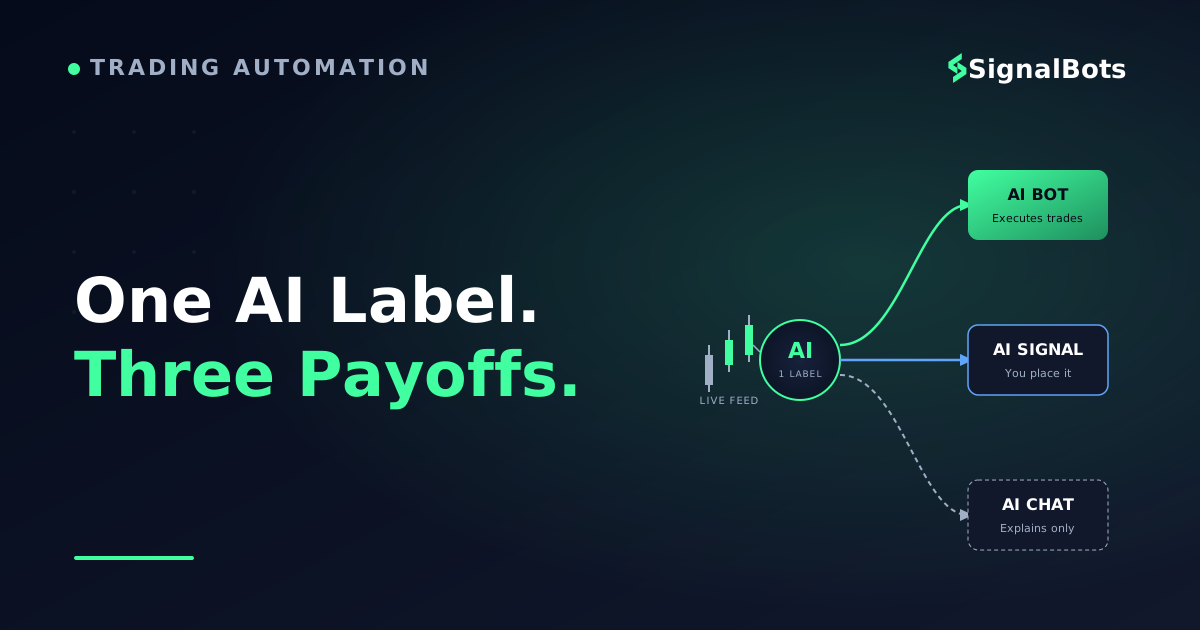
An AI bot places the CALL or PUT on your account itself; an AI signal service only sends an alert you act on; an AI chat tool answers questions and never touches an order.
Quotex ships a built-in signals panel and strategy copying, but no native AI bot and no official public trading API — every "Quotex AI bot" is third-party software layered on your account.
Most "AI" in this niche is a rule-based indicator script. Ask for the mechanism, the sample size and the losing trades before you fund anything.
Fixed payouts set the bar: at an 80% payout, better than roughly 56% of trades must land just to break even, and a binary trade has no stop-loss to rescue a bad entry.
Table of Contents (22 min read)Contents
Three Products, One "AI" Label
Almost everyone searching for a quotex ai bot wants one of three things, and most vendors are content to let the confusion stand — it widens their audience.
An AI trading bot decides and executes. It watches the price feed, applies its logic, and places the CALL or PUT on your account without you touching the mouse. On Quotex this is nearly always a browser extension, because the platform is web-based.
An AI signal service decides and tells you. You receive an alert — asset, direction, expiry — through Telegram, an app or a panel, and you place the trade yourself.
An AI chat tool does neither. It is a language model that reads your question or your screenshot and answers in words. It generates no live alert and touches no order.
The three paths
flowchart TD
    F[Live Quotex price feed] --> B[AI trading bot in your browser]
    F --> S[AI signal service]
    B --> BE[Places the CALL or PUT itself]
    BE --> BO[Position opens while you are away]
    S --> SA[Alert with asset, direction and expiry]
    SA --> SM[You place the trade by hand]
    Q[Your question or chart screenshot] --> L[AI chat tool]
    L --> LE[Explanation or a written plan]
    LE --> LN[No order and no live alert]
Same 'AI' badge, three completely different endpoints — only one of them moves money without you.
The first category is auto-trading software — a binary options bot that holds the trigger. That is the highest-consequence choice on this page, because a bad configuration keeps costing you money for as long as the browser tab is open.
The second is a signal provider wearing an AI badge. Several tools marketed as "Quotex robots" are exactly this: they analyse and alert, and the word robot refers to the analysis, not to the execution. That distinction is not pedantic. A signal service can only cost you what you choose to click.
The third is the newest and the most honestly positioned of the three. Some AI-for-Quotex sites are ChatGPT or Claude front-ends that explain candle structure, review a screenshot, or drill you on discipline. A few state plainly on their own homepage that no language model can predict a short-term price move. That is a fair description of what they are: teaching tools, not signal engines.
Snapshot
AI trading bot
AI signal service
AI chat tool
Who places the trade
The software, on your live account
You, by hand
Nobody
What you actually receive
Open and closed positions
Asset, direction, expiry
An explanation or a written plan
Typical cost model
Licence or subscription, sometimes unlocked by a deposit
Free channel with a paid VIP tier
Free tier or a chat subscription
Exposure while it runs
Every trade its size rule allows, unattended
Only the alerts you act on
None directly
Most common way it fails
Runs a losing regime for hours before you look
The alert lands late and the entry has moved
A confident answer that is simply wrong
Read the middle row first — 'who places the trade' is the only difference that changes how much of your balance is exposed.
What's Actually Behind the "AI" Label
"AI-powered" is a claim about a mechanism, and a mechanism can be described. When a vendor will not describe theirs, that silence is the finding. Three engines wear this badge in the Quotex niche, and they are not equally clever.
Rule-based indicator scripts wearing an AI badge
This is the overwhelming majority. Underneath is a stack of conditions: an oscillator below a threshold, a candle pattern, a trend filter, a minimum payout, maybe a session window. If every condition is true, fire a CALL at a one-minute expiry. Nothing learns. Nothing adapts. The same inputs produce the same output today and next year.
That is not worthless — a mechanical rule set does remove hesitation, revenge entries and the 3 a.m. impulse trade, which is genuinely most traders' largest leak. It just is not artificial intelligence, and it should not be priced or trusted as if it were. The tell is easy: open the settings panel. If it exposes indicator names, periods and thresholds, you are configuring a script. The "AI" lives in the sales copy, not in the code. Most tools sold as AI on Quotex are a fixed stack of indicator conditions — ask what is inside before you accept the badge.
Machine-learning pattern scoring
A smaller set is real. A model is trained on historical candles and outputs a score — a probability that the next few minutes close higher — and the tool acts when that score clears a threshold. This exists, it is legitimate engineering, and it comes with two caveats an honest vendor will raise before you do.
The first is overfitting: a model tuned until it explains the past perfectly has usually memorised noise rather than learned structure, and it falls apart on data it has never seen. The second is specific to this platform. Weekend and after-hours OTC instruments are quoted by the platform rather than by an exchange, so a model trained on those series has learned that quote generator, not a market. Neither point disqualifies a tool. Both are questions you get to ask: what was it trained on, over what period, and what happened when it was tested on data held back from training?
LLM tools used as a tutor, not a predictor
The third engine is a large language model with a Quotex-shaped wrapper around it. You paste a screenshot, describe the setup, and it walks through the structure, the invalidation level and the reasoning. Searches for AI trading signals on Quotex increasingly land on exactly this, which is why the category deserves naming.
A language model has no live tick feed unless somebody wires one to it, and even wired it responds far slower than a script reading the same page. It is a tutor and a second opinion, and the good ones say so. Treat any chat product that claims to generate live entries as one of the other two categories with a chat interface bolted on, and judge it by that standard instead.
Does Quotex Have Its Own AI Bot or Signal Feature?
Not an AI bot, no. The platform has never shipped native auto-execution, publishes no official public trading API, and offers no MetaTrader bridge of its own. Every "quotex ai signal bot" you will ever be offered is third-party software layered on top of your account.
What the platform does include confuses the picture. There is a built-in signals panel in the trading room that scans indicators across the available assets and surfaces suggested directions, refreshed continuously, and it carries the platform's own accuracy claim. Two things about it are worth being precise on: it is an indicator scan rather than a learning model, and it does not trade — you still click. It is a signal display. There is also a strategy-copying feature, which mirrors another account's positions; copy trading is a different mechanism with a different risk profile, and it is not a bot.
The practical consequence of having no official API is that automation has to reach your account the long way round — through the page itself. That is why nearly every Quotex bot is a browser extension that reads the DOM and clicks the buttons for you. It also means three things are on you rather than on the vendor: the permissions you grant that extension, the fragility of any tool that depends on the page layout staying put, and the platform's current position on automated trading permission, which is a term you should read for yourself rather than take from a vendor's FAQ.
How to Set Up and Test an AI Tool on a Quotex Account
The sequence below is deliberately slower than any vendor's five-step quick start, and the ordering is the point: nothing touches real money until you have your own record of what the tool does.
Test path
From install to a decision you can defend
1
Switch to the demo balance first
Flip the account selector to practice funds before you install anything. Nothing here needs a live deposit to be tested.
2
Install and read the permissions
Grant an extension access to the trading page only. Anything asking for all sites, or for your password, fails here.
3
Match the tool to one expiry
Set the tool's timeframe and the trade expiry to the same horizon it was designed for, then leave both alone.
4
Set a payout floor and a stake cap
A fixed-payout market means the payout level sets your break-even bar. Cap the stake as a flat figure, not a percentage.
5
Fix the sample size in advance
Decide the number of trades before you start, and write it down. Deciding when to stop mid-run is how a bad tool survives.
6
Log every trade yourself
Asset, direction, expiry, payout, result. Your log is the evidence; the tool's own dashboard is its marketing.
Steps 5 and 6 are the ones vendors leave out — they are also the only ones that produce evidence.
Why a binary bot cannot manage a trade
This is where generic bot guides mislead Quotex traders. On a continuous market, a bot spends most of its life managing an open position — trailing the stop, taking partial profit, cutting early when structure breaks. A bot placing a CALL or PUT at a fixed expiry can do none of that. Once the order is in, there is no stop-loss, no scaling out, no exit. The trade resolves at expiry and that is the whole story.
So "risk management" in a binary tool means only four things: how much it stakes, how often it fires, what it refuses to trade, and when it stops for the day. If a vendor's risk feature list mentions trailing stops, they have adapted a forex product and not thought about what they were adapting.
The arithmetic that sets your bar
Fixed payout, full stake at risk
━ Call payoff━ Put payoffx-axis: underlying price at expiry • y-axis: P&L per $100 staked
Illustrative: a $100 stake at an 80% payout returns $80 on a hit and costs the full $100 on a miss — so better than roughly 56% of trades must land just to hold the account flat.
The asymmetry above is why a bare accuracy claim tells you nothing. A win rate is only meaningful next to the payout percentage it was earned at, because payout alone decides the break-even win rate the tool has to clear before it is contributing anything. Run your own numbers on the break-even win rate calculator at the payouts you actually get, then compare that figure with whatever the marketing page claims. A tool's own dashboard is its marketing; the only record that settles the question is the one you keep.
That log from step six is what turns "it seems to work" into a decision. Run the tool on a demo account for the number of trades you committed to in advance — a large enough sample that a lucky streak cannot carry it — and record the result of every single one, including the trades you would have skipped. Then put your measured win rate next to the vendor's claim and next to the break-even bar. Three numbers, one honest verdict. A forward test on demo will not reproduce live conditions perfectly, but a tool that cannot clear its own claim on practice funds will not start clearing it with real ones.
How to Judge an AI Tool's Claims Before You Fund It
Every vendor page in this niche has the same hole in it: a confident mechanism claim with nothing verifiable behind it. You cannot audit their code, so audit their disclosure instead — what a vendor volunteers, and what they dodge, is information.
Due diligence
Before you fund an AI bot or signal service
0 / 9
Get the mechanism in writing — which indicators and thresholds, or what the model was trained on and over what period.
Ask what the tool does during a losing streak, and listen for whether they have ever watched one.
Check that any claimed win rate names the payout level and the number of trades behind it.
Ask to see the losing trades, not a highlight reel — a record with no drawdown figure is not a record.
Confirm whether martingale-style stake doubling is switched on by default, whatever the settings screen calls it.
Confirm you can disable auto-execution and run the tool in alert-only mode while you evaluate it.
Read the platform's current terms on automated software yourself, rather than the vendor's summary of them.
Identify who the vendor is — a name, a history, and a support channel that replies before you have paid.
Treat 'guaranteed', 'risk-free' or 'never loses' as a hard stop, not a headline.
★
Checklist complete — you’re cleared to proceed.
Work through this before any deposit. A vendor who cannot answer the first four questions has answered them.
A few of those deserve a sentence more. A backtest is only evidence if you know its period, its instruments and its assumptions — otherwise it is a curve fitted to a story. A historical win rate quoted without a maximum drawdown beside it hides the part that actually ends accounts: the run of losses you have to survive to collect the average. And a tool you cannot inspect at all is a black box — sometimes an acceptable trade-off, never an invisible one.
One pattern deserves calibration rather than alarm. Plenty of tools are unlocked by registering through a specific partner link, which means the vendor is paid by your deposit rather than by your results. That is not automatically a scam — it is how a great deal of free trading software is funded, ours included — but it does tell you where the incentive sits, and it is a reason to insist on a verified track record rather than a testimonial screenshot.
What Automation Doesn't Remove
Automation removes hesitation. It does not remove exposure, and on a fixed-expiry product it can quietly increase it.
The loss on any single binary trade is bounded at the stake, which sounds reassuring until you notice what is not bounded: frequency. A script that fires every few minutes will express a small negative edge dozens of times an hour, and a negative edge repeated fast is simply a faster path to the same place. Add stake-doubling recovery logic — martingale, under whatever friendly name the settings panel gives it — and a short run of losses can consume an account that a flat stake would have merely dented. That combination is the single largest driver of risk of ruin in automated binary trading.
Two more things sit outside the software entirely. Where the platform you fund is registered determines what recourse you have if a withdrawal stalls, and that is worth checking directly with the relevant regulator rather than on a review site. And a tool that clicks buttons on a web page breaks when the page changes — an update can turn a working bot into one that mis-clicks, and it will not tell you.
None of this argues against automation. It argues for automating a rule set you have already measured, at a stake that survives being wrong repeatedly. Our own risk warning sets out the rest of that in plain terms.
What a Transparent Signal Feed Actually Shows
The checklist above asks a vendor to disclose entry, expiry, payout context and a real win-rate history. That is easier to recognise once you have seen it done, so here is ours, with the ownership stated plainly: our binary options signal feed publishes each signal with its entry, its expiry and its historical win-rate context, free to view without an account.
Use it as a yardstick rather than an endorsement. Open it next to whatever AI tool you are evaluating and compare what each one is willing to show you before payment — the specificity of the entry, whether expiry is stated, whether the win-rate figure is attached to a visible history rather than a banner. To be clear about the boundary: that feed is a signal source, not a Quotex auto-trader. You still place the trade yourself, and a reader who wants genuine hands-off execution on their Quotex account needs a bot or a connector, which is a different decision from this one.
Which Path Fits You — Bot, Signal Service, or DIY AI?
The right category follows from what you are short of, not from which product has the best landing page.
Short of time, with a rule set you have already measured — a bot is the honest fit. You are buying execution, not insight, so weigh the Quotex trading bot market by configurability, a working kill switch and alert-only mode.
Short of setups, but present at the screen — a signal service costs you far less if it turns out to be mediocre, because you approve every trade. Judge it on how fast the alert reaches you and how much context it carries.
Short of understanding — an AI chat tool is genuinely the best value of the three, and the only one that improves you rather than substituting for you. Pair it with demo trades and it earns its place.
Certain you want automation but unsure of the strategy — none of the three yet. A bot deployed on a strategy you cannot describe automates a guess.
You arrived asking
“Is this Quotex AI bot going to trade for me, or just talk to me?”
and you can now answer it in one look:
Find out who places the trade, then judge the disclosure behind the claim..
The label never told you anything. The mechanism does.
Sort the tool first — bot, signal service, or chat tutor — because that single question decides how much of your balance is exposed. Then ask what the AI actually is, run the demo sample you committed to, and put your own logged win rate next to the payout you are being offered. A tool that survives that sequence has earned a live deposit; one that dodges any part of it has told you what it is.
No. Quotex has no native auto-trading feature and no official public trading API, so nothing calling itself an official Quotex bot is what it claims. The platform does include a built-in signals panel and a strategy-copying feature, but neither places trades on your behalf from an AI model. Every automated tool for the platform is third-party software running on top of your account, usually as a browser extension.
Can ChatGPT or Claude trade on Quotex for me?
Not on their own. A language model has no connection to the price feed and no way to press the trade button, so a chat tool can only produce words — an explanation, a plan, a critique of your screenshot. Products that pair a chat interface with live execution are doing the execution with conventional code and using the model as a front end; evaluate them as bots, using the same checklist.
Do AI bots work on OTC assets?
They run on them, which is not the same thing. OTC instruments are quoted by the platform rather than an exchange, so any tool trained or tuned on that series has learned the behaviour of that quoting process. If you test on OTC, log OTC results separately from weekday market results — mixing them produces one blended number that describes neither.
Will using a bot get my account restricted?
That depends entirely on the platform's current terms, which you should read yourself before installing anything. Automation permission is a policy, not a technical fact, and a policy can change after you have deposited. Treat any vendor who assures you it is definitely allowed, without pointing at the clause that says so, as guessing on your behalf.
How many demo trades are enough before going live?
Enough that a lucky streak cannot explain the result, and fixed in advance so you cannot stop at a flattering moment. The number matters less than the commitment: choose it, write it down, run the whole sample, then compare your logged win rate against the payout-driven break-even bar. If the tool clears the bar only when you exclude the trades you did not like, it has not cleared it.
Are free AI signal channels worth following?
Some are, as a source of setups to check against your own analysis. The economics are what to watch: a free channel is usually funded by broker registrations or by an upsell to a paid tier, which shapes what gets posted and how often. Judge one exactly as you would a paid tool — mechanism, sample, drawdown, and whether entries are posted before the move or celebrated after it.
Sources & Further Reading
Want to go deeper? These independent, authoritative sources shaped this guide — each one is worth reading in full:
The Binary Options Desk is the SignalBots editorial team for fixed-time and OTC trading coverage. We research and write the guides that explain expiry timing, payout structure and disciplined entry across the major brokers.



Discussions 0
Leave a comment