You searched for the Quotex API documentation expecting what most platforms give a developer: an auth section, an endpoint table, maybe a sandbox key. What you got instead was an AI-written answer page, a document re-uploaded to a file-sharing site, two GitHub projects with confusingly similar names, and a freelance job post from someone asking the exact question you are.
Your search was fine. The topic is the problem — and none of those pages will tell you so. This guide does: whether an official Quotex API exists, how to ask the platform directly and what to expect back, what already solves the automation you actually want, and where developers go when they still insist on writing code against a closed platform.
Key Takeaways
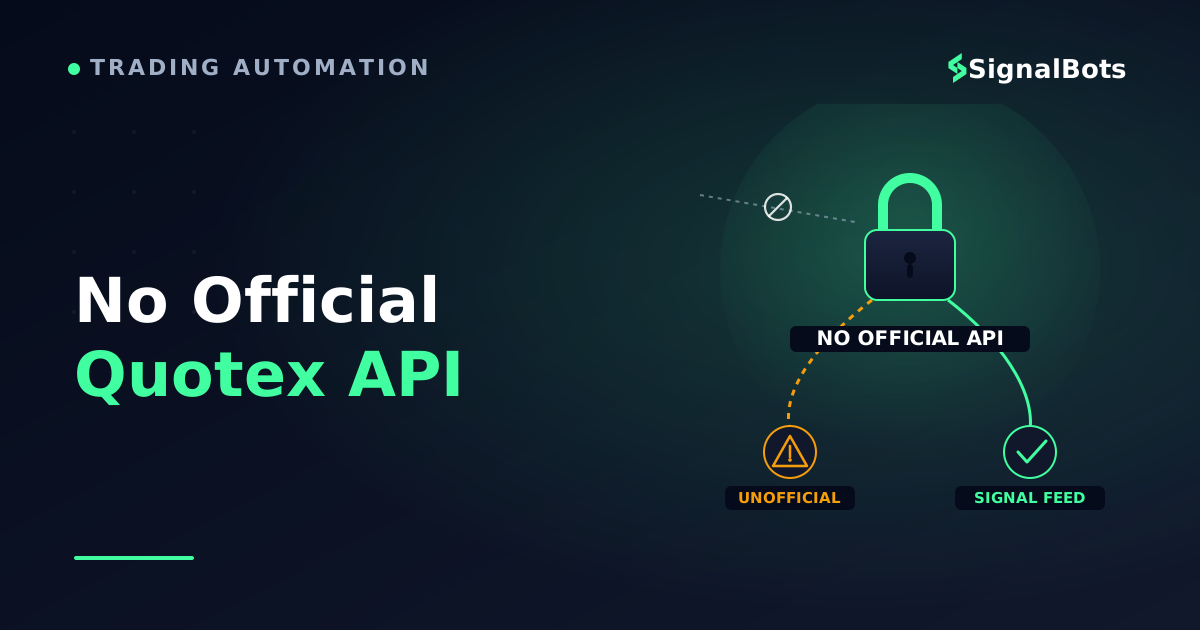
Quotex (qxbroker) publishes no official API, no developer program, no sandbox and no public documentation — there is no key to request.
Almost everything ranking for "quotex api documentation" is AI-generated text, a re-upload, a job listing, or honest community code that labels itself unofficial.
Most people searching the term want automation, not an endpoint: platform features, a screen-level bot or an MT5 connector solve that without any API.
The developer route is real but reverse-engineered — it borrows a browser session, breaks when the platform changes, and carries account and credential risk.
Table of Contents (19 min read)Contents
Does Quotex Offer an Official API?
No.Quotex — the same platform you may know by its qxbroker branding — publishes no official API, no developer portal, no sandbox environment and no public documentation. There is no page where you register an application, nowhere to generate a key, and no published endpoint reference or rate-limit policy. Everything ranking for quotex api documentation was written by someone other than Quotex.
Be precise about what that does and does not mean, because the distinction decides your next move:
It does not mean there is no interface at all. Like every web application, the Quotex platform talks to its own backend over the network. That interface exists — it is simply private, undocumented and not offered to you.
It does not mean automation on Quotex is impossible. It means automation does not happen through a sanctioned broker API the way it does on a MetaTrader-based forex broker or a crypto exchange.
It does mean nobody owes you a fix when something breaks. No official interface means no official support, no deprecation notice and no status page for the thing your code depends on.
Quotex has not published a reason for the absence, so treat any explanation as inference rather than fact. The pattern across short-expiry binary and OTC platforms is consistent, though: these are closed, self-contained web products where the platform controls the whole surface, and opening a documented programmatic channel would mean committing to versioning, abuse controls, support staff and a clear regulatory position on machine-placed trades. Platforms in this category generally decline that commitment. A closed platform is not a platform with hidden documentation — there is simply no developer entrance to find.
So the useful question is not "where are the docs" but "which of four paths matches what I am actually trying to do":
No official Quotex API — so which path is actually yours?
Take itProceed with careSkip / stand aside
Four honest paths. Only one of them involves anything resembling an API, and it is not an official one.
What "Quotex API Documentation" Search Results Actually Are
Before you click back into those results, it helps to know what each type of page actually is. They look like documentation because they borrow the vocabulary of documentation — endpoints, authentication, parameters — while none of them speaks for the platform.
Read the results honestly
What you clicked
What it actually is
Can it be official?
What it is genuinely good for
AI answer / Q&A pages
A machine-written summary of the same public guesswork you already found
No
Nothing you can act on
API-spec generator pages
A prompt template that invents a plausible-looking specification on demand
No
Nothing — the endpoints are fiction
Document-upload sites
Re-uploaded marketing text dressed up as a manual
No
Nothing verifiable
GitHub repos and their docs sites
Real, working code — written by the community, reverse-engineered, self-labelled unofficial
No
Seeing what unofficial access looks like in practice
The only party that can actually speak for the platform
Yes
Getting the answer in writing, from the source
Five of the six result types on this query cannot, by definition, contain official documentation.
Two of those rows deserve a warning of their own. Generated API specifications are the most dangerous, because they read exactly like the real thing — a base URL, a bearer-token header, a /v1/orders route — and every line of it was produced by a language model that had nothing to describe. Developers have burned evenings implementing against those pages before discovering the host does not exist.
Community repositories are the opposite: honest and technically real. Nearly all of them state "unofficial" in the first line of their README, and their maintainers are the ones warning loudest about the risks. They are the most useful thing on the results page — they just are not documentation of an official product, and no amount of stars changes that.
How to Ask Quotex for API or Integration Access
You should still ask, once. Not because the answer is likely to be yes, but because a written reply ends the uncertainty and stops you from building a plan around a forum rumour.
Open a support conversation from inside your logged-in account. The in-platform chat and the help-centre contact form are the channels that reach the platform's own staff. Ignore third-party "Quotex API support" contacts entirely — impersonation is common on this exact query.
Ask four specific questions rather than one vague one. Does an official API or developer programme exist? If so, where is the documentation? What are the eligibility conditions? And if not, does the platform permit third-party automation of the account at all? Vague questions get vague answers.
Ask for the answer in writing. A chat transcript or email reply is what you keep; a verbal "I think so" from an agent is worth nothing.
Try the partner or business channel if you have a commercial case. Volume-driving partners occasionally reach conversations that retail support cannot. That is a business-development conversation, not a self-serve signup.
Set your expectations honestly before you send it. We have seen no evidence of a retail developer programme at Quotex — no application form, no key management screen, no published terms for programmatic access — so the realistic outcome is a support agent confirming there is nothing to point you at, and possibly reminding you of the platform's stance on automated trading. That reply is still valuable: it converts "maybe there is something I haven't found" into a decision you can act on.
If the answer ever changes, it will change on the platform's own site first — not on a document-sharing page. Check the source, not the summary.
What You Can Automate on Quotex Without an API
Here is the part most of these search results skip entirely. A large share of people typing quotex api do not want an API — they want auto-trading: trades that get placed without them sitting at the screen, or signals that arrive without them watching charts. An API is one way to get there, and on this platform it is the least available one.
The platform's own built-in tools
Start inside the account you already have. The platform ships its own indicator set, chart tools and market-analysis features, and its social and copy-style features come and go by region and app version. Check what your own account actually offers rather than trusting any blog post — including this one — on which features are live for you today. If copy trading is available to you, it is worth understanding on its own terms as a hands-off alternative; it is a platform feature, not an integration you build.
The important limitation: none of this is programmable. You can configure what the platform offers, but you cannot extend it, script it, or feed it your own strategy logic.
This is the most misunderstood option on the list, so be clear about the mechanics. MetaTrader and TradingView cannot place a trade on Quotex. Quotex is a closed platform with its own order interface; MT5 orders route to MT5 brokers, and TradingView alerts route wherever a webhook is configured to go. Neither one has a supported path into a Quotex account.
What actually exists is a bridge. Your analysis lives where you like it — an expert advisor on MT5, an indicator on TradingView — and a separate piece of software performs the action on the Quotex screen on your behalf. That mechanism is broker page automation: the automation operates the platform's own interface the way a very fast, very disciplined human would, rather than calling a private backend.
Two consequences follow, and both matter more than the marketing around any bridge tool:
It is not an API integration, so nothing about it is faster or more privileged than the web platform itself. It clicks; it does not inject orders into a matching engine.
It survives platform changes better than a reverse-engineered client, because a visible interface changes less often and more visibly than a private endpoint — but it is still dependent on the platform's layout and rules.
Every credible tool in the Quotex trading bot market works this way, and the honest ones describe themselves in exactly those terms rather than dressing the mechanism up as an integration. If a tool in this space claims an "official API integration" with Quotex, treat that as a reason to distrust everything else it claims.
The Unofficial Route Developers Actually Use
If you genuinely want to write code, this is the path that exists — and it is worth understanding before you commit a weekend to it. A handful of community-maintained Python clients wrap the platform's private interface. They are unofficial and reverse-engineered, they say so themselves, and Quotex has no relationship with any of them.
The shape of every one of them is roughly the same:
There is no key to issue, so the client authenticates the way a person does — through the normal login flow.
2
A browser session is automated
Headless browser tooling completes the login and hands back the session the web app is already holding.
3
A real-time connection is opened
The client then speaks to the same streaming endpoints the browser uses for quotes and order events.
4
Your code reads quotes and sends orders
Everything runs over an interface the platform never published and never promised to keep stable.
5
A platform change breaks it
A tweaked login flow or renamed endpoint stops your bot until a volunteer maintainer ships a patch.
No API key anywhere in the chain — the whole approach rests on borrowing a browser session.
Two details in that flow explain most of the frustration people report. First, authentication is a session extraction, not a credential exchange: your real username and password go into the tooling, and what comes out is the same session token your browser holds. Second, the transport is WebSocket streaming against undocumented endpoints — fast and genuinely real-time, but with no contract behind it. When maintainers say a project "supports Quotex," they mean it worked against the platform's behaviour on the day they last tested.
Depth on this route belongs elsewhere and is genuinely worth reading before you start: the unofficial WebSocket protocol and its authentication handshake, an honest comparison of the community Python libraries, and what building your own Quotex trading bot involves end to end are each their own subject. What matters here is that the route exists, that it is unofficial, and that choosing it is a maintenance commitment rather than an integration. Community clients really do work — until the platform changes the ground they were built on.
Is an Unofficial Quotex API Connection Safe to Use?
"Safe" splits into four separate questions, and the honest answers differ.
Account standing. Automated access to a closed platform through an undocumented interface is not something the platform sanctions, and library maintainers themselves warn that aggressive or heavily parallel connections invite account restrictions. Read the terms of use of the account you are risking, not a summary of them.
Credential exposure. These clients need your live login. That means your real trading credentials sit inside a third-party codebase — often with cached session files on disk — and any dependency in that tree can read them. Never run one on a shared machine, and never paste credentials into a fork you have not read.
Silent breakage. The failure mode that costs money is not a crash. It is a client that stops receiving updates while a position is open, or that thinks an order was placed when it was not. Build for that case explicitly or do not run unattended.
No recourse. If a trade goes wrong because of a library bug, there is no support desk anywhere in the chain — not at the platform, not at the project. That risk is yours alone.
The practical mitigation is unglamorous and effective: run every unofficial connection against a demo account first, for far longer than feels necessary, and watch specifically for the silent failures rather than the loud ones. A binary options bot that behaves perfectly for an hour tells you very little; one that survives a week of reconnects, expiries and platform hiccups tells you something.
If You Just Want Automated Trade Ideas, Not an API
Come back to the decision tree at the top for a moment. If your branch was "ready trade ideas," everything above — session extraction, endpoint drift, credential hygiene — is machinery you never needed to touch. You wanted the output of an integration, not the integration.
That is what our binary options signal feed is: ready trade ideas with the asset, direction, expiry and timestamp already resolved, each shown with historical win-rate context so you can judge the feed before you act on it, viewable free and with no Quotex API integration or code anywhere in the picture. Concretely, the thing you would have had to build — connect, subscribe to quotes, evaluate a rule, decide direction and expiry — arrives as a finished line you read.
Be clear on the boundary, though: a signal feed is not an API and not an execution engine. It hands you decisions; you still place the trade, or route it through a bot or connector. If what you truly need is programmatic access — your own strategy logic, your own order flow, your own data pipeline — a feed does not replace that, and the unofficial developer route or a screen-level connector remains your path.
Where This Leaves You
The short version: there is no official Quotex API, no documentation to find, and no key to request — and the pages promising otherwise are, without exception, written by someone with no authority to promise it. What exists instead is a real set of options, and the right one depends entirely on whether you want to build something or get something.
You arrived looking for
“official Quotex API documentation and a way to request access”
and you are leaving with
a straight no, plus the four paths that actually work.
The docs do not exist — but your automation problem still has a solution
Ask Quotex once in writing so the question is closed. Then pick by outcome, not by technology: a signal feed if you wanted the decisions, a screen-level bot or connector if you wanted hands-off execution, and the unofficial community route only if you actually want to own and maintain code against an interface nobody documents.
Continue your researchAlgo trading permissionWhat a platform's own rules say about automated access→Copy tradingThe hands-off route that needs no code at all→
FAQ
Is there an official Qxbroker API?
No. Qxbroker is the same platform as Quotex, so the answer does not change with the branding: there is no official qxbroker API, no developer portal and no key issuance. Any page offering "qxbroker API documentation" is either community work on the private interface or generated text.
Where is the official Quotex API documentation?
It does not exist publicly. There is no documentation page on the platform's own site, which is the only place official docs could legitimately live. Everything else you find is third-party — helpful in the case of community projects, worthless in the case of generated specifications.
Can I get a Quotex API key?
There is no key to get, because there is no programme that issues one. Unofficial clients work around this by driving a normal login and reusing the resulting browser session, which is why they need your actual account credentials rather than a revocable token.
Does Quotex have a REST API or a WebSocket API?
Not a public one of either kind. The platform's own web app naturally communicates with a backend, and community clients reach it primarily over WebSocket rather than a documented REST API — but that interface is private, undocumented and subject to change without notice. Treating it as an API in the normal sense is the mistake that costs people weekends.
Can I use MT4, MT5 or TradingView to trade on Quotex?
Not directly. Those platforms cannot send an order into a Quotex account. What works is a bridge: your analysis runs in MT5 or TradingView, and a connector or browser extension executes on the Quotex interface for you. Useful, widely used — and not an API integration, whatever a vendor's landing page calls it.
Will Quotex restrict my account for using an unofficial API library?
That is a real possibility and worth taking seriously. Automated access through an undocumented interface is not sanctioned, and the maintainers of these libraries are themselves explicit about ban risk from heavy or parallel connections. The platform's terms of use, not a GitHub README, govern what happens to your account.
Can I test an unofficial Quotex connection on a demo account?
Yes, and you should. Community clients generally let you select the demo balance, which lets you watch reconnect behaviour, expiry handling and order confirmation without capital at stake. Give it far more time than feels necessary before pointing anything at a live balance.
Searches in other languages return the same results — is the answer different?
No. The same question searched in Spanish, Portuguese, Hindi or Arabic returns the same mix of community projects and generated pages, because the underlying fact is language-independent: Quotex has published no API and no documentation in any language.
Sources & Further Reading
Want to go deeper? These independent, authoritative sources shaped this guide — each one is worth reading in full:
The Binary Options Desk is the SignalBots editorial team for fixed-time and OTC trading coverage. We research and write the guides that explain expiry timing, payout structure and disciplined entry across the major brokers.




Discussions 0
Leave a comment