Type "quotex bot" into a search box and the results come back looking interchangeable. They are not. One is a Chrome extension that presses CALL inside your open Quotex tab. One is an Android app that only pings you with alerts. One is a Python project hosted on GitHub whose real price is quoted after you message the seller on Telegram. One is a desktop program that listens to a signal channel and relays what it hears into live trades. And one is not a product at all — it is something you would build yourself against an API the platform never officially published.
Those five things cost different amounts, break in different ways, and carry very different odds of taking your money and going quiet. Choosing well starts with knowing which one you are actually looking at.
This page is the map for that decision: what each category really is under the marketing, how to filter out the sellers you should never pay, and where to go deeper once you know which category is yours. It deliberately does not review any single bot in depth — each category points to the page that does. The phrase hides the product: an extension, an app, a desktop relay and a script are four different purchases with four different failure modes.
Key Takeaways
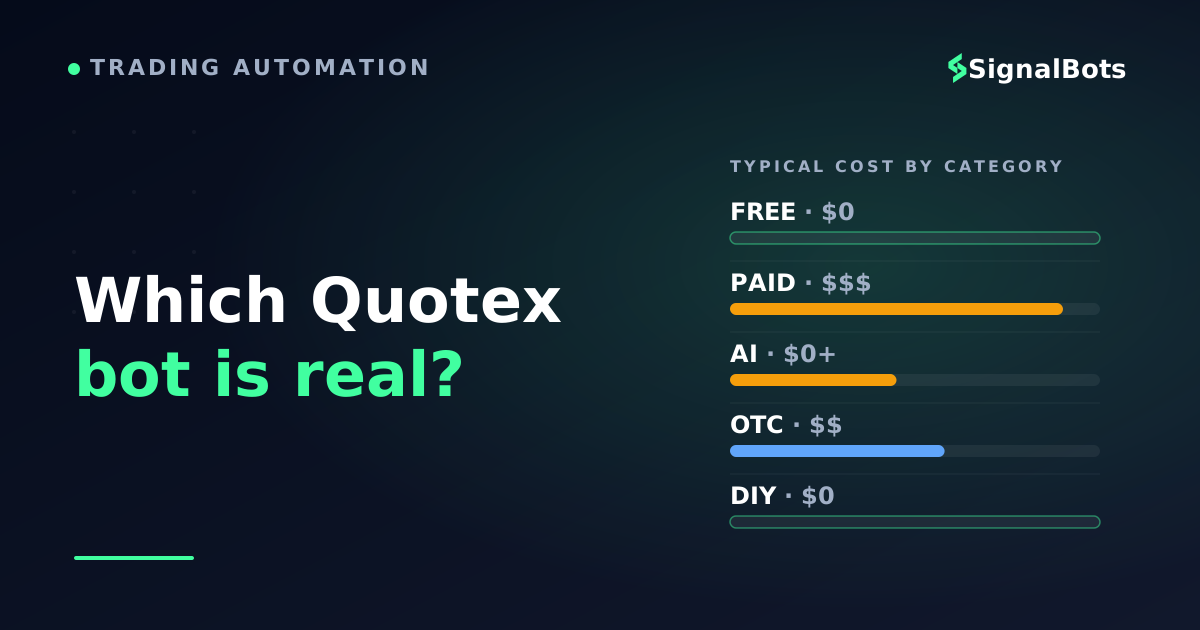
"Quotex bot" covers five different products — free scripts, paid premium bots, AI-branded extensions, OTC-specific tools and DIY API builds — and picking well starts with naming your category.
Most paid bots are someone else's signal feed wrapped in an execution layer, so judge the signal source before you judge the software.
A payout below 100% puts break-even above a coin flip: any bot advertising a win rate near 50% is advertising a losing system.
Test on a demo account for a full week and insist on an identifiable seller, a written refund policy and a loss cap you control before paying.
Table of Contents (25 min read)Contents
What Counts as a "Quotex Trading Bot"?
Two questions separate every product in this space: does it decide, and does it click?
Signal-only tools decide and then tell you. They analyse price and push an alert — Telegram message, phone notification, arrow on the chart — and you place the trade by hand. Under the branding, that is a signal provider with a countdown timer attached.
Execution bots decide and act. They place the trade themselves, on your account, at the moment their rule fires. That is genuine auto-trading software, and it is the only kind that removes your reaction time and your hesitation from the outcome.
The distinction matters more on a binary platform than almost anywhere else, because entries are timed to the second. A signal you read forty seconds late is a different trade from the one the tool intended.
Almost every product sold as a quotex bot is a signal engine bolted onto an execution layer — and the two halves usually come from different places. Knowing that one detail changes what you are shopping for: you are rarely buying an edge, you are buying a pipe that carries someone else's edge to your account without you fumbling the click.
Here are the five form factors that pipe arrives in.
Browser extension. Installs into Chrome or Firefox, reads the chart in your open Quotex tab, and presses the trade buttons for you. No separate credentials change hands, but it inherits whatever extension permissions you approved at install — and those permissions are the part almost nobody reads.
Desktop application. A program running on your PC that relays a signal source — a Telegram channel, a charting alert, its own model — into trades on the platform. Usually licence-key based, sometimes sold only after you message the seller directly.
Mobile signal app. An Android build, often sideloaded from a mirror site rather than an official store. In this niche it almost always alerts rather than executes, whatever the listing calls itself.
Script sold or shared as code. Python in a terminal, talking to an unofficial broker API. Some are genuinely open source. Others are hosted on GitHub with screenshots, no install documentation, and a price quoted by direct message — a shop wearing a repository's clothes.
A build of your own. The same architecture as the script above, except you write the rules, so there is no vendor to trust and no one else to blame when it breaks.
The Categories of Quotex Bots at a Glance
Form factor tells you where the software runs. Category tells you what you are buying and what it costs you — in money, in time, or in trust.
Priced like its parent category, sold on weekend coverage
Rules tuned to synthetic weekend quotes
Extension or desktop app
The Quotex OTC bots guide
Built by you
Nothing to buy, plenty of hours
Whatever you code — you own every rule
Your own script or small server
The API, WebSocket and Python library guides
The five things people mean by "Quotex trading bot" — read the signal-source column before the price column.
Read the signal-source column and the price column together and the pattern gives itself away. A paid premium bot and an AI-branded bot are frequently the same architecture with different marketing; the difference between them is a word on the sales page, not a difference in how the trade reaches your account. What actually varies is whether you can inspect the logic, who answers when it misfires, and how you get your money back if it never activates.
How to Choose the Right Quotex Bot for Your Situation
Four inputs narrow the field, and it is worth taking them in this order — most people start with price and end up in the worst category for them.
Trust tolerance. How comfortable are you handing a stranger's software a live account? If the honest answer is "not very", you want a signal-only tool or code you can read, not a black box that places trades while you sleep.
Technical skill. Can you install Python, read an error message, and restart something at 2am? If yes, the free and DIY categories open up and your cost drops to zero. If no, an extension is the only category that will not strand you.
Budget — and what money actually buys. Paying buys you maintenance, an interface, and sometimes a support channel. It does not buy an edge, and it never buys a guarantee.
When you trade. If your trading happens on weekday sessions, any category works. If your trading happens at the weekend, you need a bot explicitly built for the OTC market, because those synthetic quotes behave differently from weekday price.
Follow the branch that describes you today, not the one you aspire to.
Your skill level and your appetite for handing over the click decide the category — price is the last question, not the first.
Is Using a Bot on Quotex Against the Rules?
There is no honest one-word answer here, and any page that gives you one is guessing. The platform's own Rules of Trading Operations and Client Agreement are the only authority that counts, they are revised without announcement, and third-party pages currently contradict each other flatly on this exact question. Open the current version inside your account and read the clauses on trading software before you automate anything.
What is consistent across this entire industry is the pattern that gets accounts restricted, and it is rarely "you used software". It is behaviour that looks like exploitation: trading off quote lag, hammering an unofficial endpoint with requests, running identical trades across several accounts, or combining automation with bonus terms that forbid it.
The other thing worth internalising is when you find out. Enforcement on unregulated platforms typically surfaces at withdrawal, not at execution — the trades go through fine for weeks, and the question of whether your bot was allowed only gets asked when you try to take money out.
That matters because the recourse is thin, and it is worth being precise about why rather than hand-waving at "offshore". Quotex itself does not operate under a named tier-one financial regulator — there is no supervisory licence number to look up, no ombudsman to escalate a frozen withdrawal to, and no compensation scheme standing behind your balance. Binary options are permanently banned for retail consumers in the UK and restricted across the EEA, which is precisely why platforms serving this market are based where they are. The practical consequence stacks: the anonymous seller of your bot has no dispute path, and neither does the venue holding your money.
The same status decides who can open an account at all. Quotex is unavailable to residents of dozens of countries, the United States and Canada among them, so a bot marketed to a worldwide audience may simply have nowhere to run for you — and a licence key does not become refundable because your country turned out to be on the restricted list. Check the platform's current country restrictions before you pay for software whose only job is to automate it.
The practical stance that keeps you out of trouble: test everything on a demo account first, keep one account rather than several, and avoid recovery ladders that make your trade history look like abuse.
How to Spot a Scam Quotex Bot Before You Pay
If you cannot state the entry rule, the exit rule and the stop condition in one sentence, you are buying a sealed box.
This niche has a specific scam anatomy, and once you have seen it three times it becomes obvious. The storefront is a Telegram handle. The product page is screenshots. Payment happens in a direct message, in crypto, with no invoice and no stated refund policy. The strategy is described as proprietary, which is a way of saying you may not ask what it does. And the reviews that matter — the one- and two-star ones — describe people who paid for activation and never received it.
None of that is exotic fraud. It is simply a sale with every accountability mechanism removed: no company name, no dispute path, no way to compel a refund, no verified track record you could check independently. Be wary of anything advertised as "risk-free" or promising a fixed win rate — on a product whose payout structure guarantees losing trades will happen, that language is not optimism, it is a tell.
The arithmetic is the part sellers hope you skip. A binary trade pays out less than you staked when you win, but costs the whole stake when you lose. With a payout percentage below one hundred, breaking even requires winning noticeably more than half your trades — so a bot advertising a win rate just above 50% is advertising a losing system, and any historical win rate is a record of the past, not a forecast. Read every claim through that lens, and read our risk warning before you fund anything.
Why the win-rate claim decides everything
Illustrative payoff: $100 stake, 80% payout
━ Call payoff━ Put payoffx-axis: underlying price at expiry • y-axis: P&L per $100 staked
Illustrative only: with an 80% payout, a win returns less than a loss takes — which is why break-even sits well above a coin flip.
Run your own numbers on the break-even win rate calculator with the payout you actually get on the pairs you actually trade. Then compare that number to what the bot's sales page claims. If the seller cannot beat the break-even line by a comfortable margin, there is nothing to buy.
Watch especially for bots that hide losses behind a martingale recovery ladder. Doubling after a loss produces a beautiful win-rate figure and a fragile account, because the strategy converts many small wins into one catastrophic loss. The martingale calculator shows how quickly the required stake escalates — try it before you accept "recovery mode" as a feature.
One more filter, on the evidence people trust most: store ratings measure whether software installed and ran, not whether it made money. A high average with a large review count tells you the extension does not crash. It tells you nothing about profitability, and it is not a substitute for a backtested record you can inspect or a week of your own demo results.
Identify a named company or person behind the bot, not just a Telegram handle.
Confirm a written refund policy exists before you pay, not after.
Check whether you can pay through a channel that has a dispute path.
Read the one- and two-star reviews specifically for 'paid but never activated' complaints.
Ask the seller to state the entry rule, the exit rule and the stop condition in plain language.
Reject any pitch that promises a fixed win rate or calls the result risk-free.
Review exactly which permissions the extension requests and which sites it can run on.
Verify you control a daily loss cap or kill switch that the bot cannot override.
Run it on a demo account for a full week, in the sessions you actually trade, before funding it.
★
Checklist complete — you’re cleared to proceed.
If you cannot tick at least seven of these, do not send money — whatever the bot promises.
Free vs Paid Quotex Bots: What Actually Changes
Paying changes four things, and none of them is the edge.
It changes maintenance: an unofficial API breaks when the platform ships an update, and a paid product has someone whose job it is to patch it. It changes interface: free tools tend to be a terminal and a config file, paid ones a panel with buttons. It changes support: sometimes a real inbox, often a Telegram handle that answers before purchase and slowly after. And it changes recourse: a card payment to a named company is recoverable in a way a crypto transfer to an anonymous seller never is.
What paying does not change is more important. It does not make the strategy sound, it does not make the win-rate claim verifiable, and it does not give you exclusivity — the same engine is frequently resold across several platforms, so a bot marketed as purpose-built for one broker is often the identical product with a different logo. The honest way to read price in this category is as a maintenance-and-support fee on someone else's signal, and a paid bot with an unverifiable strategy is worth exactly as much as a free one with an unverifiable strategy.
Best Quotex Bots by Category, With Where to Read More
Here is the landscape as it stands, with real names so you know what you are looking at. Naming a product is not an endorsement — several of these carry the exact risks described above, and the deep-dive pages are where each one gets tested properly.
Free and Open-Source Options
Genuinely free means one of three things here: a community Python wrapper around the unofficial API, the free tier of a store extension that limits trade count or asset access, or an abandoned repository that still compiles. All three can be worth your time; all three can also be stale, since anything talking to an undocumented endpoint has a shelf life. Go here if your budget is zero and you would rather debug than trust. The current shortlist of free Quotex bots, and what each one still does, is covered separately.
Named Premium Bots
These are the products people search for by name — Bot Pro, YQT Bot Pro, Crown Bot, QBot, and desktop tools such as AutobotSignal's Quotex Robot. Structurally, most are signal generators with an execution layer and a licence tier, delivered as an Android build or a Windows application. They vary enormously in whether the seller is identifiable and whether risk controls (stake caps, daily loss limits, a stop button) are real features or screenshots. Go here if you want a supported, install-and-go tool — and read the Bot Pro, YQT Bot Pro and Crown Bot review, plus the dedicated QBot review, before you pay for any of them.
AI-Branded and Signal-Driven Bots
"AI" in this category usually means what Quotex AI bots and AI signals do underneath: a model or a signal feed that scores conditions and fires an alert, which the extension then executes in your tab. Q-bot 2.0 on the Chrome Web Store is the best-known example of the pattern, and web-based products like Quotex Pro sell the same idea with a hosted interface. The label tells you nothing about quality, so judge these exactly as you would any other black box: can you see the rules, and can you cap the damage?
Our own Quotex bot extension sits in this category too, so treat this as disclosure rather than a neutral ranking — we build it. It runs as a browser extension that scores signals inside the Quotex tab and can place the trade for you, with the risk settings under your control. Go here if you want hands-off execution in the browser; the deeper explainer on AI trading bots and signals for Quotex covers how these models are actually constructed.
OTC-Specific Bots
Weekend OTC quotes are generated by the platform rather than an interbank market, so their behaviour — ranging tendency, reaction to news, the way levels hold — is not the weekday market with the volume turned down. A bot tuned on weekday FX often degrades there, which is why OTC-capable tools are sold as a separate class. Our own Quotex OTC bot covers that window, and there is also an MT5 route for Quotex OTC if you would rather drive signals from a MetaTrader chart. Go here if you trade Saturdays and Sundays; the full Quotex OTC trading bots comparison goes through the shortlist.
Build-Your-Own via the API
Building means talking to an interface the platform never published for third parties, so before you start, be clear about what you are signing up for: undocumented behaviour, session handling that breaks without warning, and full ownership of your own risk layer — position sizing, daily loss cap, and a kill switch you can hit from your phone. The upside is total: no licence, no vendor, no black box, and rules you can change the moment the market changes. Go here if you can code and want control. The Quotex API overview, the WebSocket API with Python, the comparison of Python API libraries, the step-by-step build-your-own tutorial, and the guide to using ChatGPT to write a Quotex trading bot each cover one piece of that path.
Two things frequently filed under "bots" are not bots at all. Copy trading is broker-native mirroring — you follow a human's positions, nothing analyses the market on your behalf and nothing installs on your machine. And TradingView or MT4/MT5 integrations are routing layers, not strategies: they carry an alert you already configured elsewhere into a trade here. Both have their own guides; neither belongs in the category table above.
Working is two separate questions: does it run, and does it make money? Free tools do run — community Python wrappers and the free tiers of store extensions will place trades. Whether any of them is profitable depends entirely on the strategy inside, and free tools rarely come with a strategy anyone has validated. Treat a free bot as free execution plumbing you must supply an edge to, not as a free edge.
What is the difference between a Quotex bot and copy trading?
A bot is software that analyses conditions and places trades according to rules. Copy trading is a broker-native feature that mirrors another trader's positions into your account. The bot's risk is that its logic is wrong or unknowable; copy trading's risk is that the person you copy blows up. One is a strategy you install, the other is a person you follow — and the two are governed by completely different platform rules.
Can ChatGPT be used as a Quotex trading bot?
Not directly. A language model cannot see your chart in real time or place a trade on the platform, so it cannot be a bot by itself. What it can do is help you write one — draft the Python that talks to the API, sketch the entry logic, explain an error. That makes it a coding assistant sitting in the build-your-own category, with all the maintenance and risk-control work still on you.
Do Quotex bots keep working at the weekend?
Only if they were built for it. The platform quotes OTC instruments when the underlying markets are closed, and a bot whose rules were tuned on weekday sessions will keep firing into a different price regime without noticing. Check whether the tool names OTC support explicitly — the shortlist of Quotex OTC trading bots is where to start — and if it does, demo it across a full weekend before you trust it with funded trades.
See Real Binary Signals Before You Pay for a Bot
Work back through everything above and one thing stands out: most of what is sold as a Quotex bot is someone else's signal feed wrapped in an execution script. You are being asked to pay for the wrapper and take the feed on faith — which is a strange order to do things in, since the feed is the part that decides whether any of it works.
You can invert that. Our free binary options signals feed publishes live signals with their historical win-rate context attached, so you can watch how a signal source actually behaves across a week of real sessions before you spend anything on automation. Read them, paper-trade them, and judge the quality of the calls on their own merits.
To be clear about what it is not: it is a signal feed, not an auto-execution bot for Quotex. If what you want is genuinely hands-off clicking while you are away from the screen, you still need one of the bots in the category shortlist above — this simply lets you evaluate signal quality first, without installing anything.
Bottom Line: Which Quotex Bot Should You Try First?
Start with the cheapest test that answers your real question. If you can code, clone one of the open-source Quotex Python libraries and read its entry rules — an afternoon there teaches you more about this category than any sales page. If you cannot, install a free-tier browser extension, point it at a demo account, and run it for a week in the sessions you actually trade.
Only after that does paying make sense, and only for a seller who is identifiable, states a refund policy, and lets you cap the damage. The bots worth money in this niche are the ones that hand you control — stake limits, a daily loss cap, a stop button — not the ones that promise the biggest number.
And keep the order straight: judge the signal first, the automation second. A perfect execution layer on a bad signal just loses your money faster than you could have on your own.
Sources & Further Reading
Want to go deeper? These independent, authoritative sources shaped this guide — each one is worth reading in full:
The Binary Options Desk is the SignalBots editorial team for fixed-time and OTC trading coverage. We research and write the guides that explain expiry timing, payout structure and disciplined entry across the major brokers.




Discussions 0
Leave a comment