You have seen the thumbnails: a Quotex chart, a ChatGPT logo, and a balance that supposedly went from three figures to five in one afternoon. What none of them show you is the prompt — and the prompt is the only part that decides whether any of this works.
ChatGPT can produce a consistent, structured trade call for a Quotex pair. It cannot see your chart, it cannot place the trade, and it will invent a support level if you let it. This guide is the actual build: what the model can and cannot do against Quotex, how to get price data in front of it, a prompt template you can copy today, how to check the answer it hands back, and how to forward-test the whole loop on a demo account before a single real dollar is exposed.
Key Takeaways
ChatGPT works as a signal generator for Quotex, not as a bot: it has no market feed, no chart access and no way to place a trade — you carry the data in and place every call yourself.
Pasted OHLC text beats a chart screenshot for any rule that names a price, because a language model reconstructs levels from an image and will produce confident numbers that were never in your data.
The prompt does the work: ordered rules, a no-invention clause, a NO TRADE escape hatch and a fixed output contract are what make the output auditable instead of decorative.
Forward-test on a demo account against the break-even win rate your payout implies, logging every call and every rejection, before any of it touches real money.
Table of Contents (27 min read)Contents
Can ChatGPT Really Work as a Quotex Trading Bot?
It can work as a signal generator. It cannot work as a bot — and the difference is the whole article.
ChatGPT has no connection to Quotex. It does not receive the broker's price feed, it cannot read your open chart, and it cannot open, close or size a position on your account. Every video selling a "chatgpt quotex bot" that trades on its own is describing something else: a separate script driving a browser or an API, with a language model bolted on to write the reasoning. That execution layer is auto-trading software, and it is a different build from the one on this page.
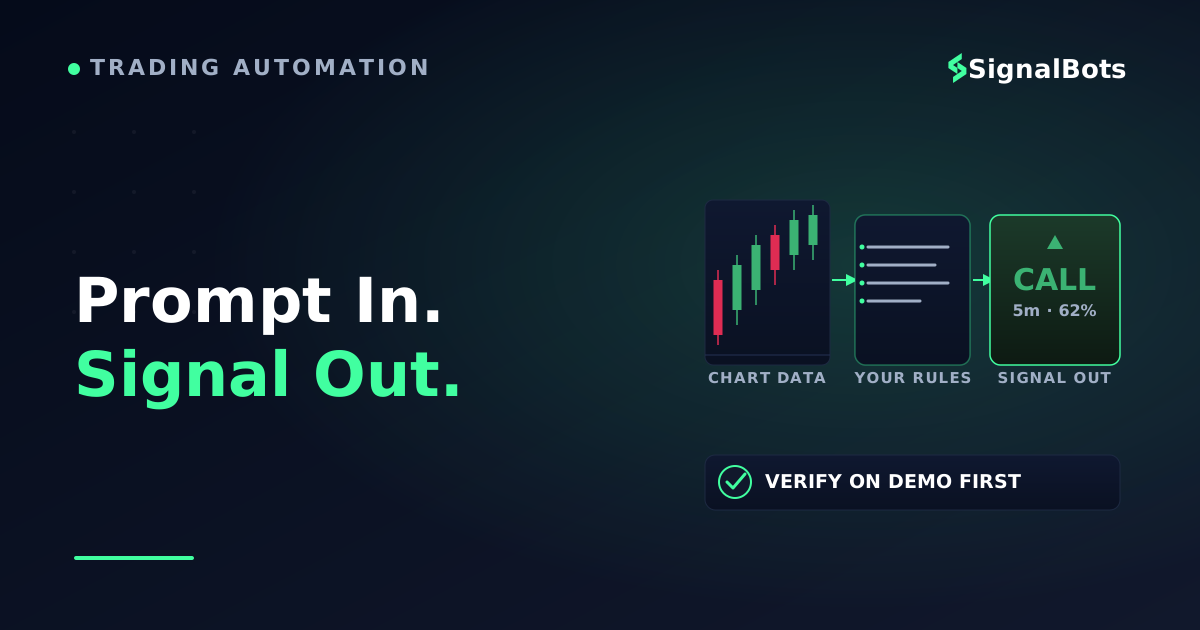
What you are actually assembling is a DIY signal provider: you carry the data in, the model applies a fixed rule set, and it hands back a binary options signal — direction, expiry, reasoning — that you place manually.
Framed that way, the model has one genuine strength and one genuine weakness.
Strength: mechanical consistency. A written rule set gets applied the same way on the fortieth chart as on the first, with no boredom, no revenge urge, and no "this one looks different." That is the same discipline argument that makes any rules-based system worth having.
Weakness: it fills gaps with plausible fiction. A language model has no pixel-to-price calibration and no memory of a price it was never shown. Ask it for support and resistance on a chart image and it will often produce clean, round, confident numbers that exist nowhere in your data.
Everything else in this workflow — the data format, the rule ordering, the output contract, the verification pass — exists to lean on the first property and fence off the second. No feed, no chart access, no order route — every input in this workflow is carried in by hand.
Screenshot the Quotex chart or copy the last 30-40 candles as text. The model has no feed of its own.
2
Send data plus rules together
Paste the data into a prompt that already contains your rule set and a strict output format.
3
Read the structured call
Direction, expiry, which rule fired, and the exact candle values that satisfied it.
4
Verify before you act
Check every number against the data you supplied. Discard anything the model could not evidence.
5
Place and log it manually
You are the execution layer. Log the call, the outcome and the stake in a spreadsheet every time.
Five steps, and you are personally responsible for three of them — that is what separates this from a bot.
What You Need Before You Start
Nothing here costs money, but skipping any of the five makes the rest useless.
A Quotex demo account. Every measurement in this workflow happens here first. Real funds come later, or not at all.
A ChatGPT account on a model that accepts image uploads. GPT-4-class models and everything after them read images; that is what makes the screenshot route possible at all. Text-only access still works — you just take the second data route below.
A data source you can actually reach. This is the constraint most guides skip: Quotex's weekend and after-hours pairs trade on the broker's own synthetic quotes. An OTC market instrument like "EUR/USD (OTC)" does not exist on public charting sites, so for weekend and after-hours pairs your only data source is the Quotex chart in front of you.
A written rule set. ChatGPT does not have a strategy; it executes yours. Hand it "analyse this chart" and you get horoscope output. Hand it four numbered, checkable conditions and you get something you can audit.
A trade log. A spreadsheet with date, pair, timeframe, the model's call, the rule that fired, your stake, the payout percentage offered, and the result. Without this you have anecdotes, not evidence.
How to Feed Quotex Chart Data to ChatGPT
There are exactly two ways to get Quotex price action into a chat window, and your choice determines how much you are allowed to trust the levels that come back.
Uploading a Chart Screenshot
Clean the chart before you capture it: candlesticks, one timeframe, and only the indicators your rules actually reference. Crop so the pair name, the timeframe and the price axis are all inside the image — then type the pair, timeframe and current price into the message anyway.
That last step is not redundant. A model reading an image is reconstructing prices from axis labels it may read imperfectly, and when the axis is dense it substitutes tidy round numbers for the real ones. Screenshots are genuinely useful for shape — is this trending, is it ranging, where are the obvious wick clusters — and unreliable for any exact level.
Pasting Price Data as Text
The alternative is to type or copy a small block of OHLC data: time, open, high, low, close, oldest line first, thirty to forty candles of the timeframe you trade. Now every number in the prompt is exact, and — more importantly — every number in the answer is checkable against something you supplied.
The cost is manual work on each cycle, and staleness: on a one-minute chart, the candle you started typing four minutes ago is ancient history. The practical compromise most people land on is text data for five-minute charts and longer, screenshots for one-minute scalps where speed beats precision.
Levels are reconstructed from axis labels, so exact prices drift
Cannot be re-checked later unless you keep the image
Use it for one-minute charts and for shape-based rules only.
VS
Winner
Pasted OHLC text
Every price is exact and auditable against your own paste
Lets you demand evidence: the model must quote your candles back
Slow to prepare, and the newest candle ages while you type
No visual context beyond the numbers you include
Use it for five-minute expiries and any rule that names a price.
Precision beats convenience the moment a rule references a specific price level.
A Prompt Template for Quotex OTC Binary Signals
A usable prompt has five blocks, and the two most people leave out are the ones that do the real work: the no-invention clause and the output contract.
Prompt template
textquotex-otc-signal-prompt.txt
ROLE
You are a rules-based binary-options signal generator for the Quotex platform.
You have no live market access. Use ONLY the data in the DATA block below.
Never estimate, recall or invent a price, a candle or a news event I did not give you.
If a rule cannot be checked from DATA, say so instead of guessing.

MARKET CONTEXT
Pair: EUR/USD (OTC)
Chart timeframe: 5 minutes
Expiry I intend to use: 15 minutes
Payout offered on this pair right now: 85%
Timestamp of the last candle: 14:32 UTC

RULES (apply in this order, add none of your own)
1. BIAS - compare the close of the last candle with the close 20 candles earlier.
   Higher = bullish, lower = bearish, difference under 0.02% = no bias.
2. LOCATION - find the highest high and lowest low in DATA. Only take a trade
   in the direction of the bias, and only from the opposite half of that range.
3. TRIGGER - the last closed candle must close against the direction of the two
   candles before it, and its body must exceed the average body of the last 5.
4. VETO - if each of the last 3 candles has a body under half the 5-candle
   average body, return NO TRADE: the range is too flat for this expiry.
5. If rules 1-4 do not all resolve from DATA, return NO TRADE.

DATA (oldest first, one candle per line: time,open,high,low,close)
14:12,1.08412,1.08429,1.08405,1.08421
14:17,1.08420,1.08438,1.08414,1.08433
<paste 30 to 40 candles>

OUTPUT - return exactly this block and nothing else:
SIGNAL: CALL | PUT | NO TRADE
PAIR:
EXPIRY: minutes, measured from the last candle's close time
TRIGGER RULE: which numbered rule fired
EVIDENCE: the exact values from DATA that satisfy it
RULES NOT MET: any rule you could not verify, and why
CONFIDENCE: high | medium | low, plus one sentence on what would invalidate it
Copy it, replace the context block and the candles, and keep the rules identical between runs.
Four things in that template are doing heavy lifting:
The no-invention clause turns a silent failure into a visible one. Without it, a missing candle gets quietly replaced by a guess; with it, the model tends to tell you what it could not check.
Numbered, ordered rules make the output reproducible and, crucially, make it auditable — you can point at rule 3 and ask whether it truly fired.
The NO TRADE path is the single most valuable line in the prompt. A model asked "what is the trade here?" will find one every time. A model allowed to decline stops manufacturing setups out of flat ranges.
The output contract forces the expiry time, the trigger and the evidence into fixed fields, so two calls a week apart are directly comparable in your log.
Change the market context and the candles between runs. Do not casually reword the rules — the moment the rule set drifts, your log stops measuring one thing.
Reading and Verifying ChatGPT's Signal Output
Here is an illustrative reply in that format, with numbers invented purely to show the shape:
What a reply looks like
textillustrative-reply.txt
SIGNAL: PUT
PAIR: EUR/USD (OTC)
EXPIRY: 15 minutes from 14:32 UTC
TRIGGER RULE: Rule 3 - reversal close against the previous two candles
EVIDENCE: 14:22 close 1.08447 (up), 14:27 close 1.08452 (up),
          14:32 open 1.08452 close 1.08419, body 0.00033
          vs 5-candle average body 0.00019
RULES NOT MET: none
CONFIDENCE: medium - a close back above 1.08452 invalidates it
Structured output is only useful because it can be checked line by line — including where it is wrong.
Now read it properly. Rule 1 in the template sets the bias, and rule 2 says a trade may only run with that bias. If the last twenty candles were climbing, this PUT is counter-bias and rule 4's chain should have blocked it — yet the reply says "RULES NOT MET: none" in a confident tone. That is the most common failure mode of this entire workflow, and it is exactly why the EVIDENCE and RULES NOT MET fields exist.
Run the same five checks on every call before it becomes a trade:
Does every number appear in what you pasted? Any price the model did not receive is fabricated, no matter how reasonable it looks.
Does the stated rule actually fire on those values? Do the arithmetic once yourself. It takes fifteen seconds and it catches most bad calls.
Does the direction agree with the bias rule? A counter-bias call that claims full compliance is a rejected signal, not a brave one.
Is the expiry measured from the last candle's close, not from the moment you happen to read the reply? Everything after that timestamp is data neither of you has.
Is the reasoning falsifiable? "Momentum looks strong" is decoration. "Invalid above 1.08452" is a statement that can be proven wrong — and that is what you want in a signal anatomy worth logging.
A call that fails any of the five goes in the log as a rejected false signal, with the reason. Those rejections are data too: if half your output gets rejected, the rule set is too vague for the model to execute.
A call that survives all five is still just text. You have two ways to act on it: type it into Quotex yourself, which is what this workflow assumes and what keeps a human between the model and your balance, or hand the direction and expiry to something that executes — a webhook consumer, a TradingView alert relay, or one of the packaged Quotex trading bots that already own that plumbing. Building that execution layer is a separate project with its own failure modes, and it is the point where a prompt stops being a prompt and starts being Quotex AI bots and AI signals territory.
Test the Workflow on a Quotex Demo Account First
Everything above produces opinions. This section is where you find out whether the opinions are worth anything — and the honest answer for most rule sets is no, which is precisely why you test on a demo account instead of a funded one.
Run a proper forward test, not a browse:
One pair, one timeframe, one expiry, one fixed stake, for a pre-committed number of calls.
Log every response, including NO TRADE and every rejected call. Cherry-picking the good ones is how the hype videos are made.
Never override the workflow mid-test. If you skip a call because it "felt wrong," you are testing your intuition, not the prompt.
Give the same data block to the model twice in a row. The answers will not always match — language models are not deterministic — and the size of that disagreement is itself a result worth recording.
Demo output is a historical, backtested indication of a rule set, never a forecast — read the risk warning before you translate any of it into live stakes.
Then compare the result against the number that actually matters. Binary payouts are below your stake, so a coin flip loses money by design: at an 85% payout, a winning trade returns less than a loser costs. Your break-even win rate is the floor the workflow must clear before it is worth anything at all.
Run your own numbers
Demo scorecard: is your ChatGPT signal beating break-even?
Enter the payout your pair was offering and the results from your demo log. The break-even line is fixed by the payout — everything above it is your measured edge, everything below it is a slow leak.
Payout offered
Signals placed in the test
Winning trades
Break-even win rate
—
Your demo win rate
—
Edge vs break-even
—
Result per $100 staked
—
A 50% win rate is a losing strategy at any payout under 100% — the break-even line, not intuition, is the benchmark.
Two warnings about reading that number. A short run tells you almost nothing: a handful of wins in a row is ordinary luck, and a sample size too small to survive a bad week is a sample size too small to act on. And if you backtest by pasting historical candles instead of live ones, remember you already know how that period ended — the temptation to keep re-running the prompt until the answer matches the outcome is exactly how a strategy gets fitted to the past.
Where This Approach Breaks Down
Being clear-eyed about the failure modes is what separates this from the content that got you here.
Invented levels. Already covered, still the number one problem. It is a general property of language models rather than a Quotex-specific bug, and no prompt eliminates it entirely.
Non-determinism. The same candles can produce a CALL now and a NO TRADE in ten minutes. A system whose output changes without its input changing is difficult to evaluate honestly.
No live price. By the time you paste, read, verify and click, the market has moved. Anything shorter than a few minutes of expiry is fighting your own reaction time.
A broker-quoted synthetic series. OTC pairs are quoted by the platform, not by an interbank market, so patterns learned from real market data may or may not carry across.
Silent model changes. The model behind the chat window gets updated. Your prompt is stable; the thing executing it is not, which means your measured results have a shelf life.
No verifiable record. The model cannot prove anything about its past calls. Only your own log can, which is why the log is not optional.
Policy limits. OpenAI's usage policies draw an explicit line at automating high-stakes financial decisions without human review — the human-in-the-loop shape taught here is the compliant one, and a fully automated pipeline is not. Highlight reels show the outcome and hide the sample it was drawn from.
That last point is worth sitting with, because it explains the genre of video that sends most people here. A screenshot of a small deposit turned into a large balance shows you an outcome and hides the sample: how many accounts were run, how many calls were skipped, what the stake schedule was, whether losses were recovered by doubling down. Report the same workflow honestly — every call, every rejection, one fixed stake — and the picture is far more ordinary. If a staking plan is what makes the numbers look dramatic, run it through a risk-of-ruin calculator before you believe them.
FAQ
Is there an official ChatGPT integration with Quotex?
No. There is no sanctioned connection between OpenAI's products and the Quotex platform in either direction — no plugin that reads the broker's feed, and no endpoint that places a trade. Anything advertised as an official pairing is a third-party product using the name.
Can ChatGPT place the trade for me as well?
Not by itself. Execution requires something that can act on the platform — a browser-side binary options bot, a webhook consumer, or a connector — with ChatGPT reduced to the component that writes the call. That is a different build with different risks, and it is not what this workflow does.
Does using ChatGPT for trading signals break OpenAI's rules?
Generating analysis you then review and act on yourself is ordinary use. The line OpenAI draws is around automating high-stakes financial decisions without human review, and around presenting model output as licensed financial advice. A workflow where you verify each call and place it manually stays on the right side of it; a fully autonomous money-moving pipeline does not.
Which ChatGPT plan or model do I need?
Any model that can read an uploaded image if you use the screenshot route; any text model at all if you paste OHLC data. Newer models follow a strict output contract more reliably, which matters more here than raw reasoning ability — the whole method depends on the reply coming back in the same shape every time.
Do the ready-made "signal GPTs" in GPT directories work better?
They are the same mechanism with the rules hidden from you. A custom GPT promising ten automatic signals a day on OTC pairs is running a prompt you cannot inspect, cannot audit and cannot fix when it drifts — a black-box system whose main advantage over your own prompt is that you did not have to type it.
How many signals a day can this realistically produce?
That is set by your rule set, not by the model. Strict rules on one pair and one timeframe may produce a couple of qualifying setups a session and a lot of NO TRADE responses. If you find yourself loosening rules to increase volume, you have started optimising for activity instead of for edge.
If You Want Validated Signals Without Writing Prompts Yourself
By this point the honest cost of the DIY route is visible: you are the data feed, the auditor, the execution layer and the record keeper, and you carry that load on every single call. Some readers want exactly that control. Others reach this section and realise they wanted a second opinion, not a second job.
If that is you, our live binary options signals are the comparison point — each call published with its historical win-rate and backtested context, free to view, with no prompt to write or maintain. Use it the way you would use any external opinion: line it up against what your own workflow produced on the same pair and see where the two disagree. The disagreements are where you learn something.
It is not a ChatGPT-based tool and you cannot rewrite its logic, and it does not click anything on Quotex for you. If building and tuning your own rule set is the point of the exercise, stay with the prompt — this article is the complete method either way.
The Honest Bottom Line
A language model with a disciplined prompt is a reasonable analyst and a terrible bot. It applies your rules without flinching, explains itself in a format you can audit, and never gets bored on the fortieth chart — and it also cannot see the market, cannot prove its record, and will produce a confident number it never received. The workflow on this page is built entirely around that trade-off: give it exact data, force it to show evidence, and measure the output against break-even on a demo account before anything real is at stake.
You arrived
“asking whether the ChatGPT bot videos on Quotex were real”
and you leave with
a prompt, a verification pass and a demo protocol.
ChatGPT can be your analyst. You are still the risk manager.
The mechanism is genuinely reproducible: exact data in, ordered rules applied, a structured call out, every number checked against what you supplied. What it is not is automation — nothing in this loop places, sizes or closes a trade, and the moment you stop verifying, you are trading a black box you built yourself. Test it on a demo account, log every call including the rejections, and let the break-even line rather than a highlight reel decide whether it earns real money.
The Binary Options Desk is the SignalBots editorial team for fixed-time and OTC trading coverage. We research and write the guides that explain expiry timing, payout structure and disciplined entry across the major brokers.



Discussions 0
Leave a comment