It is Saturday morning. Your feed has been quiet since Friday's close, the forex desks you normally trade are shut, and the only things still moving on your Pocket Option screen are the assets with three extra letters after the name: EUR/USD OTC, Gold OTC, Apple OTC. Meanwhile a channel somewhere is still posting calls. The question you actually have is narrow and practical: does that call have anything to do with the chart in front of you?
It usually does not, and the reason is one fact about how an OTC price is made — a fact that also decides which expiry you should be using and how much of a provider's track record you should believe. What people are after when they search for Pocket Option OTC signals is narrower than a shortlist, and this page is not a ranking: choosing a Pocket Option signal provider is a broader question than the one you have on a Saturday morning. This page covers the narrow one: which assets trade OTC and when, what expiry window fits the way they move, and how to line an incoming signal up against both before you click.
Key Takeaways
An OTC asset is priced by Pocket Option itself rather than pulled from an outside market — that is why it trades on weekends, and why a signal computed on live-market data does not automatically describe it.
The OTC menu spans currency pairs, metals, energy, indices, US large-cap stocks and major crypto, listed from 00:00 to 24:00 in the platform's server time, every day.
Short binary expiries cluster at 30 seconds, 1 minute and 5 minutes; on OTC series, which move more aggressively, that argues for stronger confirmation and a smaller stake, not a longer window.
Before each entry, check identity and timing: the OTC label, the asset being open, the direction mapping, the exact expiry, and whether the signal is still fresh enough for it.
Table of Contents (17 min read)Contents
What Makes an OTC Signal Different From a Standard One
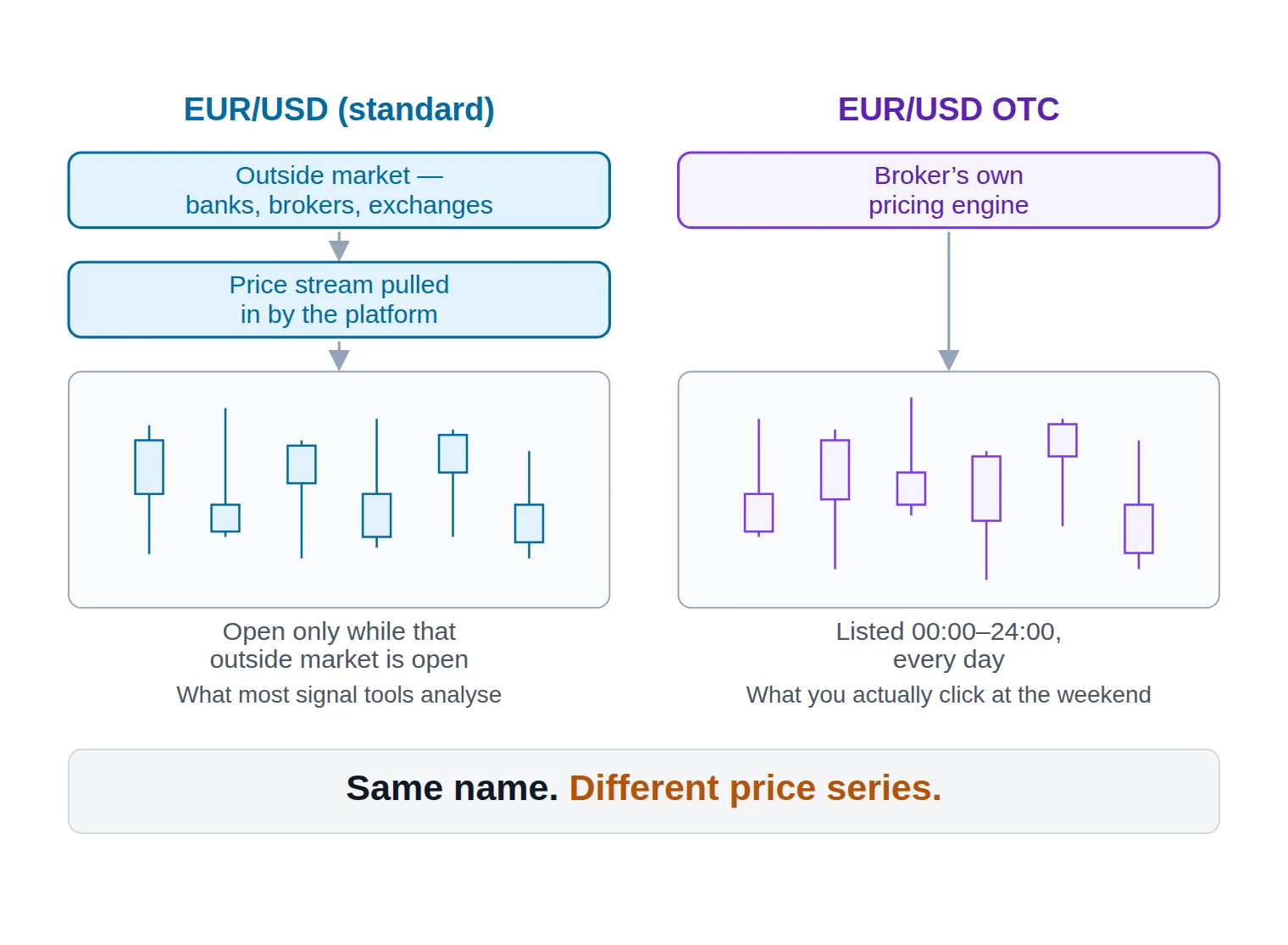
On a standard asset, the chart you see is a rendering of a price that exists somewhere else. Banks, brokers and exchanges quote EUR/USD to each other all day, the platform pulls that stream in, and your candles are a picture of an outside market. When that outside market closes, there is nothing left to render, so the asset goes dark.
An OTC asset works the other way round. Over-the-counter means the trade happens directly between you and the counterparty rather than through an exchange — and on a binary platform, the counterparty is the broker. Pocket Option generates the OTC quote itself: the series is produced in-house, referenced loosely to the instrument it is named after, and it does not depend on any outside venue being open. That single design choice is why OTC assets stay listed at 3am on a Sunday, and it is also why they are their own trading condition rather than a weekend copy of the weekday chart.
Now put a signal next to that. A binary options signal is the output of some process — an indicator stack, a model, a human reading structure — run over a price series. If that process ran over the live market series, its conclusion describes the live market chart. It does not automatically describe an OTC chart that shares the same name, because the two are not the same series. They can drift apart, print different candles at the same minute, and reverse at different levels.
Same ticker, two different price series — which is why an OTC signal has to be computed on the OTC chart.
So the real question is never "is this signal good?" but "what was this signal computed on?" An OTC-aware signal provider publishes the asset with its OTC label attached, because that label is part of the instrument's identity. A source that posts a bare pair name at the weekend is either analysing a series that stopped updating, or quietly assuming the OTC twin behaves the same way. Neither is a reason to trust the call.
Which OTC Pairs Are Available on Pocket Option, and When?
The OTC menu is much wider than the "weekend forex" reputation suggests. Pocket Option's own asset listing spans six families:
Currency pairs — the majors you would expect (EUR/USD OTC, GBP/USD OTC, USD/JPY OTC, AUD/USD OTC), plus crosses such as EUR/JPY OTC and CAD/CHF OTC and a long tail of emerging and exotic pairs.
Metals — Gold OTC and Silver OTC, alongside platinum and palladium.
Energy — UK Brent and US Crude OTC contracts, plus natural gas.
Indices — OTC versions of the big US index products (an S&P-style index, a Nasdaq-style index, a Dow-style index) and non-US ones such as a Japan 225 and an Australia 200 equivalent.
US stocks — large-cap single names including Apple OTC, Tesla OTC, Amazon OTC and Microsoft OTC.
Crypto — Bitcoin OTC, Ethereum OTC and other major coins.
On the availability side, the asset table lists OTC instruments as open from 00:00 to 24:00 — every day, weekends included. Three practical notes sit under that:
The clock shown is the platform's server clock, not yours. A window that reads "00:00 to 24:00" is trivially fine, but the moment you start reasoning about session boundaries or a news release, translate to the platform's time rather than your own.
The list is not permanent. Instruments get added and retired, and the payout attached to each one moves. Treat the OTC list as something you check at the moment of trading, not a table you memorise once.
OTC is not weekend-only. Many OTC assets sit alongside their standard twins during the week too. That matters when a signal arrives on a Tuesday naming an OTC asset — it is not a mistake, it is a different instrument that happens to also be open.
Why the Weekend Is the Whole Point
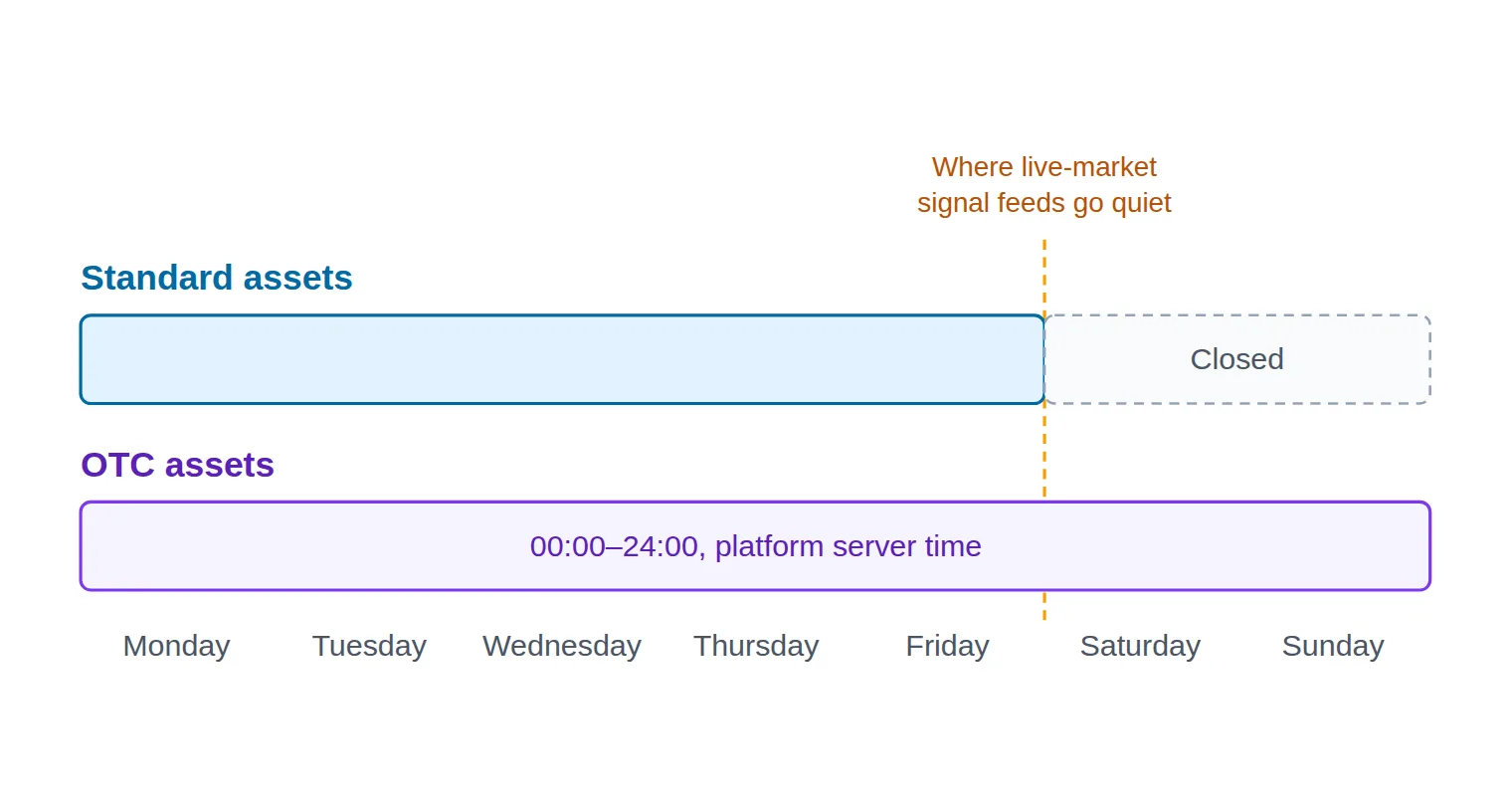
The reason most traders meet OTC assets at all is that the rest of the market stops. Interbank forex winds down from Friday's New York close and does not reopen until Sydney on Monday. Cash equities keep exchange hours. Only crypto genuinely runs through, and a binary platform's crypto menu is narrow. Weekend OTC trading exists to fill that hole: because the broker prices the instrument itself, the weekend is not a technical obstacle.
Standard assets stop at the Friday close; the OTC track does not — and neither does the temptation to trade a stale call.
The trap sits in the gap between those two tracks. Almost every free signal source — the indicator scripts, the scanner alerts, the copy-paste channels — is fed by live-market data. When that feed flatlines on Friday evening, three things can happen, and none of them are announced to you:
The source goes quiet, which is honest.
The source keeps posting from the last live series it saw, which produces a stale signal about a chart that has not moved since Friday.
The source keeps posting analysis of a live pair and lets you assume it transfers to the OTC twin.
The weekend is exactly when signal quality is hardest to judge and easiest to fake, because the market that would have contradicted a bad call is closed. That is the moment to be strict about labels, not relaxed.
Which Expiry Fits OTC Volatility?
Two separate things get confused here, so take them one at a time.
The first is general binary practice: fast setups cluster into a short band of expiry times — roughly 30 seconds, 1 minute and 5 minutes — and that band is not an OTC fact, it is how short-term binary trading is usually taught anywhere. Pick within it based on what your setup actually claims. A momentum read on the current candle is a 30-second to 1-minute idea; a pullback into a level needs room to play out and belongs at the longer end.
The second thing is genuinely OTC-specific, and it is a caution rather than a number: OTC series tend to move more aggressively and less predictably than a regular-session chart. With no outside market anchoring it, the series can produce outsized candles and sharp reversals with no visible cause. Three habits follow from that:
Wait for stronger confirmation than you would on a live pair. A borderline setup is worth less here, because the "context" you would normally lean on does not exist.
Size down. The same stake carries more variance when the underlying series is more erratic.
Do not enter immediately after an outsized candle, and do not answer a loss by doubling the next stake. Martingale-style recovery interacts badly with a series that can run several candles in one direction for no reason you can see.
Short expiries on OTC assets
Expiry window
What the setup has to give you
Where OTC hurts most
Sensible use
30 seconds
A read on the candle in front of you, right now
One erratic tick range decides the whole trade
Only with a signal that reaches you within seconds of firing
1 minute
A clear short-term direction, not just a wick
A single outsized candle can swallow the whole window
The default for most posted OTC calls
5 minutes
A level or structure the move can travel to
More time for an unexplained reversal to appear
Pullback and level-based setups; tolerates a slightly later entry
The expiry is part of the setup, not a preference — a call computed for one window is a different trade in another.
One consequence is worth stating plainly: the shorter the expiry, the more the signal's freshness matters. A 30-second call that reaches you twenty seconds late is not a late version of the same trade — it is a different trade with most of its window already spent.
Matching a Signal to the Right OTC Pair and Expiry
Everything above collapses into a short check you can run before each entry. It is deliberately mechanical: the point is that you decide before the chart tempts you.
Pre-trade checklist
Before you click: OTC signal match check
0 / 7
The signal names the asset with its OTC label, not just the bare pair name.
That exact OTC asset is listed and open on your platform right now.
The direction maps to the right button: BUY means Call, SELL means Put.
You set the expiry the signal specifies, not a rounder number you prefer.
The signal's timestamp is fresh enough for the expiry you are about to use.
The payout currently shown on that OTC asset still supports your break-even math.
The stake is the one your money-management rule allows, decided before you opened the chart.
★
Checklist complete — you’re cleared to proceed.
Seven yes/no checks. A no on any line is a skipped trade, not a trade with a workaround.
Now run it once. The demand for this is literal — people search for things like gbp/usd otc 5-minute trading signal pocket option august 2025, which is a pair, a market type, an expiry and a date in a single query. So take a posted call in exactly that shape:
Asset. The label says OTC, so open the GBP/USD OTC listing, not GBP/USD. On a Saturday that is the only one open anyway; on a Wednesday both exist and picking the wrong one silently invalidates the call.
Availability. It is listed and quoting. If it were not, there is no substitute — GBP/USD OTC and GBP/USD are not interchangeable.
Direction. SELL maps to Put. If the platform's wording differs from your source's, write the mapping down once rather than translating it under time pressure. (Call and Put is the only vocabulary you need here.)
Expiry. 5M means you set five minutes. Not three because you are impatient, not fifteen because you want room — the call was computed for a five-minute horizon and means nothing outside it.
Freshness. It is now 14:07. For a five-minute window, the entire horizon the call described has already elapsed. That is a skip, not a late entry.
Payout and stake. Check what the asset is paying right now, then apply your usual stake. Both decisions happen before the click.
Six of those seven checks are about identity and timing rather than analysis — which is the honest summary of what goes wrong with OTC signals. The mechanics beyond this point, executing OTC signals in real time with entry windows and how-late-is-too-late thresholds, are a subject of their own.
The Added Risk of Broker-Set OTC Pricing
None of the above changes the structural fact underneath OTC trading, and it deserves stating without softening.
The price has no external reference. On a live pair you can pull up a second venue and confirm that the candle you just traded is real. On an OTC asset you cannot — the series exists only inside the platform that also holds the other side of your trade. That is textbook counterparty risk, and it is the same structure a market-maker broker operates under, without an outside tape to check it against.
A track record measured elsewhere is not evidence here. If a provider publishes a historical win rate, the question is which series it was measured on. Results from live-market data say nothing about how the same logic behaves on a broker-generated series, and a backtested result on one is not a backtested result on the other. Ask; a source that cannot answer has told you something.
The payout sets your bar before any analysis does. Binary risk is asymmetric: a loss costs the whole stake while a win returns only the payout percentage. Suppose an OTC asset pays 80% — you would need to be right on better than roughly 55.6% of trades simply to stand still, and if the payout on that asset drops to 70%, the bar rises again. Run your own numbers with the binary options break-even win rate calculator before you decide whether a source's claimed accuracy clears it.
And the instrument itself is restricted in several jurisdictions. European regulators prohibited the sale of binary options to retail clients, and other authorities have issued repeated warnings about unregistered platforms. Whatever you conclude about signals, that context belongs in the decision.
Where to Check a Live Signal Against an OTC Pair
The checklist only becomes a habit once you run it against a feed that actually publishes the fields it asks for, which is a surprising amount of what separates a usable source from a screenshot.
Our own binary options Telegram channel is one place to try it: each posted signal carries the asset, the direction and the expiry — the same three fields lines one, three and four of the checklist test. So a post reading EUR/USD OTC · CALL · 5M is already answerable: the asset line carries an OTC label, so you open the OTC listing; CALL maps to the Call button; 5M sets your expiry to five minutes; and the post's timestamp gives you the freshness check. A post naming a bare pair fails line one before you evaluate the analysis at all, and that is the useful part of the drill.
To be explicit about fit: it is a general binary options channel, not an OTC-only feed. During the week it will post plenty of standard-session assets, and confirming that a given call names an OTC-labelled asset inside its own availability window remains your step, not something the feed does for you. If you trade only at weekends, that means reading past most of what is posted.
Quick Recap: Trading OTC Signals on Pocket Option
The whole subject reduces to four moves. Know that an OTC price is generated by the broker rather than pulled from an outside market, which is both why the asset is open on Sunday and why an outside-market signal does not automatically describe it. Know which assets are actually on the OTC menu and confirm the one in front of you is open. Pick an expiry from the short band that fits the setup, allowing for a series that moves harder than a regular session. Then run the identity-and-timing check before every click, and treat any accuracy claim as a question about which series it was measured on.
You came in with
“a quiet Saturday feed and a screen full of assets ending in OTC”
and you leave with
a check that tells you which of those calls belongs to the chart in front of you.
The signal was never the hard part — the match was
An OTC asset is a broker-generated series wearing a familiar ticker. Once you treat the OTC label as part of the instrument's name, most of the confusion around weekend signals disappears: you stop asking whether a call is accurate and start asking what it was computed on, whether that asset is open, and whether the expiry you are about to set is the one the call assumed.
How do I tell an OTC asset from a standard one on Pocket Option?
By the label on the asset name. OTC instruments carry an explicit OTC tag next to the ticker in the asset list — EUR/USD OTC sits separately from EUR/USD. If an asset is quoting at the weekend, it is an OTC one by definition, but during the week both can be open at once, so read the tag rather than assuming from the clock.
Can I use a regular forex signal on an OTC pair?
Not safely. A signal derived from live interbank data describes the live chart; the OTC series carrying the same name is generated by the broker and can print different candles at the same minute. Using one on the other is a guess about correlation, not an application of the analysis. Look for sources that name the OTC asset explicitly.
Do OTC assets only trade at the weekend?
No. Weekends are when they are the only option, which is why most traders meet them there, but the OTC list is available around the clock and runs alongside standard assets during the week too. A weekday signal naming an OTC asset is not a typo.
Why did a technically correct signal still lose on an OTC chart?
The three usual causes are all covered above: the call was computed on the live series rather than the OTC one, it reached you too late for the expiry it assumed, or the expiry you set was not the one it was calculated for. Beyond that, an OTC series can move sharply with no visible cause, which is why the same setup deserves a smaller stake here than on a live pair.
Is there any way to verify an OTC price?
Not independently, and that is the honest answer. The series exists only inside the platform, so there is no second venue to check the candle against. What you can do is judge the source rather than the tick: ask which series a provider's results were measured on, and keep the stake sized for an instrument you cannot audit.
Sources & Further Reading
Want to go deeper? These independent, authoritative sources shaped this guide — each one is worth reading in full:
The Binary Options Desk is the SignalBots editorial team for fixed-time and OTC trading coverage. We research and write the guides that explain expiry timing, payout structure and disciplined entry across the major brokers.



Discussions 0
Leave a comment