Someone drops an invite link into a trading chat: Pocket Option signals, free, 80% accuracy, join here. You click, land in a server with fifteen channels, a locked VIP category and a pinned wall of green screenshots — and nothing on that screen tells you whether you have found a real trading community or the front door of somebody's funnel.
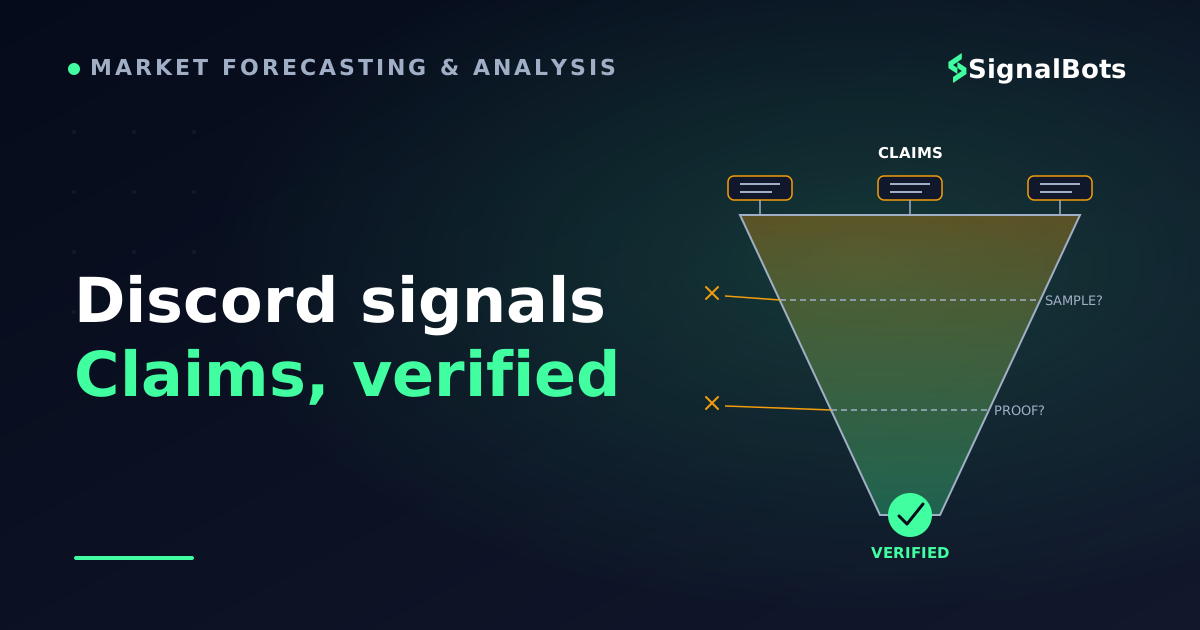
That is the actual problem hiding behind the phrase pocket option signals discord. Finding servers is trivially easy: Discord's public listing sites exist precisely so owners can advertise, and typing a broker's name into one of them returns results in seconds. The hard part is that a listing reprints the server's own marketing copy — the accuracy figure, the "verified traders" badge, the member count — and no directory anywhere checks a single word of it before publishing.
So this page does two things, in that order. First it teaches the search itself, so you can find what is live today instead of trusting a fixed list (including the one below) that starts aging the moment it is written. Then it spends most of its length on the part every directory skips: how to read a server before you join, what an accuracy claim has to be measured against, and what to do about the direct messages that start arriving afterwards.
Key Takeaways
Discord directories index whatever a server owner submits and verify none of it, so learn the tag search (narrow broker tag plus the broad binary-options tag, across two or three sites) instead of trusting any fixed list.
An accuracy claim means nothing until it names the payout, sample, period and pairs behind it: at a 78% payout you need roughly 56% winners just to break even.
Almost every real risk on a trading Discord arrives by direct message, not in the public rooms — turn off DMs from server members before you join anything.
Vet from the free side for two weeks against your own log, on a demo account at a fixed stake, before any money moves.
Table of Contents (21 min read)Contents
What a Pocket Option Signal Server on Discord Actually Is
A Discord server is a chat community made of rooms, and that one structural fact is the whole difference between this and the channel most Pocket Option traders try first. A Telegram signal channel broadcasts — the owner posts, everybody else reads. A Discord server puts the alert feed in one room and conversation in all the others, which is usually the exact reason a trader goes looking for Discord in the first place: somewhere to ask why a call was taken, not just watch it appear.
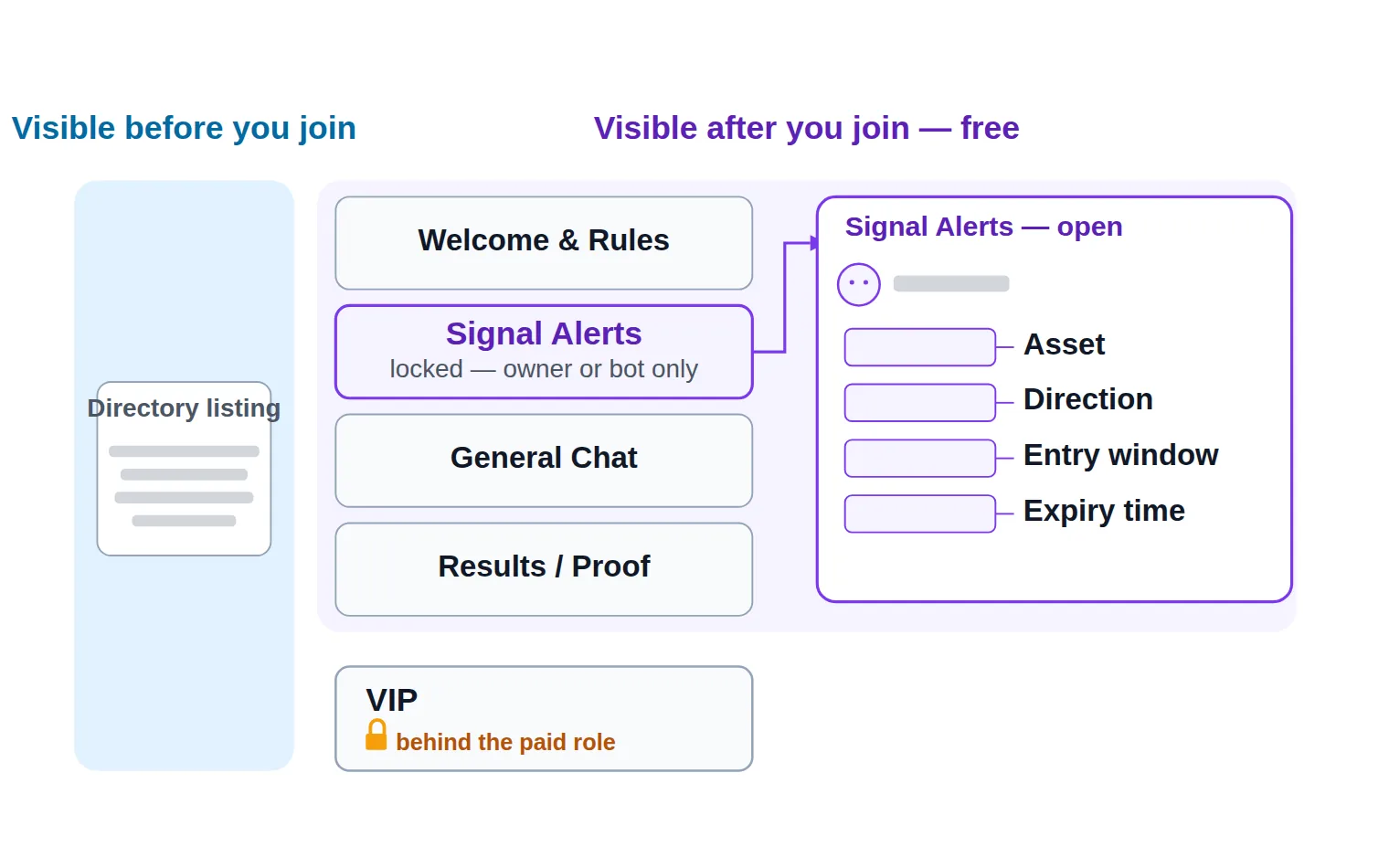
Underneath the branding, almost every Pocket Option signal server is assembled from the same four or five parts:
A welcome and rules room, where you pick up a role by reacting to a message.
A locked alerts room that only the owner or a bot can post in. This is where the binary options signal itself lands.
A general chat where members react, argue and post their own fills.
A results or proof room, usually a gallery of screenshots.
A locked VIP category behind a paid role — the free-versus-VIP split that most of these servers are ultimately built to sell.
A posted alert is short by nature: the asset, the direction, an entry window and an expiry time. That compactness is what makes the anatomy of a signal easy to automate, and a large share of alerts in these rooms are posted by software rather than a person — Discord bot automation for signals is a sub-topic of its own, with its own set of questions.
The listing shows you the outside of the box. The four rooms you can read for free are where the actual evidence lives.
Whatever the server calls itself, the person behind that alerts room is functioning as a signal provider: someone publishing tradeable calls that other people act on with real money. Hold that thought, because it sets the standard you should be judging them by — and because almost none of the parts you would use to judge them are visible until after you are inside.
Where to Find Pocket Option Signal Servers on Discord
Discord itself is not much help here. Its built-in Server Discovery only surfaces servers that meet the platform's size and safety requirements, and a small signal room almost never qualifies. Everything else is found through third-party listing sites — discord.me, DISBOARD, Discadia, Discord Home and myserver.gg are the ones carrying binary-options inventory. They all work identically: an owner submits their server, writes its own description, picks a handful of tags, and the site builds one page per tag.
Three mechanics change how you should read those pages:
The description is the owner's copy, verbatim. Nobody edits it, nobody fact-checks it, and the site has no relationship with the server beyond hosting the ad.
Ranking is usually recency, not quality. DISBOARD in particular orders a tag page by which server "bumped" itself most recently, so the top of the page is whoever advertised in the last few hours.
Tagging is inconsistent. Plenty of servers that trade Pocket Option never tag the broker at all, filing themselves under the market instead. Search the narrow tag and the broad one — pocketoption, pocket option signals, binary-options — or you will only ever see a slice.
Finding servers
The search that keeps working after this article goes stale
1
Search the narrow broker tag first
On a listing site such as discord.me or DISBOARD, open the pocketoption tag page. It is thin, but whatever sits there is aimed at your broker.
2
Widen to the binary-options tag
Most servers file themselves under the market rather than the broker. This is where the real inventory sits, so read it with your platform in mind.
3
Repeat on a second directory
Each site lists only what was submitted to it. Two or three directories return a different set of servers, not a longer version of the same one.
4
Test the invite before judging anything
Open the join link first. A dead invite means the server closed, was purged or renamed at some point after the listing was written.
5
Read the free rooms before you speak
Scroll the alerts and results history. Everything worth knowing is in what was posted last week, not in the welcome message.
The directory is a starting point, not an answer — the last two steps are where the actual information is.
What a Tag Search Turns Up Right Now — and Why It Won't Hold
At the time of writing, the broker-specific tag is thin. On discord.me the pocketoption tag surfaces a single server, GavinTrades | Binary Options, whose listing leads with an "80% ACCURACY" line and shows nothing else — no sample, no period, no log.
The broader binary-options tag is where the inventory actually lives. That page lists The Bridge – AI Central, COBRA Trading Group, B Y N E X, Trading Together, GavinTrades again, and Binary Option Community — the last of which names Pocket Option and IQ Option as the platforms its members trade. Elsewhere, a server profile on discordservers.com for EnemySignals advertises daily binary calls and a monthly-gain figure to a membership in the low hundreds.
Read that as a snapshot of a moving object. It is not a ranking, not a shortlist and not an endorsement — it is simply what the directories were showing on one day, reprinted so you have something concrete to practise the next section on. Discord servers open, fill, get abandoned and get purged constantly, and half the names above may be gone or renamed by the time you run the search yourself. The search method is the durable part; the list is disposable.
Any published list of Discord servers starts decaying the day it is written - which is why the search method matters more than the names.
How to Vet a Discord Signal Server Before You Join
Every item below is answerable from the free side of a server, before you spend anything. That is the point: the vetting has to happen inside the room, because the directory gave you nothing to work with. What you are hunting for is the beginning of a verified track record — calls posted before their outcomes were known, in an order nobody can rearrange afterwards.
Vetting checklist
Run any Pocket Option signal server through this before you commit anything
0 / 8
The accuracy or profit claim names the sample behind it: how many signals, over what period, on which pairs and expiries. A bare percentage with nothing behind it is a slogan, not a measurement.
There is a scrollable results log of timestamped calls posted before their outcomes were known - not a gallery of winning screenshots posted afterwards.
You can read the alerts room, or at least a week of its history, without paying, inviting friends or completing a task first.
The free tier posts complete signals - asset, direction, entry window and expiry - rather than teasers that only resolve inside the paid role.
Nobody is asked to deposit through a specific link, open a new broker account under a referral code, or post a screenshot of their balance to unlock access.
Members who post losses are still in the room. A results channel with no losing days has been curated; a chat with no complaints has been moderated for tone, not accuracy.
Any payment for a VIP role runs through a normal, reversible method - never a crypto transfer to an individual wallet, a gift card, or a payment to a moderator personally.
You have followed the free feed against your own written log for at least two weeks before any money moves - your entries, your expiries, your payouts.
★
Checklist complete — you’re cleared to proceed.
Eight questions the directory listing cannot answer for you, and the server can - for free.
What an Accuracy Number Has to Be Measured Against
The first checklist item does more work than the rest combined, so it is worth unpacking. A claim about signal accuracy is only half an answer, because a binary trade is not symmetrical: your stake is fully at risk on every contract, while a win returns only the payout percentage quoted on that asset at that moment.
Work it through with round numbers. Suppose you stake $100 on a contract paying 78%. A win adds $78; a loss costs the entire $100. To come out level, wins have to cover losses — which happens at 100 ÷ 178, a shade over 56%. That threshold is your break-even win rate, and it moves every time the payout moves: a thinner payout drags it higher, a richer one lets it fall.
Why the number needs context
One $100 trade at a 78% payout
━ Call payoff━ Put payoffx-axis: underlying price at expiry • y-axis: P&L per $100 staked
The win and the loss are different sizes, which is why a win-rate claim is meaningless until you know the payout it was earned at.
So "80% accuracy" is neither impressive nor fake on its face — it is simply unmeasured. Against a 78% payout it would describe a real edge; with no payout stated, no sample size, no date range and no pair list, it is a sentence somebody typed into a submission form. Run your own broker's payouts through the break-even win rate calculator and you will see how quickly the bar moves; that is the number any claim has to clear before it means anything.
The same test applies to the other flavours of claim you will read. A historical win rate becomes evidence the moment it names what it counted, and a backtested result becomes inspectable the moment it names its rules, its period and its data. Until then, both are marketing.
None of this makes binary trading itself a low-risk activity, whatever the source of the calls — please read our risk warning before you act on a signal from anyone, this page included.
Worked Example: Two Claims, One Checklist
Take the two claims from the snapshot above and run them through, so the checklist stops being abstract.
"80% ACCURACY", as it appears on the GavinTrades listing. Item one fails immediately — there is no sample, no period, no pair list and no payout attached to the number. That failure is not an accusation; it just means the listing has given you nothing to check. Item two is unanswerable from outside, so the claim moves to a pending state rather than a rejected one. What would settle it: joining the free side and scrolling the alerts room backwards to see whether calls were posted with timestamps ahead of their outcomes, and whether the room's own history reproduces anything close to four winners in five.
"Monthly gain of over 90%", on the EnemySignals profile. This one is a different animal, and it is worth noticing why. A gain figure is not an accuracy figure: it is the product of a win rate and a staking scheme, so it can be manufactured by raising stake sizes after losses rather than by picking better trades. The follow-up question is therefore not "how many won" but "at what stake, and what was the worst run of consecutive losses along the way". A membership in the low hundreds is not itself a red flag — a small room can be an honest one — but it does tell you the claim has few witnesses.
Neither server is being called a fraud here. The point is narrower and more useful: after reading both listings in full, you still cannot tell, and no amount of re-reading them will change that. The information you need exists only inside the free channels, which is exactly where your vetting time should go.
Is It Safe to Join a Pocket Option Signals Discord?
Joining a public server is, by itself, close to harmless. You take a role, you read some rooms, you leave if it is dull. The risk in this corner of Discord almost never arrives in a public channel — it arrives in your direct messages, minutes after you join, from an account whose display name and avatar match a moderator you just saw talking.
That is the pattern to internalise. A public room is self-policing, because other members can see what is said and contradict it. A DM has no witnesses, which is precisely why every serious approach happens there.
Discord-specific risk
What is happening
A normal server
The scam version
How contact starts
In a public channel, where anyone can reply
An unsolicited DM within minutes of you joining
How you get "verified"
You react to a message and a role appears
A bot DMs a link and asks you to log in through it
What staff ask you for
Nothing personal - your broker login is not their business
Your platform password, a screen-share session, or a balance screenshot
Where money moves
Nowhere, unless you choose a public, reversible payment
A private wallet address, a gift card, or a transfer to a moderator
How results are shown
A timestamped log posted before outcomes were known
A gallery of winning screenshots posted after the fact
How urgency is used
Signals expire; access does not
A countdown on the VIP price and a deadline to deposit
Read down the right-hand column before you join, not after the first DM arrives.
Four settings and habits remove most of that surface before you ever join a trading server:
Turn off direct messages from server members. Discord's privacy settings let you block DMs from people who merely share a server with you, and you can apply it as a default for every server you join from now on.
Treat every invite link that arrives by DM as hostile. Join servers from a directory or from a link posted publicly, never from a stranger's message.
Assume no bot ever DMs you first. A bot that opens a conversation offering you access, a giveaway or a "verification" step is not part of the server's plumbing.
Never hand over broker credentials or a remote session. There is no legitimate reason for anyone in a signal room to need your Pocket Option password, and an offer to "trade it for you" is a different service entirely — one you did not sign up for and cannot supervise.
If someone does approach you, say no once in the DM, then say it publicly in the server. Honest moderators want to know their members are being impersonated; a room that reacts badly to you raising it has told you something useful for free.
A Lower-Risk Way to See Pocket Option Signals
Step back from all that vetting and ask what you were actually trying to obtain with it. For a lot of readers it is not the conversation at all — it is a stream of calls to watch over time, on the pairs they trade, until they know whether it is worth anything.
That part does not need a server. Our own binary options signal feed is free to view in a browser: no invite, no role, no admin to hand anything to, and each call arrives with its asset, direction and expiry already attached. It is the same exercise the checklist asks for — follow the calls, write down what would have happened, judge the log rather than the pitch — minus the step where you first have to work out who is on the other end.
Be equally clear about what it is not. It is a read-only feed, not a community: nobody there will answer a question at two in the morning, argue about a setup, or explain why the last call went against them. If the chat is the thing you came to Discord for, the feed does not replace it — you still vet a server with the checklist above.
Before You Click Join
Back to that invite in the trading chat. Nothing in it was necessarily a lie, and nothing in it was evidence either — it was a form field somebody filled in about themselves. The whole job of this page has been to move you from reading that field to reading the room behind it.
Two weeks of watching costs nothing, and it is the only test that answers the question you actually have. Run the calls on a demo account at a fixed stake so a staking scheme cannot flatter the numbers, and keep the log yourself rather than trusting the room's. A forward-test of a stranger's edge is the cheapest due diligence in trading, and it fails fast — most servers do not survive the first week of it.
When you are ready to weigh this channel against the others, comparing all Pocket Option signal sources rather than just the Discord slice, the same two questions travel with you: what did they count, and what did it cost you to find out?
There is no verified official Pocket Option server in any of the public directories, and every server tagged with the broker's name is run by a third party with no stated affiliation. If a server claims to be official — particularly one that DMs the claim to you — treat it as unverified until you find the same link published on the broker's own site.
Are Pocket Option signals on Discord free?
Most servers run a free tier and a paid VIP tier, and the free tier exists to sell the paid one. That is not automatically dishonest, but it does mean the free room is an audition: it is where you find out whether the calls are complete, timestamped and worth following before anyone asks you for money.
Should I pay for a VIP signal role?
Not until your own two-week log of the free feed says the paid extension is worth buying. Pay through a reversible method when you do, and be wary of any price that comes with a countdown — urgency on access is a sales tactic, not a market condition.
How do I tell whether a server is still active before joining?
Open the invite link first; a dead invite settles it immediately. Once inside, ignore the member count and read the timestamp on the most recent message in the alerts room — a server can carry thousands of members and have posted nothing in months. A directory's "last bumped" time tells you when the owner last advertised, not when they last posted a signal.
Someone in the server DMed me offering to trade my account. What should I do?
Decline, do not negotiate, and report it in a public channel of the server as well as to Discord. Handing over your platform login or a remote session gives a stranger unsupervised control of your balance, and no signal room needs either to deliver a signal.
Can I automate the signals a Discord server posts?
Technically yes — the alerts are text in a channel, and traders do wire them onward to execution tools such as our Pocket Option trading bots. Whether you should is a separate question that turns on how well the source survived the vetting above; automating an unproven feed only makes you lose faster.
Is Discord better than Telegram for Pocket Option signals?
They are different shapes rather than better and worse: Discord gives you rooms, threads and other members to argue with, while the best Pocket Option Telegram channels are one-way broadcasts that are faster to skim. Plenty of providers run both, and the vetting questions on this page apply identically to either.
Sources & Further Reading
Want to go deeper? These independent, authoritative sources shaped this guide — each one is worth reading in full:
The Binary Options Desk is the SignalBots editorial team for fixed-time and OTC trading coverage. We research and write the guides that explain expiry timing, payout structure and disciplined entry across the major brokers.



Discussions 0
Leave a comment