You do not want to send a stranger on Telegram forty dollars a month for arrows you cannot check. That instinct is correct, and it is why "free pocket option signals" is one of the first things a new trader searches for. The results split into two piles that look identical from the outside: pages that hand you a join link and pages that warn you off without ever saying what to do instead.
Both piles skip the part that matters. Free signals for Pocket Option are real — the platform itself gives away two of them, and a large third-party ecosystem gives calls away all day long. What actually varies is not the price. It is what the source wants from you instead of money, and how much of its record it lets you inspect before your account is on the line.
This page maps the free sources that genuinely exist, names the three specific costs hiding behind the word free, and hands you a checklist you can run against any channel before it sees a dollar.
Key Takeaways
Free Pocket Option signals come from three very different places: the platform's built-in signals panel, its official free Telegram bot, and a large third-party channel ecosystem — only the first two have no upgrade to sell you.
The catch is three separable costs: an accuracy gap between marketed and real conditions, a free-to-paid funnel that ends in a referral deposit, and rooms whose records can be edited after the fact.
An advertised win rate means nothing until you set it against the break-even win rate your payout demands — the same source can be profitable on one asset and a slow drain on another.
Grade before you trust: log every call as it posts, forward test on a demo account, and judge the source on the record you built, not the one it published.
Table of Contents (23 min read)Contents
Where to Find Free Pocket Option Signals
"Free" is not one thing here. It covers three sources with three completely different owners, three different motives, and three different levels of accountability — and lumping them together is the single most common mistake readers make. Here is the shape of it before the detail.
The platform ships a signals module inside the trading terminal itself. You open the signals panel, pick a timeframe, and the panel lists instruments with a direction arrow beside each one — the strength of the read is shown by the arrow itself, and a copy button drops the call straight into the trade ticket without leaving the chart. It covers currency pairs, crypto, indices and commodities, and it is available to every account holder at no cost and with no premium tier gating it.
Mechanically, these are not a human analyst's opinions. They are generated from standard indicator logic — moving-average, oscillator and volatility reads — applied to live prices, which is why the panel refreshes constantly through active hours. Treat each one as a binary options signal produced by a rule, not as a forecast someone is staking a reputation on.
The honest limit is disclosure. The platform does not publish which indicators carry the most weight or how the strength grade is calculated, and there is no published long-run history attached to the panel. You get the output, not the method and not the record — which means the only track record that will ever exist for it is the one you build yourself.
Pocket Option's official free signal bot
The second official source is a Telegram bot run by the platform. It pushes calls into a Telegram chat and can, if you allow it, place the corresponding trade on your account with the stake and risk limits you set. It carries no subscription, no paid tier, and no "unlock the real signals" step — because the platform is not trying to sell you signals. It already earns from your trading.
That absence of a selling motive is the single most important thing about it. A first-party bot has no reason to run a free and VIP signal tier split, because there is no upgrade to sell you. Everything the third-party section below warns about — the tease, the paywall, the referral link — structurally cannot happen here.
What it does not remove is the accuracy question, which is exactly the same as for the panel. Configuring the bot — linking the account, setting stake limits, choosing which assets it may act on — is its own subject with its own decisions, and it is not what this page is about.
Third-party free Telegram and Discord sources
This is the largest, loudest and least accountable category. It contains public Telegram channels posting calls all day, the free tier attached to a paid room, community Discord servers with a signals channel, and third-party bots that mirror one of the above. Any one of them may be run by a genuinely capable signal provider, a marketer with an affiliate account, or a bot reposting somebody else's calls.
If your search has already narrowed to a platform — free Telegram channels specifically, or free Discord servers specifically — that comparison is a different job than this one, because ranking individual rooms says nothing about the trade-off you are making by using any of them. This page stays on the trade-off.
What the whole category shares is a business model you cannot see from inside the chat. Nobody runs a signal room for free out of goodwill; the room is paid for by something, and the next section is about what.
The Catch: What "Free" Really Costs You
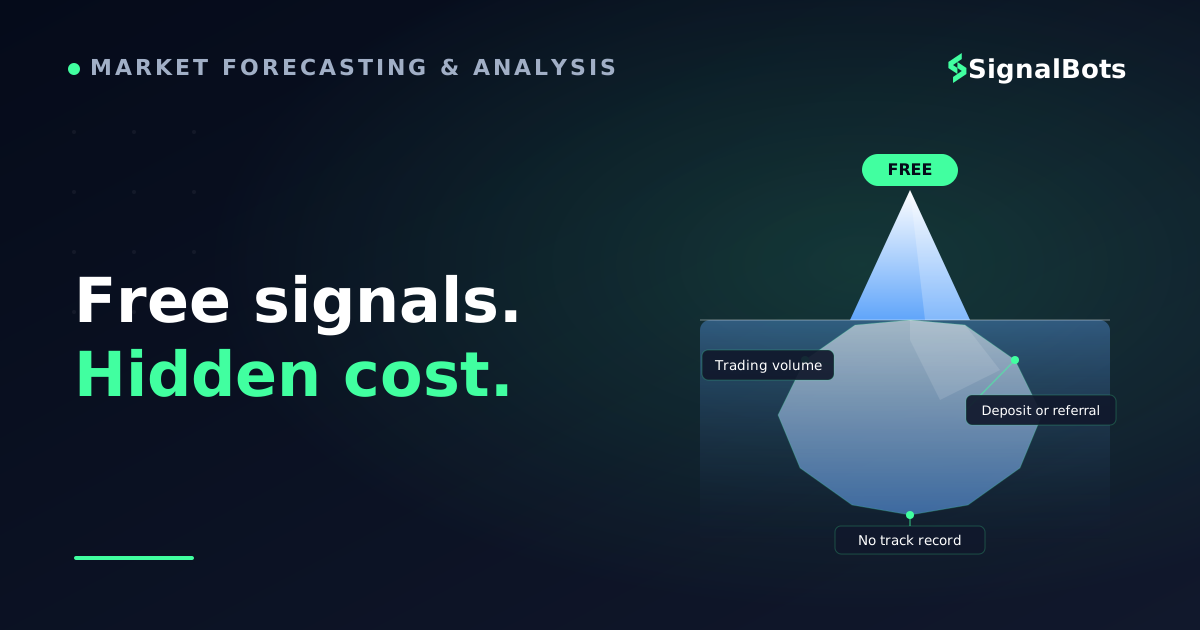
There is a catch, and it is not the vague "be careful out there" most pages end on. It is three specific, separable costs, and a given source may charge you one, two or all three.
A free signal still has a price — it is just paid in deposits, attention and an unverifiable record instead of a monthly fee.
The accuracy gap between marketing and real results
Every signal source publishes a headline accuracy band, and the band is almost always flattering. When independent reviewers actually sit with a source through live conditions — not a curated window — the figure they record is consistently lower than the advertised one, and it degrades further through news releases and volatility spikes when price stops respecting the patterns the logic was tuned on.
That gap is usually structural rather than a bare lie. A marketed figure is often a backtested result drawn from a period the rules were fitted to, or a live figure from a stretch of calm, trending conditions. What you experience is the whole distribution — quiet hours and chaotic ones, clean trends and chop. The two numbers describe different things and the marketing rarely says which one it is quoting.
The deeper problem is that no meaningfully large, independently verified test of the platform's own signal feed has been published at all. Without that, the advertised signal accuracy is not a number you can trust or distrust — it is a number you have no basis to evaluate. Every claim about signals carries real risk to your capital, which is why our own risk warning sits on every surface where performance is discussed.
So stop asking what a source's accuracy is and start asking what it needs to be. On a binary trade, a win pays you a fraction of your stake and a loss costs the whole stake, so your payout percentage sets a hard floor: the break-even win rate below which a source loses money no matter how confident it sounds.
The number the marketing never mentions
What win rate does a free source actually need to clear?
Set the payout your asset pays and the win rate you logged from the source. The break-even line is fixed by the payout alone — everything above it is your edge, everything below it is a slow drain.
Payout on a winning trade
Win rate you logged from the source
Stake per trade
$
Break-even win rate
—
Your edge over break-even
—
Result over 100 trades
—
Drag the payout down and watch the break-even line climb: a source that clears the bar on one asset can be underwater on another without changing a thing.
Run it once and the framing changes permanently. A win rate that sounds impressive in a channel bio can sit below the break-even line on a lower-paying asset, and a modest-sounding one can be genuinely profitable on a high payout. The advertised figure is meaningless until you put it next to the payout it has to beat.
The free-to-paid upsell funnel
The second cost is the one most readers walk into without noticing, because every step of it feels like a favour. A free room is rarely the product. It is usually the top of a funnel, and the funnel has a predictable shape.
The pattern to recognise
How a free signal room turns into a paid one
1
The room is genuinely free
Open channel, no payment, no barrier. Calls arrive all day. Nothing here is a trick yet — the value is real and deliberately generous.
2
Only the winners get framed
Wins are screenshotted and pinned. Losing calls are not posted, are deleted, or are quietly reframed as 'wait for confirmation'.
3
A better tier appears above it
Free calls thin out or arrive late. A VIP room is introduced where the signals are described as earlier, cleaner and more selective.
4
The tier unlocks with a deposit
VIP is offered at no cash cost if you register at the broker through their referral link and fund the account to a stated minimum.
5
Your volume becomes the payment
From then on the operator earns from your trading activity, whether the calls they send you win or lose. You never paid a fee.
No step in the chain is illegal or even unusual — but the last one is where a free room's incentives quietly stop matching yours.
Read that last step carefully, because intellectual honesty requires us to say that it describes our own business model too. SignalBots earns as an introducing broker, from the trading volume of people who register through our links — the same shape of incentive as the operator of a free Telegram room. The difference we can actually claim is disclosure: we say it in plain language on the page you are reading, rather than letting you discover it after you have deposited.
That is the test to apply, then. Not "is this source monetised?" — everything is monetised. The test is whether the source tells you how, before you act on it.
Spam and unverifiable track records
The third cost is that most free rooms are structurally impossible to grade, and the structure is doing that on purpose.
Start with the platform itself: a Telegram message can be edited or deleted after the fact, and neither leaves an obvious scar for a newcomer scrolling the history. A channel showing a wall of winners may simply be a channel that removes losers. That is why a verified track record — an independently held, unedited history — is the one credential that separates a serious source from a marketing account, and why almost no free room has one.
Then add volume. A room firing dozens of calls an hour across every asset it can reach is not being generous; it is manufacturing screenshots. With enough calls, some will land beautifully, and those are the ones that get pinned. High signal frequency without a published result for every call is the opposite of a track record — it is coverage masquerading as accuracy.
Finally, look at what a typical post omits. No entry timestamp, so you cannot tell whether it was posted before the move or narrated after it. No stated expiry, so no one can ever declare the call right or wrong. A signal that cannot be graded is not a bad signal — it is not a signal at all, just an opinion with a ticker attached.
How to Vet a Free Signal Source Before You Trust It
You do not need to decide whether to trust a channel. You need to grade it, and grading takes two weeks and no money.
You do not have to decide whether a channel is honest — you only have to record what it sends and grade it yourself.
The method is deliberately boring. The moment a call posts, copy it into your own log — asset, direction, entry time, expiry — before the original message can be edited. Then run each one as a forward test on a demo account and record the outcome yourself.
You are not looking for a good week. You are building a sample size large enough that a hot streak cannot flatter it, which in practice means weeks rather than days.
At the end, you will have something the channel does not offer: a historical win rate you personally observed. Put that number against the break-even line the payout demands, and if you want the full expected-value picture across a run of trades, the binary options expectancy calculator does the arithmetic. The wider question of how to evaluate signal quality overall — paid sources very much included — is answered with exactly the same log.
Run this before you join
Vet a free Pocket Option signal source before it sees real money
0 / 8
Confirm the channel publishes every outcome, losses included — not only screenshots of winners.
Copy each call into your own log the moment it appears, so a later edit cannot rewrite the record.
Check that every call states the asset, the direction, the entry time and the expiry. Anything vaguer cannot be graded.
Confirm you can see the signals without first registering at a broker through the channel's own link.
Watch the cadence for a week. A room firing dozens of calls an hour is buying itself screenshots, not accuracy.
Ask what the method is. A source that will not describe its logic in one sentence is asking for blind trust.
Forward test every call on a demo account until your sample is large enough to mean something.
Compare your logged win rate to the break-even win rate your payout demands, not to the number in the channel's bio.
★
Checklist complete — you’re cleared to proceed.
Eight checks, none of which require money. A source that fails three or more of them has told you what it is.
If a source clears the list, you have found something genuinely useful and free. If it fails on the first two items alone, nothing further about it is worth your time — an ungradeable source cannot become trustworthy by being right occasionally.
What a Trustworthy Free Signal Actually Looks Like
Abstract criteria are easy to nod along to and hard to apply at speed. So here is the concrete contrast, in the format you will actually meet it: two posts about the same idea, one of which can be checked and one of which cannot.
The contrast to look for
An ungradeable call
EUR/USD CALL 🚀 strong setup, get in now
No entry timestamp, so you cannot tell whether it was posted before the move or narrated after it.
No expiry stated, so the call has no moment at which it can be declared right or wrong.
The message can be edited or deleted once the candle closes.
Yesterday's losing calls are simply absent from the channel history.
A gradeable call
EUR/USD · CALL · posted 14:32 UTC · 5-minute expiry
The entry time is stamped, so the call is pinned to a candle anyone can go back and check.
The expiry is explicit, so the outcome has exactly one answer.
The result is posted afterwards against the same call, win or loss.
The running record includes the losses, so the published win rate means something.
Same asset, same direction, opposite level of accountability. The second one can be wrong in public — which is precisely why it can be trusted.
Everything on the right-hand side is cheap to publish. A source omits it not because it is technically hard, but because publishing it means the record grades itself in front of an audience.
That is the standard we hold our own feed to, and it is the reason we can point at it here rather than describe it in the abstract. Our binary options live signals page shows each call's direction openly alongside its historical win-rate context, and it is free to read without an account or a deposit — so you can see what a checkable display looks like rather than taking the description on faith. To be clear about its limits: it is a feed you read on the site, not a Telegram push and not an auto-executing bot. If what you specifically need is delivery into Telegram or automated order placement on your account, that is a different tool and this feed is not it.
Are Free Pocket Option Signals Worth It?
Yes — with one condition that changes everything about how you use them.
Free is the correct tier to start on. Paying before you can grade a source is exactly backwards: a subscription fee buys you no more accountability than a free room offers, the test that separates good Pocket Option signal providers from bad ones does not change with the price, and both are unverifiable until you log them. Starting free costs you nothing but the two weeks it takes to find out what you are dealing with.
The condition is that a free source is a candidate under test, never a system to follow. The two official sources are the honest default, since the platform has no VIP tier to sell you and therefore no reason to shape what you see. Third-party rooms are worth sampling, but only with your own log open and the referral step treated as the disclosure it is.
Which returns to the instinct you started with. You were right not to hand money to a stranger for arrows you cannot check — you just had the wrong variable in mind. The real cost of free signals was never the price. It is the account you spend finding out that nobody was grading the calls, including the person sending them. Grade them yourself, and free becomes the cheapest education in this market. Skip that step, and free turns out to be the most expensive thing on the menu.
Yes. Both the in-terminal signals panel and the official Telegram signal bot are available to account holders without a subscription, a premium tier or a deposit threshold. That is credible precisely because of how the platform makes money: it earns from trading activity, so it has no incentive to sell you a signal upgrade. What "free" does not buy you there is transparency about the method or a published long-run record — those are still absent.
Do free Pocket Option signals actually work?
Some of them clear the bar and most do not, and there is no shortcut around finding out which is which. The number that decides it is not the accuracy claimed in a channel bio but whether the source's real, logged win rate stays above the break-even rate your payout imposes. A source can be genuinely useful on a high-payout asset and quietly unprofitable on a lower-paying one without changing anything about its signals.
Why do free signal channels want you to sign up through their link?
Because that is how the room is funded. When you register at a broker through an operator's referral link and trade, the operator earns from your activity — which is why "VIP access, free with a deposit" is such a common offer. The arrangement is not automatically dishonest; plenty of legitimate operators run on it, and so do we. What separates them is whether the operator discloses it before you act or lets you discover it afterwards.
How many signals should I log before trusting a free source?
Enough that a lucky run cannot carry the result, which in practice means weeks of calls rather than a handful of days. A short sample tells you almost nothing: any source can string together a good morning, and any good source can have an ugly one. The useful stopping point is when adding another week of calls stops meaningfully moving the win rate you have recorded.
Can I automate a free signal source?
Technically yes — the official Telegram bot can place trades on your account, and third-party tools can relay calls from a channel into execution. Whether you should is a separate question, and it has the same answer as everything else here: automating an ungraded source only makes you lose faster, because the bot removes the pause in which you would have noticed the calls were not working. Grade first, automate second.
Sources & Further Reading
Want to go deeper? These independent, authoritative sources shaped this guide — each one is worth reading in full:
The Binary Options Desk is the SignalBots editorial team for fixed-time and OTC trading coverage. We research and write the guides that explain expiry timing, payout structure and disciplined entry across the major brokers.




Discussions 0
Leave a comment