Nobody publishes a trading alert out of charity. Somebody paid to build the model, or sat at a chart long enough to find the setup, and somebody is paying to keep the feed running today. So when a page offers free binary options signals, the useful question is not whether it is really free — usually it is, in the sense that no money leaves your account. The question is who is paying instead, and what do they want back from you.
Answer that and the landscape sorts itself out fast. You stop spending evenings on feeds that were never designed to make you profitable, you spot the "free" offers that quietly need a deposit first, and you can tell which genuinely free source is worth the two weeks it takes to test one properly.
This guide maps where free daily and live alerts actually come from, what each source charges you in something other than money, and how to test any provider you find before a real stake follows one of its calls.
Key Takeaways
"Free" is a payment method, not a price: every free feed is funded by trading volume, VIP upgrades, advertising or referral commission, and the funder decides what the feed is optimised for.
The real cost arrives as delay, a cut-down asset list, accuracy you cannot verify, upsell pressure, or a trading venue chosen for you - and a thinner payout raises the win rate you need just to break even.
No free provider's claims can be checked from outside, so log its calls with your own timestamps across several weeks of your own sessions before a real stake follows one.
Table of Contents (18 min read)Contents
What "Genuinely Free" Means Here — and What It Doesn't
Four different products wear the word free on a binary options search page, and only one of them is what most people mean when they type it.
A permanently free feed. Alerts keep arriving for as long as the provider runs it. No card, no installer, no funded account required first. This is the path this guide maps.
A free trial. Free for a fixed window, card usually taken up front, priced from the day it ends. Useful — but it is a paid service you are borrowing, and it comes with a deadline.
Free software you download. The app or script costs nothing, but you install something on your machine, and it generally needs a broker account before it produces anything at all.
A feed built into a broker's platform. Free to use once your account is open and funded. IQ Option's built-in signal panel is the best-known example of the type. The economics of these matter here; the platform-by-platform setup is its own subject.
One line separates them: if a card number, an installer or a deposit stands between you and the first alert, you are not looking at the thing you searched for.
Everything below assumes you already know what a binary options signal contains — an asset, a direction, an expiry — and that what you want is a dependable place for those to keep arriving without paying for them.
Where Free Binary Options Signals Actually Come From
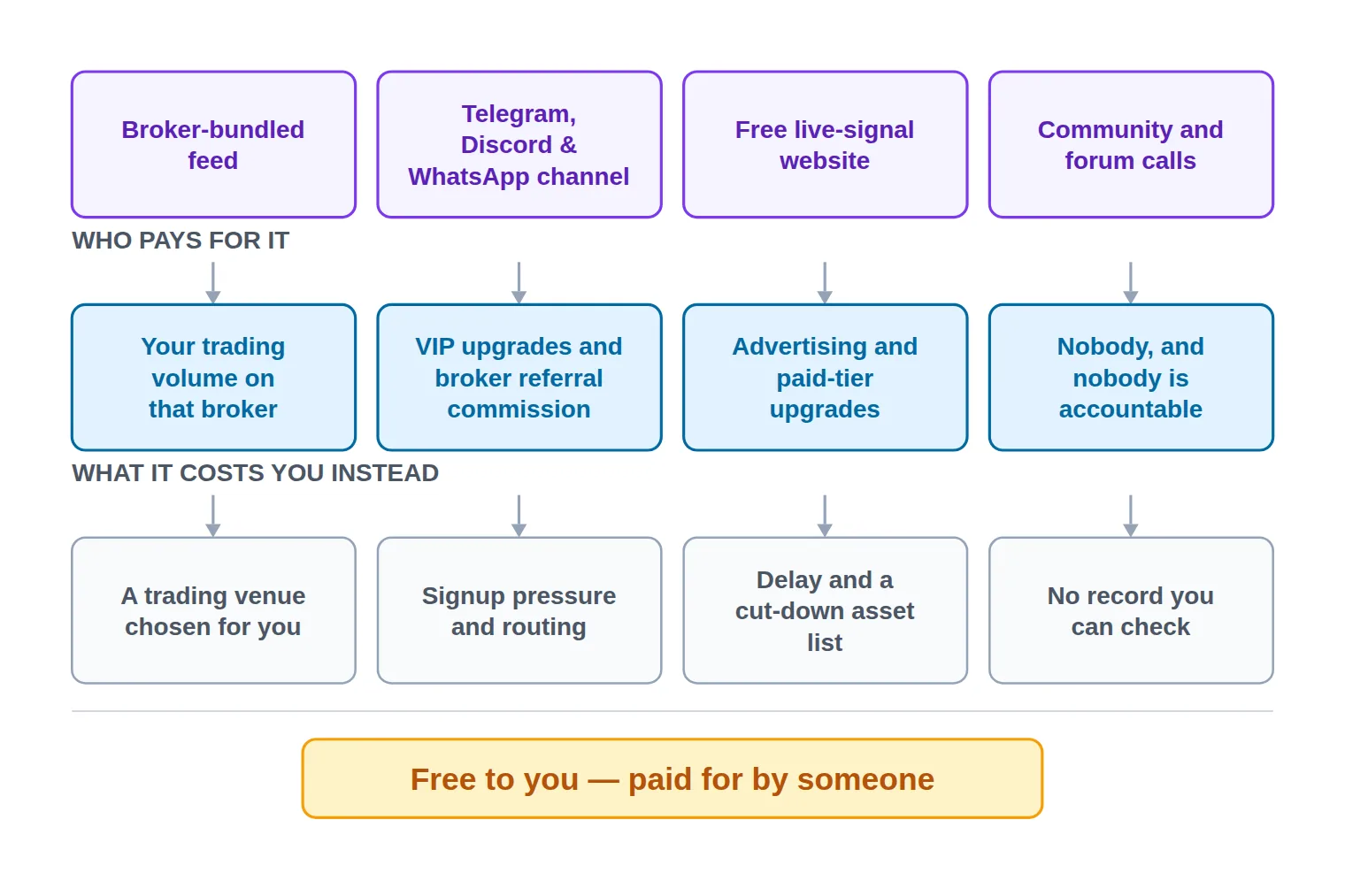
Strip away the branding and free alerts arrive from four places. They differ less in what the signal looks like than in who funds it — and the funder is what shapes the feed.
The four places free binary options signals come from, and who is paying for each one.
Broker-bundled feeds
The platform itself publishes the calls: an arrow drawn onto your chart, a sentiment panel, a list of instruments its model likes right now, or a copy feature that mirrors another account's trades. Access is free the moment your account is funded.
Why it is free: your trading volume pays for it. The platform earns from flow, so it has every reason to keep a stream of tradable-looking calls in front of you. Check carefully whether what you have been given is an alert you decide on, or an auto-trading feature that opens positions for you — the first is a signal, the second is an execution decision handed to somebody else.
Telegram, Discord and WhatsApp channels
One person, or a small desk, posts calls into a public Telegram signal channel or server. Free to join, usually instant, and by a wide margin the most common answer to how to get free binary option signals.
Why it is free: the free room is the top of a funnel. It converts into a paid VIP room, into a referral commission when you open a broker account through the operator's link, or into a course or bot sale. None of that is automatically dishonest — plenty of competent operators fund themselves exactly this way. But it explains behaviour you would otherwise misread. The free tier is tuned to keep you joined and active, and that is not the same objective as keeping your account curve intact.
Free live-signal websites
A public web page streams generated calls as they fire, usually with a countdown to expiry and a running history beside them. Nothing to install, nobody to join, and you can watch for a week before you ever act on one.
Why it is free: advertising, and a paid tier sitting above the free one. The free view is typically the paid product with something removed — fewer instruments, a delay before each call becomes visible, or a history you can read but not filter. Which piece was removed is the single most useful thing to establish about any page in this category.
Community and forum calls
Traders post their own setups into a thread, a subreddit, a Discord or a comment section. No provider, no schedule, no product.
Why it is free: there is no business here at all. That is both its honesty and its weakness — nobody is selling you anything, and nobody is accountable either. What survives in these places is filtered by memory rather than by record: winning calls get screenshotted and reposted for years, losing ones quietly scroll away.
So What Does a Free Signal Actually Cost You?
Nothing leaves your account - but every free feed collects in delay, coverage, proof or routing.
No money leaves your account. Five other things do, and knowing which one a given source is charging you is most of the skill.
Delay. Binary trades are short. A five-minute call published at 14:00 is a different trade at 14:02 and not a trade at all by 14:06. Free tiers routinely hold the feed back, because a fixed delay is the cleanest way to keep a paid tier worth paying for — and a human-run channel posts whenever that human is at the desk. Either way you are acting on a stale signal part of the time, and the shorter your expiries, the larger that part becomes.
A narrower, chosen asset list. Free tiers cover fewer instruments, and those instruments are rarely a random sample: they skew toward whatever the provider's own platform lists, and toward OTC instruments that stay quotable when the underlying market is closed. The cost is not the missing pairs. It is what a thin list does to your discipline — waiting on four instruments to set up is exactly the situation that manufactures forced trades.
Accuracy you cannot check. A free provider owes you nothing, and most behave accordingly: a headline number on the landing page, a folder of winning screenshots, no outcome log. Signal accuracy you cannot reconstruct from timestamped calls is a marketing claim, not a historical win rate. Treat any figure you cannot recompute yourself as unknown, not as optimistic.
Your attention, sold back to you. A free room's job is conversion, and conversion runs on activity. That produces feeds firing far more often than any coherent strategy would justify, urgency wrapped around every call, and a steady drip of what the VIP room gets that you do not. You pay in trades you would never otherwise have taken.
A venue chosen for you. This is the cost traders miss. When a feed is free because a broker or an affiliate funds it, part of each alert's job is to get you trading in one particular place — and in binary options, where you trade sets your arithmetic. Your loss is capped at the stake, but your win is capped by the payout percentage the venue offers. Suppose you stake $100 a trade: at a 90% payout you need to be right on roughly 53 of every 100 trades simply to stand still, while at 70% those same calls need about 59. A free feed can be genuinely better at reading direction and still leave you behind, purely because of where it sent you. Put your own numbers through the break-even win rate calculator before you accept a platform somebody else picked for you.
The four free sources
Free source
Typical delay
Asset coverage
Proof you can check
What pays for it
Broker-bundled feed
None - it fires inside the platform
Only what that broker lists
Rarely a full outcome log
Your trading volume on that platform
Telegram / Discord / WhatsApp channel
Whenever the operator is at the desk
Whatever the operator trades
Screenshots, editable history
VIP upgrades and broker referral commission
Free live-signal website
Often held back to protect the paid tier
A cut-down instrument list
Sometimes a public running log
Advertising and paid-tier upgrades
Community and forum calls
Human speed, often posted after the fact
Whatever anyone happens to post
None - no provider, no record
Nothing, and nobody is accountable either
Same word, four different bills. Read the last column first — it predicts every other one.
Red Flags That Only Show Up on Free Offers
The general checklist for judging any signal provider — accuracy, transparency, what it costs — applies here as much as anywhere. What follows are the tells specific to the free end of the market, where services tend to get joined rather than vetted. Any single one of these is enough to walk away.
The word "free" has a deposit behind it. Alerts unlock only after you register through their link, with one named broker, for a minimum amount. That is an affiliate offer wearing a free-signal headline.
A near-perfect win rate, or the phrase "risk-free". No market pays out to somebody who is right nine times in ten, repeatably, forever. A service claiming a "guaranteed" or "risk-free" outcome is telling you what it thinks you want to hear, and that is a reason to close the tab rather than a feature to compare.
A history with no losers in it. That is not a good record, it is an incomplete one. Every real feed loses trades; the honest ones publish those too.
Edited or deleted message history. Chat platforms mark edited posts and leave visible gaps where messages were removed. A call whose direction or expiry was changed after the fact was never really a call.
Martingale presented as risk management. "Double after a loss and you always recover" turns up in free rooms far more often than it should. It converts a run of small losses into a single account-sized one.
A feed that never goes quiet. Alerts every couple of minutes, across every session, are not the output of a desk reading structure. They are output tuned for engagement.
Nobody named, nothing answerable. No identifiable operator, comments switched off, replies disabled, questions routed only to a sales account by direct message.
The same calls, published earlier somewhere else. Resold feeds are common. If the alerts show up elsewhere with earlier timestamps, you are at the end of a chain and eating the delay for free.
Test Any Free Provider Before You Size Up
You cannot verify a free provider's claims from outside. What you can do, cheaply, is build your own record of what it actually does — and two weeks of your own log outranks any landing page ever written.
Start by logging, not trading. Copy each alert into a sheet the moment it lands, with your own receipt time beside the provider's stated entry time. That one column answers the question nothing else will: does this feed reach you inside the window it was built for? Then mark every call a win or a loss yourself, read off the chart at expiry, because the provider's own scoreboard is precisely the thing under test.
Run it as a forward test at zero stake, or at demo account size, and keep going well past the point where it feels conclusive. Ten calls tell you nothing at all.
A sample size spanning several full weeks of the sessions you actually trade is the minimum at which one hot streak stops being able to carry the whole result. Log only the hours you would genuinely be at the screen, too — a feed that shines in a session you sleep through is not a feed you can use.
Then, and only then, size up in small steps. A binary position loses the entire stake when it finishes out of the money, so every increase should be one you could absorb several times over. Read our risk warning before any free feed becomes a funded one.
Two-week provider test
Test a free signal provider before you trade it
0 / 9
Copy every alert into a sheet as it lands: your own receipt time, the asset, the direction, the expiry, and the price you could realistically have entered at.
Mark each call a win or a loss yourself, from the chart at expiry, never from the provider's own scoreboard.
Log only alerts from the hours you would actually be trading, not from the provider's showcase session.
Measure the gap between the stated entry time and the moment the alert reached you, on your own device and connection.
Keep the test running across several full weeks, so a single hot streak cannot carry the whole sample.
Ask to see the losing trades, and treat a history with none in it as a history that was never kept.
Search the exact wording of a few alerts; if the same calls appear elsewhere with earlier timestamps, you are on a resold feed.
Confirm nothing in the offer requires a deposit, a card or an install before the alerts keep coming.
Only once the log holds up, raise stakes gradually, and never past what you could lose outright.
★
Checklist complete — you’re cleared to proceed.
Work down the list before real money follows any free alert - the log, not the sales page, decides.
Seeing Free Live Binary Options Signals in Action
The quickest way to calibrate that test is to run it against a feed that already publishes what a feed should. Our own live binary options signals page is one example of the free live-signal website category described above: calls publish in real time as they fire, each one carries its historical win rate and reward-to-risk context, and the page is free to view with no broker deposit required to look.
Concretely, that means the first two steps of the test are already done for you. Every call arrives timestamped, and its outcome goes on the record rather than into a screenshot folder, so your log becomes a matter of copying rather than reconstructing. Steps three through five remain yours: run it across your own sessions, on your own connection, for a sample long enough to mean something.
It is worth being clear about what it is not. It is a feed to read and judge, not a program you install, not a panel inside a broker's terminal, and not an alert stream pushed to your phone. If one of those is specifically what you want, a different free path fits you better.
Which Free Path Actually Fits You?
Four situations, four answers. Choose by how you want alerts to reach you, not by which page ranked first.
You want alerts you can read, judge and act on yourself, indefinitely. A free live-signal website or a well-vetted chat channel is your path — the one this guide maps. Start with whichever one publishes a history you can check.
You want something running on your own machine or phone. Then what you actually want is free binary options signal software you download and run, trading setup effort against no longer depending on somebody else's posting schedule.
You are willing to hand over a card to sample a serious service. A free trial of a paid provider hands you the full product for a fixed window. That is a different decision, with a deadline attached, and it deserves to be treated as one.
You already trade on one platform and would rather not add a source. Then look at the signals bundled inside that specific broker's platform — and read the payout arithmetic above before you rely on them.
Whichever you pick, the same discipline decides the outcome, and it is unglamorous: log first, size later. The best free binary options signals are simply the ones that survive your own record-keeping.
You came in asking
“where free binary options signals genuinely come from”
and you leave knowing
who funds each source, and what they want back from you.
Free is a payment method, not a price
Pick the category that matches how you want alerts to reach you, establish who is paying for it, then spend two weeks logging its calls before a single real stake follows one. A free feed that survives your own log is worth more than a paid one that never had to.
Some are competent and some are noise, and from outside you genuinely cannot tell which is which — that is the honest answer. No free provider is obliged to publish a checkable record, so treat every headline accuracy figure as unverified until you have rebuilt it yourself from timestamped calls and your own outcome marks. A source that publishes losing trades alongside winning ones has at least given you something to audit.
Do I have to deposit money to get free signals?
Not for a genuinely free feed. Free live-signal websites and public chat channels publish without asking for anything, and you can watch either for weeks before opening an account anywhere. Broker-bundled feeds are the exception by design: they sit inside a funded account, so the deposit is the price of entry even though the signals themselves carry no fee.
How many free daily binary options signals should I expect?
There is no correct number, but the shape tells you a lot. A feed built around specific setups goes quiet when those setups are absent, so gaps are a sign of selectivity rather than neglect. A feed that fires continuously through every session, regardless of conditions, is usually optimising for engagement — and it hands you far more chances to overtrade than to trade well.
Are free Telegram binary options signal channels safe to follow?
The channel format itself is neutral; the operator's funding model is what to examine. Establish how the room makes money — VIP upgrades, broker referral commission, course sales — because that tells you what the free tier is optimised to produce. Then apply the same two-week log you would apply to any other source, and be especially wary of any room that unlocks its alerts only after you register with one specific broker.
Can I automate a free signal feed?
Only if the source publishes in a machine-readable way and its licence permits it, which most free rooms and pages do not. More importantly, automation multiplies whatever the feed already is: an unverified edge executed automatically simply loses faster and with less warning. Establish the edge with a manual log first, and treat automating it as a separate decision made afterwards.
Sources & Further Reading
Want to go deeper? These independent, authoritative sources shaped this guide — each one is worth reading in full:
The Binary Options Desk is the SignalBots editorial team for fixed-time and OTC trading coverage. We research and write the guides that explain expiry timing, payout structure and disciplined entry across the major brokers.



Discussions 0
Leave a comment