Your shortlist probably looks something like this: US Binary Signals, one of the RC1 PRO or Perpetual Pops products, iPipz, and a Twitter account posting five- and ten-minute calls. Four sales pages, four confident accuracy claims, and no way to line them up against each other — because every one of those pages reviews only itself.
There is also a fact none of them puts in front of you, and it reshapes the whole decision: the Nadex retail platform stopped taking trades. Not "is winding down" — stopped.
This page still does the comparison, because the services and the sales tactics did not disappear with the venue. You get the named services side by side on what can actually be checked, a straight answer on whether the exchange ever endorsed any of them, and one piece of arithmetic that tells you whether an advertised win rate is worth a subscription on any strike-based binary market — this year or next.
Key Takeaways
Nadex's retail platform is gone: deposits stopped on 6 December 2025 and trading via Nadex.com was permanently disabled on 20 December 2025, with defined-risk and event contracts continuing under Crypto.com | Derivatives North America.
No CFTC-regulated exchange has ever run or endorsed a signal service, so any "official Nadex" claim is a red flag rather than a credential.
On a contract settling at $100, the price you pay is your break-even win rate — which is why an advertised accuracy figure means nothing without knowing the contract price.
None of the named services (US Binary Signals, the RC1 PRO/Perpetual Pops family, iPipz, the short-expiry alert services) publishes a checkable trade log.
Table of Contents (27 min read)Contents
The Fact Every Nadex Signal Page Leaves Out
Nadex is the North American Derivatives Exchange, a CFTC-regulated designated contract market that spent years as the one place a US retail trader could buy exchange-listed, defined-risk binary contracts. That is what made "Nadex signals" a category of its own: it was a regulated exchange, not an offshore broker, so a whole cottage industry grew around telling people which way its contracts would settle.
The exchange became part of the Crypto.com group in 2022, and the legacy platform was retired at the end of 2025. New retail applications were halted, deposit methods were switched off on 6 December 2025, and trading through Nadex.com was permanently disabled on 20 December 2025, with open positions required to be closed by end of business that day. The regulated entity did not vanish — defined-risk and event contracts continue under Crypto.com | Derivatives North America, still a CFTC-regulated designated contract market, reached through the Crypto.com app instead of the old platform.
What actually happened
22The exchange changes hands The North American Derivatives Exchange becomes part of the Crypto.com group in 2022. Trading carries on as normal at Nadex.com, and the signal-service industry built around it carries on with it.
!New accounts stop Nadex halts new retail applications. The exact audience every signal sales page was written for — a trader about to open an account — can no longer open one.
6Deposits switched off On 6 December 2025 all deposit methods are suspended. Existing traders can still manage and exit positions, but no new money goes in.
20Trading permanently disabled On 20 December 2025 trading via Nadex.com is disabled for good. Open positions had to be closed by end of business that day, with balances withdrawn to the original payment method or a verified bank account.
→Contracts move to a new venue Defined-risk and event contracts continue under Crypto.com | Derivatives North America, a CFTC-regulated designated contract market accessed through the Crypto.com app rather than the retired platform.
The wind-down that every still-live “Nadex signals” subscription page quietly skipped.
So when you land on a page selling Nadex signals today, you are looking at one of three things: an old page nobody updated, an affiliate page that earns whether or not you can trade, or a service that has quietly repointed at something else and kept the more searchable name. None of those is a reason to hand over a card number, and all three are easy to tell apart once you know what to look for. The exchange wound down at the end of 2025; the sales pages pointing at it mostly did not.
Why a Nadex Signal Was Never Like a Regular Binary Signal
Almost every binary options signal you have seen advertised was written for a fixed-payout retail broker. There, the shape is simple: you stake an amount, and if the contract finishes in the money the broker credits a fixed payout percentage on top of your stake. Lose and the whole stake goes. The broker sets that percentage, and the broker is also the other side of your trade — which is its own kind of counterparty risk.
An exchange-listed binary works nothing like that. The contract settles at $100 if the condition is true and $0 if it is not. You do not stake a chosen amount — you buy the contract at whatever price the market is quoting between those two poles, and that price is your entire risk. Buy at $40 and you have risked $40 to make $60. Buy at $85 and you have risked $85 to make $15. You can also sell a contract you do not own, which caps your risk at $100 minus the price you sold at.
That single structural difference is what makes an advertised accuracy number almost meaningless on its own. The price you pay is the market's implied probability, so it is also your break-even.
The one formula that matters
Break-even win rate on an exchange-style binaryfx
Break-even win rate = P ÷ 100
wherewhere P is the price paid for a contract that settles at $100 or $0. Buy at $40 and you risk $40 to make $60 — you break even winning 40 out of 100. Buy at $85 and the identical contract needs 85 out of 100 just to stand still. Exchange transaction fees at entry and settlement push both numbers slightly higher.
On a strike ladder the entry price sets the bar the signal has to clear.
Read that again with a sales page in mind. A service can advertise a high break-even win rate clearance and still lose money, if the contracts it points you at are the expensive, deep in-the-money ones where the crowd already agrees with the call. It can also run a mediocre-sounding rate and be genuinely profitable, if it consistently finds cheap contracts the market has mispriced. Neither is visible in the number on the banner.
How We Scored These Nadex Signal Services
Because none of these services publishes anything auditable, ranking them on claimed accuracy would just be reprinting their marketing in a neater font. So the scoring below leans on what a reader can verify without an account:
Does the service speak the exchange's language? Contract prices between 0 and 100, named strikes, named expiry series. A provider quoting fixed percentage payouts is running retail-broker logic against an exchange product.
Does delivery survive the expiry window? A five-minute contract and a Twitter post are not naturally compatible. Channel latency is part of the product, not a footnote.
Is the cost structure honest end to end? A paid trial that silently rolls into a full subscription is a pricing tactic, not a test drive.
What does it claim about its relationship with the exchange? This one is binary, and it is covered in its own section below.
Those five checks are worth running on anything with "Nadex" on the label — including whatever replaces these services next.
Vetting checklist
Five checks before you pay for anything with “Nadex” on the label
0 / 6
The seller acknowledges that trading on Nadex.com was permanently disabled in December 2025 — a page still describing it as a live venue has not been touched in over a year.
Prices are quoted the way an exchange quotes them, as a contract price between 0 and 100, rather than as a fixed percentage payout borrowed from retail brokers.
Signals name a specific strike and expiry series, not just an asset and a direction, because on a strike ladder those two fields decide your break-even.
A downloadable trade log with entry prices and outcomes exists — not a balance screenshot, not a testimonial wall, not a video of someone scrolling.
The trial end date and the renewal price are stated in writing, and cancelling does not depend on an email address that never answers.
Nothing anywhere claims official exchange approval, endorsement or partnership.
★
Checklist complete — you’re cleared to proceed.
Six yes-or-no answers you can get before entering a card number.
The Named Nadex Signal Services, Compared
Here is the side-by-side that individual signal provider reviews never produce. Every cell describes structure, delivery and evidence — the things that stay true regardless of what the marketing says this week.
Side by side
Service
What it delivered
Delivery channel
Cost model
Evidence you can check
US Binary Signals
Directional calls on exchange-style binary contracts
Email and SMS
Monthly subscription with a short paid trial
Backtested claim with its own disclaimer; no trade log
RC1 PRO / Perpetual Pops family
Several separately branded signal products and systems
Product delivery plus alerts
Sold per product; no published rate card
No performance data published for any of the products
iPipz
Lower-frequency calls skewed to end-of-day expiries
A public Twitter feed only
Free trial period, then a monthly fee
Third-party review rating only; no audited record
5- and 10-minute alert services
Short-expiry directional alerts, several per session, weekdays
Twitter, email and SMS
Monthly subscription with a cheap one-week trial
Advertised success rate only; no per-trade history
Four services, one honest column: nobody in this table publishes a checkable record.
US Binary Signals
The most conventional of the group and the one that looks most like a real product: calls delivered by email and SMS, a stated monthly price, and a short paid trial as the on-ramp. It also does something its rivals mostly skip — it attaches a disclaimer to its backtested claim rather than presenting the number as a promise.
That honesty stops at the edge of the claim. There is no per-trade history, so you cannot tell whether the record came from cheap contracts or expensive ones, which is the difference between a real edge and a rounding error. Suits a trader who wants push delivery to a phone and is willing to treat the trial as a paid experiment with a firm cancel date.
RC1 PRO and the Perpetual Pops Family
This is a catalogue rather than a service: RC1 PRO, Perpetual Pops and their forex-flavoured siblings are sold as separate branded systems. The naming is energetic; the disclosure is not. No accuracy data is published for any of them, no rate card sits on the page, and — the detail that says the most — the vendor never compares its own four products to each other, so a buyer cannot even tell which one is meant for them.
Suits almost nobody as a first purchase. If you are drawn to one of these, ask for a trade log by product before you ask for anything else, and read the answer carefully.
iPipz
The outlier on cadence. Where the rest chase short intraday expiries, iPipz leans towards end-of-day contracts, which is a genuinely different product: fewer decisions, longer to act, and far more forgiving of a delivery channel that is not instant. It ran a free trial period before the monthly fee, which is the friendliest on-ramp in the group.
Its weakness is the same channel that makes it accessible. A public Twitter feed is a broadcast, not a delivery system: no acknowledgement, no ordering guarantee, and no way to prove after the fact that a post existed at the time it claims. The independent rating it received also sat noticeably below the accuracy figures its competitors advertise — which, awkwardly, may make it the most believable number in this article. Suits a swing-oriented trader who checks the market a few times a day, never a scalper.
The 5- and 10-Minute Alert Services
The archetype most people picture when they search for nadex binary options signals: several alerts per session on very short expiries, pushed out over Twitter, email and SMS on weekdays, behind a monthly subscription with a cheap one-week trial.
The maths of this format is brutal in a way the sales copy never mentions. On a five-minute contract, the time between an alert being generated and you finding the right strike is a meaningful fraction of the trade's life, so a stale signal is not an edge case, it is the default failure mode. Add several trades a session and the exchange's per-contract fees start compounding against you long before the win rate does. Suits a trader already sitting at the platform during the session, with the ladder open, who can act within seconds — and nobody else.
Does Nadex Run or Endorse an Official Signal Provider?
No. It never did, and no CFTC-regulated exchange does.
The reason is structural rather than a matter of policy. A designated contract market lists contracts, matches orders and clears them. Taking a directional view — telling a customer which side of a contract to be on — would put the venue on the opposite side of its own members' interests. Exchanges publish contract specifications, settlement rules and market data. They do not publish opinions, and they do not license anyone else to publish opinions on their behalf.
The same logic covers automation. There was never a native auto-trading service or an exchange-blessed trade copier for retail binary contracts. Third-party tooling existed, and some of it worked, but every bit of it was software you chose and carried the risk for yourself.
So a "Nadex-approved", "official Nadex partner" or "as endorsed by Nadex" claim is not a grey area to weigh up — it is the end of the conversation. The usual tells:
the exchange's name or mark used as decoration near a price, with no legal entity named anywhere on the page;
language that slides from "signals for Nadex" to "Nadex signals" to "official", one step at a time down the page;
an insistence that you open your trading account through their link before the subscription can be "activated";
a support address on a free mail domain sitting under a logo that implies an institution.
Any service showing you win rates, backtests or performance figures — ours included — sits inside the same reality, which is why every one of those numbers belongs next to a risk warning rather than a countdown timer. A seal with nothing behind it: no regulated exchange endorses a signal seller.
Turning a Signal Into an Actual Exchange Order
Here is the gap that quietly sinks most subscriptions, and none of the four services above closes it. A message reading "EUR/USD CALL, 10 minutes" is a complete instruction on a fixed-payout broker, where there is one contract and one payout. On a strike ladder it is only half an instruction, because you still have to choose which contract to buy — and that choice, not the direction, sets your break-even.
Signal to order
How a delivered signal becomes an order on a strike ladder
1
Read the signal's three parts
Asset, direction and expiry window. Without an expiry, a call is an opinion rather than a tradeable instruction.
2
Match the expiry series first
Contracts are listed per expiry. Pick the series whose settlement time matches the signal's window, not simply the nearest one open.
3
Choose the strike, not just the side
Each expiry lists several strikes. The strike you take decides the contract price, and the price decides your break-even.
4
Check the price has not drifted
The ask is your risk per contract; $100 minus the ask is your reward. If the ask moved while you were looking, the edge may already be gone.
5
Size in contracts and log the fill
Risk is capped at the price paid, so sizing means contract count. Record the entry price and the outcome — that log is your only honest record.
Steps two and three are where a generic directional alert stops being enough.
Notice what that sequence implies about the expiry time on any alert you receive. A signal built for a broker's fixed one-hour contract cannot be dropped onto an exchange ladder without a judgement call about which strike carries the same idea — and the moment you are making that call, you are the analyst, not the subscriber. That is fine, as long as you are not paying subscriber prices for it.
Is an Advertised 80% Win Rate Profitable on a $100 Contract?
Sometimes yes, sometimes no — and the price paid decides which, not the win rate. Work it through with round hypothetical numbers.
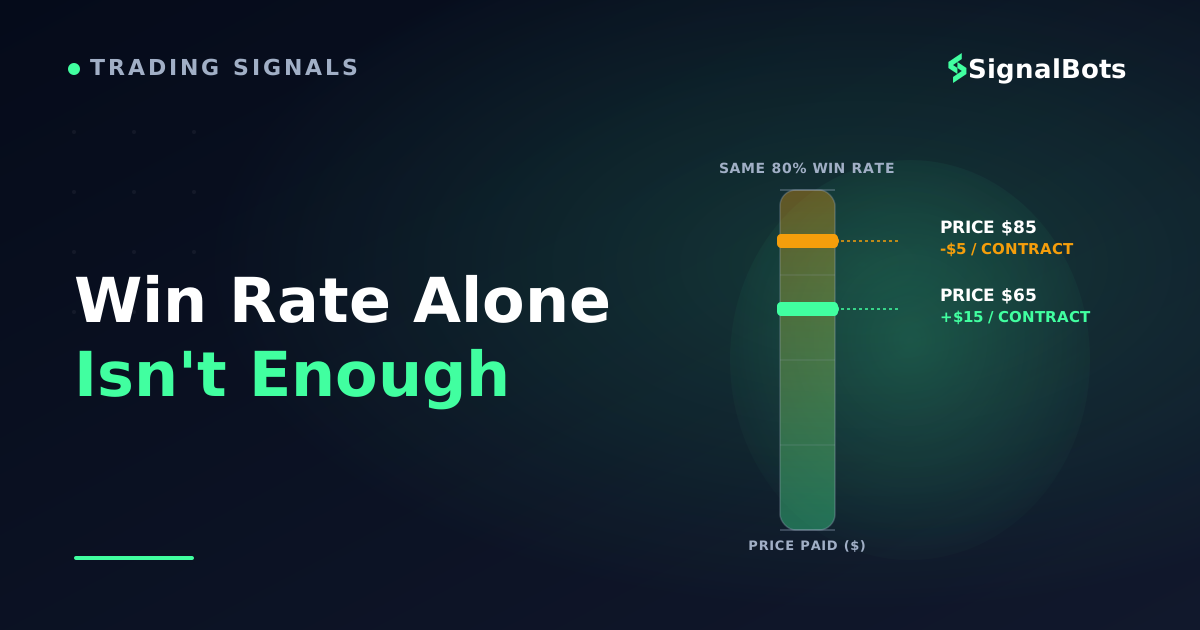
Suppose a service claims eight winners in every ten, and its calls land you in contracts you buy at $65. Ten contracts, one at a time: eight win and pay $35 each, for $280. Two lose the full $65 each, for $130. You are $150 ahead across ten contracts — $15 per contract, before fees. The claim holds up.
Now suppose the same eight-in-ten record, but the calls point at consensus contracts priced at $85. Eight winners pay $15 each, for $120. Two losers cost $85 each, for $170. You are $50 down across the same ten trades — minus $5 per contract. Identical win rate, opposite outcome, and nothing on the sales page would have told you which one you were buying.
The shortcut worth memorising: on a contract settling at $100, your expected value per contract in dollars is simply the win rate in points minus the price in dollars. Eighty percent at $65 is +15. Eighty percent at $85 is -5. Then subtract the subscription, and the per-contract expectancy has to carry the monthly fee across however many contracts you actually trade.
Run it on your own shortlist
Does an advertised win rate survive the price and the fee?
Set the contract price you would really pay, the win rate a service advertises, and what it charges monthly. Illustrative figures — not a projection of any result.
Contract price you pay
Advertised win rate
Contracts traded per month
Subscription cost per month
$
Break-even win rate
—
Expected value per contract
—
Net per month after the fee
—
Win rate needed to cover the fee
—
Drag the price up while holding the win rate still — the whole subscription flips underwater without the claim ever changing.
Two honest caveats on that model. It ignores exchange transaction fees, which are charged per contract and matter most to exactly the high-frequency, short-expiry style the alert services sell. And it assumes an average price, where a real month is a distribution — a run of losses at the wrong size can end an account long before the average asserts itself, which is what the risk of ruin calculator is for. A historical win rate is a description of the past, never a forecast of your next ten trades.
See Live Binary Options Signals Free Before You Pay for Any
The check you just ran needs raw material: a stream of real signals you can watch, price against a contract, and judge over weeks — without a card on file. That is the part the paid-trial model is designed to prevent, because a one-week window is far too short a sample to separate an edge from a run of luck.
Our own binary options live signals page exists for that stage. Each signal is published with its direction and expiry, alongside its signal accuracy and historical win rate shown openly rather than as a banner figure, and it is free to view before you commit to anything paid. Take the last worked example and run it live: watch a published call, find the contract price you would actually have paid, and check whether the win rate on display clears that price. That is the same arithmetic as the calculator above, done on a feed you did not pay to see. If you would rather have alerts pushed to you, the same feed runs through our binary options Telegram channel.
To be straight about the limits: it is a general binary options signal feed, not built to any single exchange's strike ladder or expiry series. You still have to translate a signal — ours as much as anyone's — into a specific contract yourself, and watching our feed does not substitute for demanding a real trade log from a paid provider before you subscribe to it.
Which Path Fits You Now
The platform question and choosing a signal provider are two separate decisions, and most readers arriving here have quietly merged them. Untangle them along these lines:
You were an active Nadex trader. Your account went through the wind-down described at the top, and the successor venue for defined-risk and event contracts is the Crypto.com derivatives arm rather than the old platform. Any subscription still selling "Nadex signals" as a live product is selling you a map to a closed road — settle the venue question first, then shop for signals.
You never had an account and wanted exchange-listed defined-risk contracts. Learn the successor venue's contract specifications before you buy anyone's opinion about them. A signal is only as useful as your ability to place the order it implies.
You mainly wanted a signal service and Nadex was just the venue you knew. Then the whole comparison above collapses into one question: which provider will show you a checkable record? Start with something free and long enough to sample properly, and let the price-versus-win-rate test do the eliminating.
You are cost-sensitive. Remember that a cheap paid trial that auto-renews is not a free test, it is a discounted first month. Budget it as a subscription from day one, or do not start it.
You came in
“hunting the best Nadex signal service among four near-identical sales pages”
and leave with
a price-versus-win-rate test that outlives any single provider.
The venue changed. The test you run on a signal seller did not.
Every service in the comparison above sold the same thing: a number, with nothing behind it you could check. The exchange those numbers pointed at has since retired its retail platform, which makes the specific shortlist obsolete but the method more useful than ever. Price the contract, derive the break-even, subtract the fee, and demand a log — that sequence works on the next four services as well as it worked on these.
Not through the old platform. Trading via Nadex.com was permanently disabled on 20 December 2025, after deposits were suspended earlier that month and new applications were closed before that. The regulated entity behind it continues to operate as a CFTC-designated contract market, with defined-risk and event contracts offered under the Crypto.com | Derivatives North America banner through the Crypto.com app. If a signal page tells you otherwise, that page has not been updated.
Did any Nadex signal service offer real automated trading?
None of them offered exchange-native automation, because the exchange never provided it for retail binary contracts. What existed was third-party software — copiers, click assistants, expert-advisor style tools — that a trader installed and took full responsibility for. A service advertising "auto-trading on Nadex" was describing its own or someone else's third-party tool, not a feature of the venue, and the distinction matters enormously when something misfires.
Is a higher win rate always better on an exchange-style binary?
No, and this is the single most expensive misunderstanding in the category. Because the contract price is your risk and $100 minus that price is your reward, a strategy that buys expensive contracts needs a very high win rate merely to break even, while one buying cheap contracts can be profitable at a rate that sounds unimpressive. Always ask what price the signals put you in at before you react to the percentage.
What should a Nadex-style signal contain to be usable?
Asset, direction, the expiry series it refers to, and ideally the strike and the price at which the idea still works. The last field is what separates a tradeable instruction from a headline: without a maximum price, you have no way to know whether the contract has already moved past the point where the trade made sense by the time you open the ladder.
Are free signals good enough to evaluate before paying?
For evaluation, free signals are usually better, because you can watch them for months rather than the week or two a paid trial allows — and sample size is exactly what these decisions lack. Free feeds tend to carry fewer instruments and less hand-holding than a paid service, so the honest use is as a measuring instrument first: track them against contract prices, build your own log, and only then decide whether anyone's subscription earns its fee.
Sources & Further Reading
Want to go deeper? These independent, authoritative sources shaped this guide — each one is worth reading in full:
The Binary Options Desk is the SignalBots editorial team for fixed-time and OTC trading coverage. We research and write the guides that explain expiry timing, payout structure and disciplined entry across the major brokers.



Discussions 0
Leave a comment