You already know what a binary signal is and how the contract settles. What keeps costing you money on this pair is timing — a clean-looking EUR/USD entry at three in the morning that drifted sideways until expiry, or a perfectly reasonable one that fired ten minutes before an ECB decision and reversed while the clock ran down.
Both failures share one cause. A binary contract is judged on where price sits at a fixed deadline, so the question is never simply "will EUR/USD go up?" It is "will it travel far enough, in that direction, before the timer runs out?" And how far EUR/USD travels in the next fifteen minutes depends less on the setup than on what hour of the day it is.
This guide is about that hour: when EUR/USD binary option signals are worth acting on, when they are noise, and how to tell which is which at the moment the alert lands. It covers the pair's daily rhythm in UTC, the recurring releases that override it, and the checks that turn a raw alert into a decision you can defend.
Key Takeaways
EUR/USD is only as liquid as its home sessions: the London/New York overlap (about 12:00-16:00 UTC in summer, 13:00-17:00 UTC in winter) is where signals get the follow-through a fixed expiry needs.
Overnight Asian hours are the pair's signal trap - alerts still fire, but range-edge sweeps and thin flow rarely deliver the distance before the clock runs out.
Scheduled events override session logic on both sides of the pair: ECB decision plus press conference, FOMC, US CPI and Non-Farm Payrolls all need a blackout window, not a bigger stake.
Set expiry from the pair's current pace rather than habit, and judge your win rate by session bucket instead of in aggregate.
Table of Contents (28 min read)Contents
Why EUR/USD's Own Rhythm Matters for Binary Signals
Every overview of this pair opens with the same line: EUR/USD is the world's most heavily traded major pair. True, and for a binary trader it needs a footnote. That depth is not spread evenly across the day — it belongs to European and North American desks, and it exists when those desks are at work. The same pair that absorbs enormous flow at two in the afternoon London time can barely fill a candle at four in the morning.
That matters more here than in spot trading. If you hold a spot position, a slow hour is only an inconvenience; you wait. A binary options signal gives you no such patience — the contract expires whether or not the move had time to develop. So the variable you are really betting on is distance per unit of time, and on EUR/USD that variable swings enormously between one hour and the next. A binary contract doesn't just ask which way EUR/USD moves - it asks whether the move covers enough distance before the clock runs out, and that answer changes by the hour.
The pair also answers to two calendars rather than one. Euro-area data and the European Central Bank move the numerator; US data and the Federal Reserve move the denominator. Because the euro carries by far the largest weight in the US Dollar Index, anything that repositions the dollar broadly shows up in EUR/USD first and most cleanly. Two calendars means roughly twice the number of days on which the ordinary session pattern gets suspended.
Finally, understand what EUR/USD is not. Pairs with a yen or an Australian dollar leg have genuine business in Asian hours — Tokyo and Sydney desks actually need to trade them. EUR/USD has almost no such constituency overnight. Its quiet hours are quieter than a yen cross's quiet hours, which is exactly why signal logic tuned on a 24-hour average misprices this pair after midnight UTC.
What Time Is Best to Trade EUR/USD Binary Signals?
Work in UTC and convert once. Broker platforms display server time, signal feeds often stamp entries in their own zone, and your phone shows local time — three clocks, three chances to think you are in the prime window when you are two hours outside it. Fix a single reference, then map each trading session onto it; a forex market-hours tool does the conversion in one pass.
EUR/USD Session Map
EUR/USD's UTC Trading Day24-hour clock · times in UTC
UTC timeline
AsianSydney/TokyoLondonGMT/BSTNew YorkEST/EDT
23:00–24:0023:0000:00–7:00–7:00
7:00–16:007:00
12:00–21:0012:00
000306091215182124
London + New York12:00–16:00 UTC · Prime window, deepest liquidity
Asian
London
New York
Overlap (peak liquidity)
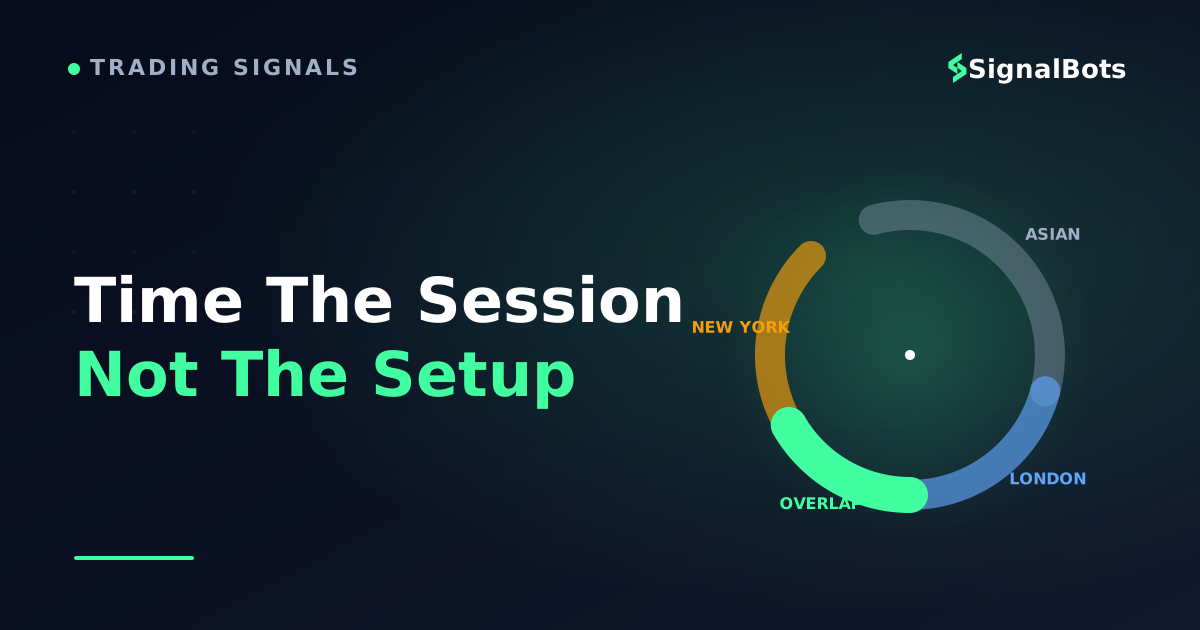
The 12:00-16:00 UTC overlap (13:00-17:00 in winter) is where EUR/USD gets the follow-through a fixed expiry needs; the 23:00-07:00 stretch is this pair's signal trap.
EUR/USD's liquidity isn't constant across the day - it belongs to London and New York, and the clock decides whether a signal has time to work.
The Asian Session — Why It's a Signal Trap
From roughly 23:00 to 07:00 UTC, EUR/USD usually does one thing: it builds a narrow range and sits in it. Order flow is thin, the desks that price the pair are closed, and the day's actual direction has not been decided by anyone yet.
The trap is that thin does not mean still. Price ticks, indicators cross, and momentum or breakout logic keeps producing alerts on moves that are noise-sized. Worse, the two edges of that overnight range accumulate resting stop orders, so a single push can spike through a boundary and snap straight back — a textbook liquidity sweep that reads on a chart exactly like a breakout. For a binary, that combination is the worst available: enough movement to trigger the alert, not enough follow-through to be on the right side of the strike at expiry.
Treat the overnight range as information rather than an opportunity. Its high and its low are the levels London will test first, and knowing where they sit makes the next session readable. Acting inside them mostly generates a false signal tally.
London Session — the Setup Builds
European liquidity arrives around 07:00–08:00 UTC and the character of the pair changes within minutes: ranges widen, quotes refresh faster, and the first genuine directional attempt of the day appears.
It is also the session's most deceptive stretch. The opening move very often runs the Asian range extreme — clearing the stops parked there — before the day's real direction establishes itself. A signal timestamped in the first half hour is frequently trading that flush rather than the move that follows it. Waiting until the open resolves costs you a handful of alerts and removes a recognisable class of losses.
Once London settles, the pair is genuinely tradeable: intraday direction persists more than it did overnight, and moves large enough to clear a short expiry become routine rather than exceptional. Euro-area releases also cluster in this window — German inflation prints, sentiment surveys, ECB speakers — so the calendar check in the next section starts here, not at lunchtime.
The London/New York Overlap — the Prime Window
Roughly 12:00 to 16:00 UTC during the northern summer, and 13:00 to 17:00 UTC during the northern winter, both halves of EUR/USD have their home market open at the same time. This is the pair's prime window, and the reason is structural rather than folkloric: European desks are still working, American desks have arrived, US data has landed, and both sides of the quote are being priced by participants who have a reason to transact.
For binaries this matters in a specific way. Follow-through is what settles your contract, and follow-through is what the overlap supplies — a move that starts here has counterparties on both sides to sustain it, so the distance your strike needs gets covered inside a realistic expiry instead of two hours later.
Fast markets carry their own cost. Quotes move between the moment a signal is generated and the moment you act, and a stale signal taken thirty seconds late during the overlap is a different trade from the one that was published. If your feed timestamps its entries, use the timestamp rather than the moment the notification reached you.
One scheduling detail catches people every year. The transatlantic gap is normally five hours, but the United States moves its clocks on the second Sunday in March and the European Union waits until the last Sunday; in autumn the EU goes back a week before the US does. For about three weeks each spring and one week each autumn, the overlap sits an hour away from where your notes say it is. If your entries — or a bot's session filter — are pinned to local time rather than UTC, that misalignment is silent.
After the Overlap — the New York Fade
When London closes, roughly 16:00–17:00 UTC, the pair loses half its audience. Moves that ran all afternoon often stall, drift back part of the way, or simply stop. New York alone can still produce clean trends on a strong data day, but the default late-session behaviour is deceleration.
By the 21:00–23:00 UTC rollover the pair is effectively back to overnight conditions, sometimes with an added wrinkle: platform-side conditions around daily rollover can widen quotes and change payouts on the very contracts a late signal would have you take.
A Quick Reference for the EUR/USD Trading Day
Read this as the pair's default behaviour, not a promise about any particular day:
23:00–07:00 UTC (Asian hours) — narrow range, thin flow, frequent fake pokes through the range edges. Poor fit for short-expiry signals; useful for marking the levels London will attack.
07:00–12:00 UTC (London morning) — expanding range, first real direction, an opening flush that often traps early entries. Workable once the first half hour resolves; euro-area data lands here.
12:00–16:00 UTC summer, 13:00–17:00 UTC winter (overlap) — deepest liquidity and the strongest directional follow-through of the day. The best fit for short expiries, and also where most top-tier US releases hit.
16:00–21:00 UTC (New York afternoon) — fading participation, partial retracements of the afternoon move. Selective; favour longer expiries or none.
21:00–23:00 UTC (rollover) — minimal flow, changeable platform conditions. Skip.
One caveat specific to binary platforms: the "EUR/USD" you can click at the weekend is usually an OTC instrument, a synthetic price the platform quotes when the interbank market is closed. None of the session logic above transfers to it, because there are no sessions — see how weekend OTC trading is priced before you apply a weekday playbook to it.
Which EUR/USD News Events Override the Session Pattern
Session timing is your baseline. Scheduled releases overwrite it, and on this pair they arrive from both sides.
On the euro side, the dominant event is the ECB Governing Council rate decision: the statement is published in the early afternoon Frankfurt time (14:15 CET), with the President's press conference half an hour later. The two stages matter independently — the decision sets an initial direction and the press conference frequently unwinds it, so a contract opened on the first move can expire inside the second. Euro-area flash inflation and the German preliminary prints land in the European morning, inside the London session rather than the overlap.
On the dollar side, US Non-Farm Payrolls and CPI are released at 8:30 a.m. New York time — which puts them in the first half hour of the overlap, precisely the window you would otherwise treat as prime. The FOMC statement arrives mid-afternoon New York time with its own press conference thirty minutes later, repeating the two-stage pattern after London has gone home.
Three failure modes follow from this, and they are distinct from ordinary chop:
The pre-release vacuum. Liquidity thins out in the minutes before a top-tier print as market makers step back. A signal firing into that hollow window looks like a breakout and is usually a drift.
The spike-and-reverse sequence. The first move after a release is often retraced within minutes. Direction can be entirely correct and the contract still expires on the wrong side, because the binary samples one instant, not the eventual outcome.
The second stage. Statement then press conference, on both central banks. Any expiry that spans the gap between them is exposed to a fresh, unrelated decision about direction.
Anatomy Of A News Release
Pre-Release
Liquidity thins as market makers step back - a signal firing here looks like a breakout and is usually a drift.
The Print
The first move often reverses within minutes - direction can be right and the contract still expire wrong.
Blackout Window
No new entries, no held expiry spanning this stretch - it runs from before the release through the aftermath.
Press Conference
ECB and Fed events add a second, unrelated move here - an expiry that spans the gap is exposed to it too.
Session Resumes
Ordinary session logic applies again once the aftermath has traded through.
The blackout isn't just the release itself - it starts in the pre-release hush and doesn't end until the press conference has traded through, too.
The fix is a rule you write down once. Define a news blackout window around top-tier euro and dollar releases — no new entries from some minutes before until the market has traded through the aftermath, and no held expiry that crosses the release — and keep an economic calendar filtered to EUR and USD open next to your feed. Which minutes exactly is your call; that the window exists is not.
It is worth being explicit about why "high volatility is good for binaries" is bad advice here. Your payout is fixed by the contract. Widening the distribution of outcomes does not widen your reward, so the reward-to-risk ratio stays exactly where the payout percentage put it while the probability of being on the correct side deteriorates. In a spot trade, a violent release at least lets you aim further. In a binary, it does not pay you a cent extra for the extra danger.
Reading an EUR/USD Signal in Context
Here is the practical shape of it. Suppose a EUR/USD binary option signal arrives: direction up, fifteen-minute expiry, timestamped 13:20 UTC on a Tuesday in June. Five checks, in this order.
Where does the timestamp sit in the day? 13:20 UTC in summer is inside the overlap, past the 12:30 UTC data slot. Baseline conditions are good.
What does the calendar say? A Tuesday in the middle of a policy cycle: nothing top-tier on either side, the German print came and went in the morning, the ECB meets Thursday. No blackout applies.
What has the day already done? London broke above the overnight range in the morning and held above it. The signal points the same way the session has been leaning rather than against it.
Is the pair currently moving at the pace this expiry needs? In the last hour, has EUR/USD been routinely covering the distance to the strike within fifteen minutes? If it has been grinding in a tight band since noon, the expiry is too short regardless of direction.
Does the payout justify the required hit rate? Compare the quoted payout against the break-even win rate it implies before you click, not afterwards. The break-even win-rate calculator turns a payout into the accuracy you would need to stay level.
Check 5: The Payout Math
Break-Even Win Rate For Your Payout
Binary payouts vary by broker and contract. Move the slider to the payout your platform quotes and see the win rate you need just to break even.
Payout on a win
Break-even win rate needed
—
Weigh the payout against the accuracy it demands before you click - the arithmetic doesn't change no matter how strong the setup looks.
Now move the same alert around the clock and watch the answer change. At 03:40 UTC it fails check one and almost certainly check four: the direction may be right, the pace is not there, and the "breakout" it fired on is most likely the Asian range being probed. At 12:28 UTC on the first Friday of the month it fails check two outright — two minutes before Non-Farm Payrolls is the pre-release vacuum, and the fifteen-minute expiry lands squarely inside the spike-and-reverse. Same pair, same direction, same logic, three different decisions.
Filtering The Signal
Should You Act On This EUR/USD Signal?
Take itProceed with careSkip / stand aside
Same signal, different verdict - the clock, the calendar and the payout decide before the setup ever gets a vote.
Same signal, different verdict - the clock, the calendar and the payout decide before the setup ever gets a vote.
This is what "filtering signals" actually means on EUR/USD. You are not second-guessing the setup; you are deciding whether the clock supports it.
Matching Expiry Length to EUR/USD's Volatility Regime
Most traders pick an expiry time out of habit — five minutes because five minutes is what the platform offers first. On a pair whose pace changes this much across the day, a fixed expiry means you are effectively trading a different strategy every few hours without noticing.
Set the expiry from the pair's current pace instead. Look at the average true range of recent candles on the timeframe you trade to see the distance EUR/USD is actually covering right now, then ask a single question: within my expiry, how often has the pair recently travelled the distance my contract needs? During the overlap the honest answer is often "routinely", and a short expiry is coherent. In the overnight range the honest answer is "rarely", and the correct response is a longer expiry or no trade — not a smaller stake on the same bad geometry.
Contract type shifts the arithmetic as well — a one-touch contract asks whether price touches a level at any moment before expiry, while an up-down contract only samples the finish — but the pacing question underneath is identical: can EUR/USD cover that distance in that time, at this hour.
Do not read that as "longer is safer". Lengthening an expiry inside a news window makes things worse, because a longer contract spans more of the event sequence — the spike, the retracement, and possibly the press conference too. Duration should track the pace of the market, not your discomfort with it.
If a bot or connector executes your EUR/USD signals, this belongs in configuration rather than in your head. A trading session filter defined in UTC, plus a calendar-driven blackout, enforces the pattern on the nights you are not watching — and it survives the daylight-saving weeks that break local-time rules.
Finally, judge your results by session bucket rather than in aggregate. A historical win rate blended across all twenty-four hours hides the thing you most need to see: that a large share of the losses came from one window you should never have traded. Split the log into overnight, London morning, overlap, and late New York, and give each bucket a fair sample size before you conclude anything.
Timing discipline improves the odds you are working with; it does not remove the risk of loss, which is why every performance figure on this site sits next to our risk warning.
Watching EUR/USD Signals as They Fire
Every check above depends on one thing you cannot get from an article: real timestamps. Knowing the overlap is the pair's prime window is theory until you watch what a feed actually publishes at 13:20 UTC versus 03:40 UTC.
That is what our live binary options signal feed is for. It streams entries as they are generated, each with its own timestamp, and the EUR/USD binary signals page narrows it to this pair — so you can hold this article's session map against live output and see for yourself which windows the alerts cluster in and how they behave on an ECB Thursday. Run the five checks against a few live entries before you risk anything; that is a faster education than any backtest.
Be clear about what it is, though: a feed to watch and learn from, not an execution engine. If what you actually want is signals delivered to your phone or pushed into a platform to be acted on hands-off, a Telegram channel or an MT4/MT5 connector is the right tool and this feed alone will not do that job.
Where to Go Next With EUR/USD Signals
Turn the reading into a routine, because the value here is repetition rather than insight:
Write the overlap window down once in UTC and in your own local time, and re-check it after each daylight-saving change on either side of the Atlantic.
Keep an ECB-and-Fed calendar open whenever your feed is live, and mark the two-stage events — decision plus press conference — as single blocks rather than single moments.
Log every EUR/USD entry with its UTC timestamp so that, a few hundred trades in, you can see which bucket is funding the others.
Choose expiry from the pair's current pace, not from habit or from the platform's default.
None of this makes a signal correct. What it does is stop you from taking correct signals at times when EUR/USD cannot deliver the move before the clock runs out — which, on this pair, is the larger share of avoidable losses.
FAQ
How long should a EUR/USD binary expiry be during the overlap?
Long enough for the pair to cover the distance your contract needs at its current pace. During the London/New York overlap that is frequently satisfied by short expiries, because follow-through is available; in the same session on a quiet pre-holiday afternoon it may not be. Check the recent range per candle rather than reusing yesterday's setting.
Should I skip EUR/USD binary signals during the Asian session entirely?
For short expiries, skipping is the sane default rather than a rule you have to prove. The pair typically ranges, alerts fire on noise-sized moves, and the range edges attract sweeps that look like breakouts. If you do trade overnight, treat it as a different strategy with its own expiry length and its own record — not as your overlap approach with worse conditions.
Do I have to avoid EUR/USD on ECB and NFP days completely?
No — avoid the window, not the day. Trading is normal outside the release itself; what breaks binaries is entering into the pre-release vacuum or holding an expiry across the print and its follow-up press conference. Mark the blackout, then resume.
Does the London/New York overlap shift with daylight saving?
Yes, and it shifts asymmetrically. The US changes clocks in early March and early November, the EU on the last Sundays of March and October, so for a few weeks each year the transatlantic gap is four or six hours instead of five and the overlap moves accordingly. Anchoring your rules to UTC removes the problem.
Is EUR/USD OTC the same as EUR/USD for signal timing?
No. OTC instruments are quoted by the platform when the underlying market is closed, so there is no London open, no overlap, and no economic calendar driving them. Session-based timing logic is built on real market hours and does not carry over.
Sources & Further Reading
Want to go deeper? These independent, authoritative sources shaped this guide — each one is worth reading in full:
The Binary Options Desk is the SignalBots editorial team for fixed-time and OTC trading coverage. We research and write the guides that explain expiry timing, payout structure and disciplined entry across the major brokers.




Discussions 0
Leave a comment