You typed something close to "ai trading academy pocket option" and got handed three different things: a free bot with a headline win-rate claim, a general trading course that never mentions AI at all, and a feature walkthrough that assumes you already know your way around the platform. None of them answers the question you were actually asking, which is closer to in what order do I learn this, and where is each part taught?
This page is that order. Four stages, what each one has to leave you able to do, which kind of resource teaches it, how to practise before money is on the line, and — the part almost nothing else covers — how to judge an AI-generated call for yourself instead of taking it on faith.
Key Takeaways
"AI Trading Academy" is a bot brand name in the wild, not a curriculum — the real question behind the search is what to learn, in what order.
The path is four gated stages: contract foundations, your account's arithmetic, model literacy, then supervised practice. Each stage has an exit test the next one depends on.
No single resource covers all four: the platform's own material owns stage one, external AI and algo courses own stage three, communities cover habits — and none of them sequences the others.
The graduation skill is judging a claim yourself: measure any win rate against the break-even rate your payout demands, then check the record's length, selection and whether it is a backtest or a forward test.
Table of Contents (28 min read)Contents
What "AI Trading Academy" Actually Means Here
The phrase has been quietly borrowed. Search it and a large share of what comes back is "AI Trading Academy" used as the brand name of a free signal bot that links to a Pocket Option account — not as a school, a syllabus, or a course. That is a product name, not a curriculum.
So two different things are wearing one label:
A product. A binary options bot or a binary options signal service that sends you calls, or places them for you. It hands you output.
A path. A sequenced way to learn AI-assisted Pocket Option trading, so that when a tool hands you output, you can tell whether it is worth acting on.
If you came looking for the product — for what an AI trading bot for Pocket Option actually is, and which ones are worth your time — that is a genuinely different question with a genuinely different answer, and this is not the page for it. This page is the path.
One reframe before the first stage, because it changes what you need to study. Learning AI-assisted trading on a binary platform does not mean learning to build a model. You are not going to train anything. What you are learning is how to work with a system that produces suggestions: reading its output, knowing where it is blind, and deciding when to take the trade and when to stand aside. The tool recommends. You still commit. Every stage below exists to make that second half survivable.
The split this whole path is built around: the model produces a suggestion, and the commit step stays yours.
Do You Need Manual Trading Skills First?
Yes — and less than you probably fear.
You do not need to be a consistently profitable discretionary trader before you touch an AI tool. You do need enough manual grounding that the tool's output is readable. Concretely: you can look at a Pocket Option ticket and say what every field does. Which way a call or put points. What the expiry time commits you to. What payout percentage the broker is showing on this asset right now, and that it changes by asset and by session. Whether you are on a live market or the OTC market that keeps running when the underlying exchange is closed.
Here is why that floor is not negotiable. An AI suggestion on a binary platform is, stripped down, a direction plus an expiry. If you cannot evaluate either half on your own, you cannot evaluate the suggestion — you can only obey it. Obedience is not a skill, and it is not the thing the tool was built to replace.
The honest self-test is one sentence: can you place a trade manually and explain out loud why you chose that expiry? If yes, start at stage two. If no, stage one is where you begin, and it is the shortest stage of the four.
The Four Skills AI-Assisted Trading Actually Demands
Strip the marketing away and this asks four things of you, roughly in ascending order of difficulty:
Contract literacy. Reading the instrument itself — direction, expiry, payout, asset, session. This is platform knowledge and it is learnable in days, not months.
The arithmetic of your own account. What win rate your payout actually demands before you are even flat, what a fixed risk per trade does to your survivability, and what a run of consecutive losses costs an account that keeps stake constant versus one that does not.
Model literacy. Understanding what an AI tool is doing when it produces a call: pattern-matching over data it was shown, expressed as a confident-looking output. It is not reading the news wire. It is not aware of the thing it was never shown. Internalising that is what lets you read a false signal as a normal property of the system rather than as a betrayal.
Decision discipline. The written rule for when you take the suggestion, when you skip it, and when you stop for the day. Even when a tool is configured for auto-trading and fires the order itself, you still own the decision to leave it running.
Notice what is not on that list: writing code, tuning a model, or understanding the maths inside one. None of the four requires it.
The Learning Path, Stage by Stage
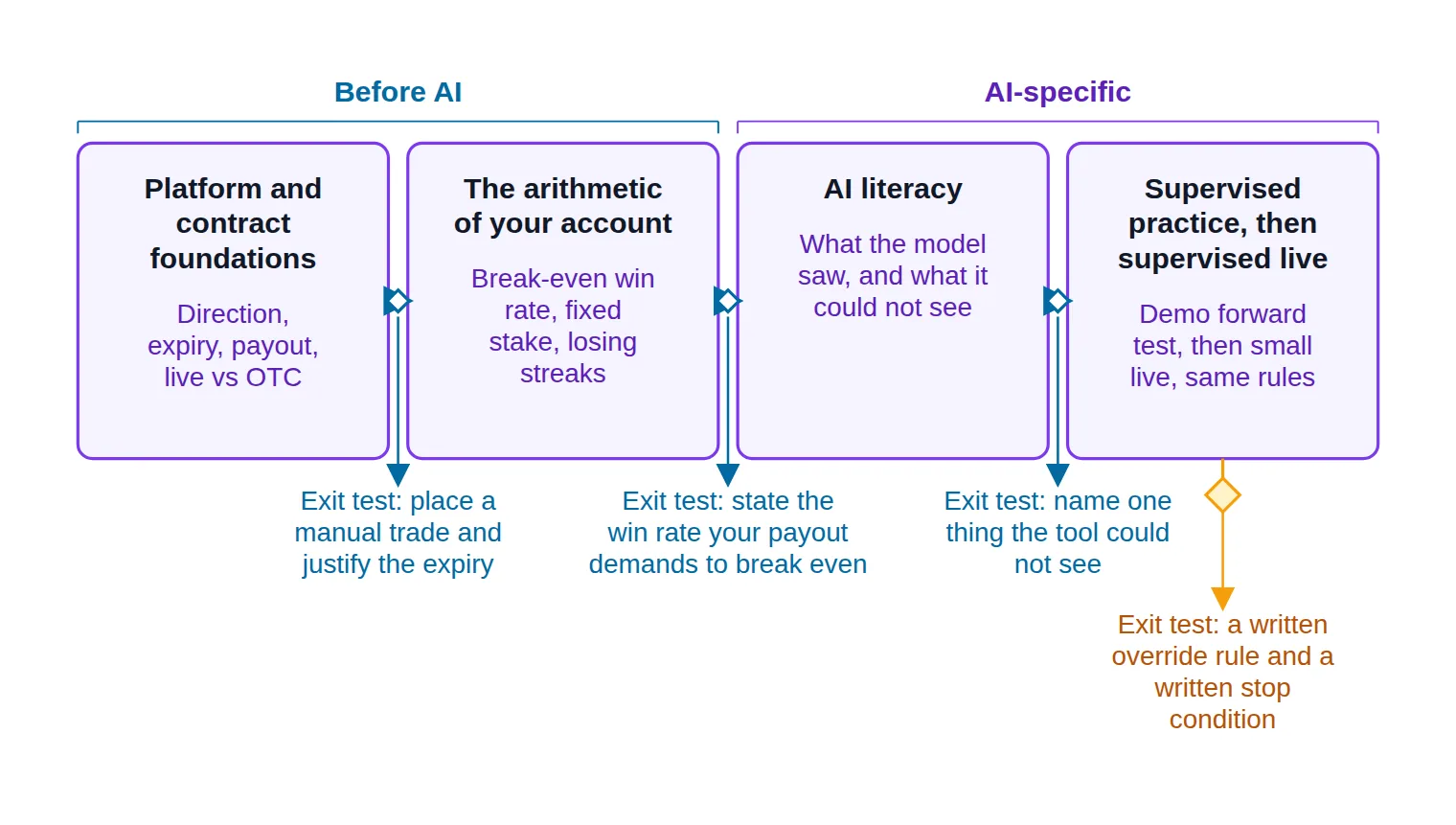
Four stages, and they are gated. Each one ends with a test, and the next stage is close to useless until you can pass it. That gating is the difference between a learning path and a reading list.
Stage 1 — Platform and contract foundations. Learn the ticket. Direction, expiry, payout, asset selection, live versus OTC hours, and how the platform behaves around a fast market. Exit test: you can place a manual trade and justify the expiry you chose.
Stage 2 — The arithmetic of your own account. This is the stage most people skip and it is the one that decides whether anything later works. Convert your payout into the win rate you need just to break even. Fix a stake rule and keep it fixed. Work out how long a losing run your stake plan actually survives — the binary options risk-of-ruin calculator does that arithmetic for you in a few seconds. Exit test: before you look at any signal, you can state the win rate your current payout demands just to stay level.
Stage 3 — AI literacy. Learn what a model is doing when it emits a call, what data went in, and — the useful half — what could not possibly have gone in. Learn to read a backtest as a claim rather than a result, and why a curve that looks flawless in testing is usually a symptom of overfitting rather than a sign of quality. Exit test: for any given tool, you can say in one sentence what it looked at to reach its call, and name one thing it could not see.
Stage 4 — Supervised practice, then supervised live. Demo first, under one fixed rule set, long enough to be meaningful. Then small live, with the same rules and the same log. Exit test: you have a written rule for when you override the tool and a written condition that ends your trading day.
The stages run in a fixed order because each one's exit test is the next one's prerequisite — and only the last two are AI-specific.
The gates matter more than the content. A trader who jumps to stage four with stage two missing does not have an AI problem — they have an arithmetic problem, and an automated tool will amplify it faithfully and quickly.
Where Each Stage Is Actually Taught
Three kinds of resource cover this ground, and they are not interchangeable. Each one is good at a different stage and bad at the others, which is why a flat list of "learning resources" leaves you no better off than before you read it.
Resource map
The platform's own learning section
External AI and algo-trading courses
Communities and peer learning
Stage it serves best
Stage 1 — platform and contract foundations
Stage 3 — how a model produces an output
Stages 2 and 4 — habits, discipline, reality checks
Format
Short articles and video lessons, self-paced
Structured multi-week courses with exercises
Conversation, screenshots, live commentary
Covers AI specifically?
Partly — the AI material reads as a feature walkthrough, and the core course is not an AI track
Yes — this is where model literacy actually lives
Inconsistently — depends entirely on who is in the room that week
Suits the learner who
wants platform-specific answers fast
wants to understand why an output looks the way it does
learns by watching others and asking questions
Main weakness
Foundations only, with no sequencing into AI work
Almost none of it is binary-options-specific
Signal-selling and referral pitches are common
The three resource types are complementary, not competing — each one covers a stage the other two leave open.
The Platform's Own Academy and Learning Section
Pocket Option publishes a free multi-module course and a running knowledge base. Both are genuinely useful, and both are stage-one material: platform mechanics, order flow, what each control does, basic market and psychology groundwork.
Be clear-eyed about the ceiling. The core course is a general trading foundation with no AI track in it at all, and the AI material that does exist is written as a feature walkthrough — here is the control, here is what it outputs — rather than as a lesson in why the output looks the way it does. Take it for stage one. Do not expect it to carry stage three.
External Courses on AI and Algorithmic Trading Fundamentals
This is where stage three actually lives, and it lives outside the trading platform entirely. University open-courseware, machine-learning fundamentals courses, and quantitative-finance material all teach the same core idea: a model turns historical inputs into a probabilistic output, and the interesting question is always what it was and was not shown.
Almost none of it will be binary-options-specific, and that is fine — you are learning how model output behaves, not how to click a ticket. Match the format to how you actually learn. If you need scaffolding, take a structured multi-week course with exercises and deadlines. If you already have some quantitative background, a focused reading list plus one hands-on project will get you there faster and cheaper.
There is also a cheap, fast, hands-on version of this stage: practising with a general AI chatbot as a low-cost learning step. Describe a setup to it, ask it to reason through a direction and an expiry, then check its reasoning against what the chart actually did afterwards. You will learn the shape of model output — confident, plausible, occasionally and invisibly wrong — quicker than any lecture will teach it to you.
Communities and Peer Learning
Discord servers, subreddits, and Telegram rooms carry the material no course does: what other traders actually did last week, how they sized it, and what it cost them. Watching someone else break a rule and post the damage teaches stage-two arithmetic faster than reading about it.
That value comes with the sharpest warning on this page. Trading rooms are where signal-selling lives. Every performance claim you see in one is a claim, not evidence, until you apply the checks in the next section to it. Treat a community as a place to compare method, not as a place to receive calls.
One smaller category is worth knowing about: a plain-language reference you can look things up in mid-lesson. Our own trading glossary covers the vocabulary above — payout, expiry, backtest, drawdown — in a form you can check in ten seconds without leaving the concept you were working on.
Practise on Demo Before Any of It Touches Real Money
A demo account is the only place where you can be wrong repeatedly at zero cost, which is precisely what stage four requires. Pocket Option provides one, and there are free tools to practise with before paying for a bot, so nothing in stage four should cost you anything but time.
The mistake is treating demo as "trading, but pretend." Used that way it teaches almost nothing, because none of the pressure that produces your real mistakes is present. Used properly, demo is a forward test — a live-data trial of a fixed rule set, run forward in time, with results you record. That is a different activity, and it needs four things:
One fixed rule set for the whole run. Changing the rules mid-run destroys the only thing the run was producing.
A log with reasons. Every trade, including the ones you skipped and why. The skips are where your actual edge or your actual impulsiveness shows up.
Realistic sizing. Demo balances are usually generous; if you will trade a $200 account live, trade $200 on demo. Sizing rules that only work on a $10,000 practice balance are not rules. The binary options money management calculator will show you what a given stake plan does to a small account across a run.
Enough trades to mean something. A handful of results tells you about luck. This is the same sample-size problem you will apply to other people's claims in the next section, applied to yourself first.
Readiness check
Before you move from demo to real money
0 / 7
Run at least 100 demo trades under one rule set you did not change mid-run.
Log every trade you took and every one you skipped, with the reason for each.
Compare your demo win rate against the break-even win rate your payout demands.
Size every demo trade the way you will size real ones, on a realistic balance.
Sit through at least one losing streak on demo without raising your stake.
Write down the single condition that ends your trading day, before you need it.
Set your first live stake at an amount you would be genuinely fine losing in full.
★
Checklist complete — you’re cleared to proceed.
Each item is verifiable — you can answer yes or no to it today, which is the point.
How Do You Judge an AI Signal Before Acting On It?
This is the graduation skill, and it is the one almost no page teaches, because it is the skill that makes you harder to sell to. Three questions, in this order.
1. Against what does this win rate have to be measured? A historical win rate on its own means nothing. On a binary contract your reward-to-risk ratio is fixed by the broker, not by you: a loss costs your whole stake, and a win returns only the payout percentage. Whenever payout is below 100%, your reward-to-risk is worse than one-to-one and win rate has to carry all the weight. So the only number that matters is the break-even win rate your current payout demands — and whether the claimed rate clears it by a margin worth the effort.
2. How long is the record, and who chose it? A short run of results is indistinguishable from luck; that is what sample size means in practice. A screenshot is worse than short — it is selected, so you are seeing the slice someone chose to show you. What you want is a verified track record: complete, time-stamped, continuous, and long enough that a good month cannot hide a bad quarter.
3. Is this a backtest or a forward test? A backtest is a claim about the past, produced by someone who already knew how the past turned out. That is why an unusually smooth backtested curve is a warning rather than a selling point. Forward results — the tool running on data it has not seen, in public, over time — are worth far more, and are far rarer in marketing material.
Run the first question yourself right now. Put in the payout your broker is currently showing, and a win rate a tool is claiming, and see what the arithmetic says:
Run the check
What win rate does your payout actually demand?
Set the broker payout and the win rate a tool claims. The break-even line is fixed by the payout alone — the claim has to clear it before anything else about the tool matters.
Broker payout on a win
Claimed win rate
Stake per trade
$
Break-even win rate
—
Margin over break-even
—
Expected result per trade
—
Same edge over 100 trades
—
Drop the claimed win rate toward the break-even line and watch the expected result flip — that single line is the first filter every claim has to pass.
Two things this arithmetic is not. It is not a forecast — it is what a claim would produce if the claim were true and stayed true, which is a much weaker statement than it looks. And it says nothing about variance: a genuine edge still loses for long stretches, which is exactly why stage two comes before stage four. Every figure here is illustrative; read our risk warning before you put money behind any of it.
Red Flags: Telling Education From a Sales Pitch
The reason this article opened with a naming problem is that the naming problem is the business model. A funnel dressed as a school converts better than a funnel that admits what it is. Six things separate the two:
The "academy" has no syllabus. If you cannot point at a sequence of lessons — ordered, named, with something you can do at the end of each — there is no curriculum, only a landing page.
Every route leads to one sign-up link. Real teaching material sends you outward: to a chart, a calculator, a demo account, another reference. A funnel sends you to exactly one place.
Numbers with no record behind them. A headline win rate with no complete, time-stamped, viewable history is a claim. Apply the three questions above and it usually evaporates.
The phrase "risk-free." Be wary of any tool or course that promises "risk-free" profit or a rate you "can't lose" — on a binary contract, where a loss costs the full stake, that language is not optimism, it is a tell.
The registration gate. Material you can only see after opening an account through a specific referral link is marketing that has been priced in advance.
No losses anywhere in the teaching. Genuine education shows you a losing streak, tells you what it costs, and explains what you are supposed to do while it is happening. Marketing never does, because losses do not convert.
It is also worth verifying, separately from any of this, that the platform you are trading on is registered where it claims to be. That check takes minutes and is independent of how good the teaching is.
Check yourself
Knowledge check
Suppose a free "AI trading academy" bot posts a screenshot showing 19 wins out of 20 trades. What is the strongest reason not to treat that as proof it works?
Why
Sample size and selection decide this one. Twenty trades sits well inside the range luck alone produces, and a screenshot is a self-selected slice — the losing weeks are simply not in the frame. A very high short-run rate is not impossible, and free does not mean bad. What is missing is a complete, continuous, verifiable record long enough to distinguish an edge from a good week.
The trap is that the intuitive objection — "that rate is impossible" — is the weakest one available.
See the Judging Framework on a Live Signal Feed
You now have a framework, and a framework only sticks once you have run it on something you did not generate yourself. Our own binary options signals feed is free to view, and each entry is published with its direction, its expiry and its historical win-rate and reward-to-risk context attached — which happens to be the exact set of fields the three questions above ask for.
So use it as an exercise rather than as a tip sheet. Open one entry and run the check end to end: what payout is your broker showing on that asset right now, what break-even win rate does that payout demand, does the published record clear it by a margin that survives a hundred trades rather than five, and would you still take it if the next three lost?
Be equally clear about what it is not. It is a feed you read — not a course, and not a bot. It will not place a trade for you, it does not replace stages one through four, and if you are still working through the arithmetic of stage two it will not mean much to you yet. Its use here is narrow and honest: a real, structured example to practise the evaluation on, so the framework becomes a habit instead of a paragraph you once read.
Your Next Steps as an AI-Assisted Trader
The phrase ai trading academy pocket option will keep returning bots dressed as schools, because that is what converts. What it was implicitly promising, though, is real and you now have it: a sequence, with a test at the end of each stage and a named place to learn it.
If you want a concrete week rather than a plan:
Today. Open the platform's own learning section and close stage one — one manual trade you can justify, expiry included.
This week. Do stage two on paper. Write down your broker's current payout, the break-even win rate it demands, your fixed stake, and the losing streak your account can absorb. This is one hour of work and it is the highest-value hour in the whole path.
This month. Start stage three properly with one external course on how models produce output, and start a demo forward test in parallel under one unchanged rule set.
Before any live trade. Run the readiness checklist above, honestly, and hold the line on the item you are most tempted to skip.
Nothing in this path makes an outcome certain, and any resource that tells you otherwise has just failed the red-flag test in the section above. What it does buy you is the ability to look at any AI-generated call — from the platform's own feature, from an AI signal bot that alerts you rather than trades for you, from a room on Telegram — and decide for yourself, with arithmetic, whether it is worth your stake.
FAQ
How long does it take to learn AI-assisted Pocket Option trading?
Stage one takes days, stage two takes about an hour of focused arithmetic plus the discipline to keep applying it, and stage three takes weeks if you take a real course rather than skim articles. Stage four is the long one, because a demo forward test only becomes meaningful once it has enough trades behind it — that is measured in weeks of consistent activity, not sessions. The people who finish fastest are the ones who do stage two properly, because everything after it becomes easier to judge.
Do I need to know how to code?
No. Nothing in this path requires you to write a line of code or tune a model. What it requires is model literacy — being able to say what a tool was shown, what it could not have been shown, and how far its published record can be trusted. Coding becomes relevant only if you decide to build your own tooling, which is a separate ambition from using one well.
Can I skip demo if I only stake very small amounts?
You can, and the cost is that you lose the log. The value of the demo stage is not the money it saves, it is the record it produces: a hundred trades under one fixed rule set, with your skips written down, that tells you whether the rules work before your emotions have a stake in the answer. Small live stakes give you the emotional pressure but usually not the discipline to keep the log — which is why the standard sequence is demo first, then small live with the same log continuing.
What should I do when an AI signal disagrees with my own read?
Decide the rule before it happens, not during. The workable version is simple: if the tool's call conflicts with your own read, you take neither side — you skip. Skipping costs you nothing but an opportunity, whereas overriding on impulse is how a rule set quietly stops existing. Then log the skip and check later which of you was right; a few dozen of those entries tell you far more about the tool than its marketing page does.
Are free AI trading courses worth taking?
Free is not the problem — the tell is what the free material is for. Genuinely free education, including university open-courseware and platform knowledge bases, exists to teach and sends you outward to other resources. Free material that exists to move you toward one sign-up link is a sales asset with a lesson attached. Judge by the syllabus and by where the links go, not by the price.
How many trades before a win rate means anything?
More than any marketing screenshot will ever show you. The practical guide is that you need enough trades for a normal losing streak to have already happened inside the record — if the sample is short enough that a bad run could not yet have occurred, the number is describing luck rather than an edge. That is also the honest standard to hold yourself to on demo, not just the standard you apply to other people's claims.
Sources & Further Reading
Want to go deeper? These independent, authoritative sources shaped this guide — each one is worth reading in full:
The Binary Options Desk is the SignalBots editorial team for fixed-time and OTC trading coverage. We research and write the guides that explain expiry timing, payout structure and disciplined entry across the major brokers.



Discussions 0
Leave a comment