Three different products get sold under the same four words. One is a browser extension that clicks the trade ticket for you. One is a Telegram channel that pings your phone and leaves the clicking to you. One is a toggle already sitting in your Pocket Option settings that proposes a direction and then waits for you to confirm it. All three are advertised as "an AI bot for Pocket Option," and all three are advertised with a win rate.
So the first job of this page is not ranking. It is telling you which product you are actually looking at — because a percentage quoted by a signal channel and a percentage quoted by an auto-executing extension are not measuring the same thing, and neither of them means anything until you know the payout it was measured against.
Here is what you will not find below: a table of percentages with a crown on the biggest one. Not out of coyness. It is that no vendor publishes the things that would make its number readable — the payout, the pair set, the expiry, the number of trades, and whether it ran on live or weekend pairs. What you get instead is the full map of routes, the arithmetic that turns any win-rate claim into a yes or a no, the setup path for the route most people actually want, and a plain answer at the end about whether any of it is worth your evening.
Key Takeaways
"AI bot for Pocket Option" covers five different products, and only two of them place a trade for you.
The platform's built-in AI proposes a direction and an expiry; you still confirm every trade yourself.
A win rate is unreadable without the payout behind it — break-even is 1 divided by (1 + payout).
No vendor publishes a checkable number, so collect your own on demo: fixed stake, fixed sample, payout logged per trade.
Table of Contents (27 min read)Contents
What an "AI Trading Bot for Pocket Option" Actually Does
Strip the marketing and a binary options bot does at most three jobs. Almost every product you will be pitched does one or two of them, never all three, and the gap between them is where the confusion lives.
Generating the call. Software reads price and indicator state on a pair and outputs a direction — CALL or PUT — plus the expiry time that call is valid for. This is the part vendors describe as "AI," and it ranges from a hard-coded indicator confluence to a model trained on historical bars.
Acting on it. Auto-trading means the software fills and submits the ticket itself while you are away from the screen. On Pocket Option this is a genuinely separate capability, and most tools that generate a call do not have it.
Proving it in advance. Backtesting replays the rule over history so you can see how it would have behaved before you fund it. This is the job that gets skipped most often, and the one the rest of this page keeps returning to.
There is one mechanical fact about Pocket Option that shapes every route below. It is a browser and mobile platform, not a broker you connect to through a public trading API the way you would connect an expert advisor to a MetaTrader account. So third-party automation reaches the platform through the page itself — a trading browser extension that reads the chart and drives the trade panel, or a desktop app that does the same thing to a browser window it controls.
That has three consequences you will feel immediately. The browser has to stay open and logged in for anything to execute. The bot runs on your machine rather than on a server somewhere, so your laptop going to sleep is the same thing as the bot stopping. And a large share of Pocket Option's activity happens on synthetic weekend instruments — the OTC market pairs — whose price history exists only inside the broker's own chart, which quietly makes independent verification much harder. Hold that thought; it comes back twice.
The last piece of mechanics is that a binary bot makes three decisions per trade, not one: direction, expiry, and the trade stake. A tool that only hands you a direction has automated one third of the problem.
Every AI Route for Pocket Option, Compared
Nobody sells you the map, because every vendor is standing on one square of it. Here is the whole board. Dedicated bot, signal channel, built-in toggle, chatbot, free tool — one phrase covers all five, and only some of them do what the ad implies.
Only the first row does the whole job. Everything else hands you a decision and leaves the click to you.
Dedicated Third-Party AI Bots
This is the route people mean when they picture a bot: software that watches the chart and places the trade without you. On Pocket Option it arrives either as a browser extension that lives on the trading page, or as a desktop application that routes calls in from an outside source — a TradingView alert, a MetaTrader indicator, a Telegram feed — and drives the platform for you.
Our own Pocket Option auto-trade extension sits in this category, and so do several independent vendors. Feature sets rhyme across all of them: you pick the pairs, fix the stake and expiry, and set the daily limits. Many also ship a martingale ladder that doubles the stake after a loss — treat that as the single most dangerous switch in the product, because it converts a normal losing streak into an account-ending one and it is usually on by default in the vendor's screenshots.
This is the route the setup walkthrough further down is written for.
Signal-Only AI Alerts
Here the software generates a binary options signal — pair, direction, expiry — and delivers it to you. You place the trade. Delivery is usually Telegram, sometimes a web feed you keep open in a second tab, and our own binary options Telegram channel and live binary signals feed are examples of the shape.
The trade-off is honest and worth stating plainly: you keep judgement and you keep veto power, but you also keep the latency. A call that fires while you are making coffee is a call you did not take, which makes the vendor's win rate and your win rate two different numbers even when the vendor is being completely truthful. How to act on a delivered alert properly is a topic of its own and gets its own treatment elsewhere.
The part almost every ad glosses over: it proposes, you confirm. It does not place the trade for you, and it is not intended to run while you are away from the screen. If you noticed the toggle and concluded that the platform already gives you automation, that is the misunderstanding to correct — what it gives you is a fast second opinion on a trade you were already about to take. Its internals and its honest limits deserve their own page rather than a paragraph here.
General AI Chatbots
Pasting a chart screenshot into a general-purpose assistant and asking where price goes next is now common enough to count as a route, so it belongs on the map. It is also the weakest one for live trading, for three structural reasons: the assistant has no live price feed, it cannot place a trade, and it produces a confident-sounding answer whether or not it has anything to go on.
Where it genuinely earns its place is after the session — pasting your own trade log in and asking what the losing trades had in common is a real use, and a much better one than asking for the next candle. The prompt patterns that make this worthwhile are a subject in their own right.
Free AI Options
Free splits into two very different things. There are legitimate free tiers of paid products, usually capped by pair count, trade volume, or the number of strategies you can run at once. And there are the free Telegram bots, which range from real community projects to outright impersonation.
One filter is worth applying before any other: a bot that asks for your platform login, asks you to deposit through it, or requires payment to "unlock" the accurate signals has told you what it is. A tool that automates a page you are logged into never needs your password, and the search results for "official Pocket Option AI bot" are crowded with channels claiming a status that is easy to claim and hard to check. Evaluating specific free options in detail is a job for a dedicated comparison, not a bullet in a landscape section.
Can You Trust a Bot's "Backtested Win Rate"?
Short answer: not as printed, and not because every vendor is lying. A historical win rate is a ratio, and a ratio with none of its conditions attached is not a claim you can evaluate — it is a decoration.
Go and look at what is actually published. The platform's own articles about the best AI bot describe the feature and print no performance figure at all. Independent vendors either publish nothing, or state outright that no win rate is promised. That consistency is informative. Nobody in this market is holding back an audited number they could have shown you; the number does not exist in a checkable form, which is why this page ranks routes by what you can verify rather than by whose percentage is biggest. The percentage is the big hollow object. The payout it was measured against is the small dense one that decides the result.
When a percentage is quoted, five things are almost always missing, and each one alone is enough to make the figure unusable:
The payout it was measured against. The single biggest omission — the next section is entirely about why.
Live pairs or weekend OTC pairs. These are different instruments with different behaviour, and results from one do not transfer to the other.
The expiry. A rule that works on a five-minute expiry can invert on a thirty-second one.
The sample size. Forty trades is a mood, not a measurement.
Whether it was a backtest or a forward test. A rule tuned until it looked good on the history it was tuned on tells you about the tuning, not the rule — the classic overfitting trap.
Why a Win Rate Without a Payout Number Is Meaningless
Binary options do not pay symmetrically. When a trade goes against you, you lose the full stake. When it goes your way, you get back the stake plus the payout percentage — never the same amount you risked. That asymmetry is the whole reason a binary win rate cannot be read the way a forex win rate can, where a healthy reward-to-risk ratio lets a low win rate stay profitable.
The shape of a binary payoff
What one binary trade can pay, either way
━ Call payoff━ Put payoffx-axis: underlying price at expiry • y-axis: P&L per $100 staked
Risk is bounded and known before entry — but so is the reward, and it is smaller than the risk. That gap is what the win rate has to overcome.
Which gives you the one piece of arithmetic worth memorising from this page.
Break-even win rate on a binary payoutfx
WBE = 1 ÷ (1 + P)
whereWBE is the share of trades you must win just to stand still, and P is the payout expressed as a decimal. At a 0.80 payout that is 1 ÷ 1.80 ≈ 0.556 — you need better than 55.6% of trades to win before the account moves up at all.
Every win-rate claim has to be read against this line, and the vendor never tells you where the line sits.
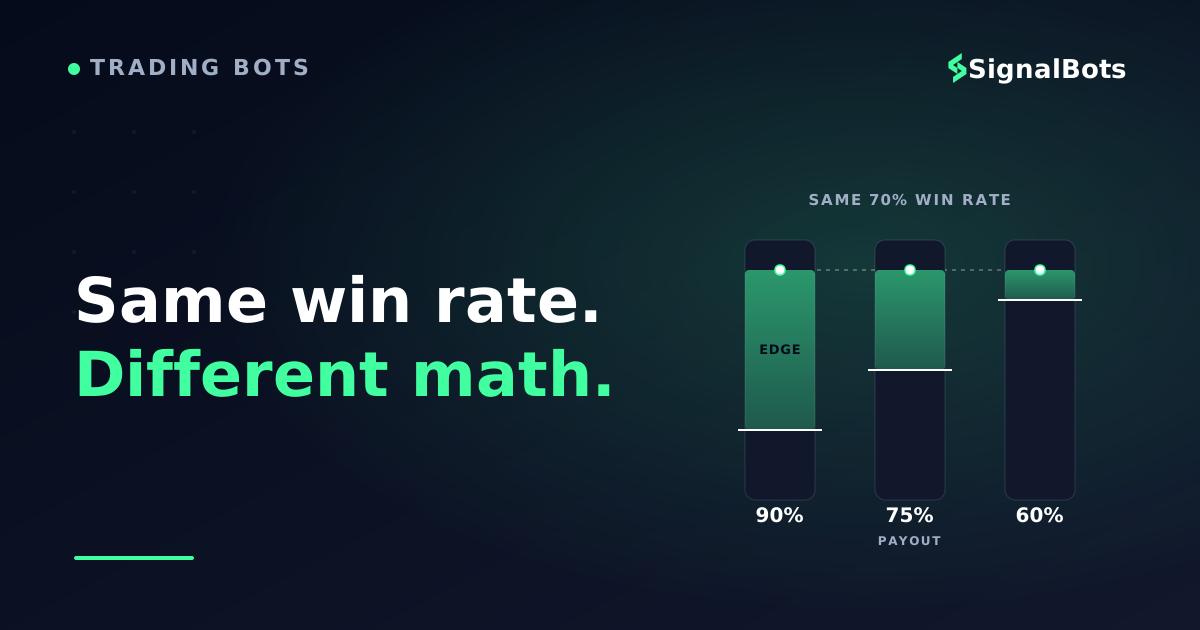
Now run a vendor's number through it. Suppose a bot advertises seven wins in ten. On an instrument paying 92%, break-even is roughly 52.1%, so a genuine 70% would be a serious edge. On an instrument paying 70%, break-even is about 58.8%, and that same 70% is a much thinner margin that a handful of unlucky weeks can erase. On a 60% payout instrument, break-even is 62.5% — and the advertised 70% bot is now losing money on a headline number the vendor never had to lie about.
The percentage did not change. The instrument did. This is why "which bot has the highest win rate" is the wrong question and "what does this bot need to clear on the payouts my account actually shows" is the right one. Run your own payouts through the break-even win rate calculator before you evaluate any claim, and if you want to see what a full sample is worth rather than one trade, the expectancy calculator takes the same inputs across a run of trades.
How to Verify a Bot Yourself
Since nobody hands you a verified figure, produce one. The protocol is short and it is the same whichever route you picked.
Start on a demo account. Not as a formality — as the place the entire first sample gets collected. Nothing about a bot's behaviour requires real money to observe.
Decide the sample size before you start. Write down the number of trades you will judge it on and do not move the finish line when the run goes well.
Fix the stake. A variable stake makes the results unreadable, because you can no longer tell whether the account moved on skill or on sizing.
Log the payout on every single trade, alongside pair, direction, expiry and result. This is the column everyone skips and the only one that makes the win rate mean anything afterwards.
Forward-test it, don't just trust a backtest. A backtest tells you how a rule behaved on data someone already saw. A forward test tells you how it behaves on data nobody has seen, which is the only condition you will ever trade in.
Compare against your own break-even line, not against the vendor's claim. If the sample does not clear it comfortably, the correct conclusion is that you do not yet know whether the bot works — not that it failed.
There is one obstacle worth naming here rather than pretending away. Verification is hardest on exactly the instruments most Pocket Option bots are sold for. Weekend OTC pairs are synthetic and exist only inside the broker's own chart, so you cannot pull their history into a normal charting tool and replay it. That is a real gap, and it has a fix — it is the subject of the connector section further down.
Choosing the Right AI Route for Your Situation
There is no single winner here, and any page that crowns one is selling that one. There is a fit, and it falls out of two questions: do you want the trade placed for you, and can your machine actually stay awake to do it.
Fit, not ranking
Which AI route fits how you actually trade?
Take itProceed with careSkip / stand aside
The route follows from what you want automated and whether a browser can stay open on the platform — not from whose win rate reads highest.
Read against that tree, the five common situations sort cleanly:
You want it fully hands-off. The dedicated-bot route is the only one that qualifies, and the setup walkthrough below is written for you. Budget real time for the demo sample before the live one.
You want the calls but not the surrender of control. Take the signal-alert route and accept that your fill timing becomes part of your results. Acting well on a delivered alert is a skill of its own.
You already like the built-in feature and wonder if it is enough. It is enough as a confirmation step and not enough as automation, because it never trades without you. Whether it belongs in your process at all depends on details worth reading up on separately.
You are cost-first and not ready to pay for anything. Start with free tiers and free channels, apply the credential filter above ruthlessly, and treat the free run as data collection rather than as income. A closer look at which free options are worth the setup exists elsewhere.
You want to understand the machine before you rent one. Trade the demo by hand for a fixed sample first. Every number on this page becomes concrete the moment you have your own log to apply it to, and there is a structured path for learning AI-assisted trading properly.
How to Set Up a Dedicated AI Bot on Pocket Option
If the tree pointed you at the auto-trade route, this is the order of operations. It is deliberately front-loaded with the boring steps, because the ones people skip are all in the first half.
Setup order
From install to first live trade, without guessing
1
Switch to the demo balance
Move the account to demo before you install anything, so the first hour of automated trading cannot cost you a deposit.
2
Install and bind the bot
Add the extension or desktop app, then link it to the one account it is licensed for and stay logged in on that browser profile.
3
Fix stake, expiry and pairs
Set the trade amount, the expiry length and the pair list by hand. Defaults are the vendor's guess, not a decision about your balance.
4
Cap the damage before you run it
Set a daily loss limit and a stop after a set number of consecutive losses, and switch any martingale ladder off.
5
Forward-test a fixed sample
Let it run on demo and log direction, expiry, payout and result for every trade. Stop at the number you chose, not at a good feeling.
6
Go live at the smallest stake
Move to the minimum real trade size and compare the live sample against the demo one before raising the stake by a single dollar.
Four of the six steps happen before any money is at risk. That ratio is the point.
A few things the vendor documentation tends not to spell out.
The session is the bot. Page-driven automation depends on the tab staying open, the account staying logged in, and the machine staying awake. Set the laptop to never sleep during a run, and expect a re-login to silently end the session — check that the bot is still armed rather than assuming a quiet hour means no setups.
Set the caps before the first trade, not after the first bad day. A daily loss cap and a consecutive-loss stop are the only two settings that decide how bad your worst day can get. Every other setting decides how good the good days look.
Weekend runs are a different experiment. If you set the bot loose on OTC pairs over the weekend, log those trades separately from the weekday ones. Mixing the two produces a blended win rate that describes neither.
One change at a time. Change the pair list or the expiry, not both, and start a fresh sample when you do. Two changes and one sample means you learn nothing from either.
Charting Pocket Option OTC Pairs in MT5 With Our Free Connector
Everything above pushes toward one uncomfortable point: the verification protocol is hardest to run on the instruments these bots are mostly sold for. Weekend OTC pairs are synthetic, they live only inside the broker's chart, and there is no obvious way to replay their history in a tool that lets you test a rule properly.
That specific gap is what our free binary MT4/MT5 connector closes. It streams Pocket Option's OTC pairs onto live MetaTrader 5 charts, which means you can run your own indicators and expert advisors on those pairs, and replay their history in MetaTrader's Strategy Tester instead of taking anyone's backtest on faith. The connector for this broker is the Pocket Option OTC MT5 connector, and it activates with a free lifetime license through support.
Here is the earlier arithmetic, made concrete on it. Take the payout your own account shows on the OTC pair you actually trade, and get your break-even line from it. Then build or load your rule in MetaTrader, run it over that pair's history in the Strategy Tester, and count how far above or below that line it lands across a sample you chose in advance. That is a number you produced, on your instrument, at your payout — the thing no vendor page hands you.
Where it does not fit. The connector is one-way by design: it brings Pocket Option's OTC prices into MetaTrader for charting, testing and analysis, and it does not send orders back out to the platform. If what you want is the trade actually clicked for you, that is the browser-extension route from the landscape above, not this. If you only want calls delivered and intend to place them yourself, the Telegram channel is the shorter path. And it assumes MetaTrader 5 is installed and you are willing to work in it — if you have no intention of ever opening MetaTrader, this tool has nothing to offer you. The full binary connector range covers the other binary brokers on the same basis.
Is an AI Bot Worth It for Pocket Option?
Worth it for a narrow job, yes. Worth it as a replacement for having an edge, no — and the gap between those two sentences is where most of the money in this niche gets lost.
What automation genuinely gives you is consistency of execution. A bot takes the setup at 3 a.m. and the setup after three losses in a row with exactly the same indifference, it never widens the stake to make back a bad morning, and it can sit on weekend OTC pairs while you do something else. Those are real problems, and they are the problems most retail binary traders actually have.
What it does not give you is an edge you did not have. A bot is a rule executed faithfully. If the rule does not clear the break-even line on the payouts your account shows, the bot will lose money faster and more consistently than you would have, which is the exact opposite of the pitch. The sequence that works is: find the rule, verify it on a sample you collected, and then automate it — never the reverse.
So the honest ranking is not by win rate at all. It is by how much of the claim you can check before you pay: a route you can forward-test yourself on demo, at your own payouts, over a sample you chose, outranks a route with a bigger number and nothing behind it. Every time. Whichever route you land on, read the full risk warning before you fund it.
It has a built-in AI Trading option you switch on from the account settings, which analyses the current instrument and proposes a direction and an expiry. It is a suggestion tool rather than a bot in the automation sense — you confirm each trade yourself, and it does not run while you are away from the screen. If you want trades placed without you, that requires a separate third-party tool.
Is there a free AI bot for Pocket Option?
Free options exist in two forms: capped free tiers of paid products, and free Telegram channels and bots. Both can be worth testing, with one filter applied first — any bot asking for your platform password, asking you to deposit through it, or charging to "unlock" the accurate signals is not a tool you should be evaluating on features. Treat a free run as data collection, not as income.
Can ChatGPT or Gemini trade on Pocket Option for me?
No. General-purpose assistants have no live price feed and no ability to place an order on the platform, so nothing they produce reaches your account without you typing it in. They are genuinely useful after the session — reviewing your own trade log for patterns in the losers is a real use — and unreliable as a source of next-candle predictions, because they will answer confidently whether or not they have anything to base it on.
What win rate does a bot need to be profitable on Pocket Option?
Whatever beats the break-even line set by your payout, which is one divided by one plus the payout as a decimal. At an 80% payout that line sits near 55.6%; at 92% it drops to roughly 52.1%; at 60% it rises to 62.5%. This is why an advertised percentage means nothing on its own — the same figure can be a strong edge on one instrument and a slow loss on another.
Do AI bots work on Pocket Option's weekend OTC pairs?
Most of them are built for exactly those pairs, since that is when the platform is busiest and conventional markets are closed. Two cautions. Results from OTC pairs should be logged separately from weekday results, because they are different instruments. And OTC price history lives inside the broker's own chart, so verifying a rule on it needs a tool that can bring those prices somewhere testable.
How long should I test a bot before going live?
Decide the number of trades before you start rather than the number of days, and hold to it — a fixed sample is the only thing that stops a good first hour from becoming the whole evaluation. Then repeat the exercise at the minimum real stake, because live fills, live payouts and live session drops all differ from demo, and compare the two samples before you increase the stake.
Sources & Further Reading
Want to go deeper? These independent, authoritative sources shaped this guide — each one is worth reading in full:
The Binary Options Desk is the SignalBots editorial team for fixed-time and OTC trading coverage. We research and write the guides that explain expiry timing, payout structure and disciplined entry across the major brokers.
Want to use the bot without paying? Message our 24/7 support team via Telegram or Viber. Our experts will guide you step-by-step on how to unlock your free lifetime license through our exclusive broker partnership program.




Discussions 0
Leave a comment