Someone forwarded you a Telegram link. Maybe it appeared in the comments under a Sinhala trading video, maybe a friend at work sent it with a screenshot of a winning trade attached. The channel posts in Sinhala, the admin answers questions in Sinhala, and after months of squinting at English-language analysis while a five-minute expiry runs down, that feels like relief.
Then you scroll a little further and notice the same admin quoting a rupee-per-dollar rate and asking people to message him privately about funding their trading account.
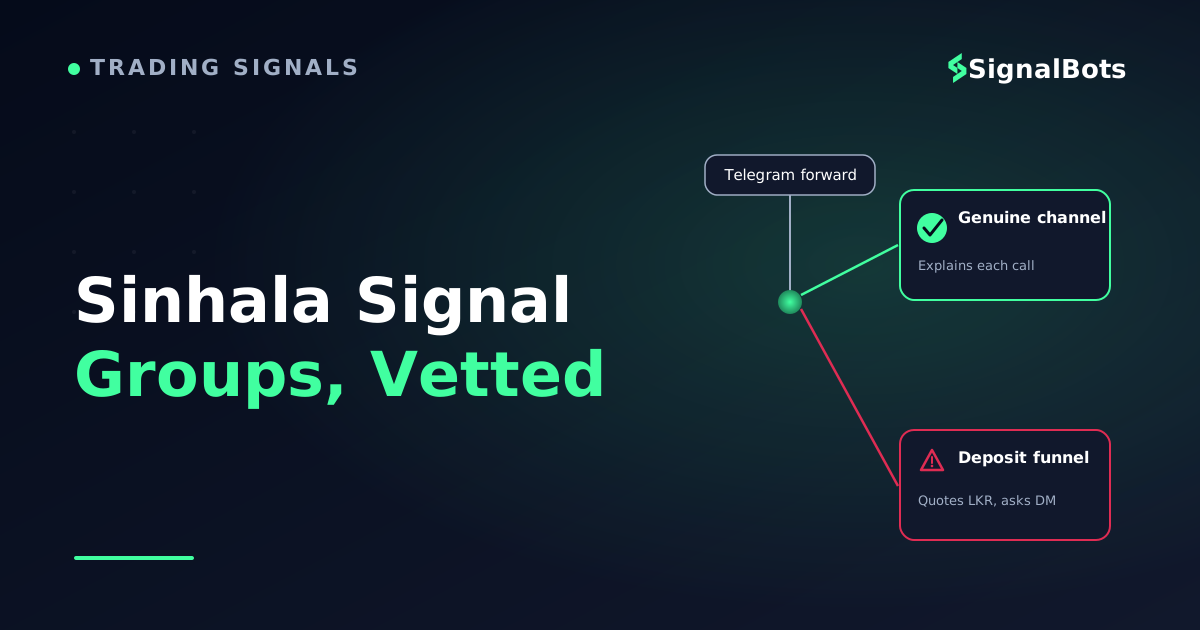
That combination is what this guide is about. Finding Sinhala-language channels is the easy half — the hard half is telling a genuine local signal group apart from a money-collection business that posts signals to attract customers. The second pattern is far more common in Sri Lanka than in the global English-language pool, for reasons that have nothing to do with dishonest admins and everything to do with how awkward it is to get money into an offshore broker from Colombo. A trading call and a request for your money can arrive from the same account — this guide shows how to tell them apart.
Key Takeaways
Sinhala binary channels are found through Telegram's own search (Latin-script names carrying "lanka" or "lk"), through Sinhala forex communities that also post expiry calls, and through the forwarded-message trail between them.
Read any channel at t.me/s/<username> in a browser before joining — the full post history, without becoming a visible member.
The Sri Lanka-specific red flag is an admin who also converts your rupees and funds your broker account; fund only through the broker's own cashier and keep your ID out of the chat.
A claimed win rate means nothing until you compare it against the break-even rate implied by your account's payout percentage.
Table of Contents (16 min read)Contents
Where Sinhala Binary Options Groups Actually Show Up on Telegram
Start with the disappointing part: no directory serves this segment. The channel-listing sites that index trading groups organise by topic and by English keyword, and none of them carries a Sinhala category. Nothing external is doing the discovery work for you, so Telegram's own search bar is the surface — and it behaves in a way that changes how you should query it.
Telegram's global search matches channel titles and public usernames, not the language of the messages inside. Most Sri Lankan trading channels title themselves in Latin script even when every post is Sinhala, because the admin wants to be found by exactly the search you are about to run — so "lanka", "sl", "lk" and "sinhala" show up in the name itself. Pair a market word (binary, forex, trading, signals) with a place word (lanka, srilanka, lk) and read what comes back. Then run the same idea again with Sinhala keyboard input, since a minority of channels do title themselves in Sinhala script and are invisible to a Latin-script query.
The second surface is the crossover, and it is where most of the pool actually lives. Purely binary-options channels in Sinhala are thin; Sinhala forex and crypto communities are far denser, and a large share of them post expiry-based calls as well, because it is the same admin, the same currency pairs and almost entirely the same audience. If you only ever search "binary", you will miss most of what exists. Search forex, then read the feed for calls that name an expiry rather than a stop loss.
The third surface is the one almost nobody uses deliberately: the forwarded-message trail. Open any Sinhala Telegram signal channel you have already found and scroll back. It will be forwarding constantly — analysis from a larger channel, a broker promo, somebody's screenshot — and every forward carries its source name as a tappable link. Twenty minutes of following forwards maps this corner of Telegram better than any query, because it shows you which channels the local admins themselves read rather than which ones bought the loudest name.
One mechanic makes all of this safer, and it is worth building the habit before you join anything. Any public channel is readable in an ordinary web browser at t.me/s/ followed by its username — the whole post history, scrollable and searchable, without becoming a visible member and without the admin knowing you looked. Read a few weeks of output that way first. Joining should be the decision you make after sampling a channel, not the way you sample it.
And treat search ranking as ranking, nothing more. A channel that appears first for "binary lanka" got there through name matching and subscriber count. Neither is a vetting signal, and both are easy to buy. Discovery only hands you candidates; everything that follows is about judging them.
What a Real Sinhala Signal Group's Day Actually Looks Like
You need a baseline before you can judge any single channel, otherwise every feed looks equally plausible on the first scroll.
An active Sinhala group posts several times a day, not once an hour. The mix is fairly consistent: a small number of actual calls, a larger amount of market and rate commentary, forwarded analysis from bigger channels, and admin housekeeping — a reminder about a paid tier, a note about a public holiday, an answer to somebody's question in the comments. Volume clusters in the late afternoon and evening local time, when the European and US sessions run and the major pairs are actually moving.
The language split is worth recognising because it confuses people. The reasoning, the chat and the answers come in Sinhala; the call itself usually arrives in a standard English format. That is not the admin being inconsistent — a binary options signal is basically asset, direction and expiry, and the broker's own interface is in English, so the payload stays in the language of the buttons you have to press. A channel where the analysis is Sinhala and the calls are formatted in English is normal, not suspicious.
The real tell is not posting volume. It is whether losing trades appear at all. Any honest feed contains calls that went the wrong way, because binary contracts settle at a fixed deadline and no method wins every deadline. A signal provider who posts entries and then only ever follows up on the ones that came good is producing marketing, not a record.
So set your expectation for a verified track record to something achievable in this pool. Nobody here has a third-party audit, and demanding one will leave you with zero channels. What you can demand is that the losers are still sitting in the scroll-back where you can count them yourself, and that results are posted as the trade settles rather than assembled into a weekly summary image after the fact.
The Deposit-Bundling Red Flag Sri Lankan Traders See More Than Anyone Else
Here is the pattern that makes this market different from the global English-language one: the same account that posts your calls also moves your money.
In practice it looks ordinary. A pinned message, or a post that reappears every few days, offers to fund your trading account at a stated rupee-per-dollar rate. You transfer rupees to a personal bank account or a mobile wallet, and dollars appear in your broker balance a few hours later. Sometimes the arrangement has its own brand name — an "academy", a "booking service", a "deposit service" — sitting alongside the signal feed as though it were a second product from the same helpful person. Often there is a request for a photo of your NIC or driving licence, framed as verification.
Nothing in that reads as fraud on first contact, which is precisely the problem. It solves a real, annoying obstacle, and it is offered by someone who has been answering your questions in your own language for weeks. But the arrangement rearranges your exposure regardless of what the admin intends.
The moment your rupees leave for an individual rather than for the broker's own cashier, the counterparty risk you carry stops being a licensed firm's obligation and becomes one person's solvency and goodwill. A local transfer to a personal account carries no chargeback route, and the broker holds no record of a payment it never received, so if the dollars never land there is no desk to escalate to and nothing to escalate with. The same asymmetry applies to the NIC photo: KYC verification exists inside the broker's own verification flow, where a document is submitted once and handled under that firm's obligations, while a copy sitting in a chat thread can be forwarded, resold or used to open accounts in your name years after you have left the group.
Underneath both sits an incentive problem that survives even a completely honest admin. Someone earning on the conversion spread is paid when you fund and when you trade, not when you are right — the same structural move as a pump and dump in a smaller, politer package, where the person telling you what to do profits from your action rather than from your outcome.
What makes that exposure recognisable in a live channel is not the reasoning above but the contrast: the ordinary version of each arrangement looks distinctly different from the bundled one, side by side.
Spot the pattern
What to check
Normal Sinhala signal group
Deposit-bundling red flag
Where deposits happen
The broker's own cashier page, in your own browser
A personal bank account or mobile wallet controlled by the admin
Where your ID documents go
Only inside the broker's own verification screen
Photographed and sent straight to the admin in chat
How the admin gets paid
Signal subscriptions, or nothing at all
A cut of the rupee-to-dollar conversion, paid on every deposit
If the money never arrives
Broker support and a transaction record to escalate
A chat log, and no recovery path
The admin who posts your calls should never be the one holding your rupees — use this to pattern-match a channel you are checking.
Why This Happens Specifically in This Market
This is not a Sri Lankan character flaw. It is a gap that grew around a genuine friction.
Funding an offshore trading account from Sri Lanka is awkward by design. The country's foreign-exchange rules are restrictive, card issuers frequently decline foreign-currency transactions aimed at speculative trading platforms, and the central bank has publicly warned the public about unauthorised foreign-exchange dealing. A trader who simply wants to put a modest amount into a binary account often finds every ordinary route closed, and then discovers that someone in a Telegram group will do it for them today.
That demand creates an informal agent economy, and a signal channel is an unusually cheap way to acquire customers for it. Read the business the right way round: the signals are the loss-leader, and the conversion spread is the product. Not everyone running that arrangement means harm — some are ordinary local agents doing a service people genuinely want — but you cannot tell which is which from inside the chat, and the exposure is identical either way.
A Quick Checklist Before You Join
Run these before you send anyone money, and run them from the browser preview rather than from inside the group.
Where the money goes. Deposits happen on your broker's own cashier page, in your own browser, on your own account. If any funding step involves a personal bank account, a mobile wallet, a personal email address or a private message, that is the whole answer — you do not need the rest of the list.
Where your identity documents go. Upload an NIC, passport or licence only through the broker's verification screen. No signal admin has a legitimate reason to hold your ID.
Whether the losses are visible. Scroll back a month. If every posted result is a win, you are reading a highlight reel and you have no idea what the method actually does in a bad week.
What the accuracy claim means arithmetically. A bio claiming a high hit rate tells you nothing on its own, because a binary trade pays less on a win than it costs on a loss. Suppose your account's payout percentage is 80% — a winning dollar returns eighty cents, a losing dollar costs the full dollar, so you need to be right on a bit more than 55 out of every 100 trades simply to break even.
That means a claimed historical win rate is only meaningful next to your own break-even line, and the break-even win rate calculator works it out for whatever payout your account actually offers. A channel advertising a number comfortably above break-even, with no settled trades you can count, is advertising a number.
Whether the paid tier is the actual product. A free feed that exists mainly to advertise a paid one behaves differently from a free feed that stands on its own; understanding how VIP versus free signals are typically structured tells you which you are looking at before you subscribe.
What else the admin sells. Deposit help, account management, a course, a broker referral, a rate service — every additional revenue line is another reason for the calls to serve something other than your result.
How the calls perform on your own account first. Follow the feed on a demo account for a couple of weeks and log every call yourself, including the ones the channel never followed up. The gap between your log and their claims is the most reliable evidence you will get.
The first two are absolute and the rest are judgement, which is why the order matters: fail either of the money-and-identity checks and you can stop reading the channel entirely, whatever the other five say about it.
None of this makes any channel safe. Binary options carry a real risk of losing the money you put in, whoever is calling the trades and however good the last week looked — our risk warning sets out what that exposure actually means before you size a position around somebody else's opinion.
Should You Widen the Search to English-Language Channels?
Be honest about what the language match is buying you, because it is less than it feels like.
What Sinhala genuinely gives you is the reasoning and the conversation: why this pair, why this hour, why the admin skipped the setup everyone else took, and the ability to ask a follow-up question and understand the answer properly. That is real value, particularly while you are still learning to read a setup.
What it does not meaningfully change is the call. Asset, direction, expiry — that payload is close to language-neutral, and the buttons you press to act on it are in English anyway. Meanwhile, insisting on a Sinhala-only pool means choosing from a small number of channels, a noticeable share of which are attached to somebody's currency-conversion business. You are trading selection and independence for comprehension you mostly need on the analysis, not on the entry.
The practical answer is to stop treating it as one decision. Keep a Sinhala channel for learning, discussion and questions, and take your actual execution feed from a wider pool that has no financial relationship with you beyond the signal itself. If you do widen the search, widen it deliberately rather than by joining whatever ranks first: the best binary options Telegram signal channels are worth comparing against the same checks you just applied locally.
That is also the honest place to mention our own. Our binary options Telegram channel posts signals with no deposit collection, booking arrangement or currency-conversion service attached to the feed — there is no admin handling your money because there is nothing for an admin to handle. It is English-only, so it will not give you Sinhala analysis or a Sinhala community to ask questions in; if that is the part you actually came for, keep a local channel for the discussion and let the two jobs stay separate.
Where to Go for the Full Vetting Framework
This guide deliberately covered only what is specific to you: where Sinhala channels cluster, what a genuine one's day looks like, and the local deposit-bundling pattern that a global checklist will never mention because its audience does not face it.
The rest of the work is not Sri Lanka-specific and is worth doing in full — vetting binary options trading groups across platforms, judging how long to observe a provider before staking anything, checking how a group handles a losing run, and deciding what a paid tier has to prove. Those checks apply identically to a Sinhala channel and an English one.
If you take three things from this page, take these: read any channel through the browser preview before you join it, count the losing calls yourself instead of accepting a headline number, and never let the person giving you signals also be the person holding your rupees. Everything else is judgement you will build by watching a feed for a month. That one rule protects you on day one.
FAQ
Are there genuine Sinhala-language binary options Telegram groups at all?
Yes, but the pool is small and most of it sits inside Sinhala forex and crypto communities rather than in dedicated binary channels. Expect to find groups where binary calls are one part of a broader trading feed, and expect to do the discovery yourself through search and forwarded messages, because no directory indexes this language segment.
Is a deposit service from a channel admin always a scam?
Not always — some are ordinary local agents providing something people genuinely need, given how hard offshore funding is from Sri Lanka. But you cannot verify which kind you are dealing with from inside a chat, and the downside is total: no chargeback, no broker record, no escalation path. The safe rule is simple and costs you nothing to follow — fund through the broker's own cashier only, whoever is offering the alternative.
Why do these channels quote accuracy percentages instead of showing trades?
Because a percentage is unfalsifiable and a trade log is not. A settled-trade history lets anyone count the losers; a headline figure in a channel bio can be whatever the admin types. When you see a claim without a countable record behind it, treat the claim as advertising copy rather than performance information.
Should I send a photo of my NIC to a channel admin?
No. Identity verification belongs to the broker, submitted through the broker's own verification screen. An ID photo in a Telegram thread can be forwarded or reused indefinitely, and there is no legitimate reason a signal channel needs one.
Can I check a channel before joining without the admin seeing me?
Yes. Public channels are readable in a browser at t.me/s/ plus the channel username, which shows the full post history without membership. That is the right way to sample several candidates at once, count their settled results, and check whether any money-handling offers appear in the pinned posts.
Sources & Further Reading
Want to go deeper? These independent, authoritative sources shaped this guide — each one is worth reading in full:
The Binary Options Desk is the SignalBots editorial team for fixed-time and OTC trading coverage. We research and write the guides that explain expiry timing, payout structure and disciplined entry across the major brokers.



Discussions 0
Leave a comment