You already know what a signal is. What you cannot find is a source that leaves a record. A Telegram ping disappears up the scroll, a "94% accuracy" banner cites nothing, and the one thing you wanted — a dated post you can go back to next week and check against what the chart actually did — never seems to exist. That is why traders search for a binary options signals blog in the first place: the blog format promises an archive, and an archive is auditable.
The bad news first. Search this niche and almost every page you land on turns out to be an indicator tutorial, a provider roundup, or a broker's education hub — not a log of calls. The useful news is that you do not need a ranked list of blogs, which would go stale in a month anyway. You need a test you can apply to any blog, in about a minute, to decide whether its posts are real calls or strategy content wearing a signals label. That test is what this article hands you.
Key Takeaways
A call is verifiable only if it shows prior commitment (published before the market resolved it), precision (asset, direction, entry moment, expiry, payout) and persistence (an unedited archive that still contains the losses).
Most pages labelled a signals blog are indicator tutorials, explainers, provider roundups or broker education hubs — the real calls, where they exist, go out through a paid or private channel instead.
A curated winning screenshot, an accuracy percentage with no sample or date range, and an undated post are the three red flags visible inside a single article.
Use blog archives to audit a source and learn its method; take the calls themselves from a real-time channel, because a minutes-long expiry resolves before a published page can reach you.
Table of Contents (20 min read)Contents
What Makes a Binary Options Call Actually Verifiable?
Verifiability is not a feeling you get from a well-designed site. It is a property of the post, and it comes down to one question: could the claim have been written before the market resolved it, and can you still see it unchanged today?
A binary options signal that passes that question states all of the following in the published post, not in a follow-up:
The asset, precisely. EUR/USD on the spot market and EUR/USD as a weekend OTC synthetic are different instruments with different price series. A post that just says "EURUSD" cannot be checked against any single chart.
The direction — call or put — stated as a commitment, not as "watch for a possible move higher".
The entry price or the exact entry moment, with a timezone. "At the open of the 14:35 UTC candle" is checkable. "On the next pullback" is not.
The expiry, as both a duration and a clock time. A 5-minute expiry taken at 14:35 resolves at 14:40 and nowhere else.
The payout percentage the call assumed. Binary outcomes are asymmetric — a win pays a fraction of the stake while a loss costs all of it — so a run of calls with no payout attached cannot be turned into an expectancy figure by you or anyone else.
A publication timestamp on the post itself, not just a "last updated" line in the footer.
Then, after resolution, a genuine call log adds the part almost nobody publishes: the outcome, disclosed as in the money or out of the money, for every call, including the losers, in an archive that is appended to rather than edited.
Those three properties — prior commitment, precision, and persistence — are the whole test. Prior commitment means the claim was exposed to risk before the answer was known. Precision means two readers checking the same call would agree on whether it won. Persistence means the losing entries are still there. Strip any one of them and what remains is commentary, however sharp the analysis is.
It follows that a historical win rate is only meaningful downstream of that archive. A percentage published without the underlying dated calls is not a statistic at all — it is a design element. If you cannot recompute the number yourself from the posts on the page, treat it as unsourced, no matter how confident the wording is. The same goes for the phrase "verified track record" when nothing is actually linked: verification means an independent party recorded the trades, not that the site says so.
Most "Signal Blogs" Are Strategy Blogs in Disguise
Read enough of them and the pattern is unmistakable. What gets published under the label of a binary options trading signals blog falls into four recognisable shapes, and only one of them is even trying to be a call log:
Indicator-combination tutorials. Posts titled after a stack — a moving-average tunnel with MACD confirmation, a Parabolic SAR plus Stochastic plus Awesome Oscillator setup, a "scalping method" with named entry rules. These teach a method. They contain no dated calls at all.
"How signals work" explainers. Definitions of entry, direction and expiry, a hypothetical example formatted to look like a real alert, a pros-and-cons table, an FAQ. Useful once. Verifiable never.
Provider roundups. Lists of signal services with accuracy figures attached, typically without a method section explaining how any figure was obtained.
Broker education hubs. Chapter-based guides published by a platform, which exist to move you toward an account, and which mention Telegram groups, bots and forums generically without naming or testing one.
There is a structural reason for this, and it is worth understanding rather than resenting. A tutorial is evergreen: it earns search traffic for years and it can never be wrong in a way a reader can point at. A dated call is a liability — it is a public commitment that resolves within minutes and is permanently checkable afterwards. A site that publishes a hundred of them has published its losses too.
The second reason is that for most of these sites the blog is not the product. When a signal provider runs a blog, the actual calls go out through the channel you pay or register for — an app, a Telegram feed, a desktop alert window — and the blog is the acquisition layer that sends you there. The archive you are looking for is deliberately not on the public web, because a public archive with losses in it is harder to sell against than a screenshot.
So the honest framing of your search: you are not choosing among a field of call-tracking blogs, because that field is thin. You are learning to spot the rare post that actually commits to a call, and to recognise instantly when a page is strategy education so you stop expecting an archive from it and read it for what it is worth — which, for a well-written indicator post, can be quite a lot.
Reading a Real Post: Which Parts Hold Up and Which Don't
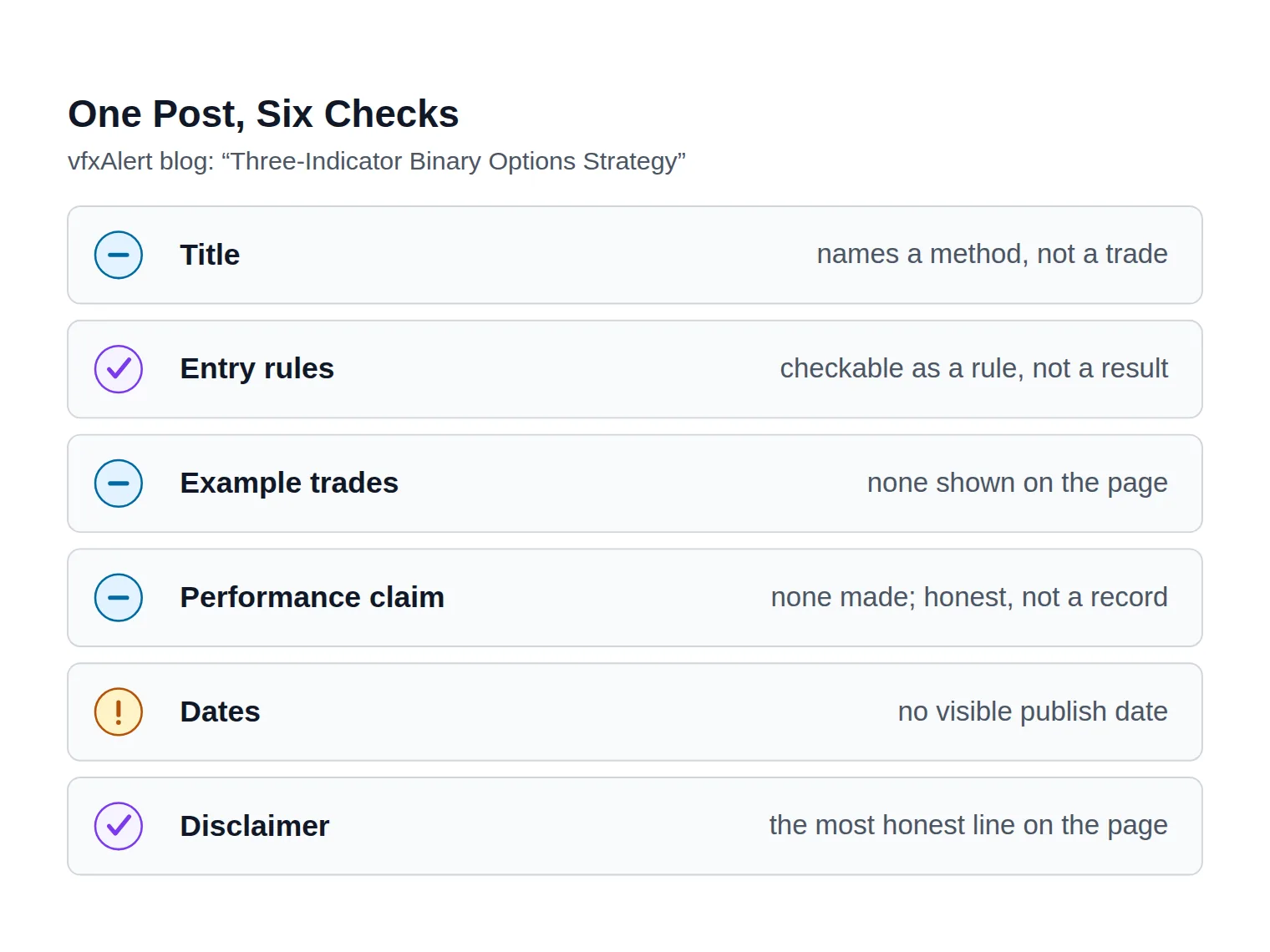
Abstract criteria do not transfer until you watch them applied once — to something you can open yourself and disagree with me about. So take a post that is live as this is written: on vfxAlert's official blog, in its Strategies section, an article titled "Three-Indicator Binary Options Strategy: Parabolic SAR, Stochastic & AO". It is a fair specimen rather than a soft target — a signal tool's own blog, competently written, and exactly the kind of page a search for binary signals drops you on. Run the test element by element.
The title. Names a method, not a trade. Already a strong tell: a call log's post titles read like EUR/USD put, 5-minute expiry, 14:35 UTC, because the trade is the content. Not a defect on its own, just a category signal.
The entry rules. These are specific. For a call: Parabolic SAR positioned below price and pointing up, the Stochastic above its zero line or in overbought territory above 80 — or at minimum moving in the same direction as price — the Awesome Oscillator green and rising, entry on the next candle once all three align, expiry set no shorter than five to seven minutes. That is genuinely checkable, but as a rule, not as a result. You could code it and backtest it yourself on any charting platform. It makes no claim about what the author actually traded, so there is nothing to verify about anyone's record here.
The example trades. There are none. No annotated screenshot of the setup working, no sequence of entries, nothing dated. The absence cuts both ways, and it is worth sitting with. Nothing on this page was curated after the fact — which is more than can be said for the strategy posts that do show one immaculate entry, an arrow at the candle and a green marker at expiry. Those screenshots are the weakest evidence on any page that carries them, because the chart was chosen after the outcome was known and you cannot tell how many were reviewed to find it: survivorship bias in its purest form. But an absence is not a record either. Either way you leave with nothing you can check against a chart.
The performance claim. Also absent, and deliberately — the post's own risks section states that no strategy guarantees profit, and that the vendor's own alerts are supplementary confirmation rather than a standalone trigger. Nothing overstated, then, but nothing recomputable either. Where a page does carry a line in the shape of "a high success rate on 5-minute expiries", read what sits behind it: no sample count, no date range, no asset list, no payout assumption. That kind of claim is unverifiable by construction, not by oversight — even its author could not reproduce it from what the post contains.
The dates. Nothing on the page tells a reader when it was published. A published-time value does sit in the page's metadata — view the source and it is there — but a timestamp the reader never sees is not an audit trail, and in any case it dates the article, not a trade. Without a visible publication moment, every claim is untethered from the market conditions it was written under. A market regime that suited the setup in a quiet range can be gone entirely by the time you read it.
The disclaimer. The site's standing note says its signals are presented for informational purposes only and are in no way a guide to action, and that the owner accepts no responsibility for the use of the information provided. Read literally, this is the site telling you what you already concluded: the post is not a call, and no one is standing behind it as one. It is also the most honest sentence on the page.
Set the six parts of the post beside the six checks and the whole page resolves at once:
The same six checks from the verifiability test, applied to one real, currently published post.
Verdict. Read as a whole, that is not a scam — it is an education post, correctly labelled by its own disclaimer, that reaches you through a search for signals. One element is checkable, none is actively misleading, and no part of it is a record. Nothing was hidden from you; the page simply was never a call log, and it says so itself in the one line most readers skip. The only mistake available here is the reader's: waiting for an archive the page never offered.
Now flip it. The same page becomes a verifiable call with three changes: a publication timestamp visible on each entry, before the candle it refers to; the payout and expiry stated as actually taken rather than recommended; and an archive index listing every prior call with its outcome, losers included. Notice that none of those require better analysis. They require accountability, which is why they are rare.
Red Flags Inside the Post Itself
Most warnings about signal fraud stay at the level of the provider. These are the ones you can see inside a single blog post, without leaving the page:
A results screenshot with no losses anywhere on the site. Any real sequence of binary trades contains losing entries. An archive of wins is not a good record; it is an edited one.
An accuracy percentage with no method. "90%+ accuracy" with no sample count, date range or instrument list is a claim you cannot check even in principle. Ask what sample size produced it — a handful of calls tells you almost nothing about the next one.
Calls with no timestamp, or posts that were edited after resolution. If an entry can be revised once the outcome is known, the archive proves nothing. This is what backdating a track record looks like from the reader's side, and it is undetectable unless the site shows an edit history.
Results published only after the fact. A recap of yesterday's winners is not a call. It is a report of a call that was never publicly made.
A paywall or Telegram invite required before any record is shown. Legitimate history is published before payment, because it is the argument for paying. Reversing that order is the tell.
Urgency around the entry. "Join now, next call goes out in 10 minutes" borrows from pump-and-dump mechanics — the pressure exists to prevent you from doing exactly the checking this article describes.
Claims that no outcome could disappoint. Any post promising a risk-free or guaranteed result on a binary trade is disqualifying on its face; binary options resolve to a total loss of stake on the wrong side, which is why the reward-to-risk ratio on a single trade is fixed by the payout and not by the analyst's confidence.
One flag worth keeping in proportion: a blog going quiet for a stretch, or posting a losing call and saying so, is not a red flag. It is the opposite. The archives worth reading look uneven, because real ones do.
What Can a Blog Archive Prove, and What Needs a Live Feed?
Even a perfect signal blog cannot do everything you want, and knowing where the format runs out saves you from expecting the wrong thing.
What the blog format is genuinely good at: it is dated, searchable and persistent, so it can carry a track record you can audit at your own pace. It has room for the reasoning behind a call — the structure, the session, the invalidation level — which no alert message ever has. And it is public, so a claim published there stays checkable by anyone, indefinitely.
What it structurally cannot do: deliver a call in time to trade it. Binary expiries in this market commonly run from 60 seconds to a few minutes. Between an author writing a post, a CMS publishing it, a cache expiring and you refreshing a page, a 5-minute expiry has already resolved. A call that reaches you after its entry moment is a stale signal regardless of how good it was when written, and signal latency measured in minutes is not a tuning problem — it is what the publishing format is.
Blog archive vs live signal feed
Blog Archive
Dated, searchable and persistent — a track record you can audit at your own pace
Room for the reasoning behind a call: structure, session, invalidation level
Public, so a claim stays checkable by anyone, indefinitely
Best for auditing a source and learning its method
VS
Live Signal Feed
Timestamps the call at the moment it is issued, before the candle closes
Reaches you inside a 60-second to few-minute expiry window
Carries no written rationale or method article behind the call
Best for trading a call while it is still live
Two different jobs, not two competitors for the same job.
The practical split is therefore clean. Use blogs to audit and to learn: to decide whether a provider's record is real, and to understand the method behind their calls. Use a live delivery channel to trade: a push alert, a connector, a feed that timestamps the call at the moment it is issued. Judging a provider by their archive and receiving their calls in real time are two different jobs, and a source that is excellent at one is usually structurally incapable of the other.
Whichever you end up using, read the risk warning first — binary trading resolves to a full loss of the stake on the wrong side, and no verification standard changes that.
Where to See Binary Options Calls as They're Published
Apply the test above to the market and you find the gap it exposes: the calls that are genuinely dated and public are rarely the ones that arrive in time, and the ones that arrive in time are rarely public. That is the gap our own binary options signals feed is built to sit in.
It is worth seeing concretely against what you have just been reading for. Take the six elements a verifiable call needs — asset, direction, entry moment, expiry, payout context, timestamp. On our feed each call is published with the asset and direction, the entry moment and the expiry window visible as it is issued, timestamped at issue rather than after resolution, and it is free to view without a subscription, so you can watch a stretch of calls resolve before you decide anything about them. That is the "prior commitment" property from the first section, made observable: you see the call before the candle closes, not a screenshot of it afterwards.
Where it is not the right fit: it is a live feed, not a blog. It does not carry the written rationale, the structure breakdown or the long-form method article that a good strategy blog gives you. If what you want is to understand why a setup works, keep reading blogs for that — the feed shows you the call, not the essay behind it. And nothing here removes the fact that a binary trade can lose the whole stake; if you want to see what a given win rate needs to be before it breaks even at a given payout, run it through the break-even win rate calculator rather than taking any published figure — ours or anyone's — at face value.
A Sixty-Second Check for Any Signal Blog You Find
Next time a search drops you on a page claiming to publish signals, run these seven questions in order. The first "no" usually settles it:
The Sixty-Second Signal Blog Test
0 / 7
A single post commits to a specific trade: asset, direction, entry moment and expiry, not just a method
The post carries a publication timestamp, including a timezone
An index of past calls exists, and it includes the losses, not only the wins
You can recompute any published win rate from the calls actually listed
The payout assumption is stated, so the record could become an expectancy figure at all
The record was published before any paywall, not only after you subscribe
A second reader would agree, from the post alone, whether each call won
★
Checklist complete — you’re cleared to proceed.
Tick through in order — the first no usually settles it.
A "no" anywhere on that list is not a judgment on the author's analysis — plenty of sharp writers fail most of it. It is a judgment on whether anything on the page can be checked by you, afterwards, without taking their word for it. Which question fails also tells you what you are actually holding.
A page that clears all seven is a genuine call archive and is rare enough to be worth bookmarking. A page that clears the first two but fails the rest is an honest analyst without an audit trail — readable, not bankable. A page that fails the first question is a strategy blog, and you should read it as one: for the method, never for the record. That single reclassification is the whole win here, because it stops you from waiting on an archive that was never going to appear.
FAQ
Are there any binary options blogs that genuinely publish verifiable calls?
A handful of individual authors do post dated, committed entries with outcomes, but they are the exception and they rarely rank for the search you used to get here — the results pages are dominated by strategy education and provider roundups. Rather than hunting for a name that may be gone in six months, apply the seven-question check to whatever you find. It survives the field changing.
How can I tell a "verified" track record from a claimed one?
Verified means an independent system recorded the trades directly from the trading account, and the record is linkable and live. Claimed means the site typed a number onto a page. The practical difference: on a verified record you can click through to the raw trade list and see the losses; on a claimed one there is nothing behind the number. A screenshot of a verified page is not a verified record — screenshots are trivial to edit.
Why do so many signal blogs publish strategy tutorials instead of calls?
Because tutorials are evergreen search assets that carry no accountability, while a dated call resolves within minutes and stays publicly checkable forever, losses included. For most sites the blog is also the acquisition layer for a paid channel where the real calls go out, so the public archive that would let you audit them is deliberately absent.
Does a losing call published on a blog mean the source is bad?
No — and its absence is the more informative signal. Every real record contains losses. An archive that shows only wins has been curated, which tells you the win rate on it is meaningless. A source that posts a loss, keeps it up and explains what invalidated the setup is demonstrating exactly the persistence property that makes an archive worth reading.
Can I trade directly from a blog post's call?
Practically, no. Binary expiries in this market often run from 60 seconds to a few minutes, and the delay between writing, publishing, caching and your reading the page usually exceeds the whole life of the trade. Read blog archives to evaluate a source and learn the method; take the calls themselves from a real-time delivery channel that timestamps them at issue.
Sources & Further Reading
Want to go deeper? These independent, authoritative sources shaped this guide — each one is worth reading in full:
The Binary Options Desk is the SignalBots editorial team for fixed-time and OTC trading coverage. We research and write the guides that explain expiry timing, payout structure and disciplined entry across the major brokers.



Discussions 0
Leave a comment