Someone added you to a chat. The pinned message says the group has been calling EUR/USD one-minute expiries for two years, the last twenty screenshots are all green, and the VIP tier opens tomorrow for a limited number of seats. You have traded binary options long enough to know that a good call and a lucky call look identical in a screenshot — but you cannot tell, from inside the chat, which one you are looking at.
That is the actual problem with binary options trading groups. The evidence you are shown is chosen by the person asking for your money, and the format of the group makes independent checking awkward on purpose. This guide gives you the other half: how these groups are built, how they earn, what fake ones do that real ones do not, and a verification routine you can run on any group, on any platform, before you deposit a cent. A results screenshot proves nothing about the calls you didn't see — this guide gives you the checks that do.
Key Takeaways
A trading group is an unregulated chat where an admin posts calls — not a broker, not a bot, and not a licensed service.
How the admin earns decides whose side they are on: subscription income needs you to survive, deposit-linked commission pays out whether you win or lose.
Fake groups gate proof behind a deposit and show wins only; credible ones post losses, timestamp calls before expiry, and disclose incentives.
Vet any group the same way: demand the full timestamped call history, check any pushed platform on the regulator's own register, then track a week of calls in a spreadsheet without funding anything.
Table of Contents (21 min read)Contents
What Is a Binary Options Trading Group?
A binary options trading group is a community channel run by a person or small team who post directional calls to members — a Telegram channel, a Discord server, a WhatsApp or Skype chat, a Facebook group, a forum thread. Someone posts an instruction like "EUR/USD, CALL, 5-minute expiry, enter now"; members place that trade on their own accounts with their own money.
Three distinctions matter before you evaluate anything:
A group is not a broker. It holds no funds, executes nothing, and has no legal relationship with your account. Your money sits with whatever platform you trade on.
A group is not a bot. It is people typing in a chat, even when a bot relays the message. Nothing is automated on your side unless you automate it.
A group is not a regulated service. In most jurisdictions, posting opinions about price direction in a chat sits outside licensing entirely — which is why anyone can start one this afternoon.
What the admin actually is, in industry terms, is a signal provider: a third party issuing a binary options signal that you decide whether to act on. The group format simply wraps that provider in a social layer — a chat where other members react, celebrate wins and, in the healthy ones, argue about losses.
That social layer is the reason groups convert so much better than a plain signal feed, and the reason they are worth vetting carefully. Fifteen people posting "thanks boss, +$400" is persuasive in a way no marketing page ever is. It is also the cheapest thing in the world to fake.
How These Groups Actually Operate
You cannot recognise an anomaly until you know what normal looks like. Almost every binary options signal group, honest or otherwise, runs the same basic machine.
Recruitment happens where traders already are: comment replies under trading videos, DMs after you post in a public forum, paid shoutouts in adjacent channels, and cross-promotion swaps between admins. The pitch is usually a results screenshot plus a low-friction entry — free, no obligation, just come and watch.
Posting cadence clusters around liquid sessions. A group calling major FX pairs tends to be quiet outside the London and New York overlap, and one calling OTC market instruments stays active at weekends when normal markets are shut. Calls typically carry an asset, a direction, an expiry, and sometimes a suggested stake.
Community management is the third moving part. A responsive admin answers questions about missed entries; an absent one lets a moderator post calls and vanishes when a losing streak starts. Watch who answers when the day goes badly — that single observation tells you more than the entire pinned pitch.
Free Tier vs Paid or VIP Access
Nearly every group runs two doors. The free tier is a public or lightly gated channel with a limited number of calls, longer expiries, delayed posting, or calls on less popular assets. The paid or VIP tier promises more calls, faster posting, tighter entries, or direct access to the admin. The mechanics of that trade-off — what you actually gain by paying, and whether free signals are worth trading — is a separate question with its own answer; here, treat the two tiers as one thing only: a funnel.
Understanding it as a funnel changes what you look for. The free tier's job is not to make you money. Its job is to produce the proof you use to justify paying. That means the free tier is where selection pressure is strongest and where results are most likely to be curated — the exact opposite of the assumption most readers make. The distinction between VIP and free signals is commercial before it is technical.
How Admins Make Money
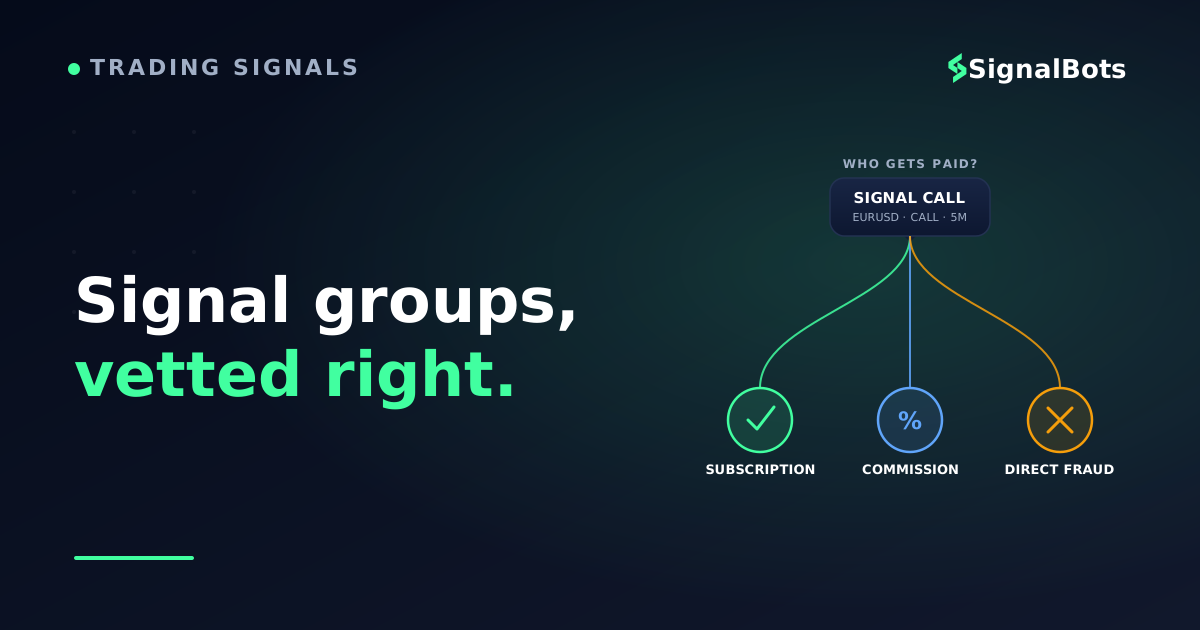
There are only three revenue models, and which one a group uses determines whose interest the admin actually serves.
Subscription fees. You pay monthly or per season for VIP access. The admin's income depends on you renewing, which depends on you not losing your account. Incentives are imperfect but broadly aligned.
Broker referral commissions. You are told to open an account through the admin's link, and the platform pays the admin a share of your deposits or of your trading volume. Incentives are now split.
Direct fraud. The group exists to move deposits to a platform the admin controls or is paid by, and the calls themselves are decoration.
Model two deserves more attention than it usually gets, because it is legal, common, and quietly decisive. When an admin earns a percentage of member deposits or turnover, the admin gets paid whether your trades win or lose — and gets paid more when you deposit more and trade more often. Every incentive in that structure pushes toward higher stakes, more frequent calls, and recovery strategies after a loss. That is exactly the pressure that makes a martingale strategy sound reasonable in a chat window when it is nothing of the sort.
Referral revenue is not automatically dishonest — disclosure is what separates the two. An admin who says "I earn a commission if you register through this link, and here is why I use that platform anyway" has told you what you need to price in. One who insists on a specific link, refuses to explain why, and cannot function if you use a different platform has told you something too.
The extreme version of a conflicted group is one where members are not the customer but the mechanism. In equities and crypto this shows up as a pump-and-dump scheme, where the group's coordinated buying is what makes the organiser's exit possible. Binary options groups run a structural cousin: the admin's payout comes from your losses being profitable to a counterparty, so a run of losing calls costs them nothing at all.
The Red Flags That Signal a Fake Group
Fake groups fail in four distinct ways, and each way leaves its own tells in the chat.
Claims that cannot be true. A group promising "risk-free" trades, "100% accuracy" or "no-loss" days is describing something that does not exist in a market where outcomes are probabilistic. Its quieter cousin is a historical win rate presented as an unbroken run of wins — not impressive but evidence of selective reporting, because every real strategy loses trades in clusters.
Proof you cannot check. Cropped platform screenshots, balance figures and payout receipts are trivially editable and carry no timestamp you can verify; proof means a call log posted before expiry, not a result posted after. The same defect shows up as missing history — losing calls that disappear, messages cleared periodically, or a channel created last month while claiming years of results, which is backdating a track record with extra steps — and as entries posted after the candle has already moved, where the signal latency puts the published results permanently out of your reach.
Money asked for before evidence. Being told to fund an account before you can see how the group actually calls the market inverts the normal order. A hard requirement to fund it through one specific link — especially with a bonus attached, or with the admin unable to explain the choice — points at a commission structure driving the recommendation rather than at the merits of the platform, and it is worse when that platform is one you have never heard of and cannot find on any register you are able to search.
Pressure applied where nobody is watching. Countdown timers, "last three VIP seats" and price rises at midnight exist to prevent the exact verification this article describes, and the move to a private one-to-one chat for "personal account management" or "help placing the trade" removes the only witnesses to what you are told. Read the room on the same principle: in a real trading community someone always complains after a bad session, so a feed of pure gratitude means comments are moderated, members are fake, or both.
Those four failure modes turn into eleven things you can physically look at. They are worth ticking off live, with the chat open in front of you, rather than read once and trusted to memory.
Red-flag checklist
Run This While You're In The Chat
0 / 11
No one claims a 'risk-free', '100% accurate', or 'no-loss' outcome.
Every result shown is a timestamped call posted before expiry, not a screenshot after.
The track record includes losing trades, not only an unbroken run of wins.
You can review calls before funding or depositing anything.
No specific broker link or bonus is a hard requirement to join or stay.
No one has pulled you into a private one-to-one chat for 'account management'.
There's no countdown timer or 'last seats' pressure to decide right now.
The message history is intact — no deleted losses, no suspiciously fresh 'years of results'.
At least one member has posted a complaint or a losing streak without being removed.
The pushed platform is one you can actually look up on a regulator's register.
Calls are posted early enough that you could realistically act on the stated price.
★
Checklist complete — you’re cleared to proceed.
Any single item is a question; three or more unticked together are an answer.
The United States derivatives regulator has published its own walkthrough of how these operations are constructed, which is worth watching once because it shows the sales side rather than the trading side:
The Truth Behind Binary Options Fraud, Episode 1: Dissecting the Scam — CFTC
What Does a Legitimate Group Look Like Instead?
A red-flag list only teaches suspicion. To join anything you need the positive picture too — the behaviours an honest operator shows because the dishonest one cannot afford to. The table below sets the two answers side by side on four questions worth asking of any group.
Fake vs legitimate, side by side
What to check
Fake / scam group
Legitimate group
Proof shown
Cropped result screenshots, shown only after the trade closes
Timestamped calls you can check against the chart before expiry
Deposit pressure
Fund through one specific link before you see any track record
You can review calls with zero money on the table
Win-rate stability
An unbroken run of wins, or a headline number that climbs every relaunch
Losses posted with the same prominence as wins, a roughly stable edge over time
Incentive structure
Admin earns a commission on your deposits, paid whether you win or lose
Admin discloses how they earn, and the calls work on any platform
The same four questions, answered two different ways — run any group against both columns before you trust its numbers.
Everything in the right-hand column costs the admin something, which is precisely why it is worth checking: a channel with an immutable public history, where a call posted at 14:02 for a 14:07 expiry can be matched against the chart by anyone, is the practical form of a verified track record in a chat-based group. Two further markers never make it into a table, because they live in how a group talks rather than in what it publishes.
Risk is discussed in the group's own voice. Position sizing, session filters, drawdown, and sitting out bad conditions come up unprompted. If nobody in a chat about leveraged short-expiry products has ever mentioned risk, the omission is the message.
Claims survive arithmetic. A legitimate admin can tell you what payout percentage they assume and what that implies for the win rate needed to break even. Which brings us to the part you can do yourself.
How to Verify a Group Before You Trust It
Three checks, in this order. Each one is cheap; together they will eliminate most of what is out there.
Verification routine
Three Checks Before You Trust Any Group
1
Request the track record
Ask for the complete timestamped call history, then check completeness, sample size and arithmetic.
2
Check the broker's license
Look up the exact legal entity name on the regulator's own register and warning list before funding anything.
3
Test-track for a week
Log every call before the outcome is known, without depositing, then compare your log to the group's own reporting.
Each step is cheap on its own; run all three before you trust a single call.
Requesting a Real Track Record
Ask for the complete call history over a defined window — every call in the last thirty days, in order, with asset, direction, entry time, expiry length, and outcome. Not a highlights reel, not a screenshot: the full sequence, including the flat days.
Then check three things:
Completeness. Do the entry times form a plausible sequence, or are there gaps exactly where losing streaks would sit? Consecutive numbering with holes in it is a confession.
Sample size. Twelve calls tell you nothing about anyone. A run of a few hundred over months is the point where a claimed edge starts to mean something, because short samples are dominated by luck in both directions.
Arithmetic. Count how many finished in the money versus out, and compare that against the payout of the platform they assume. On a typical short-expiry payout, a win rate near coin-flip is a slow loss, not a small profit — run the numbers yourself on the break-even win rate calculator rather than accepting the admin's framing. If a group's claimed hit rate sits below its own break-even line, the marketing has answered your question for you.
How the admin reacts matters as much as the file. "Here it is, judge for yourself" and "our results are for VIP members only" are two different businesses.
Checking Any Linked Broker's License
If the group requires or strongly pushes one platform, that platform is now part of what you are evaluating.
Take the exact legal entity name from the platform's own terms or footer — not the brand name on the banner.
Search the register of the regulator it claims to be licensed by, on the regulator's own site. A licence number that does not resolve, or resolves to a different company or a different permission, is decisive.
Check the regulator's public warning lists of unauthorised firms. Several regulators publish named warnings about specific signal groups and promoters, not just platforms.
Note the jurisdiction. Binary options are restricted or banned for retail clients in a number of major markets, so a platform offering them to you may be operating outside the protections you assume you have.
The point is not that an offshore registration is automatically fraud. It is that an unregulated counterparty holding your deposit means a dispute has no forum — and a group steering you specifically there, with a commission attached, has made that choice on your behalf.
Test-Tracking Calls Before You Fund Anything
This is the step nearly every warning article skips, and it is the only one that produces evidence rather than opinion. You are going to forward test the group for a week without giving it any money.
Here is what a week looks like in practice. Open a spreadsheet with six columns: time posted, asset, direction, expiry, price at post, outcome. Every time a call lands, log it within a minute — before the outcome is known. Track the result on a chart or in a demo account; do not fund anything, and do not act on the calls with real money.
Suppose the group posts four calls a day. By Friday you have around twenty entries and five things you could not have learned any other way:
How many calls you could actually have taken. If the price had already moved past the stated entry by the time you logged it, that call was not tradeable for you regardless of how it resolved.
Whether the posted results match the real ones. Compare the admin's Friday summary against your log line by line. Any discrepancy in their favour ends the evaluation.
What the losing sequences look like. Note the longest run of consecutive losses. That is the drawdown your account would have had to absorb, and it is the number that decides your stake size, not the win rate.
Whether calls are structured or reactive. Do entries cluster in a defined session with a stated reason, or do they scatter across the day chasing whatever just moved? Ask what reward-to-risk ratio the group is working to; a provider who cannot answer is guessing.
How the room behaves after a loss. This is the test the marketing cannot survive. A group that goes silent, deletes the call, or immediately proposes doubling up to recover has told you its entire operating philosophy in one afternoon.
Pass looks like this: the log matches the group's own reporting, most calls were reachable at the posted price, the losing streaks were survivable at a stake you could tolerate, and the expectancy is positive when you run it through the payout the platform actually offers — worth checking against an expectancy calculator rather than eyeballing. Fail is anything else, and by far the most common failure is not fraud. It is a group whose calls are genuine and simply not profitable after payout.
One week is a screening test, not a verdict. It is enough to eliminate the obviously broken and to justify a small, capped commitment to the rest — never to conclude that an edge is proven.
Where to Go Once You've Vetted a Group
Whatever your week produced, you now have a standard rather than an impression. That standard is portable: it applies to a Telegram signal channel, a Discord room, a forum thread, or the next invitation someone sends you.
If a group failed, the useful move is not to hunt for a better-marketed one. It is to keep the log going against whatever you look at next, so every candidate faces the same test instead of the same sales pitch.
If you want a concrete reference point for what "transparent" means in practice, our own binary options Telegram channel is one you can inspect the same way you would inspect anyone else's: calls are published openly in the channel with their outcomes tracked, so the history is there to be audited against a chart rather than summarised in a screenshot. We are the operator, so read it as an example of the transparency standard this checklist describes, not as neutral advice. It is a reference point, not a replacement for vetting the group you were actually considering — and it is not a claim to outperform any other legitimate group. Any signal source, ours included, still exposes you to the risks set out in our risk warning, and none of them removes the need for your own position sizing.
The broader lesson is that a Telegram signal channel — or any group — is a data source, not a decision-maker. Your entry rules, your stake, and your stop conditions stay yours no matter how confident the person posting sounds.
Bottom Line
Binary options trading groups are unregulated communities where an admin posts directional calls and members trade them at their own risk. Some are run by competent traders sharing real work; many are funnels built to move your deposit to a platform that pays the admin a commission whether you win or lose.
You do not need to guess which is which. Ask for the complete timestamped call history and check the arithmetic against the payout. Verify any platform the group pushes on the regulator's own register and warning list. Then track a week of calls in a spreadsheet without funding anything, and see whether the group's own reporting survives contact with your log.
A group that welcomes that process is showing you exactly why it deserves the benefit of the doubt. A group that resists it has already answered the only question that mattered.
FAQ
Are binary options trading groups legal?
Running a chat where someone posts opinions about price direction is generally not a licensed activity, so most groups operate legally in that narrow sense. The legal exposure usually sits elsewhere: in the platform the group routes you to, in whether binary options may be offered to retail clients in your jurisdiction at all, and in whether the admin is making regulated financial promotions without permission. Several regulators publish named warnings about specific signal groups for exactly that reason.
Is a free binary options signal group safer than a paid one?
Not inherently — free and paid are two doors on the same funnel, and a free tier is often the most curated part of an operation because its job is to sell the upgrade. Judge either one on the same evidence: a complete timestamped call history, disclosed incentives, visible losses, and results that hold up when you track them yourself.
How long should I track a group before deciding?
A week of live tracking is enough to screen out groups whose calls are unreachable, whose reporting does not match reality, or whose losing streaks are larger than your account could absorb. It is not enough to confirm an edge — short samples are dominated by luck. Treat a passed week as permission to commit a small, capped amount and keep logging, not as proof of anything.
What if the admin refuses to share a full track record?
Treat it as the answer. Every legitimate reason to withhold a call history — "it is VIP-only", "our strategy would be copied", "the results speak for themselves" — describes information the admin already publishes to strangers in the form of marketing screenshots. A provider who will show you selected outcomes but not the complete sequence is telling you the complete sequence looks different.
Does a group being on Telegram rather than Discord or WhatsApp change how I vet it?
The checklist is the same everywhere, but one platform property matters: whether the message history is public, immutable and searchable. A channel where past calls can be silently deleted makes independent verification impossible, so on those platforms your own real-time log stops being a nice-to-have and becomes the only record you can trust.
Sources & Further Reading
Want to go deeper? These independent, authoritative sources shaped this guide — each one is worth reading in full:
The Binary Options Desk is the SignalBots editorial team for fixed-time and OTC trading coverage. We research and write the guides that explain expiry timing, payout structure and disciplined entry across the major brokers.




Discussions 0
Leave a comment