Joining a free Telegram channel costs nothing, which is exactly what makes one hard to judge before you are already inside it. There is no trial period to evaluate, no refund to weigh, no invoice that forces you to ask what you are getting. You just tap Join, and the calls start arriving.
This page is about what actually lands in your feed when you do that: what a free binary options signal contains, why a channel gives those calls away, what the free tier realistically leaves out compared with a paid one, and how to decide whether free is enough for the way you trade.
Key Takeaways
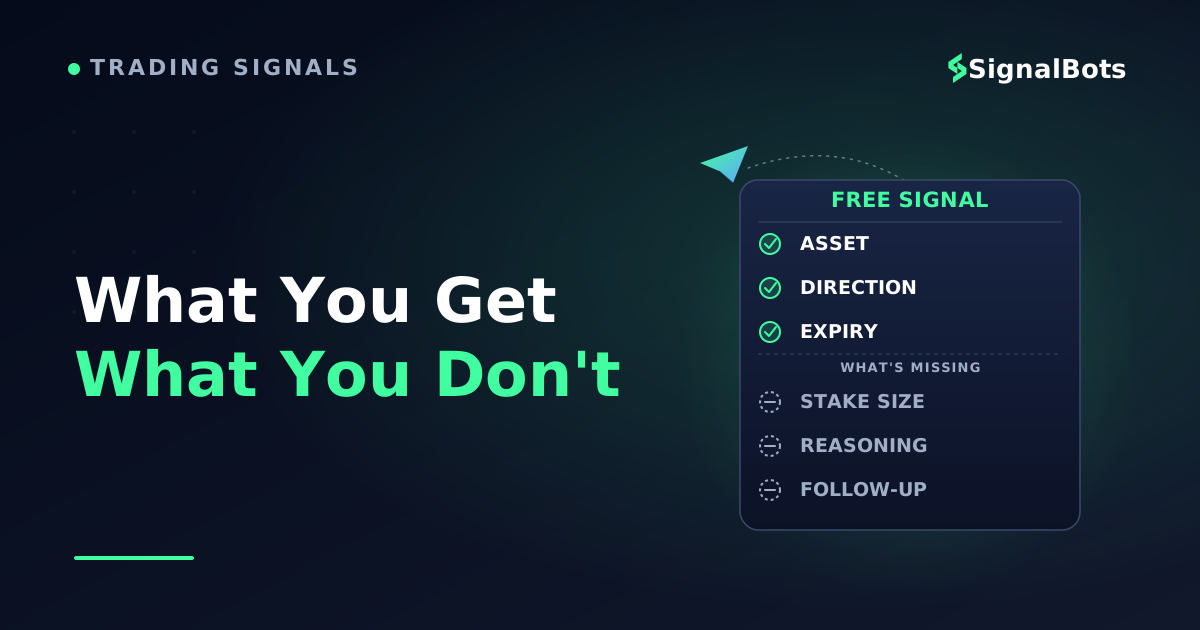
A free binary options signal on Telegram carries asset, direction, entry timing and expiry — and almost never carries stake sizing, reasoning, or a follow-up on losing calls.
Channels are free because broker referral revenue, a paid VIP upsell, or a deposit-gated "free lifetime access" arrangement pays for them; the funding model predicts the channel's behaviour better than its claims do.
Paying usually buys frequency, context and responsiveness — not accuracy. Whether a provider publishes its losing trades is the variable that separates serious channels at any price.
A claimed win rate is unreadable without the payout percentage it was earned at, because the break-even threshold moves with the payout.
Table of Contents (21 min read)Contents
What a Free Binary Options Signal on Telegram Actually Includes
Open almost any free channel and the posts look near-identical, because the format has converged. A single binary options signal is a short block carrying four things:
Asset — a currency pair, an index, gold, or a synthetic/OTC symbol that only exists on one broker's platform.
Direction — CALL or PUT (up or down), sometimes written as BUY/SELL out of habit from spot trading.
Entry timing — usually "enter now" or "enter at the open of the next candle", occasionally a price zone.
Expiry time — the horizon the prediction is measured against: 1 minute, 5 minutes, end of hour.
That is genuinely useful information, and it is the same core payload a paid channel sends. A free tier is not a fake product; it is a real trade instruction, delivered fast, at no charge.
What matters more is the list of things that post does not contain, because those omissions are where free tiers consistently differ:
No stake sizing. You are told what to trade, never how much of your account to put behind it. Nothing in the message adapts to a $200 account versus a $20,000 one.
No reasoning. You rarely learn why the signal provider expects that direction, so you cannot judge whether the logic still holds when price has moved 40 seconds later.
No follow-up on losers. Winning calls get a celebratory follow-up post. Losing calls often get silence, which is what turns a channel's visible history into a highlight reel rather than a record.
No handling of lateness. A stale signal — one you read three minutes after it was posted, because you were in a meeting — is worthless on a 1-minute expiry, and free channels almost never say so out loud.
No account context. Whether you are on a demo or live account, whether the market is in a session the strategy was built for, whether you already have three positions open: none of that is the free channel's problem.
Line those two halves up against a channel you are actually looking at, and the useful question stops being how good are these calls and becomes who is covering the rest:
Who supplies what
Part of the trade
In a free Telegram post
Otherwise supplied by
Asset and direction
Stated outright, CALL or PUT
—
Entry timing
"Enter now" or the next candle
—
Expiry horizon
Stated in minutes or to the hour
—
Stake size
Never stated
Your own fixed risk per trade
Reason for the call
Rarely stated
Your own read of the chart
Outcome of a losing call
Often left unposted
Your own log of every call taken
Lateness handling
Not flagged
Your own cut-off for stale calls
Session and account context
Absent
Your own trading plan
Everything the post leaves out still has to come from somewhere — and that somewhere is you.
Read that way, a free channel is a feed of trade ideas, not a trading system. Every part of the system that converts an idea into a survivable position — sizing, timing discipline, review — stays your job.
Why Are Binary Options Signals Free on Telegram?
Running a signal channel is not free for the operator. Someone builds or licenses the strategy, watches the market, writes the posts, and moderates thousands of members. That cost is paid by somebody — and understanding who tells you far more about a channel's behaviour than any claim in its pinned message.
There are three economics behind almost every free binary options signal channel on Telegram. A free channel still has to be paid for — by a broker's referral fee, a future upsell, or the deposit you make to unlock it.
Broker referral revenue
The most common model. The channel is affiliated with one or more brokers and earns from the accounts it sends over — typically a share of the broker's revenue from those clients, an introducing-broker style arrangement, or a per-account payment. The signals are the acquisition layer; the broker relationship is the business.
This model is not disqualifying, and it is worth saying plainly: it is the same commercial structure a great deal of the industry runs on, ours included. But it does shape incentives in ways you can observe. A channel paid per referred account has a reason to insist you trade on a specific broker, to prefer symbols only that broker offers, and to post frequently enough that new members see activity in their first hour.
The upsell funnel
The free channel is the top of a funnel and the paid VIP room is the product. Here, the free tier is deliberately calibrated: enough signals to prove the service is alive, not enough to be the whole offer. The difference between VIP and free signals is a designed gap, not an accident — that gap is the sales argument.
Again, structurally fine. The thing to watch is whether the free tier is a fair sample of the paid one or an advertisement dressed as a sample: a free tier that posts only the setups the operator likes most will produce a track record the paid tier cannot repeat.
"Free but conditional" access
The third pattern deserves its own name, because it is the one most often described in language that hides it. Access is free — after you open an account through the channel's link, or after you fund it with a minimum deposit. You will see it phrased as "free lifetime access", "free for our partners", or "VIP unlocked with any deposit".
That is a genuine offer, and for many traders it is a reasonable trade. But it is not the same product as a channel you can read without spending anything, and the distinction is the single most useful thing to check before joining:
Unconditional free — you can read the signals and scroll the history without an account anywhere.
Conditional free — you can read nothing meaningful until money has moved to a specific broker.
Neither is a scam by definition. Confusing the two is how people end up funding a broker account they did not intend to open, to see signals they have not yet been able to evaluate.
Free vs Paid Signals: What Actually Changes
The instinctive assumption is that paid signals are more accurate. That is the wrong axis, and expecting it to be true is how traders end up disappointed by a subscription they paid for. What you buy when you pay is rarely a better prediction — it is more structure around the prediction.
Six things typically change between a free tier and a paid one:
Signal frequency. Paid tiers usually post more calls per session, and post through the hours the free tier skips. If your available trading window is narrow, frequency may matter more to you than anything else on this list.
Depth of context. Paid posts more often carry the reasoning, an invalidation condition, or a chart. That context is what lets you skip a signal that no longer fits — a free "CALL now" gives you nothing to skip on.
Responsiveness. Paid rooms tend to have an operator who answers questions; free channels usually have comments disabled or an unmoderated flood.
Loss transparency. This is the real dividing line, and it does not track price at all. Some paid channels hide losers just as thoroughly as free ones. What distinguishes a serious provider at either price is whether every posted call gets an outcome posted after it.
Track-record depth. A verified track record — results you can reconstruct yourself from timestamped posts, rather than a graphic claiming a number — is uncommon at both tiers and disproportionately valuable.
Broker independence. Free channels are more often tied to one broker, because that tie is what pays for them. A subscription can, in principle, buy you a provider with no stake in where you execute.
Sorted by whether money actually moves them, those six axes split cleanly in half — which is the whole answer to the question this section asks:
What a subscription actually buys
Axis
What paying adds
Does paying reliably fix it?
Signal frequency
More calls, wider session coverage
Yes — this is the core of the offer
Depth of context
Reasoning, invalidation, sometimes a chart
Usually
Responsiveness
An operator who answers questions
Usually
Loss transparency
Nothing structural
No — an operator choice at any price
Track-record depth
Nothing structural
No — rare at either tier
Broker independence
The option of a provider with no execution stake
Sometimes — check before subscribing
Only the top three axes move reliably with price; the bottom three depend on the operator, not the invoice.
The honest summary: paying removes some friction and buys some accountability. It does not buy accuracy, and any channel that presents its price as evidence of its win rate has told you something about its marketing, not its results.
Is a Free Channel Enough for You? A Quick Decision Check
The answer depends entirely on what you are trying to do this month, not on the channel's quality in the abstract. Run yourself through both lists.
A free channel is genuinely sufficient when:
You are sampling a provider's style before paying anyone. Watching a free tier for a few weeks tells you the assets it favours, the expiries it uses, and whether it posts losses — all things no sales page will tell you.
You are learning the format. Reading calls, then checking whether they finished in the money, is a fast way to internalise how direction and expiry interact. Do it on a demo account and the education costs nothing but attention.
You trade rarely and selectively. If you take two or three positions a week and filter hard, a low-volume free feed is not a constraint.
You already have your own risk framework. If your risk per trade is fixed and non-negotiable, the missing sizing guidance is missing from something you were not going to outsource anyway.
The gaps start to matter when:
You need consistent volume at specific hours — a free tier that goes quiet during your only available session is not a service, it is a lottery.
You need risk-managed guidance, not just direction. Nobody should learn position sizing from a channel that never mentions it.
You want to judge results on evidence rather than claims, and the channel's history has been curated.
You are not willing to move brokers. If a free channel's signals only work on symbols its partner broker offers, "free" costs you your choice of execution venue.
Whichever side you land on, treat the signals as inputs to your own decision rather than instructions. Binary options carry a real risk of losing the full amount staked on every position, and no signal source changes that — our risk warning sets out what that exposure means in practice.
One Quick Way to Read a Free Channel's Claimed Win Rate
Free channels advertise with accuracy claims, because it is the only number a stranger can be shown quickly. Here is the one piece of arithmetic that makes those claims readable — and it takes less time than scrolling the channel.
A binary payout is asymmetric: a winning position returns only part of your stake, while a losing one costs all of it. Suppose a broker pays 80% on a win — four correct calls out of five leave you clearly ahead, but the same four-out-of-five record stops looking impressive as soon as the payout percentage drops, because each loss still takes the whole stake while each win pays less. Accuracy and payout only mean anything read together.
That relationship is the break-even win rate: the minimum accuracy required for a given payout to leave you flat. It means a claimed historical win rate is meaningless without the payout it was earned at, and free channels almost never publish both. Rather than working that through in prose for numbers that are not yours, put your broker's real payout and the accuracy you expect into our binary options break-even win rate calculator below and read the threshold off it directly.
Do the math yourself
Break-Even Win Rate Calculator
Enter the payout your broker actually offers and the win rate you expect, and see whether that combination is even profitable.
Broker's payout
Your expected win rate
Break-even win rate
—
Net on 5 trades of $100
—
The win rate that matters is the one measured against your broker's real payout, not a headline claim.
Three fast checks on any free Telegram signal channel, before you take a single call from it:
Is every signal followed by an outcome post? Count outcomes against calls over one recent day. A channel with more results than losses posted has curated its own history.
Are the results posted after the fact, or is the whole record a single graphic? Telegram timestamps every message and lets you scroll back. A provider confident in its record does not need a summary image.
Does anything promise certainty? "Risk-free", "guaranteed profit" or "we never lose" is not aggressive marketing — it is a statement no honest provider makes about a leveraged directional bet, and it should end your evaluation there.
That is the fast version. The full legitimacy check for any trading group — operator identity, payment pressure, withdrawal complaints, fabricated screenshots — is a bigger subject, and it applies across every platform, not only Telegram.
A Transparent Free Option Worth Knowing
Since the whole point above is that transparency, not price, is the variable worth checking, it is fair to show you what that looks like on our own surface rather than describing it abstractly.
Our binary options Telegram channel posts every trade outcome in-channel — win, loss, or tie — next to the original call, with the full history scrollable in the app. That is the check described a moment ago, done for you: you can count outcomes against calls yourself, on your own phone, before trusting anything. Basic access is free to view without a broker deposit.
The boundary is worth stating just as plainly: full lifetime access does still require opening a broker account through our partner link, which is exactly the "free but conditional" pattern named earlier. We think it is a fair exchange and we say so up front rather than in a footnote — but if your requirement is signals with no broker tie-in whatsoever, that is a real limitation, and you should weigh it as one.
Where to Go From Here
You now have the framework this question actually needed: what a free call contains, who pays for it, what the paid tier adds, and when the difference matters for you specifically. Three directions from here, depending on what you are trying to do next.
If you want to see which channels exist and how they compare, the next step is a ranked comparison of binary options Telegram signal channels, free and paid together, rather than a general trade-off framework. If your concern is legitimacy rather than pricing, what you need is the full checklist for vetting a trading group — the deeper diligence this article deliberately gestured at once and left alone. And if you are weighing platforms rather than providers, free signals distributed through Facebook groups and automated Telegram signal bots each behave differently enough from a human-run channel to be worth understanding on their own terms.
Whatever you join, keep the habit this article was built around: judge the channel on what it publishes about its losses, not on what it claims about its wins.
FAQ
Are free binary options signals on Telegram worth using at all?
They are worth using for what they genuinely are — a sample of a provider's style and a fast way to learn how direction and expiry interact — and not worth treating as a trading system, because they carry no sizing guidance and usually no accountability for losing calls. Reading a free channel alongside a demo account for a few weeks costs nothing and tells you more than any sales page.
Why would anyone give away binary options signals for free?
Three reasons, usually in combination: the channel earns from broker referrals when members open funded accounts, the free tier feeds a paid VIP upsell, or "free" access is unlocked only after a deposit through a partner link. None of these is automatically dishonest, but each explains behaviour you will otherwise find confusing — such as insistence on one specific broker.
Do paid signal channels have a better win rate than free ones?
Not reliably, and price is a poor proxy for accuracy. Paying typically buys more signals, more context around each call, and someone who answers questions. Whether losing trades are published is the variable that actually separates serious providers from marketing operations, and it does not track price at all.
What does "free lifetime access" usually mean on a Telegram signal channel?
Almost always that access is free of a subscription fee, conditional on opening or funding a broker account through the channel's referral link. It is a real offer, but it is not the same as a channel you can read without spending anything — check which of the two you are being offered before you deposit.
How can I check a channel's claimed accuracy myself?
Scroll back through a recent day's messages and count how many posted signals received a posted outcome. A record that shows more results than losses has been curated. Then ask what payout the claimed accuracy was earned at, since the same win rate is profitable at one payout and negative at a lower one.
Sources & Further Reading
Want to go deeper? These independent, authoritative sources shaped this guide — each one is worth reading in full:
The Binary Options Desk is the SignalBots editorial team for fixed-time and OTC trading coverage. We research and write the guides that explain expiry timing, payout structure and disciplined entry across the major brokers.



Discussions 0
Leave a comment