You have some form of automation in front of you. Maybe it is a Chrome extension that clicks Call and Put on the platform for you, maybe a Python script you wrote against an unofficial endpoint, maybe nothing more than a Telegram channel that pings you before a setup. The vendor page says it is completely safe. A forum thread says someone's balance was frozen overnight. Both cannot be right, and neither one shows you the rule they are arguing about.
They are arguing about a single clause. Pocket Option's policy on trading bots is not a guidance page and not a blanket ban — it is one line inside the Service Terms every account holder accepted at signup, plus a handful of neighbouring clauses that do far more damage than the bot line ever will. The worry underneath the search is always the same: a Pocket Option ban for using bots, arriving without warning, right after the first week that actually worked.
This page reads that paperwork with you. It assumes you already know what trading bots do on Pocket Option, so it skips the explainer and goes straight to the rules: what the terms say, which kinds of automation touch which clause, how a platform notices automated behaviour at all, and what to do so nobody ever has to make a judgement call about your account.
Key Takeaways
Pocket Option permits automation and even names third-party bots, but its Service Terms let the company cancel or revise any trade "performed with the help of unauthorized bot software" - and never define unauthorized.
That clause is a trade-result remedy, not a login ban: outright termination language is attached to fraud, exploiting site vulnerabilities and holding more than one account.
Risk is decided by who performs the trade. Signal-only alerts sit outside the clause entirely; anything that presses the button for you sits inside it and is judged on the pattern it leaves.
Restricted jurisdictions, mismatched verification and multiple accounts freeze more balances than bots do - fix that layer before tuning a single bot parameter.
Table of Contents (22 min read)Contents
Does Pocket Option Allow Automated Trading Bots?
Yes — and the platform is not shy about it. Pocket Option ships its own AI-driven auto-trade feature, runs an official Telegram signal bot you install from the platform's own Applications menu, and its published material names third-party tools such as MT2Trading, Autobot Signal and the free 2Bot browser extension as things that work with the platform. A broker that treated automation as forbidden would not be advertising the integrations.
So, does Pocket Option ban bots? Not as a category. What it reserves is narrower and sharper. In the list of situations where the company may cancel or revise the result of a trading operation, one item reads: the operation was "performed with the help of unauthorized bot software."
Read that twice, because two things in it decide your real exposure.
The first is the remedy. The clause is not aimed at your login. It is aimed at the outcome of your trades. The realistic bad day for a bot user is not "I cannot sign in" — it is "the profitable week I was about to withdraw has been reversed, and now I am arguing about it in a support ticket."
The second is the word unauthorized. The terms use it and never define it. There is no published whitelist, no approval form, no registry of blessed trading bot vendors. That silence is the actual risk: authorization is not something you obtain in advance, it is a judgement the platform makes after the fact, usually at the least convenient moment — when a withdrawal is on the table.
Which makes the honest verdict neither yes nor no. Automation is permitted. The platform decides retroactively whether a given piece of software counted as authorized. Your entire job is to keep your setup somewhere no reasonable reviewer would ever need to make that call.
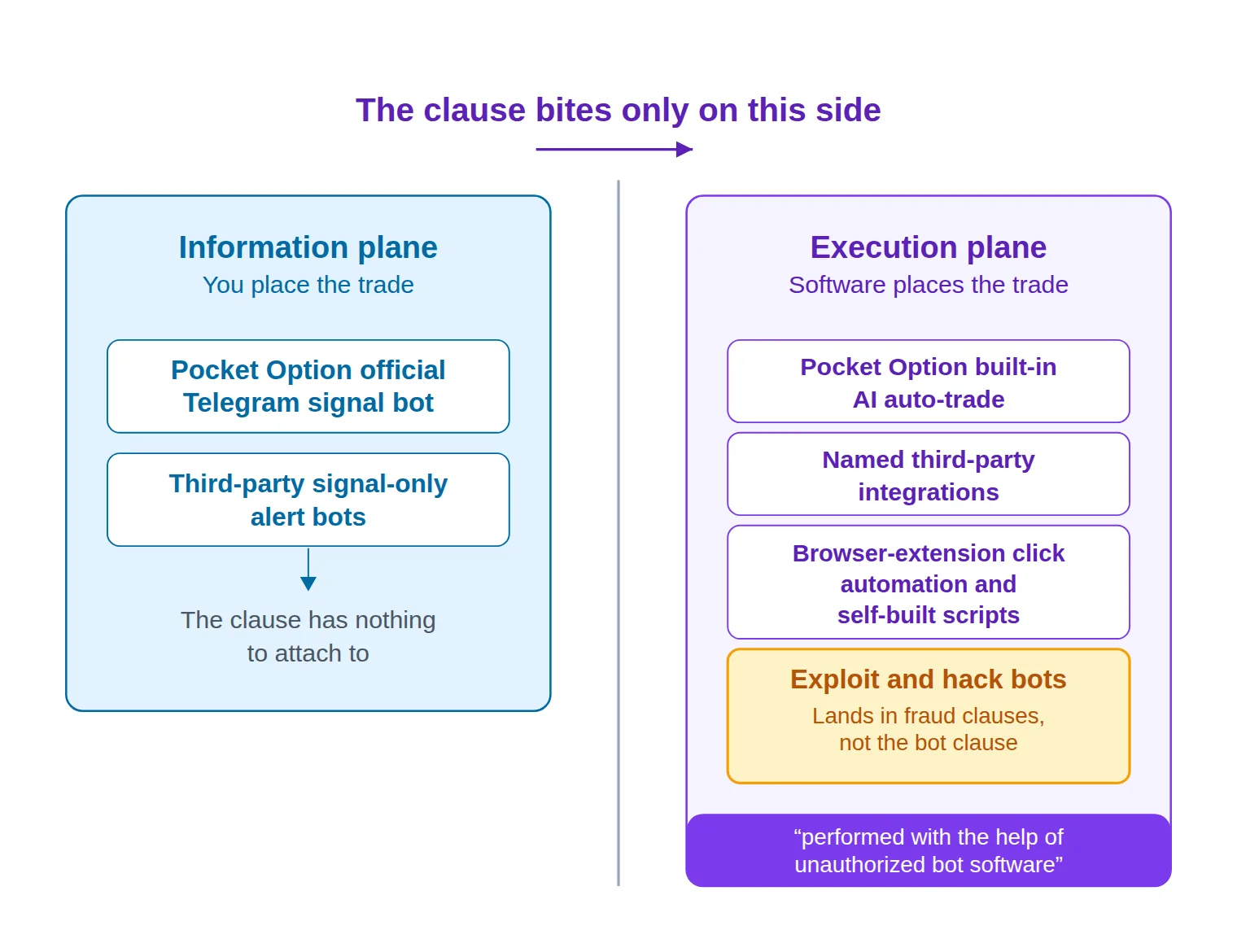
Signal tools and execution tools sit on opposite sides of the only line the terms actually draw.
What Pocket Option's Terms Actually Say About Automation
The document you want is the Service Terms — the public offer agreement linked from the site footer, not the knowledge-base blog. Open it yourself before you act on anything here. Terms get revised, and any page summarising them, including this one, is a snapshot with a date on it.
Two details in that document matter more than the bot line itself.
The company the clause keeps. The bot line does not stand alone. It sits inside a list of circumstances under which the company may cancel or revise a trading operation's result, and its neighbours in that list are operations opened or closed at a non-market quotation, and software failures on the trading server. That tells you what kind of clause it is. It was written as a trade-integrity provision — a mechanism for undoing results the platform does not consider to reflect a real market price — not as an anti-automation crusade.
The clauses that actually end accounts sit elsewhere. Three of them deserve more of your attention than the bot line:
Fraudulent activity and the exploitation of vulnerabilities in the company's websites. This one carries termination language, not trade-reversal language. Automation aimed at the platform rather than the market lands here.
More than one trading account per client. Holding several is prohibited outright. A cluster of synced accounts running the same bot is a violation before anyone even asks what software you used.
Abusive trading, including hedging the same exposure from different accounts. Also a standalone breach, and also something automation makes trivially easy to do at scale.
Now notice what the document does not contain: no definition of "bot software", no criteria for what makes it authorized, no approval process, no distinction between a script and an extension. Any page that quotes a Pocket Option rule saying "bots are permitted provided X" is inventing the rule. The platform's blog is closer to marketing collateral than policy, and where the blog and the terms differ, the terms are the document you agreed to.
The Line That Decides Everything: Reading a Signal vs Letting Software Trade
Strip the clause to its grammar and it turns on five words: a trading operation performed with the help of bot software. A trading operation is the trade — the thing that opens, expires and settles. So the question is not "do you use software?" Everyone uses software; the platform is software. The question is who performed the operation.
If a tool tells you EUR/USD looks like a Call and you decide, size and click, nothing performed the operation but you. The alert was information, and information is not a trading operation. That is why signal delivery — a channel, an overlay, a mobile push — sits almost entirely outside this clause, no matter how sophisticated the analysis behind it.
The moment software presses the button, you are inside the sentence. Every other distinction people argue about online — extension versus script, cloud versus local, official versus third-party — is detail layered on top of that one boundary.
The load-bearing distinction
Which plane is your automation standing on?
Signal-only alerts
Software analyses; you decide, size and click every entry
No trading operation is performed by software, so the bot clause has nothing to attach to
Works from a channel, an overlay or a phone push, with no account access needed
Your judgement is the bottleneck, which is slower and also the point
Information, not execution: effectively outside the clause.
VS
Execution automation
Software opens the position on your behalf, with or without you at the desk
The trade is performed with the help of software, which is what the clause describes
Usually needs your session, credentials or an open logged-in browser tab
Runs at machine cadence, which is what makes a pattern visible
The plane where the terms clause and the review actually live.
The clause turns on who performed the trade, not on how clever the software is.
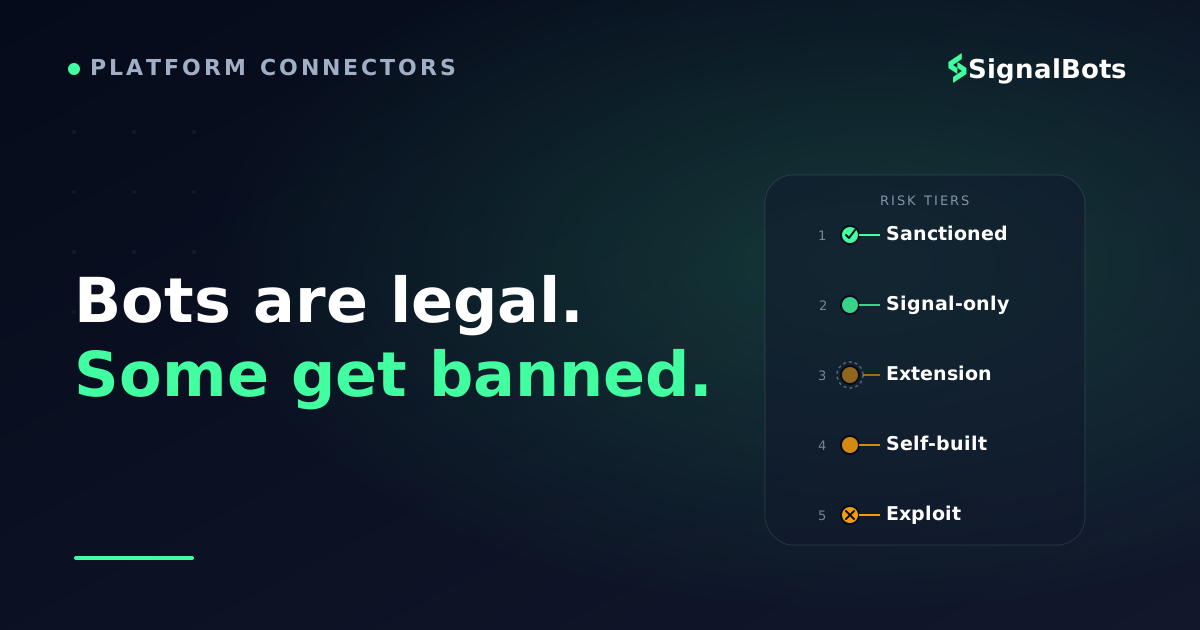
Risk Tiers: Which Bots Are Safe and Which Get Accounts Closed
Once you sort automation by which clause it touches, the vague fear resolves into a ladder. Find your own setup on it before you read anything else about bans.
The risk ladder
Type of automation
Who places the trade
Clause it touches
Realistic worst case
Exposure
Pocket Option's own AI auto-trade and official Telegram bot
The bot clause, judged on click pattern rather than architecture
Results reversed after a review of trade cadence
Moderate
Self-built API and script bots on unofficial endpoints
Your code, using your session
The bot clause; a runaway loop can spill into abusive-trading wording
Results reversed; a defective run flagged as unnatural activity
Elevated
Exploit and 'hack' bots aimed at the platform itself
Software, by design, against the system
The fraud and vulnerability-exploitation clauses
Account terminated and results wiped
Severe
Ban risk is not about using a bot. It is about which clause your bot's behaviour touches.
Officially Sanctioned Tools and Integrations
The platform's own auto-trading feature and its official Telegram signal channel bot are the floor of this ladder, for a structural reason: a platform cannot credibly call its own feature unauthorized bot software.
The named third-party integrations are one step out from that floor, and the step is bigger than it looks. Naming a tool as compatible in a blog post is not the same as authorizing it in the sense the terms clause means. What the naming does buy you is argumentative cover — it is hard for anyone to claim a tool was obviously off-limits when the platform's own material describes how to use it. What it does not buy you is a written permission. And these tools generally need account access to work, which is a separate exposure entirely: you are handing a third party the ability to trade your balance, and that risk exists whether or not any clause is ever invoked.
Signal-Only Alert Bots
A binary options bot that only tells you things — a channel message, a browser overlay, a push notification — is the safest automation there is, because it is not automation of trading at all. It is automation of research. Nothing performs a trading operation except you, which means the clause has nothing to attach to.
This is also the tier most traders end up in after weighing the rest, and the reason is not timidity: a signal you evaluate is a signal you can veto during news, at a bad spread, or when the day is simply going badly. Setting up a Telegram delivery bot is a separate job with its own steps, and so is the Discord equivalent — each has its own page.
Browser-Extension Screen Automation
A trading browser extension that reads the page and clicks for you sits in the most argued-over tier. The standard defence goes: it never touches the broker's servers, it only does what your hands do, so it cannot be "bot software" at all.
That is half true, and you should not lean your account on it. The clause describes how the trading operation was performed, not which network path the click travelled down. From the server's side of the connection, a click is a click. What differs between you and a script is the pattern of clicks — and that pattern is visible without anyone reverse-engineering your extension. This is auto-click trading, and it is the tier where your behaviour, not your architecture, decides how a reviewer reads you.
Self-Built API and Script Bots
Pocket Option does not publish a public retail trading API, so a self-built bot is not using a documented broker API the way a forex expert advisor would. Community projects drive the platform's own session from outside, using your credentials or a captured token, and that has two consequences worth sitting with.
First, this is unambiguously "bot software" under any reading of the clause. There is no argument available to you here, so plan as if the clause applies, because it does.
Second, this is the tier where a bug becomes a pattern. A retry loop that misreads a rejection can fire hundreds of identical orders in a minute. Nobody wrote that behaviour on purpose, and nobody reviewing it later will care that it was accidental — it will simply look like machine abuse. Rate-limit your own code harder than you think you need to. Writing the bot itself is a different article's territory; this one only sets the boundary it has to stay inside.
Exploit and "Hack" Bots
The last tier is anything sold on the promise of a leaked algorithm, a guaranteed win, or an OTC "pattern" only the seller knows. It carries two separate problems stacked on each other.
Most of these tools simply do not do what the sales page claims — be wary of anything advertised as "risk-free" or unable to lose, because that language is a marketing tell rather than a description of a mechanism. And the minority that genuinely attempt to exploit the platform put you inside the fraud and vulnerability-exploitation clauses, where the remedy is not a reversed trade but a terminated agreement. That is the one tier where "will I get banned" has an unhedged answer. Evaluating specific offers in detail belongs on its own page; here it is enough to know which clause they land in.
How Pocket Option Detects and Enforces Bot Violations
You cannot see the server side of this, and neither can anyone selling you a bot. No honest page will describe the platform's monitoring internals, because nobody outside the company knows them.
You do not need the internals. Every trading platform records the same primitives — session events, request timing, order parameters, outcome distributions — and what automation does to those primitives is not subtle. The tell is never one trade. It is the regularity across many.
The detection reality
How automated behaviour becomes visible from the other side
1
Every action lands in a log
Session events, order timing, stake, expiry and outcome are recorded per account as a matter of ordinary operation, not surveillance.
2
Regularity separates code from a person
People vary. Identical stake, identical expiry and a fixed interval sustained for hours describe a loop, not a trader at a desk.
3
A review gets triggered by consequence
Scrutiny usually follows something that costs the platform money or breaks a rule: a withdrawal request, an unusual run, a flagged pattern.
4
A human reads it and picks a remedy
The terms offer graded responses: cancel or revise specific results, reset results, or terminate the agreement outright.
Nothing here requires the platform to detect your software. It only has to read the pattern your software leaves.
No single automated trade looks unusual. The regularity across hundreds of them is the part you cannot see from your side.
Those three remedies are graded on purpose, and the grading is the most useful thing in the whole document. Cancelling or revising the results of specific operations is the response the bot clause names. Resetting results and terminating the agreement are attached to fraud, vulnerability exploitation and multiple accounts.
So when the question is whether Pocket Option bans accounts for using bots, the answer the paperwork supports is this: bot usage is framed as a trade-result problem, while the things that genuinely end accounts are the things you would recognise as cheating even without reading a contract. That is not a promise of safety. It is a map of where the sharp edges are.
The Scalping Trap
Fast trading is a legitimate style, not evidence of anything, and any page telling you that short expiries alone put you at risk is guessing.
A scalping bot does not become a problem because it is fast. It becomes a problem when the speed is aimed at the pricing mechanism rather than the market — entries clustered on quotes that have gone stale, which is what latency arbitrage means, and which is precisely the behaviour the non-market-quotation line in the terms exists to unwind.
The distinction is clean once you see it. A human scalper takes the price the platform offers and accepts the risk that it moves. Latency arbitrage takes prices the platform would not consider live prices at all. The first is a trading style. The second is the thing the clause was drafted for.
The Red Flags That Turn Automation Into a Violation
Everything the terms actually object to reduces to six behaviours. Read the list and notice that not one of them is "using a bot":
Trading against quotes the platform would not treat as live — the latency-arbitrage pattern the non-market-quotation clause is written for.
Automation aimed at the platform instead of the market — exploiting a bug, a display glitch or a payout mispricing.
Running several accounts in sync, which breaches the one-account rule on its own, before any question about software arises.
Hedging the same exposure across different accounts, named as abusive trading in its own right.
A cadence no person could produce — identical stake, identical expiry, sub-second spacing, unbroken for hours, with no pauses and no hesitation.
Anything requiring you to misrepresent who is trading — shared logins, spoofed activity, an account not in your own name.
The Thing That Closes More Accounts Than Bots
Here is the part almost no bot discussion mentions. Pocket Option states plainly that it does not provide service to residents of a list of countries, including the EEA, the United States, the United Kingdom, Japan, Brazil, Israel and the Philippines.
An account opened from a restricted country, or a KYC verification packet that does not match the address and payment method on file, is a far more common reason a balance stops moving at withdrawal than any script ever written. If you are running automation from behind a VPN in a restricted jurisdiction, the bot is not your exposure — it is the least of it. Fix that layer before you tune a single bot parameter.
How to Run a Trading Bot Without Risking a Ban
The practical goal is not to prove your bot is authorized. You cannot, because there is no mechanism to. The goal is narrower and entirely achievable: make sure nobody ever has to decide. An account with clean identity, one login, human-shaped activity and a boring withdrawal history does not generate the review in which the word unauthorized gets used.
Pre-deploy checklist
Before you let any bot trade a live Pocket Option balance
0 / 10
Open the Service Terms from the site footer and read the cancel-or-revise list yourself, rather than relying on a summary, including this one.
Confirm you are trading from a country the platform actually serves, with identity and payment details that match each other.
Complete verification before you scale, not after a withdrawal is already held up.
Hold exactly one trading account. No second account for the bot, no partner's account running the same strategy.
Run the bot on a demo account long enough to see it misbehave, not just long enough to see it win.
Rate-limit your own code or your extension so a rejection loop cannot fire dozens of identical orders.
Vary stake and expiry with the setup rather than firing a fixed pair endlessly around the clock.
Give the bot defined trading hours and let it stop, so activity does not run unbroken for days.
Delete anything sold on a guaranteed-win or leaked-algorithm claim before it ever touches your balance.
Withdraw modest amounts on a regular cadence, so a real payout history exists before a larger request arrives.
★
Checklist complete — you’re cleared to proceed.
None of this proves your bot is authorized. It removes every reason for anyone to ask.
Two of those deserve a sentence more. Testing on a demo account is not really about validating the strategy — it is about watching the software fail, because the failure mode that gets an account reviewed is almost always a defect rather than a strategy. And the withdrawal cadence matters because reviews cluster around payouts: an account whose first withdrawal request is also its largest looks very different from one that has been paying out steadily for months.
Getting the Signal Without the Execution Risk
If the ladder above lands where it lands for most readers — the information plane costs you nothing, the execution plane is where the clause lives — then the obvious question is whether you can keep the useful half and skip the exposed half. Usually you can, because on binary options the valuable part of most bots is the read, not the click.
That is what our free binary options Telegram channel is built to do: it delivers trade alerts you evaluate and place yourself. It is a signal feed, not execution automation — nothing on our side performs a trading operation on your account, so it carries none of the enforcement exposure this article has been describing.
It is also not a substitute for the decision you came here to make. It will not press the button for you, and it does not settle the question for anyone set on full automation — if you want software placing trades, you still have to weigh your own tier against the clauses above and accept what that means.
The Bottom Line
The vendor page and the forum thread were arguing past each other because neither had read the clause. Now you have. Pocket Option permits automation, names third-party tools that automate, and reserves one specific power over it: the ability to cancel or revise a trade performed with the help of unauthorized bot software, with unauthorized left undefined and decided after the fact.
That turns a yes-or-no question into a positioning question. Signal-only tools sit outside the clause entirely. First-party features sit under it safely. Third-party integrations, extensions and self-built scripts sit inside it and are judged on the pattern they leave. Exploit tools sit in a different, harsher part of the document altogether. Find your row, fix the identity and account-hygiene layer first, and the phrase that started your search stops being a threat and turns into a checklist.
Not for the fact of using one. The terms treat unauthorized bot software as grounds to cancel or revise the results of affected trades, while outright termination language is attached to fraud, exploiting vulnerabilities in the company's websites, and holding more than one trading account. In practice, a bot alone is a trade-result risk; a bot combined with multiple accounts, a restricted jurisdiction or an attempt to exploit the platform is an account risk.
Is a browser extension safer than a script because it never touches the server?
Marginally, and not for the reason usually given. The clause describes how the trading operation was performed, not which network path was used, so "it only clicks like a human" is not a defence in itself. What genuinely lowers your exposure is the click pattern — an extension that varies stake and expiry and runs in defined sessions reads very differently from one firing an identical order every thirty seconds all night.
Does Pocket Option allow scalping with a bot?
Short-expiry trading is a legitimate style and the terms do not prohibit speed. What they do give the platform is the power to unwind operations executed at a non-market quotation, which is what separates ordinary fast trading from latency arbitrage. A bot trading quickly on live prices is on very different ground from one built to catch stale ones.
Will testing a bot on a demo account protect my real account?
It protects you from the most common cause of trouble, which is a software defect rather than a policy breach. A demo run long enough to include a rejection, a disconnect and a bad fill will surface the retry loops and duplicate-order bugs that make an account look like machine abuse. It does not change how the terms apply once the bot is live.
Are the third-party bots Pocket Option names in its own blog officially approved?
Being named as compatible is not the same as being authorized in the sense the terms clause uses, because no authorization mechanism exists. What the naming gives you is a reasonable argument that the tool was not obviously off-limits. What it does not remove is the access risk: most of those tools need your session or credentials to place trades, which is an exposure entirely separate from the rules.
How do I check the current policy myself?
Open the Service Terms from the Pocket Option site footer and read the section listing when the company may cancel or revise a trading operation's result, plus the clauses on prohibited and fraudulent activity and on the number of accounts per client. That document governs. Support replies and blog posts are useful context, but they are not the agreement you signed.
Sources & Further Reading
Want to go deeper? These independent, authoritative sources shaped this guide — each one is worth reading in full:
The Binary Options Desk is the SignalBots editorial team for fixed-time and OTC trading coverage. We research and write the guides that explain expiry timing, payout structure and disciplined entry across the major brokers.




Discussions 0
Leave a comment