You have a link in front of you. Maybe it came from a Telegram group, maybe from a YouTube comment, maybe from a Chrome Web Store listing that showed up when you searched for a way to automate your trades. It promises a bot that beats Pocket Option — not one that helps you trade it, one that beats it. And before you click download, install, or pay, you want to know one thing: is this real, or is this the part of the story where the money disappears?
That question deserves a real answer, not a lecture about how nothing in life is free. Some of the software sold under this label genuinely runs and genuinely places trades. Some of it is a referral funnel with a countdown timer. The difference is checkable in about five minutes, once you know what to look at — and that is what the rest of this page is for.
Key Takeaways
No binary platform has an exploitable seam a downloadable bot can reach — the price feed and payout are server-side, so "hack" describes the marketing, not the software.
Execution reliability and profitability are different properties: a bot can place every trade perfectly and still lose, because the payout asymmetry sets a break-even win rate it has to clear.
Four questions sort any offer — what mechanism does it use, where do my credentials go, is there a checkable record, and does it survive a week on demo.
The most common loss is not theft: it is a tool that works exactly as described, following signals nobody can vouch for.
Table of Contents (28 min read)Contents
What a "Pocket Option Hack Bot" Actually Claims to Be
Start with the word itself, because it is doing a lot of work.
A pocket option hack bot is not a category of software. It is a category of claim. Nobody ships a technical product whose documented function is "exploit the broker" — what they ship is an automation tool, and "hack" is the wrapper applied to it so the offer reads as an edge rather than as a convenience. A hack has to exploit something. The price feed and the payout table sit on the broker's servers, out of reach of anything running on your device.
That distinction matters because a genuine hack needs something to hack. On a binary options platform, the three things that decide whether you make money are the price feed, the payout percentage attached to each asset, and the direction you picked before the expiry ran out. The first two live on the broker's servers and are identical for every account. The third is the only variable a bot can touch, and touching it is just called trading. There is no fourth thing sitting on the outside of the platform waiting to be triggered.
So when an offer says it "hacks" the platform, it is claiming one of two things — and neither of them holds:
That it changes the payout or the feed. It cannot. Those are server-side, and a piece of software running in your browser or on your laptop has no more access to them than you do.
That it predicts direction with a certainty ordinary analysis can't reach. This is the real claim, dressed as an exploit. It may or may not be true, but it is a claim about a forecasting method — and a forecasting method can be described, tested, and checked. "Hack" is what you say when you would rather not describe it.
Searches for a hack bot for Pocket Option cluster around the free end of the market. The phrase people actually type is "pocket option hack bot free", and the free ones deserve more scrutiny than the paid ones, not less — when there is no price tag, the payment is being collected somewhere else, and the two usual places are your account access and a referral sign-up.
One boundary before we go further: whether running third-party automation puts your account at risk under the broker's own terms is a separate question with its own answer, and it deserves its own page. This one is about whether the software itself is what it says it is.
How These Tools Actually Work Under the Hood
Strip the branding off and almost everything sold as a hack bot is one of five mechanisms. None of them is exotic. All of them are things you could describe to a friend in a sentence — which is exactly why a seller who refuses to describe theirs is telling you something.
1. Browser automation. A trading browser extension loads inside the Pocket Option tab and drives the interface the same way your hands would: read the current price off the page, decide, then click the amount field, the direction button, and the expiry selector. This is broker page automation — no special API, no privileged access, just a script pressing the platform's own buttons faster than you can. It works because the platform is a web page.
2. Input simulation on your desktop. The crudest version skips the browser entirely. A script pulls prices from an outside data source, applies a rule, and then simulates keyboard and mouse input at fixed screen coordinates so the platform receives what looks like a human clicking. This is auto-click trading in its most literal form. It is genuinely how some of the open-source projects on GitHub work, and it is as fragile as it sounds — the platform redesigns a button, the coordinates shift, and the bot starts clicking on nothing.
3. Signal-triggered execution. A bot watches a Telegram signal channel, parses each message into asset, direction, and expiry, and fires the trade. Here the bot is not the brain at all — it is a courier. Its reliability is a software property; its profitability belongs entirely to whoever writes the messages. A vendor who advertises the courier and stays quiet about the source has inverted the thing that matters.
4. A bridge from MetaTrader. An expert advisor runs on MT4 or MT5 where the strategy logic lives, and a paid connector relays its entries into binary trades on the broker. This is the most conventional architecture in the group, and the one most often sold as a product rather than a secret.
5. Copying somebody else's trades.Copy trading mirrors a chosen account's positions into yours, scaled to your balance. Worth knowing before you evaluate a third-party "copy hack": Pocket Option already carries this natively, in its Social Trading section, where you pick the account, set the copy percentage and the stop balance, and authorise all of it from inside your own logged-in account. A third-party tool offering the same thing from outside is not adding a capability. It is adding a middleman who now needs your credentials.
That last point generalises, and it is the single most useful mental model in this article: for every one of these mechanisms, ask where does my login end up.
Where your login actually goes
sequenceDiagram
    autonumber
    participant You
    participant Bot
    participant Broker
    participant Vendor
    You->>Bot: Enter email and password
    alt Bot runs only on your device
        Bot->>Broker: Log in from your machine
        Broker-->>Bot: Session stays in your browser
        Note over You,Broker: Credentials never leave your computer
    else Bot sends credentials away
        Bot->>Vendor: Upload login for storage
        Vendor->>Broker: Log in from an unknown server
        Broker-->>Vendor: Session someone else controls
        Note over Vendor,Broker: You cannot see or revoke this
    end
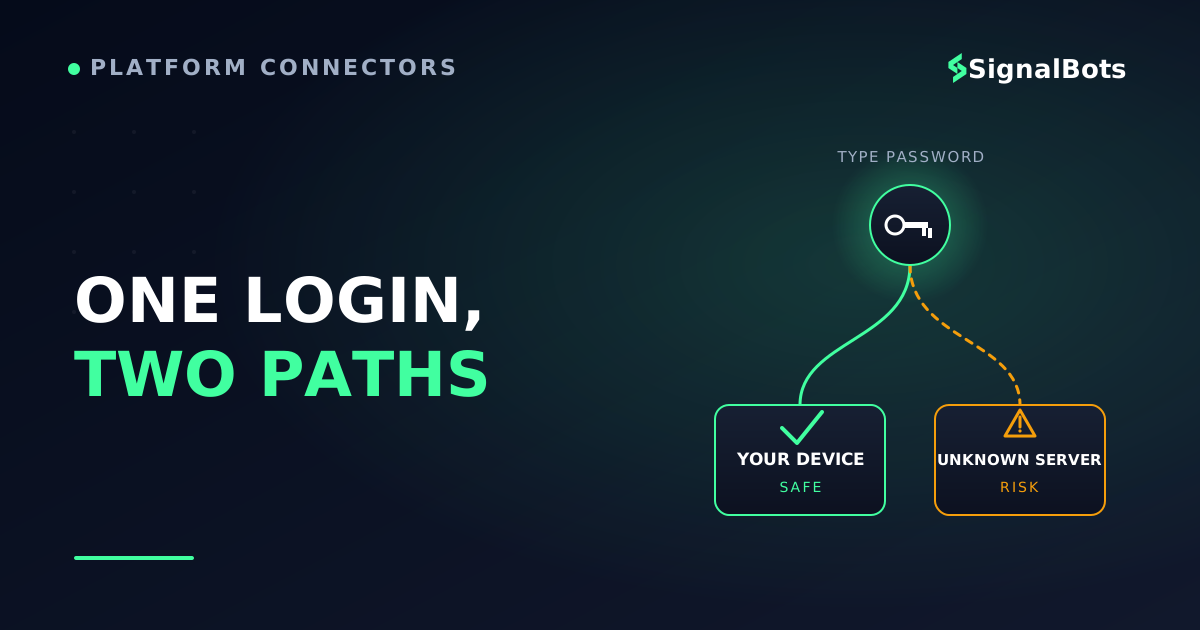
The same first action — typing your password into a bot — has two completely different destinations. Nothing on the screen tells you which one you are in.
The honest tools in this space run local-only execution: the credentials stay on your machine and the vendor never sees them. The dangerous ones look identical from the outside. That is why the mechanism question is not curiosity — it is the whole audit.
Do Hack Bots Actually Deliver?
Split the question, because "does it work" hides two different questions with two different answers.
Does it execute reliably? Often, yes. Execution is a solvable engineering problem, and a competent signal-to-trade bot really will place the trade it was told to place, within a second or two, nearly every time. This is measurable, it is honest, and it is the thing the better open-source projects actually publish. It is also not what you are being sold.
Does it make money? That is a completely different property, and no amount of execution reliability produces it — because the arithmetic of a binary payout does not care how fast you clicked.
Here is the structure the "guaranteed win" pitch has to survive. A binary option pays you a fixed percentage when you are right and takes your whole stake when you are wrong. The two outcomes are not symmetrical, and the gap between them sets a floor under how often you have to be correct before you are even level.
Why the payout, not the clicking, sets the bar
Illustrative payoff: $100 stake at an 80% payout
━ Call payoff━ Put payoffx-axis: underlying price at expiry • y-axis: P&L per $100 staked
Win and you collect $80 on a $100 stake. Lose and the full $100 is gone. That asymmetry, not the bot's speed, is what decides the outcome over time.
Work it through with that illustration. Suppose a payout of 80% and a stake of $100 on every trade. A win adds $80; a loss subtracts $100. Over nine trades you need to win five and lose four just to come out slightly ahead — a break-even point a little above 55%. Raise the payout and the bar falls; lower it and the bar climbs. You can run your own numbers with the break-even win rate calculator instead of taking that on faith.
Two things follow, and they are the honest answer to "do they work":
Speed and reliability buy you nothing on their own. A bot that executes flawlessly at a losing historical win rate simply loses faster and more consistently than you would have by hand.
The only claim that would matter is the one these offers never document. Beating that break-even bar over a meaningful number of trades is possible, and plenty of automated strategies attempt it — but it is a claim about a method, provable only with a dated, continuous record that includes the bad months. "Hack" is offered precisely so that record never has to be produced.
Trading these products carries real risk of losing your deposit; read our risk warning before you put money behind any automated strategy, ours or anyone else's.
Red Flags in a "Hack" Bot Offer
Everything below is a pattern you can spot on the offer page itself, before you install anything.
Outcome-First Claims With No Method Behind Them
The tell is not a high number. The tell is a number with nothing attached to it.
A legitimate performance claim comes with the shape of the test: which assets, over which period, at what stake, through which losing stretches. A hack-bot claim comes as a bare figure in a headline, sometimes with a screenshot of a balance. Screenshots of balances are the easiest artefact in this entire industry to fabricate, and backdating a track record — publishing "results" for trades assembled after the fact — costs a scammer nothing.
Be wary of any tool that promises "risk-free" trading or wins that "can't lose". That language is not enthusiasm; on a product with a fixed-loss payoff structure, it is a statement the seller knows to be untrue.
Watch too for the martingale strategy appearing on either side of the pitch. Some offers advertise it as the engine ("doubles after a loss until it recovers"); others advertise its absence as the feature ("profits without martingale"). Both are hooks aimed at readers who have heard the word. Doubling after losses converts many small wins into one catastrophic drawdown, so a bot built on it is dangerous — but a bot that merely says it avoids martingale has told you nothing about what it does do.
It Wants Your Credentials Before It Shows You Anything
Sequence matters more than the request itself.
Any tool that trades on your behalf eventually needs authorisation — that part is unavoidable. The question is whether it asks before or after you have seen it do anything. An offer that demands your Pocket Option email and password, or a broker API key, on step one, before a demo, before a screenshot of it running, before any explanation, has arranged the transaction so that you pay first and evaluate never.
Two specific patterns are worth naming:
Plaintext credential files. Several open-source bots ask you to drop your login into an unencrypted configuration file with no warning attached. That is not automatically malicious — it is often just careless — but a file like that is readable by anything else running on your machine, and it is a fair proxy for how much thought went into the rest of the project.
Extension permissions. A browser extension that automates a broker needs host access to that broker's site, which means it can read and modify every page you load there — including the one where you are logged in. Chrome shows you those extension permissions at install time and most people click past them. On a trading site, they are the whole security decision.
No Explanation of the Mechanism
Ask the seller one question: what does it look at before it decides?
An honest answer sounds boring. "It reads the last twenty candles on the one-minute chart and takes a trade when the range breaks with the trend on the five-minute." You may disagree with that rule. You can at least evaluate it, backtest it, and know when it will fail.
A black box trading system answer sounds impressive. "Proprietary AI." "Complex algorithms scanning the markets." "Neural analysis of market information." Those phrases appear verbatim across listings that share nothing else, which is itself informative: they are the standard filler for a field where the honest answer would lose the sale. Some genuine products are legitimately secretive about their edge — but those products compensate with a checkable record. Secrecy plus no record is not an edge, it is an absence.
Referral Gating and Buried Disclaimers
Follow the money and read the page bottom-up.
If the "free" bot only unlocks after you register a new broker account through the seller's link, the bot is not the product — your deposit is. That model is not automatically fraudulent; plenty of legitimate affiliates disclose it plainly. It becomes a red flag when the referral requirement is presented as a technical step ("verify your account to sync the bot") rather than as what it is.
The second half of this tell is layout. Look at where the risk disclaimer sits. On the offers that end badly, the promise is above the fold in large type and the disclaimer is at the very bottom in grey, and that ordering is a deliberate statement of what the page wants you to remember.
What Transparent Automation Looks Like Instead
Calibration matters here, because "avoid everything" is bad advice that costs people access to tools that work. Automation for binary options is a real product category with real vendors — paid MetaTrader-to-broker connectors, for instance, that publish off-site reviews, document their settings, and state in plain language that no result is guaranteed. Those exist alongside the hack-bot pages, sometimes in the same search results.
The two are distinguishable at a glance once you know what you are contrasting.
The contrast to calibrate against
A hack-bot pitch vs transparent automation
The "hack" pitch
Leads with an outcome — a win rate, a daily return, money earned while you sleep
Never names the method, the data it reads, or the conditions where it fails
Full access unlocks only after you register through a referral link
Risk language exists, but sits at the bottom of the page in small type
No way to check yesterday's calls against what the market actually did
Sells the result and hides the machine.
VS
Transparent automation
Leads with a capability — what it connects, what it executes, what it cannot do
States near the top that results are not guaranteed
Publishes support channels and reviews you can read off its own site
Documents its settings, so you can predict its behaviour before running it
Expects you to demo it before a live account is ever connected
Sells the machine and lets you judge the result.
Neither side of this contrast is about price. Paid tools appear on the left constantly, and free ones on the right.
Mapping the Checklist to the Offer in Front of You
The general rules are only useful once they land on the specific thing in your browser tab. Five delivery forms carry the "hack" label, and each fails in its own characteristic way.
Five delivery forms, five failure modes
Offer type
What it needs from you
What it can genuinely do
The characteristic red flag
Telegram bot
Your Telegram account; broker authorisation if it executes
Deliver alerts to your phone within seconds of a setup
Asks you to authorise trading outside the platform's own in-account flow
Chrome extension
Host access to the broker site — read and write on every page you open there
Click the platform's own buttons faster and more consistently than you
The listing never states how it decides, while the permission covers your live session
GitHub / Python script
Your credentials in a config file, plus the ability to run it yourself
Read an outside price feed and simulate your input on the platform
Plaintext credentials with no security note, no README, no recent commits
Paid EA / robot bridge
A subscription and a MetaTrader install to run the strategy in
Relay an expert advisor's entries into binary trades on the broker
Priced like a product but sold on a win-rate promise instead of documented behaviour
Copy-trading tool
Standing permission to place trades on your account
Mirror another account's positions, scaled to your balance
Recreates a feature already built into the platform, but from outside it
Every row needs something different from you. Match the offer to its row, then check the last column first.
A few notes that don't fit in a table cell:
Telegram bots are the hardest to evaluate because the software and the signal source are separate products bundled into one experience. Judge them separately: the bot's job is delivery, and the channel's job is the calls. A flawless bot in front of an unaccountable channel is a faster route to the same losses.
Chrome extensions carry a real audit trail most people ignore. The store listing names a developer, links a privacy policy, and states whether the developer claims to collect your data — and Google's own store rules require that data use be limited to the extension's disclosed purpose. An extension automating a broker with a blank developer identity and no policy has failed a check it was given every chance to pass.
GitHub scripts are the most honest category in the group and the least useful out of the box. The good ones make no profit claims at all — they are execution plumbing, published as-is. Read the commit history: two commits, no README, and no activity since publication means nobody is maintaining the thing your money would be running on.
EA bridges invert the usual question. The connector is normally the trustworthy half; the strategy running on MetaTrader is the half nobody validated. A "hack" label here is almost always attached to the EA, not the bridge.
Copy-trading tools should be checked against the native feature first. If the platform's own Social Trading section already lets you mirror an account with proportional copying and a stop balance you control, a third-party tool must justify why the same job now requires handing your login to someone else.
Once you have found your row, run the offer through this before anything gets installed.
Your pre-install audit
Before you download, install, or pay
0 / 7
Find the sentence that explains HOW it decides a trade. If there is no such sentence, you are buying a black box.
Check what it asks for before it shows you anything working. Credentials demanded on step one are a payment, not a login.
Look for a record you can verify yourself — dated, continuous, and including losing stretches, not a highlight reel.
Read the disclaimer and note where it sits. Promise at the top, risk at the bottom, is a deliberate ordering.
Work out how the seller gets paid. If it is a referral deposit rather than a price, your deposit is the product.
Confirm the authorisation happens inside your own broker account, not by handing your password to a third party.
Run it on a demo account long enough to see a losing streak before a single real dollar goes near it.
★
Checklist complete — you’re cleared to proceed.
Seven questions, five minutes, no installation required. Anything that fails two of them is not worth the download.
The last item deserves emphasis, because it is the cheapest protection available. A demo account costs nothing and carries no financial risk, and a week on demo will surface almost everything a sales page hides — including the losing streak that every strategy has and no promotional page shows you.
The Real Risks: Credentials, Malware, Bans, and Lost Deposits
"Be careful" is useless advice without a list of what actually goes wrong. Four things do. The moment a login leaves your device, you stop controlling how many copies of it exist. Your credentials stop being yours. This is the largest risk and the least visible one. A password typed into third-party software may stay on your device or may be transmitted and stored somewhere you will never see, and the interface looks identical in both cases. Once a login has left your machine, you cannot count the copies, cannot revoke them, and will not find out until the account is used. An API key is worse in one specific way: it keeps working after you change your password.
The installer is a real attack surface. A browser extension is reviewed, at least loosely, by a store. A downloadable executable or a sideloaded mobile package from a Telegram link is reviewed by nobody. Software that already has a legitimate reason to ask for elevated access, and that you have been primed to trust because you want it to work, is close to an ideal delivery vehicle for something that steals more than your trading account.
Third-party automation can put the account itself at risk. Brokers set their own terms about what software may connect to an account, and the consequences of breaking those terms land on the account holder, not the tool vendor — worth checking Pocket Option's actual rules on bots before you connect anything to a funded balance.
The most common loss is the boring one. Most people who lose money to a hack bot are not hacked at all. They install a tool that works exactly as described, follow signals nobody can vouch for, and watch a real balance drain at an entirely predictable rate. No theft, no malware, no drama — just an automated strategy with no edge, executed with perfect discipline, against a payout structure that requires an edge.
A Signal Source That Never Asks for Your Login
If you have read this far, the practical question has probably narrowed: where do you look at signals without handing anyone your account?
Our binary options Telegram channel is one answer to that specific question. It posts live binary signals for free, and it never asks for a Pocket Option login, password, or API key — because it does not touch your account at all. You read the asset, direction, and expiry, and you decide whether to place the trade yourself, in your own platform, with your own hands on the stake.
That is the honest boundary too: it is an alert feed, not an execution tool. If what you actually want is hands-off automation that places trades while you sleep, this is not that, and no signal channel is. And it is not a shortcut — you still need your own break-even arithmetic, your own stake sizing, and the discipline to skip the ones that don't fit your plan. What it does remove is the part of this article you are most exposed to: there is no credential to hand over, so there is nothing to lose by looking.
Bottom Line: Hack Bot, or Just a Bad Bet?
Here is the verdict the title asked for, in three parts.
The framing is always a scam signal, even when the software isn't. No binary platform has an exploitable seam that a downloadable bot can reach, so "hack" describes marketing, not capability. A vendor who uses it has chosen a word they cannot defend over a description they could — and that choice is information about everything else on the page.
The software underneath is a spectrum, not a verdict. At one end sit crude open-source scripts that make no promises at all and simply automate clicks; they are honest and mostly unremarkable, and their real defect is neglect rather than malice. In the middle sit ambiguous products that disclose their risks and their non-affiliation, then gate the good parts behind a referral sign-up. At the far end sit pages with debug errors bleeding into the layout, a headline return figure, and a disclaimer hidden at the bottom. Only the last group is a scam in the ordinary sense — but the middle group can still cost you money, and the first can still cost you an account if it is careless with your login.
What actually protects you is not avoidance. It is the sequence: know the mechanism, check where your credentials go, demand a checkable record, and demo it before funding it. That works on a Chrome extension, a GitHub repository, a Telegram bot, or a paid robot, and it will keep working on whatever the next pocket option hack bot is called. When you do want automation, start from legitimate Pocket Option bots that describe what they do — and if budget is the constraint, there are legitimate free trading bots that document their behaviour instead of promising a number.
The bots that guarantee wins do not exist. The ones that reliably click buttons do, and they are worth exactly as much as the strategy behind them.
The takeaway
You arrived with
“a link promising a bot that beats the platform, and a decision to make before downloading it”
and you leave with
a five-minute audit you can run against any automation offer, on any broker.
"Hack" is the one claim that never survives a follow-up question
The mechanism, the credential path, the checkable record, the demo run — four questions, asked in that order, sort every offer in this category. A tool that answers all four may still lose money, because no automation escapes the payout arithmetic. But a tool that refuses to answer even one has told you what it is before you have installed anything.
No — not in the sense the word implies. The price feed and the payout percentages are set on the broker's servers and are the same for every account, so no software running on your device can alter them. The only thing any bot can influence is which trade gets placed and when, which is trading, not hacking. Tools that genuinely automate that decision exist; tools that break the platform's economics do not.
Are free Pocket Option bots more dangerous than paid ones?
Not automatically, but the free ones need a harder look, because "free" only means you are not paying in money. The two common alternative payments are your account access and a required broker registration through the seller's referral link. Neither is inherently fraudulent — plenty of tools disclose the referral model openly — but when a free tool asks for your password before it demonstrates anything, the cost has simply moved somewhere you can't see it.
Can a browser extension actually see my Pocket Option password?
An extension that automates a broker's site needs permission to read and modify pages on that site, and that permission covers the page you are logged into. Whether it does anything with your session depends entirely on the developer, and you cannot tell from the outside. That is why the store listing details matter: a named developer, a working privacy policy link, and a data-collection disclosure are the only external evidence you get before installing.
What should I check first if I already installed one?
Change your Pocket Option password immediately, and revoke any API key the tool was given, since a key keeps working after a password change. Remove the extension or uninstall the software, then review your account's trade history for positions you did not authorise. If the tool required a config file with your credentials in it, delete that file too — it stays readable on your disk long after the bot is gone.
Do bots that just deliver signals carry the same risk?
The credential risk is different in kind. A signal-only feed that you read and act on manually never needs access to your trading account, so the theft and unauthorised-trading risks largely disappear. What remains is the risk that the signals themselves are worthless — which is why the same demand applies: a checkable record over a meaningful stretch of trades, including the losing ones, before any real money follows the calls.
Does using automation put my Pocket Option account at risk of a ban?
Brokers set their own terms about which software may connect to an account, and the consequences of violating them fall on the account holder rather than the tool's developer. That makes it a question worth answering before connecting anything to a funded balance rather than after — and it is a separate question from whether the tool itself is legitimate, since a perfectly honest bot can still be against a platform's terms.
Sources & Further Reading
Want to go deeper? These independent, authoritative sources shaped this guide — each one is worth reading in full:
The Binary Options Desk is the SignalBots editorial team for fixed-time and OTC trading coverage. We research and write the guides that explain expiry timing, payout structure and disciplined entry across the major brokers.




Discussions 0
Leave a comment