You tap Signals inside Olymp Trade, and in the next browser tab a robot vendor is already showing you a win rate. Both are asking for a subscription before you have watched a single one of their calls lose.
That is the real difficulty with Olymp Trade signals. Good sources exist. But almost nothing on the page selling one — the platform's Market card, the vendor's landing page, a channel's pinned post — tells you how the number was counted, when the call actually fired, or what happened to the trades that went the other way. A binary options signal is just a direction and an expiry. A signal service is a claim about how often that direction is right, and only one of those two things is easy to verify.
So this comparison runs the other way round: criteria first, ranking second. Below are the four tests that survive contact with a one-minute contract — track-record transparency, delivery latency, cost measured against payout, and asset coverage — then every realistic source of signals for Olymp Trade scored against them, the red flags that end an evaluation early, and where each type honestly fits. One of these can be checked before you pay. The other cannot.
Key Takeaways
A win rate you cannot audit is marketing; a per-signal log that shows losses beside wins is evidence — rank every Olymp Trade signal source on that first.
The platform's built-in Signals are the baseline: mathematical-model suggestions in Scalping, Intraday and Swing tiers with a roughly ten-minute action window, sold as Market subscriptions.
Judge delivery latency against the shortest expiry you actually trade; on the 1-5 minute tier a two-minute delivery hop is effectively a different trade.
Read any claimed win rate against the payout — at an 80% payout you need better than five wins in nine just to break even.
Table of Contents (21 min read)Contents
Who Counts as an Olymp Trade Signal Provider?
Drop the brand from the phrase for a moment. Nothing about a fixed-time trade idea is built for Olymp Trade the way an expert advisor is built for MetaTrader. A call is an asset, a direction, a timestamp and an expiry — EUR/USD, CALL, 14:32:00, five minutes. It becomes a signal for Olymp Trade only when that asset is listed there and that expiry exists there.
Read every offer through that lens and the market for an Olymp Trade signal provider collapses into four honest categories:
The platform's own Trading Signals — generated inside Olymp Trade, displayed in the platform, sold through its Market. The only category the broker itself stands behind.
Third-party robots and bots — desktop apps, browser extensions or connectors that take a call from their own model, a channel or a TradingView alert and either pre-fill the ticket or place it for you. AutobotSignal and OlympMatix are two publicly advertised examples of this binary options bot category.
Independent signal services — a service running its feed separately from any platform, delivering calls to an app, a dashboard, an email or a channel. You place the trade yourself.
Copy-trading and social feeds — here you are not receiving a call at all, you are mirroring somebody's positions. That is social trading, and what you are judging is a trader, not a model.
Only the first sits inside the platform. For the other three, your Olymp Trade account history tells you nothing about the source's accuracy until after you have paid and traded — which is exactly why the evidence test below decides more than any ranking does.
How to Judge a Signal Provider's Win-Rate Claim
A headline percentage is the cheapest asset in this industry to manufacture and the hardest to disprove. You cannot audit it, you cannot reproduce it, and the seller chose both the sample and the window it was measured over. Treat a claimed historical win rate as a marketing input rather than evidence, and score candidates on four things instead.
Track-record transparency — can you read the individual calls, losses included, before you pay?
Latency against your expiry — how much of a one- to five-minute contract disappears between the model firing and your click?
Cost against payout — a subscription is a fixed monthly charge stacked on top of the payout gap, and it moves the reward-to-risk ratio of every trade you take on that feed.
Coverage — the assets, expiry lengths and weekend hours you actually trade. A feed that fires beautifully on instruments Olymp Trade does not list is worth nothing to you.
A Win Rate Means Nothing Without the Payout
Fixed-time trades are asymmetric by design: a loss costs the entire stake, while a win returns only the payout percentage. Suppose the payout on your asset is 80% and you stake $100 — you are risking $100 to make $80, so you need to be right more than five times in every nine simply to stand still. Drop the payout to 70% and that break-even level climbs again.
Why the percentage alone tells you nothing
Illustrative payoff: $100 stake, 80% payout
━ Call payoff━ Put payoffx-axis: underlying price at expiry • y-axis: P&L per $100 staked
Illustrative example. The downside is the full stake and the upside is only the payout, which is why break-even sits well above 50% of trades won.
That asymmetry is why "high win rate" is an incomplete sentence. Ask which assets, which expiry lengths and which payout tier the number was measured on, then work out your own threshold with the break-even win rate calculator before you decide whether the claim would even be profitable if it were true.
Every performance figure discussed on this page, ours included, is history rather than a forecast — the risk warning applies to all of it.
What Separates a Track Record From a Banner
A publishable record has five properties, and a banner has none of them: calls timestamped before expiry rather than written up afterwards; losses shown in the same stream as the wins; a sample size spanning weeks and more than one market mood; a per-asset breakdown, so you can see whether one pair is carrying the whole edge; and a history nobody can quietly rewrite.
Simulated results are not a substitute. A backtest tells you how a model behaves on data it has already seen — a useful design check, and a different class of evidence from a live log. When a provider shows only the former, you are being asked to trust the modelling, not the outcome.
Find a public list of individual calls — asset, direction, time sent, expiry, result — not just a headline percentage.
Confirm losing trades appear in the same place as the winning ones.
Check the record spans several weeks and more than one market mood, not a single good session.
Look for a per-asset breakdown, so you can see whether one instrument is carrying the whole edge.
Ask which payout tier the win rate was measured against, then compute your own break-even level.
Separate live results from backtested or simulated ones — they are different classes of evidence.
Time delivery yourself on a trial: the timestamp printed on the call versus the moment your device showed it.
Verify the assets and expiry lengths exist on Olymp Trade during the hours you actually trade.
Run the source on a demo account and keep your own log before any subscription renews.
★
Checklist complete — you’re cleared to proceed.
Work down the list on any candidate. A source that fails the first two rarely survives the rest.
Olymp Trade's Own Built-In Signals: What They Are and What They Cost
Start here, because this is the baseline you already have access to, and no third party is worth paying for until you know what it has to beat.
Olymp Trade generates its Trading Signals automatically from mathematical models reading the current market — algorithmic trading in the plainest sense, with no human analyst in the loop. The suggestions are grouped into three timeframe tiers: Scalping (1, 3 and 5 minutes), Intraday (10 to 60 minutes) and Swing (four-hour through monthly). Each suggestion carries an action window of roughly ten minutes; act later and the quote it was built on has moved, which makes it a stale signal rather than merely a late one.
Access is sold as a subscription inside the platform's Market on one-, three-, six- and twelve-month terms, renewing automatically unless you cancel a couple of days ahead. Access to the different tiers is layered by account status, so check the Market card in your own account for the terms that apply to you. Olymp Trade also states in its own help documentation that the signals support market analysis and do not guarantee trading results — worth noting, because it is more candid than most of what surrounds it.
The native feature wins on three of our four criteria almost by default. There is no delivery hop between generation and display. No third party touches your account. Coverage matches the platform's assets and expiries exactly, because it is the platform.
The gap is the one this whole page turns on: there is no public per-signal outcome log to audit before you subscribe. You buy the tier first and discover the hit rate afterwards.
There is a cheap way around that. Subscribe to nothing yet, run the tier you are considering on the demo account, and keep your own sheet — asset, time received, expiry, direction, result. Two weeks of that and you have built the track record nobody published, on the same source, at zero cost. Do it with any third-party trial too and you will finally be comparing like with like.
Best Olymp Trade Signal Providers and Services, Compared
How this was scored. Each source is rated against the four criteria above, with transparency weighted heaviest, because it is the only one you can verify before money changes hands. The ranking is by category rather than brand: individual vendors in this niche appear and vanish faster than any published shortlist survives, while a category's evidence model stays constant. Where a named product appears below, it illustrates the type — it is not a recommendation of that product.
Ranked by what you can verify first
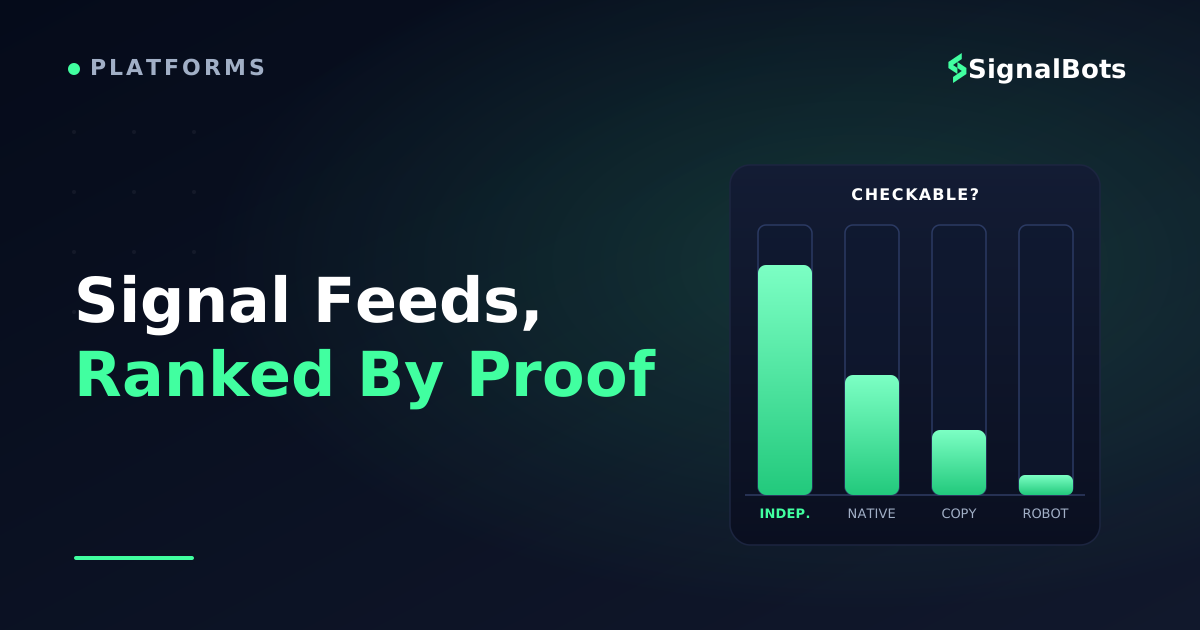
Signal source
Track-record transparency
Latency on 1–5 minute expiries
Cost model
Coverage
#1 · Independent feed with a public per-signal log
Transparency decides the order: every other criterion can be tested after you subscribe, but this one cannot.
#1 — An independent feed with a public, per-signal log. It ranks first for one reason only: it is the single category that can hand you evidence before payment. That does not make any particular independent service good — most are not — but it is the only shape in which a bad one is exposed quickly and a good one is provable. Apply the checklist and this category sorts itself.
#2 — Olymp Trade's built-in Trading Signals. Second on transparency, first on everything mechanical. The absence of an auditable history is a real cost, yet it is the only source with zero delivery latency and guaranteed asset alignment, and you can reconstruct the missing record yourself on demo in a fortnight.
#3 — Copy-trading and social feeds. Judged differently from the rest: you are evaluating one trader's visible equity history, drawdown and consistency rather than a model's hit rate. When that history is genuinely public and long, this can outrank a native subscription. When it is a leaderboard snapshot from a good month, it does not.
#4 — Robot and bot vendors whose only evidence is the sales page. AutobotSignal, for example, routes calls from AI, Telegram and TradingView sources into Olymp Trade execution, and to its credit states openly that it cannot guarantee win rates and that the trade figures in its illustration are placeholders. OlympMatix leads with a single headline outcome claim alongside a free demo. Either product may work exactly as described — that is not the issue. The issue is that nothing published lets you test the edge before you install it, which under criterion one puts the category last however good an individual tool turns out to be.
Which Delivery Channel Fits You — Native, Robot, Telegram, or Copy Trading?
The ranking says which evidence model to trust. This part says which shape fits your day.
Native, in-platform. Fits if you trade with the chart already open and want suggestions on the same screen as the ticket. Fastest possible delivery, nothing to install, nothing external to trust.
Robot or bot software. Fits if you cannot watch the screen when your setups appear. This is where the wider question of automated trading options for Olymp Trade begins — from one-click ticket fillers through to fully hands-off Olymp Trade trading bots. If you would rather generate signals on MetaTrader and route execution separately, that is what an MT5-to-Olymp OTC connector is for.
Telegram-delivered. Fits mobile traders who want an alert that survives a locked phone. Telegram is a delivery method, not a quality tier — the same four criteria apply, and picking the best Telegram channels for signals is a comparison of its own.
Copy trading. Fits if you would rather outsource the decision entirely and can accept somebody else's risk appetite on your balance.
If budget rather than transparency is the binding constraint, test the no-cost signal options first and hold the subscription money back until a feed has earned it. On any Telegram signal channel, the difference between VIP and free tiers is usually frequency, asset coverage and support rather than a different underlying model.
A Ten-Minute Window on a One-Minute Expiry
Native delivery has one hop: the model publishes, you see it. Every external channel adds hops, and each one costs seconds you do not control. That is why signal latency has to be judged against the shortest expiry you genuinely trade rather than against the fastest number in a vendor's marketing.
Work it through. A call stamped 14:32:00 for a one-minute contract that reaches your phone at 14:33:10 is not a late trade — it is a different trade, because the entry price the model measured no longer exists. Attach the same delay to a Swing suggestion running to the end of the week and it is pure noise. Olymp Trade's own ten-minute action window is generous on the Intraday tier and almost meaningless on the one-minute Scalping tier, where the setup can invalidate inside the window the platform tells you to act within.
Where a one-minute contract actually goes
The model fires
The engine flags the setup and stamps the call at 14:32:00.
Publish and route
The server pushes to an app, dashboard or channel. Every extra hop costs seconds you do not control.
Your device shows it
With the phone in a pocket, this leg is measured in minutes rather than seconds.
You place the trade
Asset, direction, stake, expiry — typed by hand unless software fills the ticket for you.
Expiry resolves
On a one-minute contract, delay you never measured has already become part of your result.
Latency tolerance scales with expiry: what is noise on a Swing call decides the outcome on the Scalping tier.
So before subscribing anywhere, run the trial for a week and log the gap between the timestamp printed on each call and the moment it landed on your screen. That measured gap, not the advertised one, is your latency.
Red Flags That Should Rule a Provider Out
A win rate with no log behind it. The number is unfalsifiable by design.
Placeholder or illustrative trade figures presented as performance. Some vendors label them honestly; screenshots of "sample" profits do not become results because they are shown next to a price.
One statistic, one day, one account. A single flattering outcome describes a sample, not an edge.
No stated scope. If the claim does not name the assets, the expiry lengths and the sessions it was measured on, it cannot be checked against your trading.
A record that only materialises after the outcome is known. Results added retroactively, screenshots taken post-expiry, calls published with no pre-trade timestamp — that is backdating, and it can make a coin flip look like a system.
Guarantees. Anything selling a fixed-expiry contract as "risk-free" or unable to lose is describing an instrument that does not exist. Treat it as disqualifying, not optimistic.
Pressure pricing. Countdown timers and lifetime licences on a brand with no history are a sales tactic being asked to do the job of evidence.
A verified track record — third-party recorded, or at minimum published live and immutable — clears most of this list in one move. Anything deeper, including whether Olymp Trade robots are legit as a category, is a separate investigation from this shortlist. Look closely at the proof: if the outcome fields are empty, there is nothing to evaluate.
Where a Transparent, Checkable Feed Like SignalBots Fits
Turn the checklist on us before taking our word for anything. Our live binary options signal feed posts each CALL or PUT with its asset, strike, expiry and settled outcome — wins, losses and ties in the same stream, with per-symbol history you can scroll instead of a single headline percentage. That is a capability statement rather than a promise: what you can check is the record, and no feed can offer you the future.
The fit boundary matters as much as the claim. It is a general binary options feed, not Olymp Trade's native Signals button and not an auto-executing robot. The assets and expiry lengths have to line up with what you trade on the platform, and you place every trade yourself. If what you want is in-platform suggestions attached to the account you already trade, hands-off copying, or software that clicks for you, the categories above fit you better than we do.
The Short Version
You cannot verify a percentage. You can verify a log. That single distinction reorders the whole market for signals for Olymp Trade: the platform's native feature is the honest baseline you can measure yourself on demo, an independent feed earns its subscription only by publishing losses next to wins, copy trading is a bet on one trader's visible history, and a robot with nothing but a sales page stays last until it shows the trades. Choosing the source is half the work — how to act on a signal once you have one, from stake sizing to when to skip a call, is the other half.
You arrived with
“two win-rate claims and no way to tell which one was real”
and leave with
a four-criteria test you can run on any feed before you pay.
Rank the evidence, not the percentage
Transparency first, latency against your shortest expiry second, cost measured against the payout third, coverage fourth. Run those four in order on the platform's own Signals, on any channel or robot you are weighing, and on us — then keep your own demo log for a fortnight before a subscription renews.
Not as a whole. Part of the platform's signal offering is bundled with account status, while wider timeframe tiers are bought inside the Market as one-, three-, six- or twelve-month subscriptions that renew automatically unless you cancel ahead of the date. Terms change, so read the Market card in your own account rather than a third-party summary. Whatever the price, the demo account lets you evaluate a tier's suggestions before paying for it — and if cost is what decides it, the free Olymp Trade signal sources are the place to start.
Are Olymp Trade trading signals accurate?
No source — the platform included — publishes a figure you can hold it to, and Olymp Trade's own documentation says its signals support market analysis rather than guarantee results. Accuracy is also not one number: the same model can behave very differently on a one-minute expiry versus an hourly one, and on a quiet session versus a news-driven one. The only honest answer is the one you measure yourself, on your assets, over enough trades to mean something.
Can I trust a third-party robot's win-rate claims?
Trust the log, never the claim. If a vendor cannot show individual calls with timestamps and losing trades before you buy, the percentage is an assertion. A vendor that openly labels its examples as illustrative is being straight with you — but that honesty is not the same as evidence of an edge, and it should still be tested on demo before a licence is bought.
Do signals built for other binary platforms work on Olymp Trade?
Usually, on two conditions: the asset must be listed on Olymp Trade and the expiry length must exist there. The catch is weekend and synthetic pricing — OTC market quotes are broker-specific, so a call measured on one platform's OTC series may not map cleanly onto another's. Match the instrument and the session before you assume portability.
Sources & Further Reading
Want to go deeper? These independent, authoritative sources shaped this guide — each one is worth reading in full:
The Binary Options Desk is the SignalBots editorial team for fixed-time and OTC trading coverage. We research and write the guides that explain expiry timing, payout structure and disciplined entry across the major brokers.



Discussions 0
Leave a comment