You searched for free binary options signals on Facebook, so you have probably already seen the format: a page posting a chart screenshot with an arrow on it, a currency pair, a direction, an expiry, and a comment section full of fire emojis. What you cannot see from the outside is what happens after you tap Follow or send a join request — how many calls actually arrive, who is posting them, and what they want from you in return.
This article stays on that one question: what to expect from free binary options signal sources on Facebook, and how to read a page or group for red flags before you join one. It is not a review of any specific page, and it is not the general free-versus-paid argument — it is the pre-join look at a platform that happens to be both a real home for signal communities and a documented channel for investment fraud.
Key Takeaways
Free Facebook signal sources are real, but the platform supplies no timestamped delivery record and no verifiable outcome log, so nothing posted there can be checked.
The Facebook-specific red flags are identity-based: borrowed lifestyle photos, testimonial accounts with no history, win-rate claims with no payout context, and a push into DMs or an offshore broker link.
A one-minute pre-join check — page age and name history, whether losses are ever posted, whether calls precede expiry, and where every call-to-action ends — settles most pages without joining.
Never pay a fee to release a profit balance and never hand over account credentials; both are the point where a marketing funnel becomes fraud.
Table of Contents (21 min read)Contents
What free binary options signals on Facebook actually look like
Facebook does not have a signals product. What exists is ordinary Facebook surfaces — pages, groups, reels, live video — used by a signal provider to broadcast calls. That matters, because the platform gives you none of the structure a trading tool would: no timestamped delivery record, no per-call outcome log, no way to prove a post existed before the market moved.
A typical free call there is a binary options signal compressed into an image caption: asset, direction, entry window, and an expiry time like "1 min" or "5 min". Sometimes the broker platform is named. Often the post arrives after the candle it refers to has already closed.
Public pages vs. private groups vs. video posts
The three formats behave very differently once you are inside them, and the difference that decides everything is how much you can see before you commit anything.
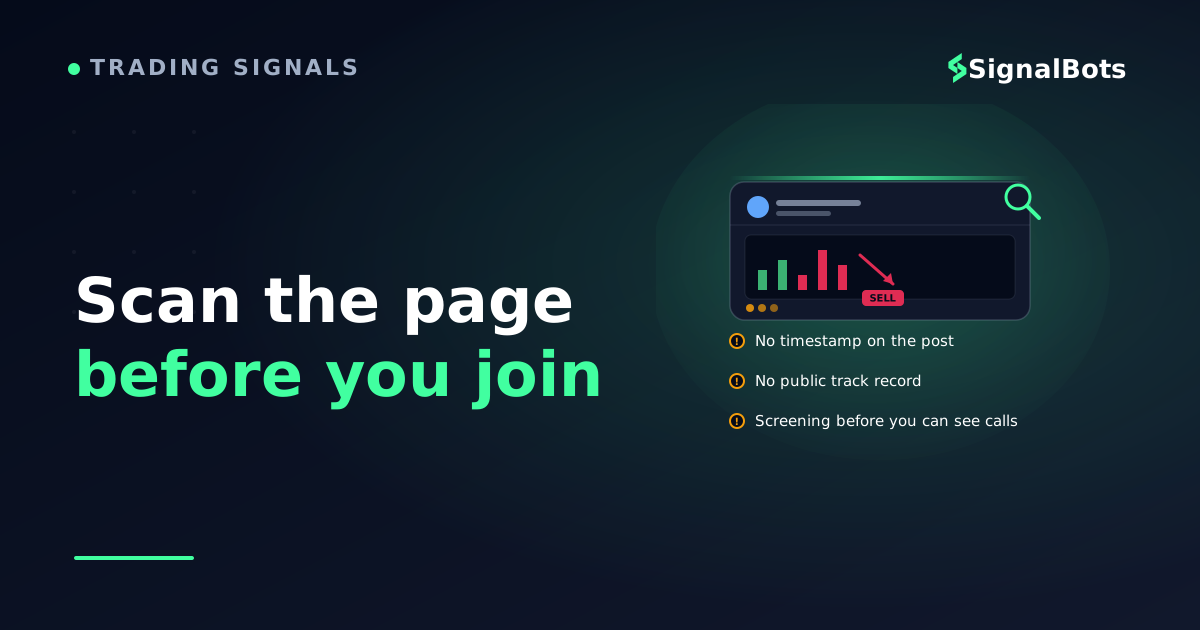
A public page is an open archive, so even its weaknesses are auditable from the outside. A private group inverts that: the join request usually arrives with screening questions — which broker you use, how much capital you are starting with — and those questions are rarely about fit, they are qualifying you as a lead. Video posts, reels and live sessions feel like the strongest evidence of the three and are the weakest, because a screen recording shows one trade, chosen after the fact, on an account you cannot verify is real money. The table below sets the three side by side on the checks that matter.
What to check
Public pages
Private groups
Video/reels
Visible before you join
Yes — full public archive
No — nothing until admitted
One clip, no history
Typical call frequency
Sparse, heavily promotional
Frequent, but invisible to outsiders
One trade per clip
Screening before you're in
None
Lead-qualifying questions
None — passive viewer
Who can warn others about it
Anyone scrolling can flag it
Only members already inside
Only the algorithm's other viewers
Public pages leave an audit trail; private groups and video clips don't.
A fourth pattern sits across all three: the comment funnel. The post itself contains no signal at all — it says "comment SIGNAL and I'll send it to you" or "DM me for today's calls". The public artifact is engagement bait; the actual conversation is designed to happen where nobody else can see it.
What does "free" actually get you here?
Free on Facebook is rarely free in the sense of "a working service, given away". It is a customer-acquisition surface, and the economics show up in the content itself. Expect some combination of:
Low call volume, high post volume. A handful of actual calls a week, surrounded by motivational posts, screenshots of profits, and recruitment.
Late delivery. Feed ranking, not chronology, decides when you see a post. A call for a 60-second expiry that reaches you nine minutes later is a stale signal — unusable regardless of whether the original idea was good. No social feed is built for the signal latency a short-expiry instrument needs.
An upsell. The free tier exists to sell a VIP tier, and the pitch is usually that the "real" calls are behind it. The broader trade-off between free and VIP signals is worth understanding on its own terms; on Facebook specifically, treat the free tier as an advertisement for the paid one, because that is what it is built to be.
A broker link. Very often access is conditional: open an account through the admin's referral link and deposit a minimum, and the signals become "free". That is not a free service; that is you paying a commission you cannot see, to a platform you did not choose.
None of that is automatically fraudulent. Affiliate-funded signal groups are a normal business model. But it does mean the incentive on the other side of the screen is your deposit, not your results — and that shapes everything else you will read on the page.
The red flags that show up on Facebook specifically
Every platform has scam patterns. Facebook's are distinctive because the platform is built around profiles — identity, photos, friends, testimonials — so the fraud built on it is identity fraud first and trading fraud second. These are the patterns that are visible from outside the group, before you have committed anything.
Fake trader lifestyle photos and fabricated testimonials
The classic setup is a personal profile rather than a business page: a young trader with rented-looking wealth — car keys on a laptop, a watch, a boarding pass, a hotel balcony — and a bio promising to teach you the same. The photos are frequently lifted from stock libraries or from unrelated real people's accounts. Under each post sit testimonials from accounts with no history, no mutual connections, and oddly similar phrasing. The lifestyle photos and testimonials on these pages are often borrowed, not earned.
Three checks cut through this quickly:
Open the Page transparency panel (or the profile's "About" details). A page created recently that has already changed its name several times, run by admins in a country unrelated to the audience it claims to serve, is telling you something.
Reverse-image-search one or two of the lifestyle photos. Borrowed identity collapses immediately under this test.
Click through the people leaving glowing testimonials. Real customers have ordinary, messy accounts with years of unrelated posts.
The same coordinated-hype machinery appears in other markets as a pump-and-dump scheme, where manufactured social proof moves a price rather than a signup. Recognising the machinery in one place makes it obvious in the other.
Unverifiable win-rate claims
A page claiming a very high historical win rate is not lying by definition — it is simply making a statement you have no way to test. Facebook posts can be edited, backdated in effect by posting results after the fact, deleted silently, or cherry-picked from a much larger set of calls. That is exactly the gap a verified track record is meant to close, and no Facebook page can produce one from inside Facebook. If a page's history contains only wins, you are not looking at a record; you are looking at a highlight reel, and the practice of backdating a track record is easy and undetectable on a social feed.
There is also an arithmetic tell. A win rate means nothing on its own for binary options, because your break-even point depends on the payout percentage the broker gives you. Suppose a hypothetical trader gets an 80% payout: every winning trade returns 0.8 of the stake, every loss costs the whole stake, so they need to win a bit more than 55% of the time just to stand still. A page advertising a big number while never mentioning payout, stake sizing or losing streaks is not talking about trading; it is talking about marketing. If you want to see where a claimed number would actually leave you, run it through a break-even win rate calculator instead of accepting the headline.
Break-even win rate calculator
The payout a broker pays on a win sets the win rate a page needs just to stand still — before any edge at all.
Broker payout
A claimed win rate
Break-even win rate
—
Edge above break-even
—
Move the payout slider and watch how far above break-even a claimed win rate really sits.
Genuine risk warnings are almost entirely absent from these pages, which is itself informative — regulated firms are required to carry them, and honest educators tend to volunteer them.
Being moved from the group into a DM or an unregulated broker link
This is the highest-signal red flag on the platform, because it is the step where a spectator becomes a victim. The sequence is consistent:
A friendly reply in the comments, then a private message — or a nudge to continue on WhatsApp or Telegram, where Facebook's reporting tools no longer apply.
A specific broker you must sign up with, through a specific link, "because the signals are calibrated to their platform". The firm is typically registered offshore and appears on no regulator's register.
An offer to help you place the first trades, sometimes via screen share or by asking for your login. Handing over account access to a stranger is the point of no return.
A profit balance that grows impressively on a dashboard you cannot withdraw from, followed by a fee to release it — a tax, a verification charge, an upgrade. This is the tell that the balance was never real; no legitimate platform charges you to hand back your own money.
Two structural points make this worse in binary options specifically. First, on many of these platforms your counterparty is the platform itself, so it profits directly when you lose. Second, retail binary options are banned or restricted in a number of major jurisdictions, which means the firms still marketing them to retail traders through social media are, by construction, operating outside those regimes.
How to check a page or group before you join
You can run this in about a minute, and you can run it on any page or group without joining, sending a message, or giving up an email address. The full sequence is in the checklist below; three of its steps carry most of the weight.
Search the archive for a losing call, honestly labelled — its complete absence is the most reliable negative in the whole check. Compare a post's timestamp against the session it names, because results-only posting is not signalling, however confident the caption sounds. Then trace where every call-to-action ends: a broker link, a private message, a paid tier, or nothing at all. If every road ends at a deposit, you already know what the product is.
Anything that survives the check still has to earn its place slowly. Log its calls yourself for a couple of weeks in a demo account and score them against what actually happened; your own log is the only track record on this platform you can trust.
One-minute pre-join check
0 / 7
Check the page's creation date and name history in Page transparency
Scroll the archive for at least one honestly labelled loss
Compare a call's timestamp against the expiry it names
Read ten comments, not just the top one, for empty or scripted accounts
Trace every call-to-action to see where it actually ends
Look up any named broker on a regulator's register and warning list
Paper-trade the calls in a demo account for two weeks before trusting them
★
Checklist complete — you’re cleared to proceed.
Run this on any page or group before you request to join — no signup required.
That routine is deliberately Facebook-shaped. A broader vetting checklist for signal sources across platforms — and the equivalent read on a Telegram signal channel, where delivery is chronological and the mechanics are different — belongs alongside this, not inside it.
Is a free Facebook signal group worth joining?
Honestly: as a source of trade decisions, almost never. Not because everyone posting there is a fraudster — some are ordinary traders sharing ideas — but because the platform cannot supply the two things a signal source has to have. It cannot deliver a short-expiry call fast enough to be tradable, and it cannot prove what it posted, when, or how it turned out. Even a genuinely skilled trader broadcasting through a Facebook page is handing you an unverifiable, late signal.
There is a narrower use that does hold up. Reading a couple of active groups teaches you how calls are worded, which pairs and sessions people trade, and what the marketing around this market sounds like — useful context, at zero cost, as long as you keep three lines intact: never deposit through a member's referral link, never move the conversation into a private message, and never trade a call you did not independently check on your own chart.
Treat the group as a place to observe the market's social layer, not as a service. The moment you find yourself waiting for someone else's post to decide a trade, the free group has become the most expensive thing in your process.
Where to go for a live signal feed instead
If what you actually wanted was to watch real calls and judge them for yourself, the fix is not a better Facebook page — it is a feed where each call is published openly with its context instead of as a screenshot after the fact.
That is what our live binary options signals feed is for: each call is shown with its asset, direction and expiry as it fires, free to view, with no join request, no DM funnel and no referral link standing between you and the history. Apply the same check you would apply to a Facebook page — scroll the calls, watch a session, keep your own score before you act on anything. Being able to run that check at all is the difference.
To be clear about the fit: it is a signal feed to evaluate, not a community. If what you want from Facebook is the discussion, the banter and other traders to talk to, a feed will not replace that, and you should keep looking for a group — just one you have checked properly first, the way you would check any live Facebook signal page.
Quick recap
Free binary options signals on Facebook are real in the sense that the pages and groups genuinely exist and genuinely post calls. They are unreliable in the sense that matters: the platform provides no delivery guarantee and no way to verify a claim, and the same profile-driven format is a well-documented vector for investment fraud.
Expect sparse calls, late delivery, an upsell, and a broker referral link somewhere in the funnel.
Watch for borrowed lifestyle photos, testimonial accounts with no history, win-rate claims with no payout context, and any push toward a private message or a specific offshore broker.
Check page age and name history, whether losses are ever posted, whether calls precede expiry, and where every call-to-action ends — before you request to join.
Never pay a fee to release a profit balance, hand over account credentials, or deposit through someone else's link because it unlocks "free" signals.
FAQ
Are free binary options signals on Facebook legit?
Some are ordinary traders sharing their own ideas; many are affiliate funnels; a meaningful share are outright fraud. The problem is that Facebook gives you no way to tell them apart from the content alone, because posts can be edited, deleted, backdated in effect and cherry-picked. Assume a page is unverified until your own log of its calls says otherwise.
Why do so many Facebook signal pages ask you to open a broker account through their link?
Because that link is how the page earns. Affiliate arrangements pay for the referral and, in some models, on your trading volume or losses. That is legal and common, but it means the person choosing the broker for you is paid by that broker — and it explains why the recommended platform is so often an offshore firm you have never heard of rather than one you can look up on a regulator's register.
Is a private Facebook group safer than a public page?
Usually the opposite. A public page leaves an archive strangers can audit; a private group's content is visible only to people who have already been screened and admitted, which is precisely the environment high-pressure pitches need. The join questionnaire is often lead qualification, not a filter for your benefit.
How can I verify a win-rate claim posted on Facebook?
From inside Facebook, you cannot. What you can do is convert the claim into something testable: ask what payout it assumes, what stake sizing it assumes, and over how many trades. Then log the page's next few weeks of calls yourself with timestamps and score them. A claim that dissolves when someone keeps score was never a measurement.
What should I do if I already sent money to a Facebook signal admin?
Stop paying immediately — especially any "release fee", "tax" or "upgrade" required to withdraw a balance, since that request is itself the confirmation the balance is not real. Contact your bank or card issuer about a chargeback, preserve every message and screenshot, report the profile and page to Facebook, and file a report with the financial regulator and fraud reporting body in your country. Be wary of anyone who then contacts you offering to recover your funds for an upfront fee; recovery scams target people who have already been defrauded once.
Sources & Further Reading
Want to go deeper? These independent, authoritative sources shaped this guide — each one is worth reading in full:
The Binary Options Desk is the SignalBots editorial team for fixed-time and OTC trading coverage. We research and write the guides that explain expiry timing, payout structure and disciplined entry across the major brokers.




Discussions 0
Leave a comment