You saw the claim in an ad, a forum thread, or an influencer's caption: make $100 a day trading crypto. Now you are about to fund an account, and you want to know whether that number is real before your own money is on the line.
The honest answer isn't a hype video or a doom warning. It's arithmetic. Below, you'll turn that flat dollar figure into the actual daily return your account would need, see why crypto's volatility makes the target riskier to chase than the same figure in forex or stocks, and understand the specific trap that turns "$100 a day" into a blown account.
Key Takeaways
$100 a day is possible, but the only number that matters is what $100 represents as a percentage of your account: 10% a day on $1,000 versus 0.4% a day on $25,000.
Crypto's wide daily swings make the same percentage target more volatile than in forex or stocks, so a single bad day can erase several good ones.
The real danger is the escalation trap: chasing a fixed dollar number pushes a small account into oversized risk after a losing stretch, accelerating toward ruin.
What actually correlates with reaching the target is enough capital, a tested edge with positive expectancy, disciplined per-trade risk, and a realistic timeline, not a bigger daily goal.
Table of Contents (22 min read)Contents
Can Crypto Trading Really Make $100 a Day?
Yes, crypto trading can make $100 in a day. Traders do it. But "can" and "reliably, every day, on a small account" are three very different claims, and the gap between them is where most beginners lose money.
Here's the reframe that changes everything: $100 is not a target, it's a percentage of your account in disguise. The same $100 is a trivial 0.4% on a $25,000 account and an almost impossible 10% on a $1,000 account. Until you know your account size, the dollar figure tells you nothing about how hard the goal actually is. So before anything else, let's find your real number.
How Much Capital You'd Actually Need
The math is simple division: your daily target divided by your account size is the return you need to earn every single day. Plug in your own figures and watch what the target really asks of you.
Run your own numbers
What $100 a day really asks of your account
Enter your account size and daily target to see the return you'd need every trading day, and what that pace would pay in a month.
Account size
$
Daily profit target
$
Return needed every day
—
Income at that pace (22 days)
—
The same $100 target is a rounding error on a large account and a daily miracle on a small one.
Notice the second number too. A $1,000 account clearing $100 a day would compound into a professional-grade monthly income, which is exactly why that pace is a fantasy, not a plan. Consistent double-digit daily returns would make you the best trader alive within a year. No one does it, because the moment your account grows, the same dollar target becomes an easier percentage, and the early, tiny-account phase is precisely when the percentage is most brutal.
Why Small Accounts Need Impossible Daily Returns
Stack the tiers side by side and the problem is impossible to unsee. As the account shrinks, the required daily return doesn't creep up, it explodes.
A $500 account needs a 20% daily return to make $100; a $25,000 account needs 0.4%. The target's difficulty is set almost entirely by your capital.
A seasoned discretionary or systematic trader might target a low-single-digit percentage return on a good day and be thrilled with it. Asking a $500 account to produce 20% daily isn't ambitious, it's mathematically detached from how markets behave. The takeaway isn't "give up", it's that the honest lever is capital, not effort: the same skill applied to a larger, well-managed account turns $100 a day from a miracle into a modest, defensible goal.
Before you size a single trade toward that goal, it helps to work out how much of your account each position should risk. A crypto position-size calculator turns your risk rule into an exact coin quantity so the target never tempts you into an oversized bet.
Why Crypto's Volatility Changes the Math
Every generic "$100 a day" guide borrows a capital table from stock or forex day trading and pastes the word crypto on top. That's the flaw. Crypto's daily ranges are far wider than a major currency pair's, and wider swings cut both ways.
A bigger range means your good days can be bigger, which is the part the ads sell. But it also means your bad days are bigger, your drawdown is deeper, and the variance around your average is enormous. A target that looks smooth on paper ("just 2% a day") arrives in reality as a jagged sequence: +9%, -6%, +1%, -11%, +7%. The average might even work out, but the path can bankrupt you before the average ever pays.
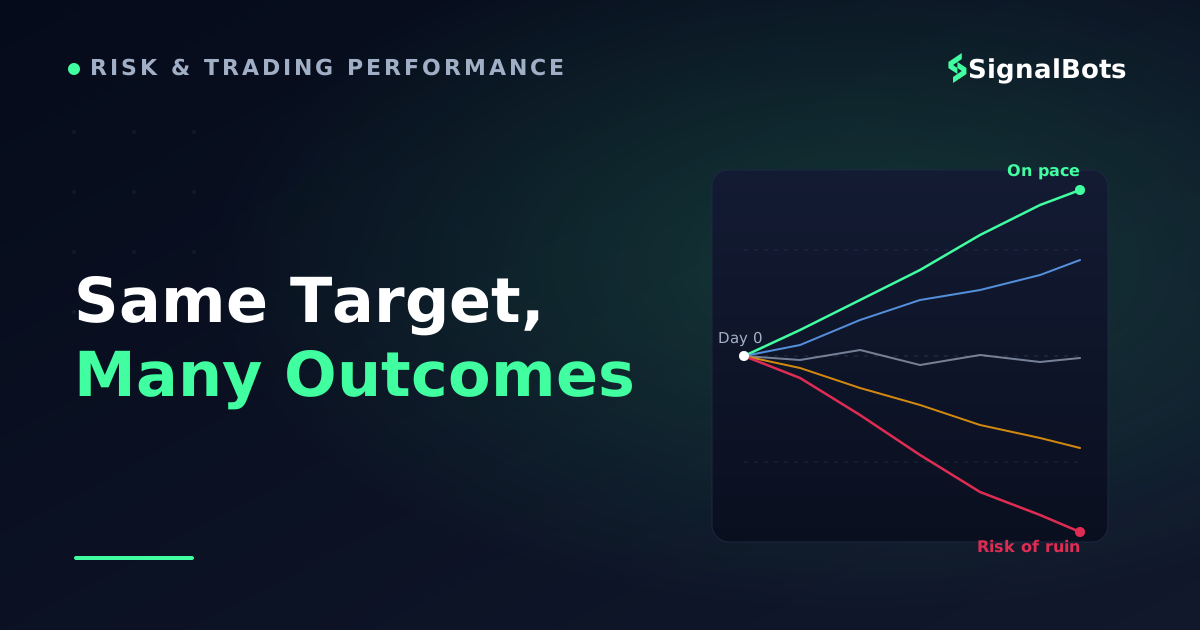
This is why the same percentage target is genuinely riskier to chase in crypto. Run one realistic edge across hundreds of possible sequences and the outcomes fan out into a wide cone, not a straight line, and the bottom of that cone is where accounts hit risk of ruin.
200 equity paths from a single crypto edge
10th–90th percentile bandMedian pathBreak-even
Median return
—
final equity, all paths
Profitable paths
—
finished above start
Worst drawdown
—
deepest peak-to-trough
Risk of ruin
—
hit −30% equity
Same edge, same rules, 200 possible futures. Some paths reach the target comfortably; others are wiped out early. The wider the swings, the wider this fan, and the more paths end in ruin.
Press Run a few times. Nothing about the strategy changes, yet some accounts thrive and others are gone. That spread, not the average, is the real cost of chasing a fixed daily number in a high-volatility market, and it is exactly the part every borrowed table leaves out.
The Trap: How Chasing a Fixed Daily Number Blows Up Small Accounts
Here is the mechanism that actually blows up accounts, and it has nothing to do with picking bad coins. It's a feedback loop triggered by the fixed dollar goal itself.
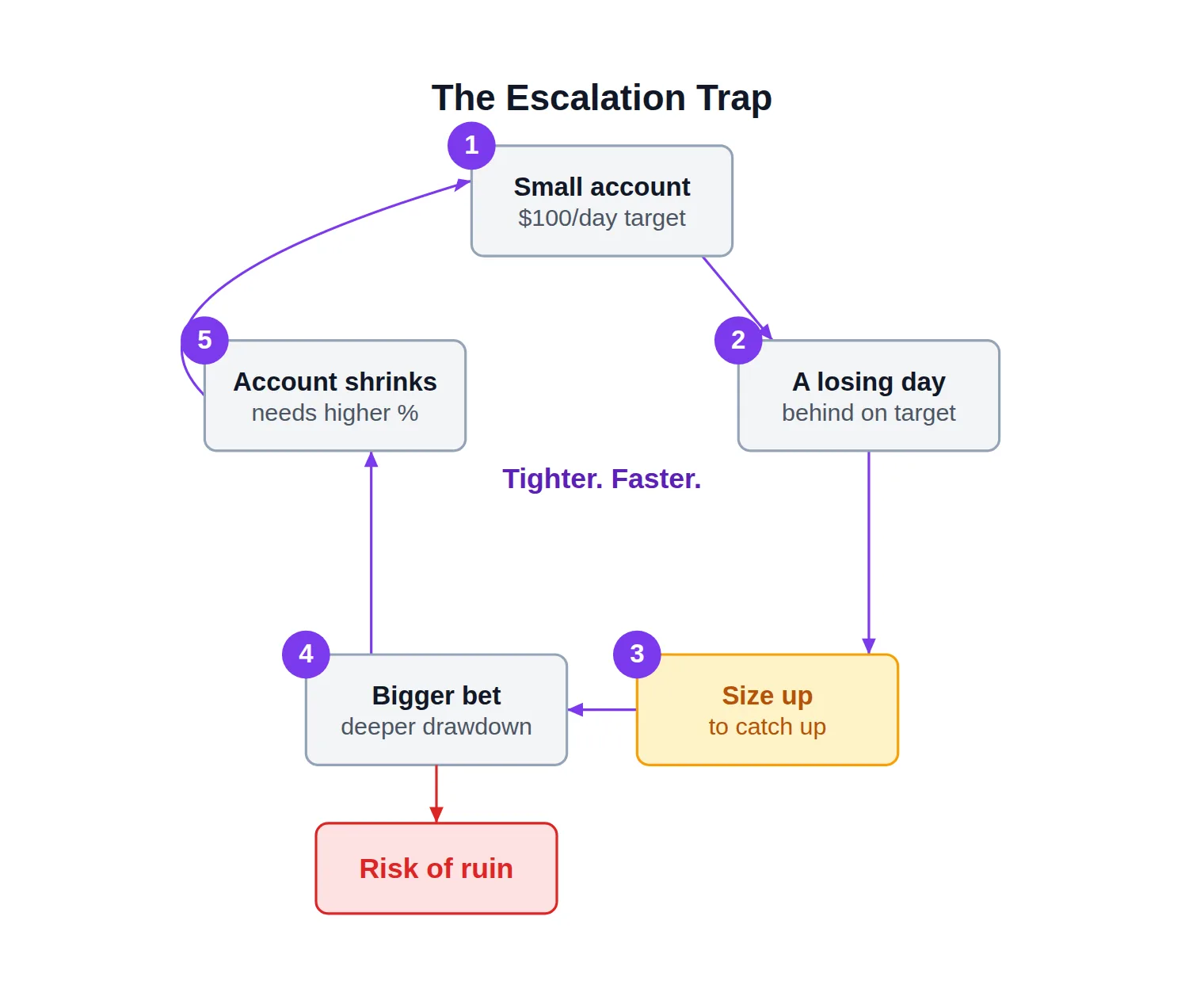
Suppose you set out to make $100 today and, by the afternoon, you're down $80. A fixed dollar target quietly turns into pressure: to "get back to $100" you now need to win $180, so you increase your position sizing to catch up. The bigger position deepens the next loss, the account shrinks, and a smaller account needs an even higher percentage to make the same $100. Each turn of the loop makes the next one worse.
The escalation trap is a cycle: each losing day pushes bigger bets on a smaller account, accelerating toward ruin.
That's the escalation trap: a small account, a fixed dollar goal, and a losing stretch combine into ever-larger bets on a shrinking balance, which is the fast lane to ruin. It's worth seeing the downside concretely. Imagine an $800 account riding a five-day losing streak while the trader sizes up each day to "make it back": a string of down days doesn't just dent the balance, it raises the percentage climb needed to recover, and you can run the recovery math yourself to see how a 25% drawdown already demands a 33% gain just to get back to even.
Breaking the loop comes down to managing risk so a daily income target doesn't blow up the account: risk a fixed, small percentage of your balance per trade rather than a fixed dollar figure, and let the daily P&L land where it lands. The trap only has power over a trader who has promised themselves a number the market never agreed to.
What a Realistic Path to $100/Day Actually Looks Like
So what actually correlates with reaching $100 a day sustainably? Not a bigger goal or a secret indicator. Four unglamorous things:
Enough capital. As the chart above showed, the target's difficulty is set by account size first. A well-funded account turns $100 a day into a sane percentage; a tiny one guarantees you'll take reckless risk to chase it.
Disciplined per-trade risk. Percentage-based risk, not dollar-chasing, is what keeps a losing streak survivable instead of terminal.
A realistic timeline. Capital compounds and skill accrues over months and years, not over a hyped "first week."
One more thing every borrowed table ignores: costs. Competitors point to scalping as the fastest route to $100, which quietly means dozens of small trades a day, and each one pays a spread, an exchange fee on both the entry and exit, and some slippage on the fill.
What one small scalp really costs (round turn)
Spread
Exchange fees (in + out)
Slippage
0All-in cost
Spread0.4 USD
Exchange fees (in + out)1.0 USD
Slippage0.6 USD
Total cost per trade— USD
Illustrative cost of a single small scalp. Run 50 of them a day chasing the target and roughly $100 evaporates in costs alone, before a single winning edge is counted.
Those costs are not a footnote. On a scalping-heavy path, the fee drag can equal the very target you're chasing, which means your edge has to first clear a $100 hole before it earns your first real dollar. A slower, higher-quality approach with fewer trades often nets more precisely because it stops bleeding out in costs.
Seeing Real Reward-to-Risk Numbers Before You Chase the Target
After all this math, the natural next question is: what do real numbers even look like? The illustrative figures above make the shape of the problem clear, but you shouldn't take any single number, ours or an influencer's, on faith.
Our free live crypto signals page publishes each call's real-time reward-to-risk ratio and its historical win rate, so you can look at concrete, live numbers alongside the illustrative math here instead of guessing.
Reading how an actual trading signal states its entry, stop, and target, and seeing the reward-to-risk it implies, is a grounded reference point for judging whether any claimed daily-income figure is even plausible. You can browse those numbers on our live crypto signals feed.
One honest boundary: that feed is a signal source you size and execute manually. It doesn't run the capital math from this article for you, it doesn't manage your account, and it isn't a hands-off bot that guarantees a daily figure, so any signals or performance stats you read come with the usual risk warning. It's a way to see real reward-to-risk data, not a shortcut to $100 a day.
The Bottom Line
Can crypto trading make $100 a day? Yes, but not as a fixed promise on a small account. The number was never really $100, it was the percentage of your capital that $100 represents, and on a small balance that percentage is high enough to force the exact risky behavior that blows the account up.
Throw away the flat dollar goal. Fund an account you can size sensibly, prove you have an edge before you trade it, risk a small fixed percentage per trade, and let a realistic daily figure emerge from good process rather than chasing a number the market never agreed to. Reached that way, $100 a day stops being a trap and starts being a byproduct.
FAQ
Can you make $100 a day trading crypto with $500?
Mathematically, $100 on a $500 account is a 20% daily return, a figure no consistent trader sustains. You'd have to take enormous risk per trade to have any chance, which is exactly what leads to a blown account. A $500 balance is better treated as a learning account with a tiny dollar goal, not a $100-a-day income machine.
How much money do you need to make $100 a day in crypto?
There's no single answer, because it depends on the daily return you can realistically and repeatedly earn. If a disciplined trader targets roughly 1% on a good day, $100 a day implies an account around $10,000, and even that assumes a genuine, tested edge. The larger and better-managed the account, the saner the required percentage.
Is crypto day trading a reliable income?
For the vast majority of people, no, at least not early on. Crypto's high volatility means results arrive as a wide spread of outcomes rather than a smooth paycheck, and costs eat into every trade. Treating it as reliable income before you have both capital and a proven edge is what turns trading into gambling.
Do trading fees really matter for a $100/day target?
Enormously, especially on a scalping-heavy path. When your plan is dozens of small trades a day, spreads, exchange fees on both sides, and slippage stack up quickly, and the total can rival the $100 you're trying to make. An edge that ignores costs is an edge that loses money in practice.
Sources & Further Reading
Want to go deeper? These independent, authoritative sources shaped this guide — each one is worth reading in full:
The Crypto Desk is the SignalBots editorial team behind our digital-asset coverage. We research and write the guides and explainers on spot and perpetuals, exchange mechanics, funding rates and the 24/7 structure that sets crypto apart from every other market.



Discussions 0
Leave a comment