Your phone buzzes on the desk. The text reads EUR/USD — CALL — 5 min expiry. You unlock, switch to your broker, and the candle the alert was talking about has already closed. The call was correct. Your entry was late.
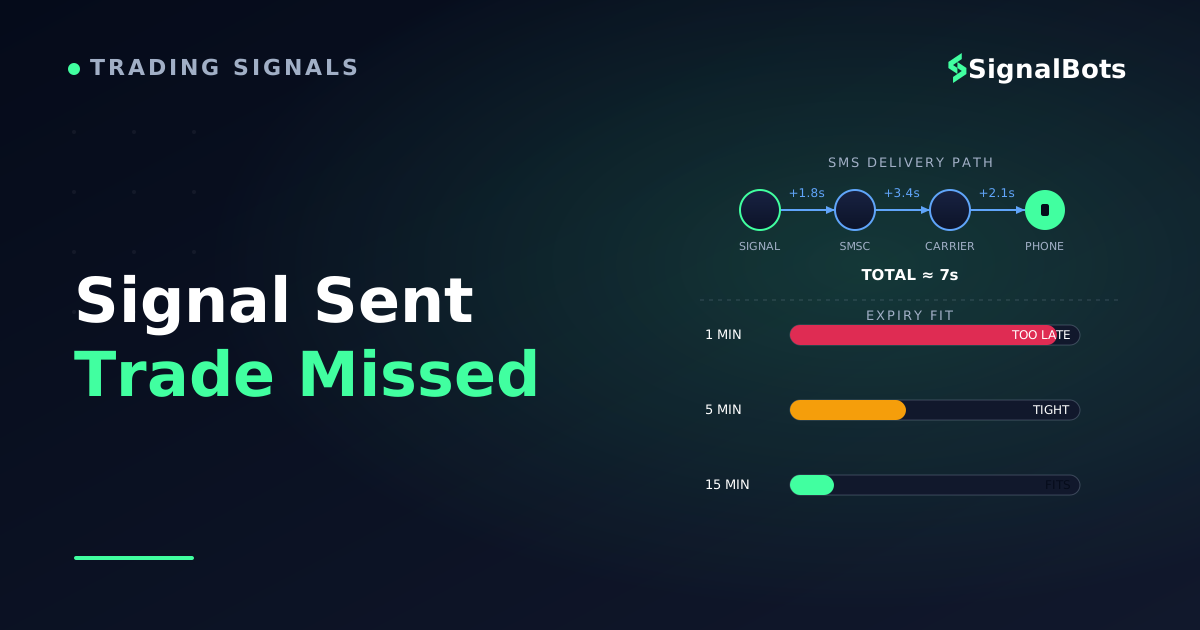
That gap — between the moment a signal fires and the moment it lights up your lock screen — is the entire story of SMS as a delivery channel. Almost every provider that offers binary options signals by SMS describes it as "instant". Almost none of them tell you what "instant" means once the message leaves their server, or what happens to it on the four or five hops that follow. This page fills that gap: how an SMS signal is actually routed, how much delay each hop adds, why some texts never arrive at all, how to opt in and out cleanly, and — the part that decides everything — which expiry lengths SMS can realistically support. Five hops sit between "sent" and "delivered" — and each one can add delay you never see.
Key Takeaways
SMS is a store-and-forward channel, not a live one: the sender queue, the aggregator and your carrier's message centre each add delay you never see.
A direct gateway route usually lands in seconds; an email-to-SMS bridge can take many minutes, and the major North American carriers are retiring those bridges.
Measure your own worst-case arrival lag with timestamped alerts, then let it set the shortest expiry you will trade off a text.
Keep a faster IP-based channel as your primary and SMS as the failover, so a data outage and carrier filtering can't blind you at once.
Table of Contents (20 min read)Contents
What SMS Signal Delivery Actually Is (and Isn't)
SMS is worth understanding as a store-and-forward system rather than a live connection. Your handset does not hold an open session waiting for a message. A message is handed to your carrier's message centre, which stores it and forwards it to your phone when the network says your phone is reachable. That design is why a text sent while your phone was off in a drawer still lands the second you power it up — and it is the same design that makes SMS a poor fit for anything measured in seconds.
Compare that with the two channels you are implicitly choosing between when you pick SMS as your delivery channel:
App push — an IP message delivered over a live connection your phone maintains with a push service. Fast, but it needs data and it dies when the operating system kills the app or the device drops off Wi-Fi. See how a push notification alert is triggered and what can suppress it.
Telegram (or another messaging app) — also IP-based, with the same data dependency, but with a delivery history you can scroll back through and no per-message cost. Choosing between Telegram channels themselves is a separate question with its own vetting criteria.
SMS — carrier-based, no data connection required, no app required, works on a decade-old handset and on a weak 2G signal in a rural area.
That last line is the only honest reason to choose SMS, and it is a genuinely good one. If you trade from a region with unreliable mobile data, if your phone is a basic handset, or if you want a binary options signal to reach you when every data-dependent channel has failed, SMS is the channel that still works. What SMS is not is real time. Treat it as the slowest of the common channels and you will size your trades correctly; treat it as instant and the market will correct you.
How SMS Signals Get Routed to Your Phone
A signal text does not travel from your signal provider to your phone. It travels through a chain, and every link in that chain has its own queue.
The provider's own system decides a setup qualifies and creates the alert. This part is usually the fastest — milliseconds.
The messaging platform or aggregator accepts the message over an API and queues it for sending. Business senders have throughput ceilings here; a broadcast to a large subscriber list goes out in sequence, not all at once.
The upstream carrier accepts the message from the aggregator. Note the wording — accepted, not delivered. This is where a provider's dashboard usually stamps "sent".
The recipient's message centre stores the message, looks up where your handset currently is on the network, and attempts delivery. If your phone is off, out of coverage or roaming, it holds the message and retries.
Your handset receives it and rings, buzzes, or stays silent because you have Do Not Disturb on.
The practical takeaway from that chain is a distinction most traders never make: "sent" is not "delivered." Messaging platforms track those as separate states, and a provider showing you a timestamped send log is showing you hop three, not hop five. If a provider tells you their alerts go out at the close of the candle, they are describing when they handed the message off — not when your phone lit up.
Direct SMS gateway vs. email-to-SMS bridge
Two very different routes hide behind the same phrase "SMS alerts", and which one your provider uses determines the delay you personally experience.
A direct SMS gateway means the provider sends through a proper messaging platform onto the carrier network — a registered business sender, an alphanumeric sender ID or a short code, and delivery receipts coming back. This is the fast route.
An email-to-SMS bridge means the provider emails yournumber@carrier-gateway-domain and lets the carrier convert that email into a text. It costs the provider nothing, which is exactly why cheap and free alert services use it. It also means your trading signal now travels through the entire email stack first: outbound mail queues, greylisting, spam scoring, retry timers. Mail systems are designed to retry politely over minutes; an alert stuck in a retry loop can arrive long after the trade it described is finished. Worse, the major North American carriers have been retiring these free bridges, so an alert feed built on one can stop working entirely without a word of warning.
Two very different routes hide behind the same phrase 'SMS alert'
sequenceDiagram
    autonumber
    participant Provider
    participant Aggregator
    participant Carrier
    participant Handset
    alt Direct gateway
        Provider->>Aggregator: Send via API
        Aggregator->>Carrier: Registered A2P route
        Carrier->>Handset: SMS delivered
        Note over Provider,Handset: Seconds, receipt confirmed
    else Email-to-SMS bridge
        Provider->>Aggregator: Email to carrier gateway
        Aggregator->>Carrier: Mail relay, retries queued
        Carrier->>Handset: SMS delivered eventually
        Note over Provider,Handset: Minutes or never, no receipt
    end
A direct gateway confirms delivery in seconds; an email-to-SMS bridge queues through mail retries and can arrive minutes later, or not at all.
You can usually tell which route you are on from the message itself:
A short code or a branded alphanumeric sender, no subject-line junk, and the ability to reply STOP → direct gateway.
A message that arrives with an email-style header, a subject line jammed into the body, or a sender that looks like an address rather than a number → email-to-SMS bridge.
No delivery confirmation available from the provider at all → almost certainly a bridge, or an unregistered route.
Ask the provider directly which one they use before you subscribe. A provider who cannot answer that question is not measuring their own delivery, which tells you what their latency guarantees are worth.
How Fast Does an SMS Signal Really Arrive?
There is no single number, and any provider quoting you one is quoting the best case. What there is instead is a set of bands, and knowing which band you are in is the useful skill. Think of signal latency on SMS in three tiers:
Seconds — a registered direct route, a domestic number, a phone that is on and in good coverage, off-peak. This is the case everyone advertises. A few seconds from fire to buzz is realistic here.
Tens of seconds to a couple of minutes — the same route under load: a large subscriber broadcast being metered out, an international leg, a roaming handset, or a carrier applying spam scoring before it lets the message through.
Many minutes, or never — an email-to-SMS bridge, an unregistered business sender being filtered, a message caught by content filtering, or a handset that was out of coverage when the message centre first tried.
Notice that you can be moved between those tiers without changing anything on your end. A provider that grows its subscriber list, switches messaging vendors to cut costs, or starts putting a link in every alert can push you from tier one to tier three overnight.
Which is why the only number that matters is your own. Measure it: ask the provider to include the signal's fire time inside the message text, then compare that stamp against the arrival time your phone records, ten or fifteen times, spread across the sessions you actually trade and including at least one busy news period. The spread you get — not the average, the worst case — is the number you plan around.
What causes the delay
Each of these adds independently, and they stack:
Sender-side throughput limits. Business SMS senders are rate-limited. A signal fanned out to a large list is sent in sequence, so your position in the queue decides your delay — and the person who joined before you gets the trade earlier. This is the same mechanism as signal throttling, applied by the network instead of the provider.
Aggregator routing. Wholesale messaging is routed by cost as well as quality. A cheap route may hop through additional intermediaries, drop the sender ID, or return no delivery receipt at all.
Carrier filtering. Networks score inbound business traffic for spam. Trading vocabulary is unlucky here: words like profit, win, CALL/PUT and — above all — shortened links are exactly the pattern filters are tuned to catch. A filtered message is delayed for review or silently dropped.
Store-and-forward retries. Phone off, in a lift, on a plane, or briefly out of coverage? The message centre holds and retries on its own schedule, not yours.
International interworking. Cross-border messages traverse more networks, and quality varies by corridor. A provider in one country texting subscribers in twenty others does not have one latency figure; it has twenty.
Your own handset. Do Not Disturb, focus modes, notification grouping and battery-saver settings can all delay the moment you notice a message that technically arrived on time.
When a Late SMS Turns a Winning Setup Into a Loss
Here is the arithmetic that no generic SMS-alerts page performs, because no generic SMS-alerts page is written for someone whose trade is over in five minutes.
Suppose a provider fires an alert at 14:00:00 for a five-minute expiry time — the call is that price will be higher at 14:05:00. The text is queued behind a broadcast, routed internationally, and lands on your lock screen at 14:01:40. You are away from the desk; you see it at 14:02:20 and place the trade at 14:02:40.
Two separate things just went wrong.
The window shrank. If the expiry is a fixed clock time, you have not bought a five-minute trade — you have bought a two-minute-twenty trade, because the expiry timestamp did not wait for you. Less than half the move the analysis was predicated on is still ahead of you.
The entry price moved. If instead the expiry is a fixed duration from your entry, you get your full five minutes, but you enter nearly three minutes into the move the signal was reading. You are buying after the displacement the setup was built on, which is precisely the situation where a call that would have finished in the money finishes out of it. The signal was right. Your fill was wrong.
The arithmetic no generic SMS-alerts page performs
14:00:00 — Signal fires
Provider sends a 5-minute CALL alert for EUR/USD.
14:01:40 — Text arrives
Queued behind a broadcast and routed internationally before it lands.
14:02:40 — Trade placed
Nearly three minutes of the move already happened without you.
14:05:00 — Expiry
The clock the analysis was built on is already up.
A 100-second delivery delay eats nearly half of a 5-minute expiry — the window shrinks or your entry moves, and either way the setup you saw is not the setup you traded.
Both failures are the same defect wearing different clothes: you acted on a stale signal without knowing it was stale. Two habits fix it:
Enforce an age check. Only trade an alert that carries its own fire timestamp, and set a personal rule — for example, discard anything older than a fixed fraction of the expiry. If more than a quarter of the window is already gone by the time you read the text, skip it. The discipline of skipping is cheaper than the trade.
Set an expiry floor from your measured worst case. If your worst observed SMS arrival is around two minutes, five-minute expiries are not viable on this channel and one-minute expiries are not a conversation. Give the expiry enough room that your delay is a rounding error rather than a third of the trade.
Country and Carrier: Where SMS Quietly Fails
Delay is the visible failure. The invisible one is worse: messages that are accepted, billed and reported as sent, and simply never reach a handset. Where you live changes how likely that is.
Delivery quality varies by corridor and by operator. Some networks strip alphanumeric sender IDs and replace them with a random number, which breaks the sender-based filtering rules you set on your phone. Some return no delivery receipts, so the provider genuinely cannot tell you whether the alert arrived. Roaming adds a leg and a set of agreements that can slow or block business traffic. If you trade while travelling, assume your SMS feed behaves like a different channel abroad than it does at home — and verify it with a test message before you rely on it.
The US/Canada carrier-blocking problem
North America is the sharpest case, and it catches traders out constantly. US carriers now require business senders to register the brand and the campaign behind their application-to-person traffic before they will carry it reliably. Unregistered traffic on ordinary long-code numbers is filtered heavily or blocked outright — not delayed, blocked. Canada applies its own tightened rules on the same commercial traffic.
For you as a subscriber, three consequences follow:
A small or offshore signal provider may simply have no working route to a US or Canadian number. They may not know this, because a blocked message can still be reported as accepted upstream.
Financial and trading content attracts extra scrutiny. Carriers police this category hard, because it is heavily abused. Legitimate alerts get caught in the same net.
The free email-to-SMS bridges that offshore providers fall back to are being switched off by the major North American carriers, which is exactly the workaround such a provider is most likely to be using.
If you are on a US or Canadian number, ask the provider one specific question before paying: is your sending number registered for application-to-person messaging on US carriers? A vague answer means the honest expectation is intermittent delivery, and you should plan on a different primary channel.
How to Opt In (and Opt Out) of SMS Signals
Unlike app push, SMS is regulated consent territory — the provider needs your express permission and must give you a way to withdraw it. That cuts both ways: the process is slightly more work to set up, and considerably more reliable to escape.
Opting in cleanly:
Enter the number in full international format — country code, no leading zero, no spaces (+441234567890). The single most common setup failure is a locally-formatted number that routes nowhere.
Complete the verification step. A legitimate service texts you a code and will not activate the feed until you return it. That step exists to prove the number belongs to you, and its presence is a small signal that the provider is on a compliant route.
Send yourself a test alert and time it. Do this before you need it, and again from any country you travel to.
Set the frequency and quiet hours if the provider offers them. Every alert you do not want is a message competing for throughput with one you do.
Save the sender in your contacts so your phone treats it as known and your own spam filters leave it alone.
Check what else you agreed to. Note whether opting in also enrols you in marketing texts, and whether your number is shared with third parties — that clause is where a signal subscription turns into a stream of cold calls from unregistered "brokers".
Opting out cleanly:
Reply STOP to the sender. On a compliant route this is honoured automatically and you should get one confirmation message and nothing after it. HELP returns the sender's contact details. Localised keywords exist on some routes; STOP is the safe default.
Understand that STOP is per-sender, not global. If a provider sends from multiple numbers or short codes, you must stop each one. Unsubscribing in your account dashboard as well is the belt-and-braces move.
Treat a STOP that is ignored as a verdict on the provider. Messages continuing after a proper opt-out mean either a non-compliant route or an operator who bought your number rather than earning it. Block the sender at the handset or carrier level, and report it to your national telecoms regulator.
Never send STOP to a text you did not sign up for. Replying to an unsolicited blast confirms your number is live. Block and report instead.
That last point deserves weight. Unsolicited "hot signal" texts pushing a binary options platform are a well-documented recruitment channel for fraud, and the aggressive follow-up is the point of them. A signal service you found and subscribed to is a different thing from one that found you. If you are still deciding which communities and providers to trust, that vetting deserves its own checklist before any phone number changes hands.
A Faster Live Feed as Your Backup
Once you have measured your own SMS delay, the sensible architecture stops being "pick the best channel" and becomes redundancy: a fast primary channel that you actually trade from, plus SMS as the failover delivery path that catches you when the fast one is unavailable. Same signals, two routes, different failure modes — data outage kills the first, carrier filtering kills the second, and they rarely fail together.
For the primary route, that means something that carries the signal over an IP connection rather than a carrier queue. Our own binary options signal feed is one option for that slot: signals are pushed to the dashboard within milliseconds of forming, and because the path never touches an SMS gateway, none of the delays described above apply to it. You can see the same thing this article has been teaching — a signal's fire timestamp, its direction, its expiry — rendered at the moment it exists rather than after a queue has had its way with it, which is also the cleanest way to measure exactly how far behind your SMS copy of the same alert is running.
The boundary is honest and it is the reason this article is not simply telling you to abandon SMS: a live feed needs an internet connection and a browser or app. If your whole reason for wanting texts is that you do not reliably have one — a basic handset, a low-coverage region, a relative you are setting this up for — then SMS or a messaging app remains your channel, delay included, and the right response is to lengthen your expiries rather than to switch.
Is SMS the Right Channel for Your Trading Style?
The verdict is not "SMS is bad." It is that SMS is a notification channel that some traders mistake for an execution channel.
SMS works well for:
Longer expiries — end-of-day, multi-hour, and daily-close binaries, where a delay of a minute or two is immaterial.
Position-level and account-level alerts: an approaching expiry, a filled trade, a risk limit hit.
A "go look at the platform" nudge rather than a trade-this-now instruction.
Low-connectivity and no-data situations, where it is not the best channel — it is the only one.
A redundant second channel behind a faster primary.
SMS fails for:
Sixty-second and five-minute expiries. The delay is a material fraction of the trade.
Any strategy where entry price matters more than direction, since you are entering after the move has started.
US and Canadian numbers served by a provider with an unregistered sending route.
Any feed where you cannot verify the message's fire time, because then you cannot tell a fast alert from a stale one.
Decide it with a measurement, not a preference. Time your own alerts, take the worst case rather than the average, and let that number set the shortest expiry you are willing to trade off a text. Then keep the discipline that follows from it: an alert that arrives outside your window is not a trade you take late — it is a trade you skip. Whatever channel carries them, signals are probabilistic and every binary position risks the full stake, so read our risk warning and size accordingly.
FAQ
Can I trade 60-second binary options from SMS alerts?
Realistically, no. Even on a good direct route the message passes through a sender queue, an aggregator and your carrier's message centre before it buzzes, and you still need time to read it and place the trade. On a sixty-second expiry that overhead is most of the trade. If a provider markets SMS specifically for turbo expiries, ask them for the delivery latency they measure at the handset, not the send time from their server.
Why does the Telegram copy of a signal arrive before the SMS copy?
Because they take different roads. A Telegram signal channel message travels over an IP connection your phone already holds open, while the SMS copy is handed to a messaging platform, queued against a throughput limit, passed to a carrier, filtered, and only then forwarded to your handset. Seeing both is actually useful: the gap between them is a free, continuous measurement of your personal SMS delay.
How do I tell whether my provider uses an email-to-SMS bridge?
Look at the sender and the shape of the message. A branded alphanumeric sender or short code, a clean body, and a working STOP reply point to a direct gateway. An email-style header, a subject line stuffed into the message body, or a sender that reads like an address point to a bridge. If in doubt, ask whether the provider can show you delivery receipts — bridges generally cannot produce them.
Does replying STOP unsubscribe me from every trading text?
No. STOP applies to the sender number or short code you replied to, so a provider using several numbers needs several STOPs. Unsubscribe in your account settings as well, and if messages continue after a correct opt-out, block the sender at the handset or carrier level and report it — a route that ignores STOP is not a compliant route.
Do SMS signals work without a data connection?
Yes, and that is the channel's real advantage. SMS rides the carrier's signalling network rather than mobile data, so it reaches a phone with no data plan, no Wi-Fi and no app installed, and it will queue and deliver once a phone that was switched off comes back into coverage. The trade-off is exactly the delay this article describes — buy the reliability, but pay for it with longer expiries.
Sources & Further Reading
Want to go deeper? These independent, authoritative sources shaped this guide — each one is worth reading in full:
The Binary Options Desk is the SignalBots editorial team for fixed-time and OTC trading coverage. We research and write the guides that explain expiry timing, payout structure and disciplined entry across the major brokers.




Discussions 0
Leave a comment