A PAMM account lets many people fund one account that a single professional trades, then splits the outcome by ownership share.
You keep seeing the term PAMM account next to forex brokers and managed-money offers, and the pitch always sounds the same: hand your capital to a professional trader and let them do the work. That is the promise — but it tells you nothing about the mechanic. Who actually holds the money? How does one trade become your gain or loss? What does the manager get paid, and what happens when they lose? This page answers exactly that, from the plumbing up, so you can tell a real PAMM structure from a repackaged pitch before any of your money is involved.
Key Takeaways
A PAMM account (Percentage Allocation Management Module) pools money from many investors into one master account that a single manager trades — profit and loss are split back by each person's percentage of the pool.
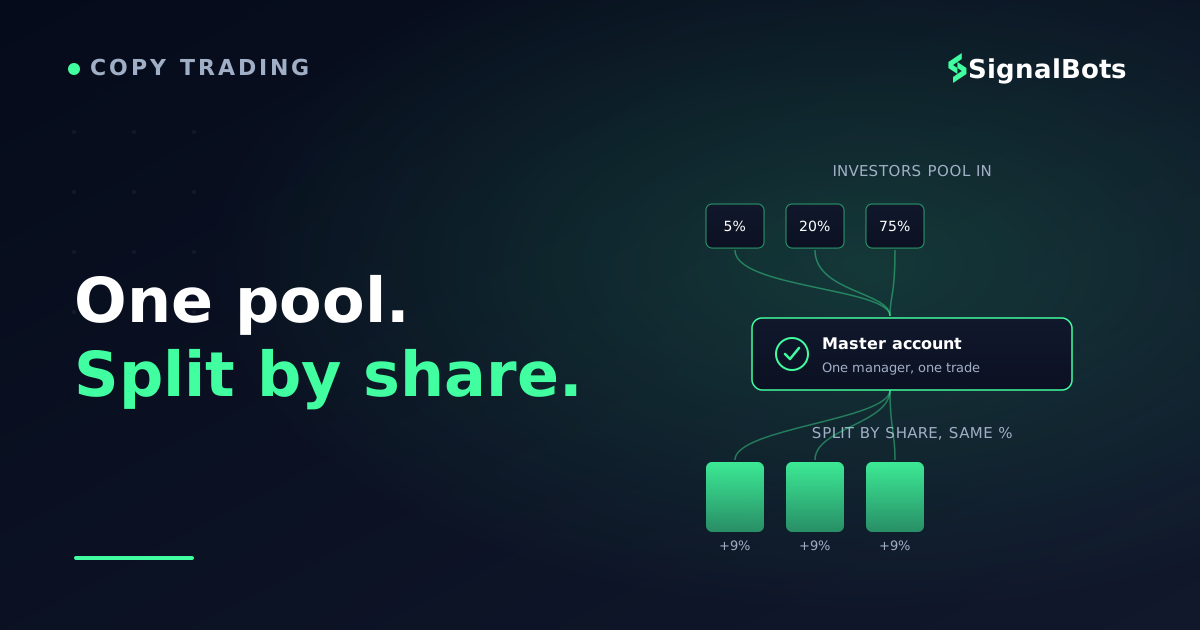
The manager trades once on the pooled capital; the platform then allocates the result proportionally, so a $1,000 investor and a $100,000 investor ride the exact same percentage return.
The manager earns a performance fee on profits, usually gated behind a high-water mark so they only get paid on genuinely new gains — not on recovering a loss.
PAMM is hands-off pooled money management, which is a different trade-off from copy trading: you get one clean fill but zero control over individual trades, so manager risk and drawdown are the numbers that matter most.
Table of Contents (23 min read)Contents
What a PAMM Account Actually Is
PAMM stands for Percentage Allocation Management Module. Strip away the jargon and it is one idea: a pool of money from many investors, traded through a single account by a single manager, with the result divided back out by each investor's percentage of that pool.
There are three parties, and keeping them straight is most of the battle:
The manager (sometimes called the master or money manager) — the professional trader who runs the strategy. They usually put their own capital into the pool too, so they have skin in the game.
The investors — the people who deposit money into the manager's pool without trading themselves. You are almost always here.
The broker — the venue that hosts the PAMM software, holds the money, executes the master account's trades, and does the proportional accounting automatically.
The defining feature — the one that separates PAMM from every look-alike — is pooling. Your money is not sitting in your own account being traded on your behalf. It is combined with everyone else's into one master account, and the manager trades that single combined balance. You own a slice of the pool, not a private position.
A quick analogy: think of a PAMM account like a shared investment pot at a table. Ten people each drop cash into one pot. One appointed player makes the bets for the whole pot. When the pot grows or shrinks, each person's share grows or shrinks by the same percentage — the person who put in $1,000 and the person who put in $100,000 both earn the identical rate of return, just on different amounts.
How the Pooling Actually Works, Step by Step
Here is the full lifecycle of money moving through a PAMM account, from the moment a manager sets it up to the moment your profit lands.
The manager opens a master account at a PAMM-enabled broker and deposits their own capital first. That personal stake is what aligns them with you — if the account bleeds, they bleed too.
Investors join the pool. You deposit into the manager's PAMM offer through the broker. At the instant you join, the software records your deposit as a percentage share of the total pool. Deposit $5,000 into a pool that now totals $100,000 and you own 5% of it.
The manager trades the pooled balance as one account. They place one order sized against the whole pool — not one order per investor. One trade, one execution, one fill.
The result is allocated by share. When that trade closes with a profit or a loss, the broker's engine splits it across every investor strictly in proportion to their percentage. A 5% owner absorbs 5% of the gain or the loss. Nobody gets a different fill, a different price, or a different slippage — because there was only ever one trade.
Fees are deducted, then you can withdraw. At an agreed settlement point (often when you withdraw, or on a schedule), the manager's performance fee comes out of your profit share, and the rest is yours.
That single-execution design is the heart of it. Because the manager trades the pool once, every investor experiences mathematically identical performance. There is no drift between accounts, no "my copy filled late," no per-account tracking error. It is the cleanest form of shared execution that exists — and, as you will see, that cleanliness is also its main trade-off.
The allocation mechanic
One master trade, split by each investor's share
Manager's master accountBUY EUR/USD on the $100,000 pooled balance
Allocated back to the pool
Investor A - $5,000Owns 5% - absorbs 5% of profit or loss
Investor B - $20,000Owns 20% - absorbs 20% of profit or loss
Manager - $75,000Owns 75% - real skin in the game
Every investor rides the exact same percentage return because there is only ever one trade on the pooled balance.
Pooling means one execution, then a proportional split - not a separate trade per person.
Working the Numbers: Your Share and the Manager's Fee
The part most PAMM pitches skate over is the arithmetic of your take-home. Two numbers decide it: your percentage of the pool, and the manager's performance fee on the profit that percentage earns. The fee is not a flat charge on your whole balance — it is a cut of your gains, which is why a good month for the manager is a good month for you, and a flat month costs you little.
Use the calculator below to see how a pool's return flows down to your share after the manager's fee. Change your deposit, the pool's total, the manager's return, and the fee, and watch your net profit move.
Try the numbers
PAMM investor take-home calculator
See how a pool's return becomes your net profit after the manager's performance fee. Illustrative only.
Your deposit
$
Manager's return this period
Manager performance fee
Your gross profit
—
Manager's fee on your gain
—
Your net profit
—
Your effective return
—
Notice the fee only bites on profit - a losing period passes the full loss to you, but the manager takes no cut of a loss.
Two things fall straight out of playing with those numbers. First, the fee is asymmetric in your favour on the cut — the manager takes nothing when the period is flat or negative. Second, the loss is not asymmetric — a bad month passes the full percentage loss down to you, unbuffered. That is the honest shape of money pool: the manager shares your upside but not, dollar for dollar, your downside.
The high-water mark, and why it protects you
A fair PAMM adds one more rule to the fee: a high-water mark. It means the manager only earns a performance fee on profit that pushes the account above its previous peak — not on gains that merely recover a loss.
Suppose the pool climbs from $100,000 to $120,000 (the manager earns a fee on that $20,000), then falls back to $105,000, then recovers to $118,000. Without a high-water mark, the manager would be paid again on that recovery. With one, they earn nothing until the pool clears the old $120,000 peak — because until then they have not made you any new money. If a PAMM offer has no high-water mark, treat that as a red flag: it quietly lets a manager get paid twice for the same profit.
PAMM vs MAM vs LAMM vs Copy Trading
PAMM gets confused with three neighbours constantly, and the differences are not cosmetic — they change who holds your money and how much control you keep. This is the comparison that saves people from signing up for the wrong structure.
Know the difference
Structure
Where your money sits
How trades allocate
Your control
PAMM
Pooled into one master account
One trade, split by % of the pool
None over individual trades
MAM
Your own account, manager has trade access
Manager's trade allocated to each account
Some - you can set risk, sometimes intervene
LAMM
Your own account
Copied at a fixed lot size, not by equity %
You set the lot allocation
Copy trading
Your own account
Trades replicated per account, scaled to your balance
Full - start, stop, or override any time
The dividing line is pooling: only PAMM merges your money into a shared account. The others keep your capital in your own account.
The one distinction to burn in: PAMM is the only structure that pools your money. In a MAM (Multi-Account Manager), a LAMM (Lot Allocation Management Module), and in copy trading, your capital stays in your account and the manager's trades are mirrored into it. That difference is why PAMM gives you the cleanest execution but the least control — and why copy trading gives you the most control but a fill that can differ trade to trade.
If you would rather keep your money in your own account and mirror a strategy into it — starting and stopping whenever you like — that is copy trading, a fundamentally different model from pooled PAMM management. It is worth understanding the distinction before you commit capital, because the two feel similar in a marketing pitch but behave nothing alike once your money is in.
One small but important practical detail: because your money is pooled in a PAMM, you typically never receive the account's trading credentials at all. There is no investor vs master password handed to you the way there is on a MAM or a standalone managed account — the broker's PAMM engine does the accounting, and you interact with a share, not a login. If someone offering you a "PAMM" starts talking about giving you a trading password, they are describing a different (account-access) structure, not a true pool.
Is a PAMM Account Right for You?
A PAMM is a specific tool for a specific investor, not a universal "let a pro handle it" button. It fits you when you genuinely want hands-off exposure to a strategy and are willing to trade away control for simplicity. It fits you poorly if you want to learn, intervene, or keep a hand on the wheel. Walk the branches below.
Decide
Should you use a PAMM account?
Take itProceed with careSkip / stand aside
The two make-or-break questions: do you truly want zero control, and can you verify the manager's history and worst drawdown?
Before committing capital to any manager, the single most important number to demand is their maximum drawdown — the deepest peak-to-trough fall the account has ever taken. A headline return means little without it. A strategy that returned handsomely but survived a brutal drawdown along the way may be far riskier than a steadier one with a smaller peak return, and pooling your money means you ride that entire dip with no ability to step out mid-trade.
Where PAMM Fits in a Trader's Toolkit
Be honest with yourself about why a PAMM appeals. Usually it is because emotion and second-guessing have cost you money, and handing the wheel to a professional feels like the fix. That instinct is sound — removing emotion from execution is one of the biggest edges a retail trader can gain. But pooling your money into someone else's account is only one way to get there, and it is the one with the least control and the least learning.
If the real goal is disciplined, emotion-free execution rather than never touching a chart again, there are structures that keep your capital in your own account and still take the emotional decisions off your plate — from mirroring a vetted strategy to running rules-based automation you can pause any time. Traders who want the discipline of money pool on a market like forex, without surrendering their account into a pool, often start with vetted forex signals they act on themselves, or a forex Telegram channel that delivers calls in real time. You keep the wheel; you just remove the second-guessing.
The point is not that PAMM is bad — it is that "let a pro trade for me" has several shapes, and PAMM is the most hands-off, most-pooled, least-controllable one. Pick it deliberately, with the manager's drawdown in front of you, not because a broker's landing page made pooling sound like the only option.
FAQ
What does PAMM stand for?
PAMM stands for Percentage Allocation Management Module. The name describes the mechanic exactly: investors' money is pooled, a manager trades it, and profit or loss is allocated back to each investor by their percentage of the pool.
Who actually holds my money in a PAMM account?
Your money is pooled into a single master account hosted by the broker, and the broker holds it. You do not hold it in your own separate account, and you do not hand it directly to the manager as cash — you own a recorded percentage share of the pooled balance, and the broker's PAMM engine does the proportional accounting.
How does the manager get paid?
Through a performance fee — a cut of the profit your share earns, commonly gated behind a high-water mark so they are only paid on genuinely new gains above the account's previous peak. Some managers also charge a flat management fee on assets regardless of performance. Crucially, the performance fee applies only to profit; the manager takes no cut of a losing period, though you still absorb the full loss.
What is the difference between a PAMM account and copy trading?
Pooling. In a PAMM, your money is merged into one shared master account and the manager trades that combined balance once. In copy trading, your money stays in your own account and the manager's trades are replicated into it, scaled to your balance — and you can start, stop, or override at any time. PAMM gives you cleaner execution but zero control; copy trading gives you full control but fills that can vary trade to trade.
What is the biggest risk of a PAMM account?
Manager risk you cannot exit. Because your money is pooled and you have no control over individual trades, an aggressive manager can pass a deep drawdown straight to your share, and you cannot close a single losing position to protect yourself. That is why a verifiable track record and, above all, the manager's maximum drawdown are the numbers to demand before depositing — and why you should only pool capital you can afford to lose.
Can I lose more than I deposit in a PAMM?
In a standard retail PAMM your loss is bounded by your share of the pool — you absorb your percentage of the account's loss, down to your deposit, not beyond it. What you cannot do is limit that loss mid-trade the way you could in your own account, because you have no control over the manager's positions. Always confirm the exact loss and withdrawal terms with the broker before investing.
The bottom line
You came in asking
“what a PAMM account actually is beneath the pitch”
and now you know
it is pooled money, one manager, split by share.
You now know the real mechanic - so decide with the manager's drawdown in front of you
A PAMM is the most hands-off, most-pooled way to have a professional trade for you: one master account, one execution, a proportional split, and a performance fee gated behind a high-water mark. It buys clean execution at the price of control. If what you actually want is emotion-free trading without surrendering your account into a pool, keep your capital in your own account and let vetted signals or rules-based automation take the second-guessing off your plate instead.
The Cross-Market Desk is the SignalBots editorial team for topics that span every market — platform connectors, copy trading, partnership and IB programs, and the general mechanics of trading automation. We research and write the guides that apply no matter what you trade.



Discussions 0
Leave a comment