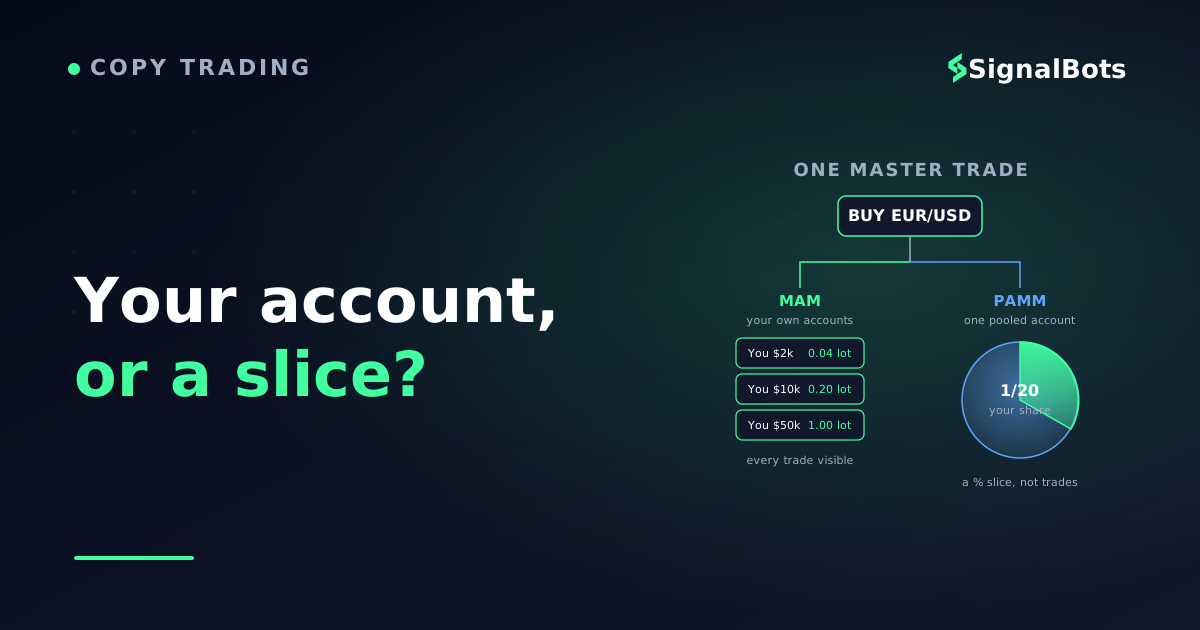
MAM keeps your money in your own account with live, trade-by-trade visibility; PAMM pools all investors into one master account where you own a percentage share.
MAM allocates per account (percentage or fixed lots), so risk can be tuned per investor; PAMM applies one risk profile to the whole pool.
Fees differ by meter, not by name: PAMM computes performance fees at the pool level; MAM computes them per account against your own high-water mark.
Choose MAM for control and visibility, PAMM for hands-off simplicity - and judge the manager's strategy first, because the structure is plumbing, not edge.
Table of Contents (17 min read)Contents
The choice underneath the label
You already know you want your account traded by someone whose track record you trust — a signal provider, a fund manager, or your own second strategy account. What you have not decided is the plumbing that connects their trades to your balance. That plumbing has two dominant names in the managed-account world: MAM and PAMM. Pick the wrong one and you can end up with a stake in someone else's blended pool when you wanted your own visible sub-account, or with a manager who can't dial your risk down to match your appetite.
This is not a "which is better" question with one answer. MAM (Multi-Account Manager) and PAMM (Percentage Allocation Management Module) are two ways of doing the same job — copying one master's trades onto many followers' money — and each is better for a different kind of investor and a different kind of manager. The right frame is: what do you need to see, control, and be charged for? Answer that and the label chooses itself.
If you are new to the idea that one person's trade can land on your account automatically, the umbrella concept is copy trading — a manager or strategy account leads, your account follows. MAM and PAMM are two allocation engines that sit under that umbrella. The differences below are entirely about how the follow happens.
How the money is actually held
The single fact that separates these two models is where your capital sits while it's being traded.
Under a PAMM, your deposit is pooled. Every investor's money is merged into one master trading account, and the manager trades that combined balance as a single pot. You don't have a sub-account with visible open positions — you have a percentage share of the pool. If you contributed one-twentieth of the total equity, you own one-twentieth of every gain, loss, and cost the pool generates. At the end of a trading period the software settles each investor's share and applies the fee. It's clean, it's proportional, and it's opaque by design: you see your equity curve and your share, not the individual trades.
Under a MAM, your money stays in your own account. The manager holds trading authority over it — usually through a master password that lets them place trades while you keep read-only investor access — but the funds never leave your name. When the manager fires a trade, a copier engine mirrors it into your account, sized to your balance and your risk setting. You can log in and watch every position open and close. Nothing is blended.
That difference in custody is not a technicality. It drives everything downstream: what you can see, whether the manager can treat you differently from the next investor, how fees are computed, and how easily you can walk away.
The core mechanic
One master trade, mirrored to each follower's own balance
Manager master accountBUY EUR/USD - risks 2% of equity
Each investor's own sub-account (MAM)
Investor - $2,0000.04 lot - same 2% risk
Investor - $10,0000.20 lot - same 2% risk
Investor - $50,0001.00 lot - dialed to 1% risk
In a MAM, the same signal becomes a differently-sized position on each account, scaled to that investor's balance and risk. In a PAMM, there are no separate positions to see - just your percentage of the single pooled trade.
The master trades once; the allocation engine translates it onto every follower. MAM shows you your own position; PAMM shows you your slice of the pool.
The scaling you see above — the same 2% risk becoming a 0.04-lot trade on a small account and a 1.00-lot trade on a large one — is the whole point of an allocation engine. In a MAM it can even be tuned per investor: notice the $50k account above running at 1% instead of 2% because that investor asked for less exposure. A PAMM cannot do that; everyone in the pool rides the same percentage by construction.
Allocation: percentage, lots, and where MAM gets its flexibility
Both models have to answer one question every time the manager trades: how big is each investor's slice? The method they use is where the real behavioural difference lives.
PAMM allocates by equity percentage. Your slice is fixed by your share of the pool. Deposit more and your percentage rises; everyone moves in lockstep. There is exactly one risk profile — the manager's — and every investor wears it identically.
MAM allocates by percentage or by lots, per account. The manager can mirror trades proportionally (like PAMM) or set a fixed lot multiplier per follower — half-size for a cautious investor, full-size for an aggressive one. This per-account control is MAM's defining advantage and the reason experienced investors and risk-conscious managers reach for it.
You may also meet LAMM (Lot Allocation Management Module) in broker literature. Think of it as MAM's ancestor: it allocates purely by lot count rather than equity percentage, so a small and a large account can be told to trade the same lot size — which is usually the wrong thing for a small account. Most modern brokers have folded LAMM's fixed-lot capability into their MAM offering, so you rarely need to choose it on its own.
Here's the part that matters for your decision: percentage allocation is fair but rigid; lot-level allocation is flexible but demands trust. A PAMM's equity-percentage math guarantees nobody in the pool is treated better than anybody else. A MAM's per-account control means the manager could size your account differently — great when you want lower risk, but something you should be able to verify, which is exactly why MAM's visibility matters.
What you can see — and why it changes your risk
Visibility is the quiet decider most first-time investors underrate.
With a MAM, you typically hold the investor (read-only) password to your own account. You can log in any time and watch positions, floating profit and loss, and closed history in real time. If the manager starts revenge-trading after a losing streak, you'll see it happening, not discover it in a monthly statement. That transparency is a genuine risk control: you can pull your authority the moment the behaviour stops matching what you signed up for.
With a PAMM, you see your equity curve and your percentage share, but not the underlying trades in real time — they belong to the pooled master account, not to you. You're trusting the manager and the broker's settlement engine to report your share honestly. For a passive investor who wants to check a number once a week, that's fine and even preferable. For someone who wants to audit how the return was made, it's a wall.
Side by side
What you're comparing
MAM (Multi-Account Manager)
PAMM (Percentage Allocation)
Where your money sits
Your own account, in your name
Pooled into one master account
What you see
Every trade, live
Your equity curve + % share
Risk customisation
Per-account (lot or %)
One profile for the whole pool
Allocation method
Percentage OR fixed lots
Equity percentage only
Best-suited investor
Hands-on, control-first
Hands-off, set-and-forget
Manager complexity
Higher - manages many accounts
Lower - trades one pool
Exit / withdrawal
Usually anytime - it's your account
Often at period close / rollover
MAM trades visibility and per-account control for more moving parts; PAMM trades control for simplicity. Neither column is 'the winner' - the right one depends on what you value.
Fees: the same words, two different meters
Both models usually charge a performance fee (a cut of profit, often reset against a high-water mark so you're not charged twice for recovering the same drawdown) and sometimes a management fee (a flat slice of assets). The words are identical; the meter underneath differs.
In a PAMM, fees are computed at the pool level and then split by share. Because everyone is in one pot, the high-water mark and the performance calculation apply to the pool's equity curve, and your fee is your percentage of that. It's simple and hard to game, but it also means your fee is entangled with when other investors deposited and withdrew.
In a MAM, fees are computed per account, against your balance and your high-water mark. Two investors who joined the same manager on different dates can owe genuinely different performance fees because each account has its own curve. This is fairer to you as an individual, but it's more bookkeeping for the manager — which is part of why MAM setups sometimes carry slightly higher headline fees or minimums.
There's a subtle trap worth naming, because it's the kind of promise you should distrust: any managed-account pitch that implies a "risk-free" or "guaranteed" return is a red flag regardless of the account structure. MAM and PAMM are allocation plumbing, not a source of edge. The edge — if it exists — is the manager's strategy, and every strategy carries drawdown. Judge the trader, then pick the structure.
The manager's view — because if you're the IB, this is your product
Most articles frame MAM vs PAMM only for the investor. But a large share of the people choosing between them are on the other side of the master password — signal providers, strategy owners, and introducing brokers who want to trade client money at scale. If that's you, the calculus flips.
A PAMM is operationally lighter. You trade one account, the broker's engine handles allocation and settlement, and you can onboard a hundred investors without managing a hundred terminals. The cost is inflexibility: you cannot tailor risk to a nervous client, and you cannot let a sophisticated client run hotter. Everyone gets your one profile.
A MAM is your premium offering. Per-account risk control lets you serve a beginner and a professional from the same strategy without forcing them into the same risk. Full investor visibility is a trust-builder that shortens the "will you really let me watch?" conversation. The price is complexity: more accounts to reconcile, per-account fee accounting, and a real need for reliable copier infrastructure so a fill on your master lands identically across every follower. This is where execution quality — latency, slippage, symbol mapping across accounts — stops being an abstraction and starts costing you clients.
The manager's structure
One master account, many investors, one allocation engine between them
Strategy / master accountThe manager or IB trades here
Allocation engine
MAM or PAMMCopies + scales every master trade
Investors
Beginner - low risk
Balanced investor
Pro - full risk
One master feeds many investors through the allocation engine. In a MAM the three investors can each run a different risk; in a PAMM they must share one.
If you're building this as an IB business, the account structure is only half the stack — the other half is the copier and connector layer that actually delivers your master's fills onto client platforms. For the MT5 side of that, our MT5 connectors are the same kind of execution bridge that makes a MAM feel instant rather than laggy to your followers.
Which one fits you — a straight decision
Strip away the jargon and the choice comes down to four questions: do you want to see the trades, do you need your own risk level, are you hands-on or hands-off, and how easily do you need to exit. Walk the tree.
Decide
MAM or PAMM - which structure fits you?
Take itProceed with careSkip / stand aside
Visibility and custody decide first; risk customisation and exit flexibility settle the rest. Most control-seeking investors and premium managers land on MAM; most passive investors land on PAMM.
A quick reality check, because the intuitive answer here is often wrong.
Check yourself
Knowledge check
You want your funds to stay in your own account and you want to watch every trade live. Which structure gives you that?
Why
PAMM pools everyone's capital into one master account, so you own a percentage share, not visible positions. MAM keeps your funds in your own account and lets you watch every trade via investor (read-only) access. If custody and visibility matter to you, that's MAM.
Where SignalBots fits into a managed-account decision
SignalBots isn't a fund and doesn't custody your money — so we don't run a MAM or PAMM ourselves. Where we fit is the layer around the decision: the signals that a manager (or a disciplined solo trader) trades from, the connectors that mirror those trades onto MT5 with low latency, and the support an IB needs to run this as a business.
If you're an investor still deciding whether to hand over control at all, the honest first step is to trade the signals yourself before you pool your capital with anyone: our forex trading signals and the forex Telegram channel let you follow a strategy's calls manually and judge the track record on your own account first. If you're the manager or IB, the MT5 connector suite is the execution bridge that keeps every follower's fill fast and faithful — the practical difference between a MAM that feels instant and one that lags.
Either way, size your exposure before you commit it. Whether you end up in a pooled PAMM share or your own MAM sub-account, the amount you put at risk per trade is still your decision to make.
FAQ
Is MAM or PAMM safer for my money?
Neither structure is inherently "safer" — the risk lives in the manager's strategy, not the plumbing. That said, MAM gives you more protective visibility: your funds stay in your own account and you can watch every trade live, so you can revoke access the moment the manager's behaviour stops matching what you agreed to. PAMM asks you to trust the pool and the settlement engine. If control and auditability reduce your anxiety, MAM is the safer-feeling choice.
Can I lose more than I deposited in a MAM or PAMM account?
In a normal managed account you can lose up to your allocated capital, and leverage means a bad run can erode it quickly. Some accounts include negative-balance protection so you can't go below zero, but that's a broker feature, not a property of MAM or PAMM. Always confirm it exists and understand the manager's worst historical drawdown before committing.
How are fees different between MAM and PAMM?
Both typically charge a performance fee (often against a high-water mark) and sometimes a management fee. The difference is where they're calculated: a PAMM computes fees at the pool level and splits them by your share, while a MAM computes them per account against your own balance and high-water mark. Per-account accounting is fairer to you individually but means more bookkeeping for the manager.
Do I place any trades myself in these accounts?
No — that's the point. You grant the manager trading authority (usually via a master password) while you hold read-only investor access. The manager trades; the allocation engine copies and scales each trade onto your balance. Your only active decisions are choosing the manager, setting your risk level (in a MAM), and deciding when to withdraw.
What's LAMM, and do I need to care about it?
LAMM (Lot Allocation Management Module) is an older model that allocates by fixed lot count rather than equity percentage — so a small and a large account could be told to trade the same lot size, which usually over-risks the small one. Most brokers have absorbed LAMM's fixed-lot capability into their MAM offering, so you rarely choose it on its own today. If you want lot-level control, look for a MAM that supports it rather than a standalone LAMM.
As an IB or signal provider, which should I offer my clients?
Offer a MAM if per-client risk control and trade visibility are selling points for your audience, and if you can support the extra reconciliation and a reliable copier stack. Offer a PAMM if you want to onboard many hands-off investors with minimal operational overhead and a single risk profile suits your strategy. Many established managers run both and let the client self-select via the decision above.
Sources & Further Reading
Want to go deeper? These independent, authoritative sources shaped this guide — each one is worth reading in full:
The Cross-Market Desk is the SignalBots editorial team for topics that span every market — platform connectors, copy trading, partnership and IB programs, and the general mechanics of trading automation. We research and write the guides that apply no matter what you trade.



Discussions 0
Leave a comment