You want a proven trader's positions mirrored to your account automatically — but many brokers advertising 'copy trading' bolt a badge onto a weak platform.
IC
IC Markets— broadest copy surface
Raw-spread ECN execution suits an automated copier
Assessed on platform copy support, execution model and automation rules — not on any invented rating.See how we compared them →
A copy-trading broker is only as good as the copy layer its platform ships — that is what this shortlist is built around.
You already know the appeal. Instead of staring at charts all day, you find a trader whose track record you trust, and their positions appear on your account automatically, sized to your balance. That is copy trading, and on paper it is the most hands-free way to be in the market.
The problem is the shortlist. Search "best broker for copy trading" and every broker claims it. But the broker itself rarely runs the copying — its trading platform does. So the real question is not "which broker is best," it is which broker ships a platform whose copy layer actually works, on an account model that won't fight an automated order flow. That is the lens this guide uses.
This is written for a forex trader — beginner or a rung up — who wants copied positions on a real broker account, not locked inside a standalone copy-trading platform. If you are in crypto or binary options, the mechanics rhyme but the venues differ; stay with forex here.
Key Takeaways
The broker doesn't run copy trading — its platform does. Pick by which copy layer it ships (MT4/MT5 Signals, cTrader Copy, or a native copier), not by a marketing badge.
The four things that separate a good copy-trading broker: execution model (ECN/STP beats a dealing desk for a copier), automation-friendly account rules, low all-in cost per copied trade, and how the platform scales the leader's trade to your balance.
Copy trading is not hands-off risk management — you inherit the leader's drawdown, and a great win rate at a poor reward-to-risk ratio still bleeds. Size your copy allocation like your own position.
Table of Contents (19 min read)Contents
What "copy trading" actually means on a broker account
Strip away the branding and copy trading is one idea: a leader (also called a strategy provider or master) opens and closes trades, and a follower account mirrors those trades in real time, scaled to the follower's own balance and risk setting. You don't pick entries; you pick a person and a risk allocation.
The term you'll see used almost interchangeably is mirror trading — historically that meant copying a strategy's signals rather than a specific person, but in 2026 most brokers use the words as synonyms. What matters for choosing a broker is not the label; it's the plumbing underneath, which the diagram below makes concrete.
How one leader trade lands on every follower
Lead strategy accountBUY EUR/USD - risks 2% - 1.00 lot on $50k
Mirrored to each follower's own balance
Follower - $2,0000.04 lot - same 2% risk
Follower - $10,0000.20 lot - same 2% risk
Follower - $30,0000.60 lot - same 2% risk
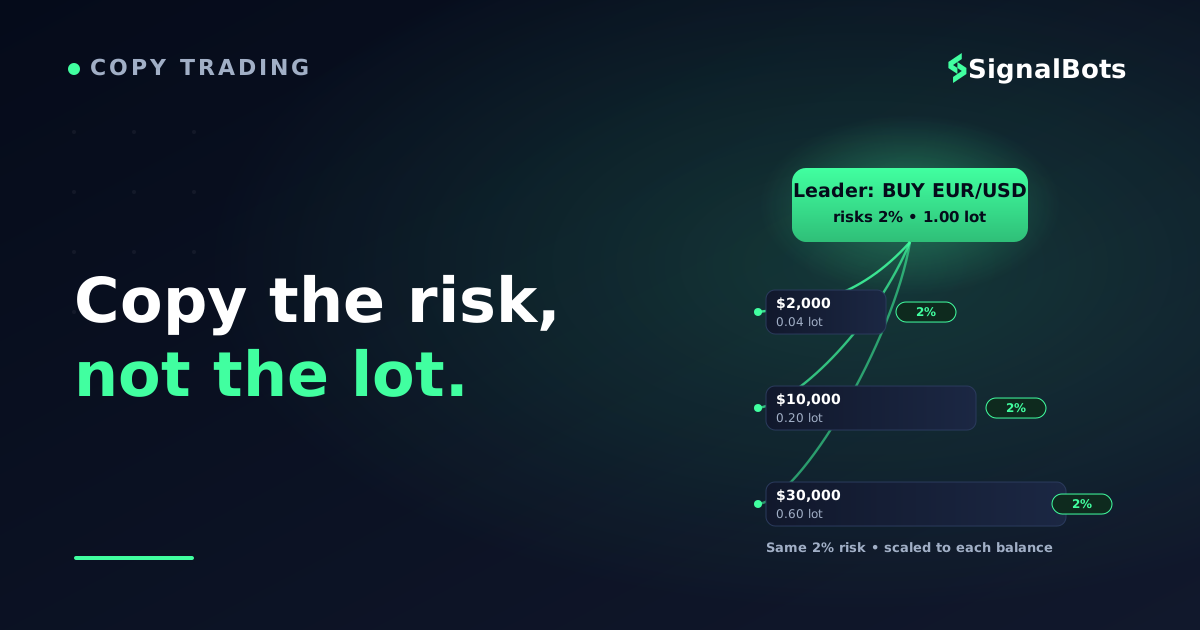
Good copy allocation mirrors the leader's RISK, not the leader's lot size - each follower takes the same 2% hit, scaled to their own account. A broker that only copies raw lot size is a red flag.
Notice the key detail: a well-built copier mirrors the leader's risk percentage, then translates it into a lot multiplier that fits each follower's balance. A $2,000 account and a $30,000 account both take the leader's move, but at 0.04 and 0.60 lots respectively — same 2% risk, wildly different position size. A copier that just clones the raw lot would blow up the small account and barely move the large one. When you evaluate a broker's copy tool, this scaling behaviour is the first thing to confirm.
The four things that actually separate copy-trading brokers
Marketing pages compare brokers on regulator, minimum deposit, and a star rating. Those matter, but they are not what makes a broker good at copying specifically. Four things do.
1. The copy layer its platform ships. This is the whole ballgame, and it splits into three real options:
MT4/MT5 Signals — MetaTrader's built-in subscription marketplace, where you subscribe to a signal provider and their trades copy to your terminal. Ubiquitous, but the copier runs client-side, so your terminal (or a VPS) has to stay online.
cTrader Copy — cTrader's native, cloud-side copy system where you invest in a strategy and copying happens on the broker's servers, no terminal required. Cleaner for hands-off followers.
A native / third-party copier — the broker's own social platform (e.g. a BlackBull-style copier) or an integration like Myfxbook AutoTrade or ZuluTrade bolted on.
A broker that offers only one of these isn't disqualified, but the one it ships decides your whole experience. If you never want to run a terminal, a cTrader-copy or cloud-copier broker beats an MT4-Signals-only one.
2. The execution model. Copying multiplies order flow — one leader trade becomes hundreds of follower orders hitting the book at once. On a dealing-desk / market-maker setup, that concentrated flow is exactly what a desk may re-quote or slip. An ECN broker or STP model passes orders straight to liquidity providers, which is friendlier to synchronized copied fills. For a copier, execution model is not a footnote — it's a core criterion.
3. Automation-friendly account rules. Some brokers restrict scalping, hedging, or high-frequency algo flow. Copy trading is a form of automated order flow, so a broker that welcomes Expert Advisors and copiers (and offers a VPS) is structurally better suited than one whose terms quietly discourage it.
4. The all-in cost per copied trade. You pay twice: the broker's spread and commission on every mirrored trade, plus the leader's performance fee. A leader who trades frequently amplifies broker costs fast. A raw-spread ECN account with a small commission usually beats a "zero commission, wide spread" account once a copier is firing dozens of trades a week.
The copy layers, compared
Copy layer
Where copying runs
Best for
Terminal needed?
Watch-out
MT4/MT5 Signals
Your terminal (client-side)
MetaTrader loyalists; huge provider pool
Yes - or a VPS
Copying stops if your terminal is offline
cTrader Copy
Broker cloud (server-side)
Truly hands-off followers
No
Fewer strategies than MT's marketplace
Native / social copier
Broker platform / app
Beginners who want one clean app
No
Locked into that broker's ecosystem
3rd-party (ZuluTrade / Myfxbook)
External service
Cross-broker strategy shopping
Sometimes
Extra layer = extra latency and fees
The copy layer decides everything downstream - whether you need a terminal running, how many strategies you can pick from, and where the copying actually executes.
The brokers worth shortlisting for copy trading in 2026
With those four criteria in hand, here are the forex/CFD brokers that genuinely earn a place on a copy-trading shortlist. These are named on what their platforms offer, verifiable from each broker's own documentation — not on any invented ranking or performance number.
IC Markets — the broadest copy surface. It runs raw-spread ECN execution and carries both MT4/MT5 Signals and cTrader Copy, so you can pick your copy layer without switching brokers. Its execution policy is notably permissive toward algo and copied order flow, which is exactly what a copier wants.
Pepperstone — strong cTrader-native copying, plus MT4/MT5 Signals and TradingView. If you want the cloud-side, terminal-free copy experience, its cTrader Copy support is a clean route, and its execution is built for automated flow.
FP Markets — MT4, MT5, and cTrader all on one roster, so it covers both major copy layers, alongside a proprietary copy option and Myfxbook AutoTrade. A solid all-rounder if you're undecided between MetaTrader and cTrader.
BlackBull Markets — runs MT4, MT5, and cTrader, and layers its own low-latency copier and social-investing platform on top. Worth a look if you value a broker-native copier over a marketplace.
Exness — has leaned hard into social and copy trading, with a beginner-friendly copy app that keeps the setup light while still supporting more advanced flow. A reasonable pick if simplicity is your priority.
RoboForex, XM, HFM, Tickmill, AvaTrade — all offer credible copy or social routes (CopyFX, MT Signals, DupliTrade/Ava Social, and similar) and are legitimate candidates depending on which copy layer and account model you prefer.
A note on integrity: this is a forex shortlist, so every name here is a forex/CFD broker. If a copy-trading page is pushing crypto exchanges or binary-options brokers under the same heading, it has crossed markets — and that's a sign the list was assembled for breadth, not for you.
Want the live provider list before you commit to a leader? Our forex signal pages show what our own automated signals look like across the major pairs, so you can compare a leader's style against a transparent reference.
Copy trading is not a substitute for risk management
Here is the part the glossy roundups skip. When you copy a leader, you inherit their entire outcome distribution — including their drawdown. A leader can have a beautiful win rate and still hand you a brutal losing streak, because win rate alone says nothing about how much is risked per trade.
The metric that actually matters is the reward-to-risk ratio behind those wins. A leader who wins 70% of trades at a 0.5:1 reward-to-risk ratio is a slow bleed; a leader who wins 45% at 2:1 compounds. Before you allocate a dollar, look at the math, not the headline win rate.
What your copied leader's reward-to-risk really implies
Long setup
Reward zone+0.0060
Risk zone−0.0030
TP 1.0910
Entry 1.0850
SL 1.0820
Reward-to-risk ratioYou aim for 2.00x what you risk
1 : 2.00
Risk (1R)
0.0030
Reward
0.0060
Break-even win rate
33.3%
Drag the stop and target: at 2:1 a leader only needs to be right ~33% of the time to break even, but at 0.5:1 they need ~67%. A 'high win rate' leader with a tight target may have almost no margin for error.
This is why sizing your copy allocation matters as much as choosing the leader. Treat the amount you assign to a copied strategy exactly like a position of your own — decide the percentage of your account you're willing to see in drawdown, and set the copier's risk multiplier accordingly. Our forex position-size calculator does that math for you, and the same logic applies to a copy allocation. As with any strategy that references win rates and backtested results, read our risk warning before you commit capital.
From leader to your account: the setup flow
Once you've chosen a broker and a leader, the mechanical setup is short. It's worth seeing end to end so you know what a legitimate copy relationship looks like — and, crucially, that a good copier never asks for your account's master password.
How a copy relationship goes live on your account
1
Open the right account type
Fund a live account on your chosen broker and enable the platform's copy layer (MT Signals, cTrader Copy, or the native copier).
2
Pick a leader and a risk level
Choose a strategy by its reward-to-risk profile and drawdown history, then set the risk multiplier that scales it to your balance.
3
Subscribe with read-only access
A legitimate copier links via investor/read-only permission, never your master password. It can copy trades but not withdraw.
4
Monitor and adjust, don't set-and-forget
Check the leader's drawdown weekly; unsubscribe or cut the multiplier if their risk profile drifts from what you signed up for.
Step three is a genuine security line, not a formality. The difference between an investor and a master password is the difference between a tool that can watch and copy and one that can control and withdraw. Any copy service demanding the master credential is a hard no.
If you'd rather route a provider's calls through your own automation instead of a marketplace, our MT5 connectors bridge external signals to your MetaTrader account — a middle path between fully manual and fully copied.
Your pre-copy checklist
Before you subscribe to any leader on any broker, run this. If you can't tick every box, you're not ready to allocate.
Before you copy a single trade
0 / 7
Confirmed the broker's platform ships a copy layer you can actually use (MT Signals, cTrader Copy, or a native copier)
Checked the account is ECN/STP or otherwise automation-friendly, not a restrictive dealing desk
Verified the copier scales the leader's RISK to your balance, not the raw lot size
Read the leader's reward-to-risk ratio and worst historical drawdown - not just the win rate
Set a risk multiplier sized to a drawdown you can genuinely stomach
Confirmed the copier links via investor/read-only access and never your master password
Priced the all-in cost: broker spread + commission on every copied trade, plus the leader's performance fee
★
Checklist complete — you’re cleared to proceed.
Where SignalBots fits
SignalBots isn't a broker, and we don't run a copy marketplace — which is exactly why we can be straight with you about how to pick one. Our lane is the automation layer: transparent, low-latency forex signals you can evaluate against any leader you're considering, and delivery straight to where you already are. If a public Telegram forex channel is closer to how you want to follow a strategy than a broker's copy tab, that route stays open too.
The honest summary: choose the broker by its copy layer and execution model, choose the leader by their reward-to-risk math, and size the allocation like it's your own trade. Do those three things and "hands-free" stops meaning "hands-off your risk."
You came in
“wanting a proven trader's positions mirrored to your account automatically”
and now you can judge
the broker by its copy layer, not its badge.
The best copy-trading broker is the one whose platform copies well - now you know how to spot it.
Copy trading works when three things line up: a broker whose platform ships a real copy layer on an automation-friendly account, a leader chosen by reward-to-risk math rather than a headline win rate, and a copy allocation sized to a drawdown you can live with. Get the plumbing and the risk right, and the 'hands-free' promise finally holds.
There's no single winner — it depends on the copy layer you want. If you want the broadest options in one account, IC Markets carries both MT4/MT5 Signals and cTrader Copy on a raw-spread ECN model. If you want terminal-free, cloud-side copying, Pepperstone's cTrader Copy is a clean route. FP Markets and BlackBull Markets are strong all-rounders. Match the broker to how you want to copy, not to a star rating.
Do I need MetaTrader running for copy trading to work?
It depends on the copy layer. MT4/MT5 Signals copies client-side, so your terminal (or a VPS) must stay online for trades to mirror. cTrader Copy and most native/cloud copiers run on the broker's servers, so copying continues even with your device off. If you can't keep a terminal or VPS running, prefer a cloud-side copier.
Is copy trading safe? Can the copier access my money?
A legitimate copier links to your account through investor / read-only access — it can open and close copied trades but cannot withdraw funds. It should never ask for your account's master password. The real risk isn't theft; it's market risk: you inherit the leader's full drawdown, so size your allocation to a loss you can absorb and read our risk warning first.
How does copy trading scale a big trader's position to my small account?
A well-built copier mirrors the leader's risk percentage, then converts it to a lot size that fits your balance. If the leader risks 2% on a 1.00-lot trade, a $2,000 follower might take 0.04 lots and a $30,000 follower 0.60 lots — same 2% risk, different position sizes. Avoid any copier that clones the raw lot size regardless of account balance.
What does copy trading actually cost?
You pay on two layers. First, the broker's spread and commission on every copied trade — a frequent-trading leader multiplies this, which is why a raw-spread ECN account often beats a wide-spread "commission-free" one. Second, the leader's performance fee, typically taken on new profits. Price both before you subscribe.
Can I copy trade forex and crypto from the same account?
Usually not from one broker account. A forex/CFD broker copies forex, indices, and metals; crypto copying happens on exchange or crypto-native platforms. Keep the market and the venue matched — a forex copy setup belongs on a forex broker, not a crypto exchange dressed up as one.
Sources & Further Reading
Want to go deeper? These independent, authoritative sources shaped this guide — each one is worth reading in full:
The Forex Desk is the SignalBots editorial team responsible for our currency-market coverage. We research and write the guides, explainers and reference articles on how the majors, minors and crosses actually trade — sessions, spreads, swaps and the macro releases that move price.



Discussions 0
Leave a comment