You clicked a thumbnail. Maybe it read something like "$1 into five figures in thirteen minutes," maybe a Telegram group you're in dropped the link, maybe the video autoplayed after something else. Now there's a person on screen placing trades, the balance is climbing, and you're trying to decide whether these are calls you should actually be taking with your own money.
That decision is harder on YouTube than anywhere else in this market — and, oddly, also easier. Harder because there is no account statement, no third-party audit, no way to click through to a verified history. Easier because YouTube is the only venue where you can literally watch the trade happen. Nobody on Telegram shows you the click. So judging binary options signals on YouTube isn't really a question about the trader's reputation. It's a question about the footage: is what you're watching a continuous recording of a real account, or a sequence of decisions made in an editing timeline?
This article gives you a way to answer that from the video itself, plus a method to check a claim after the video ends. It doesn't rank channels — this niche churns hard, and a channel worth naming today is often deleted or sold within months.
Key Takeaways
On YouTube the question is not the trader's reputation but the footage: a cut at the entry or expiry, a cropped balance, or a stopped clock turns proof back into a claim.
Classify the channel first — trade-along, education, paid-group promotion, or broker-signup funnel — because the description link tells you what the video is optimized for.
Capture asset, direction, timestamp, expiry and outcome while watching, then replay that minute on an independent chart; OTC and synthetic assets can never be checked this way.
A channel worth watching shows losing sessions, names its platform and account type, and teaches a method you can forward-test on demo yourself.
Table of Contents (31 min read)Contents
What Counts as a Binary Options Signals Channel on YouTube
"Signal channel" on YouTube covers four very different things, and telling them apart is the first filter — it takes about sixty seconds and it decides how much of the rest matters.
Trade-along channels. The creator records a session and calls entries as they happen. Closest thing to a live signal provider on the platform, and the only format where the proof and the call arrive in the same frame.
Strategy and education channels. The upload is a method — a setup, a filter, an entry rule — and any binary options signal shown is an example of the method, not a call for you to copy. These age well because the reasoning outlives the trade.
Signal-service promotions. The video exists to sell access to a paid Telegram group, a bot, or a course. The trades on screen are a sales asset. Understanding the difference between free and VIP signal tiers tells you what's being advertised.
Broker acquisition funnels. The video's actual product is a registration. The strategy or "free bot" is the bait; the description link is the point.
You can usually classify a channel before the first ad break. Open the description: if the top line is a registration link with a bonus code, you're in category four regardless of what the title said. Check the pinned comment — funnels pin the offer. Scroll the uploads tab: education channels build playlists around methods, while funnels post the same result-video shape over and over with different numbers in the thumbnail. Look at the cadence too. A channel with two years of steady uploads is a different proposition from one whose entire history starts six weeks ago.
Classifying without pressing play
Channel type
Upload pattern
Where the description link goes
How to treat it
Trade-along
Session recordings on a steady cadence
Varies — the creator's own broker or group
Closest to a real call, but check the footage tells first
Education
Playlists built around one method
Often none, or a course/community page
Ages well — forward-test the method yourself
Signal-service promo
The same results-video shape, new numbers
Top line is a paid Telegram or course link
Treat the video as an ad, not a track record
Broker funnel
Short history, high volume, recycled footage
Top line is a registration link with a bonus code
Assume the real product is your sign-up
Cadence and the description link classify a channel before any of its footage does.
None of these four categories is automatically worthless. A promotional channel can still teach you something real. But you should know which one you're watching before you decide whether to act on a call.
Can You Actually Verify a YouTube Trader's Results?
Partly — and knowing exactly where the verifiable part stops is the whole skill.
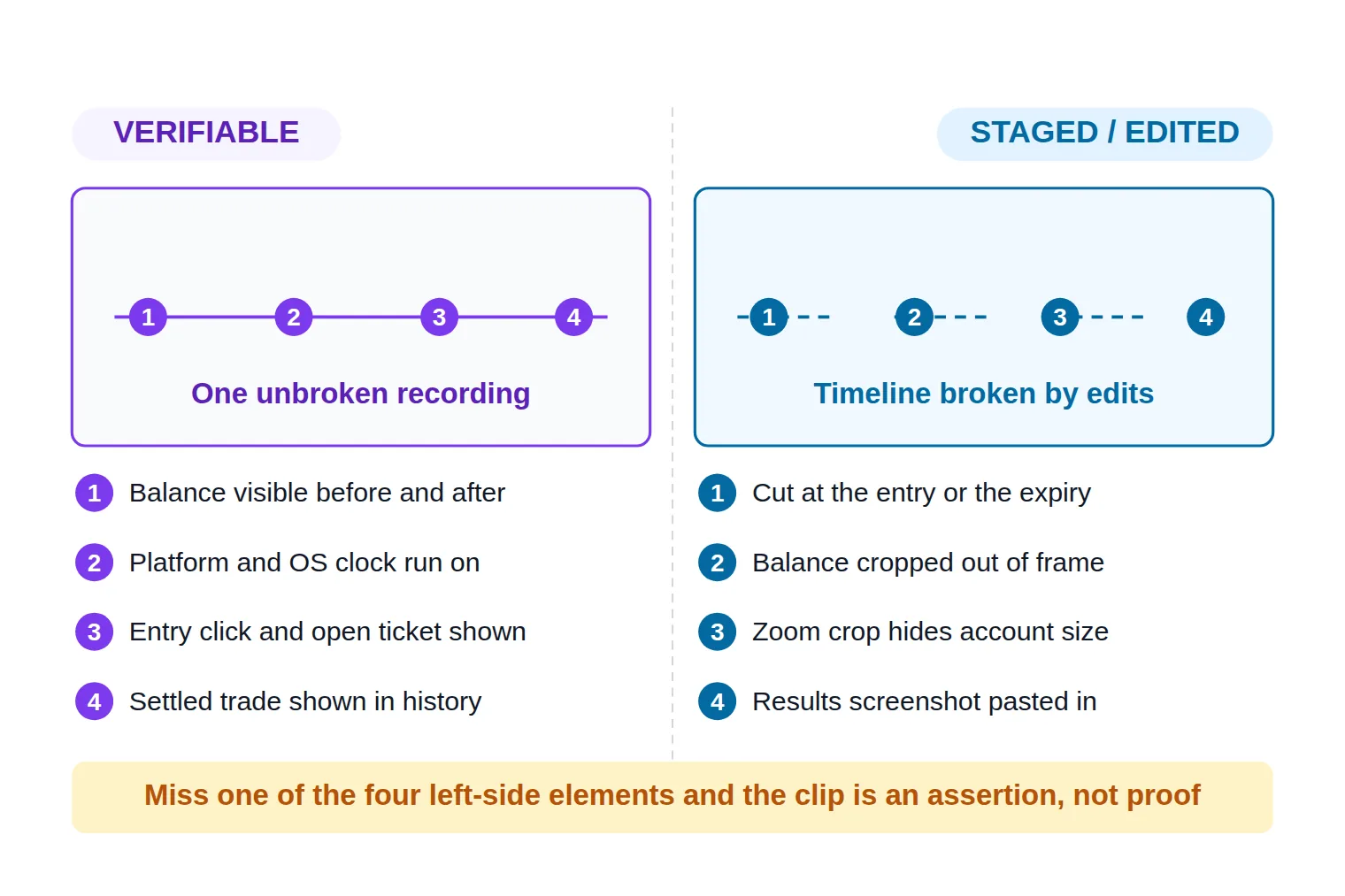
A trade is verifiable on video when a single unbroken recording carries you from before the entry to after the expiry, with these things visible in the same frame and never cropped out:
The account balance before the click and after the result settles.
The platform's own clock, and ideally the operating-system clock too, running continuously.
The asset and direction on the ticket, plus the expiry time selected.
The actual click — cursor movement, the ticket opening, the position appearing in the open-trades panel.
The settled trade afterwards in the platform's trade history, showing in the money or out of the money with the same stake and timestamp.
Miss any one of those and the segment stops being proof and becomes an assertion. That's not a technicality. A cut at the moment of entry is enough to hide four losing attempts. A zoom that crops the balance hides the account size, which is how a $50 win gets presented as though it came from a $5,000 account. A results screenshot pasted in at the end proves the person owns image-editing software.
Continuous footage proves a call; a cut, a crop, or a pasted screenshot only asserts one.
Three things defeat even honest-looking footage:
Demo accounts look identical. On most binary platforms the demo account interface is the live interface with a different label in one corner — the corner that's easiest to crop or blur. Unless the account-type indicator is visible and legible throughout, you're watching a session that may have cost the creator nothing.
OTC assets can't be independently checked. Weekend and synthetic instruments on the OTC market are priced by the platform itself. There is no outside chart to compare against, which means an OTC session is unfalsifiable by construction. Real traders do use OTC assets; it's just that OTC footage can never be more than a claim.
Ten wins in a row is not evidence. Even flawless, unedited footage of a great session tells you about that session. What you'd need to judge a historical win rate is a sample large enough to be meaningful and, crucially, the sessions that went badly. Uploads are self-selected — you're seeing the survivors of a filtering process you can't observe, which is survivorship bias in its purest form. A channel with fifty uploads and no losing session isn't lucky; it's editing.
There's a piece of arithmetic worth doing before you're impressed by any win streak. With a payout below 100%, losses cost more than wins pay, so the win rate you need just to break even is higher than half — and higher than most viewers assume. Run your platform's actual payout through a break-even win rate calculator and you'll have a number to hold every claimed result against. A channel showing results that sit far above that line, month after month, without ever showing the drawdown that a real edge still produces, is making a claim that deserves more scepticism than a thumbnail can carry.
Follow the Money: How These Channels Get Paid
Ad revenue on a niche finance channel is small. Almost every binary options channel of any size earns from one of three places, and each one bends the content in a predictable direction.
Broker affiliate links. The description carries a registration link. The creator earns when you sign up and fund an account — sometimes as a share of your trading activity. The optimization target here isn't your results; it's your deposit. That's why funnel videos are short, front-load the win, and stop before any part of the session that would make you hesitate.
Paid group or course upsell. The free video is a demonstration and the product is access — a Telegram signal channel, a subscription, a "mentorship." Here the incentive is to make the free sample look like the ceiling of what's possible, since the pitch is that the paid tier is better still.
Paid promotion of a third-party tool. A bot, an indicator, or a signal service pays for placement. Disclosure varies wildly, and the trades shown are frequently supplied by the vendor rather than recorded by the creator.
None of these is inherently dishonest — plenty of legitimate educators monetize exactly this way and say so plainly. The point is directional: once you know what a video is optimized for, its editing choices stop looking arbitrary. A creator paid per deposit has a reason to cut the losses. A creator paid per subscriber has a reason to keep the method vague. A creator who's transparent about the arrangement, still shows the losses, and explains the method anyway is telling you something about themselves.
Regulators have been tightening exactly here. Financial-promotion rules generally apply to social media the same way they apply to any other advertising channel, which means a promotional video pushing a leveraged product with no mention of downside is a compliance problem, not just a taste problem. When a channel never says the word "risk," that absence is data.
The Truth Behind Binary Options Fraud, Episode 2: Fraud on a Global Scale — CFTC
Red Flags That Only Show Up on Video
Some warning signs are generic to any signal service, and the usual advice is to demand a verified track record. These are the ones you can only catch by watching, roughly in the order you'll encounter them:
Thumbnail arithmetic that doesn't survive contact with a calculator. A specific, odd number ("$8,802") reads as authentic precisely because it's specific. Ask what stake and what streak would produce it, and how many consecutive correct calls that implies.
A cut at the entry or the expiry. Watch the frame edges, the cursor position, and the clock across the transition. Jump cuts around the decisive moment are the single most reliable tell in the format.
An audio seam without a video seam. Room tone changes, a breath cut mid-word, or narration that suddenly sits differently in the mix often marks a re-record over spliced footage.
A balance that doesn't reconcile across uploads. Note the closing balance in one video and the opening balance in the next. Real accounts carry forward; staged ones reset to whatever the story needs.
No losing trade anywhere in the upload history. Not in this video — in any video. Scrub a few older uploads. Nothing is more diagnostic than a channel where nothing ever goes wrong.
Withdrawal "proof" held up to the camera. A phone screen filmed by another phone is the least verifiable artefact on the platform, and it's popular for exactly that reason.
No platform or account type ever named. Legitimate walkthroughs say where they're trading and on what kind of account, because the payout and the instrument list depend on it. Vagueness here is a choice.
Comment sections that read as staged. Bursts of short emoji praise posted within minutes of each other, no questions, no arguments, or comments disabled entirely. A real audience asks awkward things about losses.
Urgency wrapped around the offer. A countdown, a "closing to new members tonight," a bonus code that expires. Urgency exists to prevent exactly the checking this article describes.
Any promise phrased as certainty. Treat "risk-free," "never loses," "guaranteed" and "no-loss strategy" as automatic disqualifiers in this niche — a real edge is a statistical one and anyone with one describes it that way.
A brand-new channel with a suspiciously large audience. Recycled footage across uploads, mismatched thumbnails, and a subscriber count that doesn't match engagement all point at a channel bought or inflated rather than built. It's the same manufactured-credibility pattern that drives a pump-and-dump — build the appearance of a crowd, then convert it fast, before anyone checks.
Two of these together is usually enough to close the tab. You don't owe a stranger a full investigation, and one clear tell at the decisive moment settles it on its own. The reverse is worth saying just as plainly: a clean video is not evidence of skill. It only means nothing has yet given you a reason to walk away — which is a much smaller claim than the thumbnail is making.
What a Genuinely Useful Channel Looks Like Instead
A rejection list alone leaves you with nothing to watch, and good creators in this space do exist. Here's the positive shape:
A long, boring upload history. Consistent output over many months, with the visible unevenness of a real schedule. Gaps and off-weeks are a good sign, not a bad one.
Losses shown and dissected. Not one token losing trade as a credibility prop, but sessions that end down, with an explanation of what the setup got wrong.
A method you could apply without the creator. The video teaches a condition — a structure, a level, a session filter — rather than announcing entries you're expected to copy blind.
Stakes proportional to a plausible account. A trader risking a sensible fraction of a modest balance is much more believable than one risking a car payment per click.
Platform, account type and instrument stated openly, including when a session is on demo or on OTC assets. Naming these costs a creator nothing if they're honest, and costs them everything if they're not.
A comment section with friction. Specific questions, disagreements, follow-ups from returning viewers, and creator replies that engage with the hard ones.
No signal upsell as the main product. Education channels sell education, sponsorships, or nothing. When the endpoint of every video is a group link, the videos are the advertisement.
A channel like this is worth watching. That still isn't the same as worth following blindly — the useful output of a good educational channel is a method you test yourself, not a call you take on trust.
Searching So Education Surfaces First
YouTube's default results for binary options trading signals skew heavily toward promotion, because that's the content optimized to be clicked. You get a different corpus by changing the phrasing:
"binary options strategy walkthrough" and "price action binary options" surface method content over result content.
"live session" and "full session" (rather than "live signals") pull unedited longer recordings.
"backtest" or "bar replay" find creators testing an idea across history instead of showcasing an afternoon.
"signal service review" and "tested for a week" surface third-party scrutiny of the services you're being pitched.
Filter by duration and sort by upload date. A thirty-minute video is far harder to stage than a three-minute one, and recency matters because platforms, payouts and instrument lists change.
How to Cross-Check a Channel's Claimed Results
Video ends, doubt remains. This is how you close the loop afterwards — it takes a few minutes per trade and you only need to do it a handful of times to form a judgment about a channel.
Capture the five facts while watching. Asset, direction, entry timestamp with its timezone, expiry length, claimed outcome. Pause and write them down; you won't reconstruct them later.
Pull the same asset on an independent chart. Any charting platform that isn't the creator's broker will do. Set the timeframe fine enough to isolate the entry minute.
Replay the moment. Use bar replay to step to the entry timestamp and forward to the expiry, then check whether price actually finished on the claimed side of the entry. A call that didn't happen the way it was shown will fail this immediately.
Note when you can't check. If the asset was OTC or synthetic, no independent chart exists — record that as "unverifiable," not as "passed." A channel trading only unverifiable instruments has chosen the one venue where nobody can audit it.
Repeat across a run of calls. One matching trade means little. Track a channel's public calls for a couple of weeks in a spreadsheet with entry, expiry, outcome and stake, and calculate the win rate yourself rather than accepting the one in the title.
Forward-test the method on demo before anything else. If the calls survive steps 3 to 5, run the setup on a demo account across enough sessions to see a losing stretch. What you're looking for isn't a good week — it's whether the drawdown is one you'd have sat through with real money.
Step 3 is where a claim usually breaks, and it's a smaller job than it sounds — a few candles either side of the entry minute is all you're reading.
Cross-check example
EUR/USD — replaying a claimed call independentlyEUR/USD1m
Replaying the same asset and timestamp on an independent chart confirms — or breaks — a claimed call in minutes.
This is what step 3 (replay the moment) produces: an independent chart that confirms or breaks the claim.
Two things make this cheap. You can do steps 1 to 4 on a single trade in about five minutes, and a channel that fails it fails fast. Do it once on the video that brought you here before you do anything else.
See Verified Signals Without Fact-Checking Frame by Frame
Notice what you were actually reconstructing in that last section: asset, direction, timestamp, expiry, outcome. That five-field record is the thing a signal source should be publishing in the first place — the entire cross-check exists only because a video refuses to publish it.
That's the design behind our own live binary options signals. Each call is posted with its asset, direction and expiry, timestamped as it fires, and the outcome is logged against it afterwards where anyone can read it — free to view, without an account, and without needing you to trust an edit. It's the same information you were pausing a video to transcribe, except it's written down before the outcome is known, which is the part footage can never demonstrate. Historical results are exactly that — historical, not a forecast; every binary trade puts the full stake at risk, and our risk warning spells out what that means.
Be clear about what this isn't. It's a live feed to watch and evaluate, not a replacement for education. If what you actually want is somebody walking you through a setup, explaining why a level matters and what the invalidation looks like, a signal feed won't give you that — you still need to go find and vet a teaching channel, and the criteria above are how you do it.
Where to Go From Here
You now have a three-way sort you can apply to any binary options signals video on YouTube within a couple of minutes of pressing play. Classify the channel from its description, pinned comment and upload history. Watch the frame edges and the clock across every entry and expiry, and treat a cut at the decisive moment as an answer. Then either close the tab, or capture the five facts and check one call against an independent chart before you risk anything.
Applied honestly, most channels land in "educational, watch but don't copy," a smaller number in "skip," and a rare few earn a place on your watch list — after they've survived a forward test, not because of a thumbnail.
Are there any legitimate binary options signal channels on YouTube?
Legitimate educational channels covering binary options certainly exist — creators who teach a method, show losses, and are open about how they're paid. Channels that broadcast reliable, verifiable live calls are far rarer, because the format itself makes verification easy to fake and the monetization pulls hard in the other direction. Treat "worth watching" and "worth copying" as two separate verdicts with two separate bars.
How can I tell if a YouTube trading video is edited?
Watch the clock, the balance and the cursor across every transition. In a continuous recording the platform clock advances smoothly, the balance changes only when a trade settles, and the cursor moves without teleporting. Jump cuts at entry or expiry, a re-recorded voiceover over spliced footage, a change in room tone mid-sentence, or a balance that doesn't reconcile with the previous upload all point at an editing timeline rather than a session.
Why do so many binary options signal videos link to a broker?
Because the registration link is usually how the video earns. Affiliate arrangements pay the creator when a viewer signs up and funds an account, which makes the deposit — not your outcome — the video's optimization target. That doesn't make every such video dishonest, but it does explain why the losing part of the session so often ends up on the cutting-room floor.
Can I verify a trade shown on an OTC asset?
No, and that's the point worth internalizing. OTC and synthetic instruments are priced by the platform itself, so there is no independent chart to compare a claimed entry and expiry against. Footage of an OTC session can be entirely genuine — it just can't be proven either way, which is why a channel that trades nothing else deserves extra scepticism.
How many trades should I track before trusting a channel's calls?
More than a session, and enough to include a bad stretch. A run of ten calls tells you almost nothing; tracking a channel's public calls across a few weeks, recording entry, expiry, stake and outcome yourself, gives you a win rate you calculated instead of one you were shown — and, more importantly, shows you the losing sequence any real method produces. Forward-test on demo through that stretch before any of it touches a funded account.
Sources & Further Reading
Want to go deeper? These independent, authoritative sources shaped this guide — each one is worth reading in full:
The Binary Options Desk is the SignalBots editorial team for fixed-time and OTC trading coverage. We research and write the guides that explain expiry timing, payout structure and disciplined entry across the major brokers.



Discussions 0
Leave a comment