You have a link. Maybe a friend pasted it into a chat, maybe it came from a stranger's DM, maybe it was a row on a directory page you found searching for a whatsapp group link binary options traders actually use. Attached to it is a promise: live calls, entries, expiry times, a win rate. The decision in front of you is tiny — tap or don't — and the information you have is close to zero.
This page is about the channel, not the calls. Before you join a binary options signals WhatsApp group, it pays to know exactly what an invite link does, what the admin controls once you are inside, and what WhatsApp — as a piece of software — can and cannot do as a broadcast medium for time-sensitive trading messages. Most of the unpleasant surprises people report after joining come from the platform's mechanics, not from the binary options signals themselves. An invite link hands you a promise and nothing to check it against — until you know what to look for.
Key Takeaways
A WhatsApp invite link shows you a preview, not a track record: joining starts your view at "now," so nothing the group posted before you arrived is ever visible to you.
WhatsApp has no public group search and no legitimate automation path for large rooms, which is why link-directory sites exist and why calls arrive at human speed.
Admins control everything that matters — link resets, message deletion, disappearing messages — so verification burden falls entirely on you.
Check the admin's identity, posting permissions, history depth and the first off-app request before treating any call as tradable.
Table of Contents (17 min read)Contents
How WhatsApp Signal Group Invite Links Actually Work
Every WhatsApp group link has the same shape: chat.whatsapp.com/ followed by a string of random characters. That string is the invite code, and it is the group's only public handle. There is no username, no vanity address, no profile page — the code is the address, which is why these links get copied around as raw URLs and QR codes rather than as names you could look up.
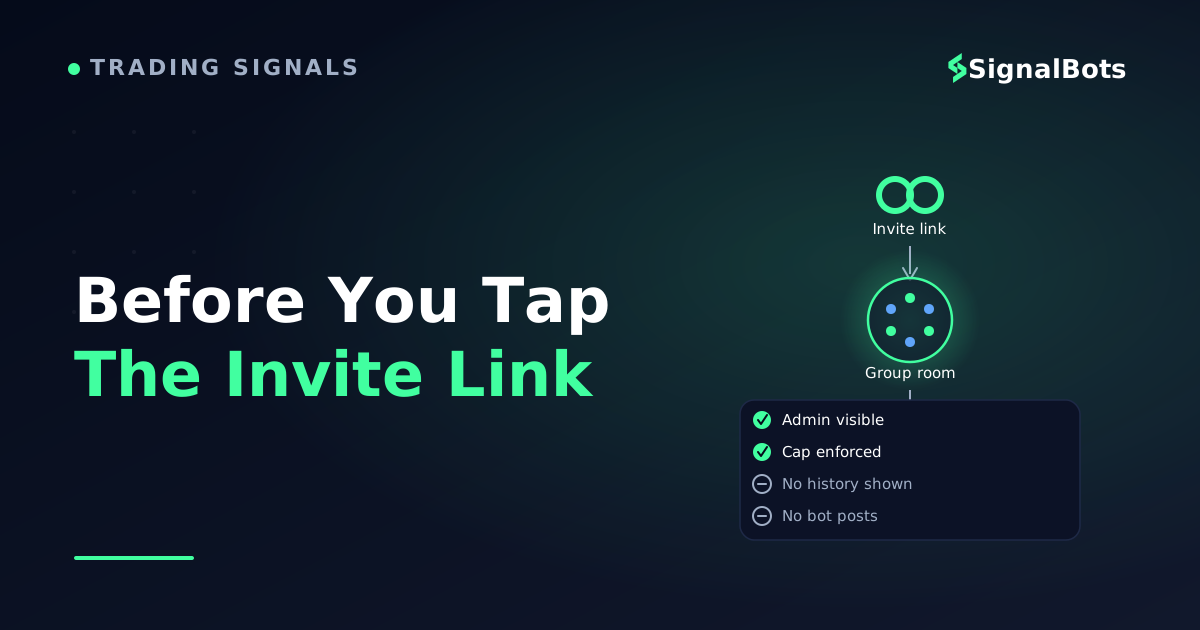
Tapping the link does not put you in the room. What it starts is a short sequence — four steps, laid out below — and only one of them is a real decision: the button in the preview. Where it says Request to Join rather than Join Group, treat that as a mild positive signal, because someone is at least curating the room. It is also the moment the admin has your name and number while you still have nothing from them.
The join flow
How joining a WhatsApp signal group actually works
1
Tap the invite link
Opens a preview inside WhatsApp — you never join instantly just by tapping.
2
See the preview
Group name, icon, member count and a description, if the admin wrote one.
3
Join Group or Request to Join
One button puts you in immediately; the other sends the admin your name and number to approve.
4
You land at "now"
Nothing the group posted before you arrived is visible — there is no back catalogue to scroll.
Four taps, and the room already knows more about you than you know about it.
The moment you are in, three things become true that most first-time joiners do not expect.
Your phone number is now visible to every other member of the group, alongside your profile name and photo (subject to your own privacy settings). In an ordinary group there is no anonymity in either direction — except that the admin may be operating under a number and display name that tell you nothing about who they are.
You start at "now." WhatsApp does not hand a new joiner the room's back catalogue. WhatsApp's newer group history sharing only fires when an existing member adds you and chooses to pass along a small slice of recent messages — joining yourself through an invite link triggers nothing. Everything the group posted before you arrived is invisible to you, permanently.
The admin holds every lever. They can reset the invite link (which instantly kills every copy of the old code, everywhere it was ever pasted), switch the group to "only admins can send messages," turn on disappearing messages, delete their own messages for everyone, remove you without explanation, and edit the group description to say something different tomorrow.
That link-reset power explains a lot of what you will run into. A code that worked when a directory page indexed it is dead the moment an admin rotates it, and the page keeps serving it anyway.
One practical step before you tap anything: open your own WhatsApp privacy settings and set who is allowed to add you to groups. If you join a room, leave it, and the admin still has your number, a permissive setting lets them put you straight back in.
Why WhatsApp Groups Aren't Built Like Telegram Channels
If your mental model of a signal room comes from Telegram, adjust it — the two products solve different problems, and the differences all land on exactly the things that matter for a delivery channel.
A Telegram signal channel is a one-to-many broadcast object with a public username, an unlimited subscriber count, and a permanent archive that every new subscriber can scroll from the first post onward. A WhatsApp group is a many-to-many chat room that holds up to about a thousand members, has no public name, and shows you nothing that happened before you walked in. Four consequences follow.
Ceiling and shape. A room capped in the low thousands cannot scale as one audience. An operation that outgrows it splits into duplicate rooms — group 2, group 3, a Community bundling several — and the calls in each drift apart in timing and wording. Because a group is two-way by default, member chatter, greetings and "did anyone take this?" replies also sit between you and the actual calls unless the admin has muted everyone.
Discoverability. There is no in-app search for public WhatsApp groups. You cannot type "binary options" into WhatsApp and browse rooms the way you can browse Telegram channels. WhatsApp's Channels feature does offer one-way broadcasting with a directory and hidden follower identities, but channel updates expire on their own after roughly a month — so even the format that looks closest to Telegram leaves no long-term archive to inspect.
Automation and speed. Meta's official Groups API exists, but it is scoped for business support conversations: it requires an Official Business Account and caps an API-managed group at a handful of participants. No provider is legitimately piping automated alerts into a thousand-member room through it. That leaves two options — a human typing or pasting each call, or unofficial automation tooling that puts the sending number at risk of being banned mid-session, taking the room's continuity with it. Either way the signal latency is human-shaped, measured in the seconds or minutes it takes someone to notice a setup and retype it. On a short-expiry binary trade, that gap is the difference between a live idea and a stale signal you can no longer act on at the stated price.
Permanence. Messages in a WhatsApp group are deletable by their sender for everyone, and an admin can switch on disappearing messages so the whole room self-erases on a timer. Combine that with the missing back catalogue and you get the structural problem: there is no archive against which anyone — you, a reviewer, a future member — could ever assemble a verified track record. Screenshots of winning trades are not an archive; they are the losing trades, cropped out.
Those four consequences — ceiling, discoverability, speed, permanence — line up point for point against how Telegram handles the same jobs.
WhatsApp vs Telegram, mechanically
WhatsApp group vs Telegram channel, for signal delivery
WhatsApp Group
Caps out near 1,000 members, so big operations split into duplicate rooms
No public search — links spread only through directories and DMs
No legitimate bot path for a large room; a person relays every call
Messages are deletable and can auto-disappear, erasing any back catalogue
Fine for chatting with other traders, weak as a delivery channel
VS
Winner
Telegram Channel
Scales to unlimited subscribers as one broadcast, no splitting
Public username makes channels searchable and shareable
Bots post calls the instant a setup fires — no manual relay lag
Full posting history stays visible to every new subscriber
Built for fast, verifiable one-to-many signal delivery
The two platforms solve different problems — only one of them is built to deliver a time-sensitive call fast and provably.
So what does WhatsApp genuinely give you in exchange? Three real things. The app is already installed and already carries your contacts, so there is no second account, username or onboarding to manage. Notifications behave like the messages you already read all day, which for some traders means calls actually get seen. And a two-way room is a room — you can ask a question, see other members react to a call in real time, and read how people handle a losing sequence, none of which a pure broadcast channel offers. If what you want is a community of traders, that is a legitimate reason to be there. If what you want is dependable delivery of time-critical calls, the trade-off runs the other way.
Where These Group Links Come From (and Why That Matters)
The missing public directory is precisely why third-party "group link" sites exist. Someone had to fill the discovery gap WhatsApp deliberately left open, and what filled it was a genre of page that lists hundreds of invite codes under headings like "free binary trading groups," monetized by ad impressions and ranked by sheer volume of links. Understanding what those pages are is half the safety work.
A directory row is an unverified string of characters that someone submitted at some point in the past. Nobody checked what was on the other end, and nobody rechecks it. In practice that produces a predictable set of outcomes:
Dead codes. The admin rotated the link months ago; the row is a fossil.
Rooms that changed hands or purpose. The same code can outlive the person who created it and now open something unrelated — a crypto pitch, a marketing blast, a bare spam room.
Duplicate listings. One operator seeding the same room across dozens of pages under different names, so a "shortlist" of ten groups is often two rooms.
Bulk-join tooling. Browser extensions exist specifically to scrape every invite code off a directory page and join them all in one pass. If someone runs that, your number is exposed to every one of those rooms simultaneously — and numbers harvested from member lists get resold, which is where the unsolicited "account manager" DMs come from.
The deeper issue is accountability. A link carries no information about the signal provider behind it — no registered name, no history, no way to tell whether the person posting calls today is the person who set the room up. That anonymity is the enabling condition for the classic coordinated-hype pattern: a room primed with payout screenshots, a synchronized "everyone in now" call, and an exit that only the organizers time correctly — the mechanics of a pump-and-dump scheme, transplanted from thin-volume assets into a chat room. The same anonymity makes the follow-on ask easy: deposit through this specific link, top up with this wallet, pay the fee to unlock withdrawals.
None of this makes every directory-sourced room malicious. It makes the sourcing path itself uninformative, which is a different and more useful conclusion: prefer a link you can trace to a named source — a provider's own site, a verifiable channel, a person with a reputation to lose — over a row on a page that would list anything submitted to it. If you want the full cross-platform framework for vetting a trading signal group's legitimacy, that belongs in its own checklist rather than here; this article stops at what is specific to WhatsApp.
What to Check in the First Five Minutes After Joining
You are in. Tick off every item below before you treat a single call as tradable — all of them are visible from inside the app, and all of them take seconds.
Run this before you act
Your first five minutes inside a WhatsApp signal group
0 / 7
Tap the group name and check the admin list for a named account with a photo — not a bare number with a default avatar
Check who can send messages — if everyone can, expect DM impersonation from someone who read your number off the member list
Scroll up as far as it goes to confirm you have no history before you arrived
Weigh the advertised win rate against your broker's actual payout before trusting it
Check whether disappearing messages are switched on
Watch one full call arrive and compare its timestamp against the expiry time it names
Note any first-hour request to deposit, install an outside app, or move to a private one-on-one chat — and leave if you see it
★
Checklist complete — you’re cleared to proceed.
Nearly everything here is visible in the app in under five minutes — before you treat a single call as tradable.
What each of those checks is actually telling you, in order:
Tap the group name and read the admin list. You are looking for whether the admin is anyone at all: a business profile, a named account, a photo, an "about" line that matches the group's claims — or a bare international number with a default avatar. An admin with nothing attached to them cannot be held to anything they post.
Check who is allowed to send. In group settings, "send messages" is either everyone or admins only. If everyone can post, expect impersonation: a member who reads your number in the participant list can DM you privately posing as the admin, and beginners routinely pay that person.
Scroll up as far as it goes. If the first thing you hit is the encryption notice and a handful of today's messages, you have confirmed you have no history to audit. Then ask the room for past results and watch which kind of answer comes back — a link to something continuously public, or a folder of screenshots.
Read the group description against arithmetic. Rooms advertise a win rate in the description almost by default. Judge it against the payout you would actually receive: a fixed-payout trade has a break-even threshold below which a strategy loses money no matter how confident it sounds, and it is worth running your broker's payout through a break-even win rate calculator before deciding what an advertised number would even be worth. Treat any figure that appears without a defined sample or period as marketing, and read what a historical win rate actually claims before you weigh one.
Check whether disappearing messages are on. If they are, the room is designed to leave no record. For a group whose entire value proposition is a track record, that is a contradiction worth taking seriously.
Watch one full call arrive before acting on one. A usable call names the asset, the direction, the entry condition and the expiry time. Note the timestamp on the message against the expiry it specifies: if a five-minute call reaches you three minutes in, the room's delivery speed has already eaten most of your edge, and that will not improve tomorrow.
Note any immediate off-app request. A first-hour message asking you to deposit through a particular link, install an app from outside the official stores, send identity documents to a private number, or continue "one-on-one" is the point to leave. Legitimate rooms do not need any of that in the first five minutes.
Running that list makes something obvious: nearly all the verification burden sits on you, because the platform provides no archive, no identity guarantee and no way for a provider to prove continuity. If that is the part that bothers you, our own binary options Telegram channel posts calls directly to subscribers with no invite-link hunting and no directory sites in the path, and the channel's posted history stays visible to anyone who opens it. It is Telegram, though, not WhatsApp — if staying inside the app you already use is the whole point for you, that specific thing is not what we offer.
Is a WhatsApp Group Worth Joining for Binary Options Signals?
As a place to talk with other traders, a WhatsApp room is fine and occasionally excellent — small, high-context, everyone reachable. As the primary delivery mechanism for time-sensitive calls, it is structurally the weakest option available to you: no history for a new member, no public identity for the operator, human-speed relay with no legitimate automation path, an audience ceiling that forces splitting, and a discovery route that runs through pages with no vetting at all.
That does not mean leave. It means calibrate. If you decide to join a binary options WhatsApp group, join it as a conversation, not as an instruction feed: check every call on your own chart, size positions by rules you set before the message arrived, and never let a room's urgency choose your stake for you. Anyone promising "risk-free" entries or a can't-lose sequence in a chat room is telling you something about themselves, not about the market — and the honest starting point for any of this is our risk warning.
FAQ
Is it safe to click a WhatsApp group link from a directory site?
Clicking the link itself only opens a preview inside WhatsApp — you are not in the group until you tap the join button. The risk is in what follows: joining exposes your phone number and profile to everyone in a room whose operator nobody vetted, and directory pages have no mechanism to check what a code currently opens. Treat a directory row as an anonymous tip, not a recommendation.
Can I see a WhatsApp signal group's past calls after joining?
Not by joining through an invite link. WhatsApp starts your view of the group at the moment you enter, and its optional history sharing only applies when an existing member adds you and chooses to pass along a small number of recent messages. This is the single biggest practical gap versus a Telegram channel, where the entire posting history opens to any new subscriber.
Does everyone in the group see my phone number?
In a standard WhatsApp group, yes — your number and profile name appear in the participant list to all members, and admins see them regardless. That is worth weighing before you join a large room of strangers, because member lists are the raw material for the unsolicited trading DMs that follow.
How many people can be in a WhatsApp signal group?
A standard group holds roughly a thousand participants, after which an operator has to split the audience across separate rooms or a Community. That ceiling is why large WhatsApp signal operations tend to run several parallel groups whose calls do not always match, and why some providers move to WhatsApp Channels or another platform entirely as they grow.
Why do signals arrive late in a WhatsApp group?
Because there is no legitimate way to automate posting into a large group. Meta's Groups API is built for small business-support rooms, so calls in a big signal group are typed or pasted by a person after they spot the setup. The delay between the trigger on the chart and the message on your phone is human, and on short expiries it is often the whole edge.
Sources & Further Reading
Want to go deeper? These independent, authoritative sources shaped this guide — each one is worth reading in full:
The Binary Options Desk is the SignalBots editorial team for fixed-time and OTC trading coverage. We research and write the guides that explain expiry timing, payout structure and disciplined entry across the major brokers.




Discussions 0
Leave a comment