You opened the Alpari app, found a tab called Signal Centre — or an email arrived promising trade ideas — and the obvious question followed: is this a genuine analytical product, or a bundled extra that exists because every broker ships one?
It is a hard question to answer from Alpari's own website, because the broker barely markets the service. Its main forex pages walk you through platforms, account types and instruments without mentioning signals at all. The thing is documented properly in exactly one place: a terms page most clients never open.
So here is the whole picture on one screen — who actually produces the signals, what each one contains, how you reach and act on them, and the part no broker page will hand you: an honest read on whether they are worth building a routine around.
Key Takeaways
Alpari does not produce these signals — it licenses a Trading Central feed and displays it in the app's Signal Centre, free with a live account and invisible on demo.
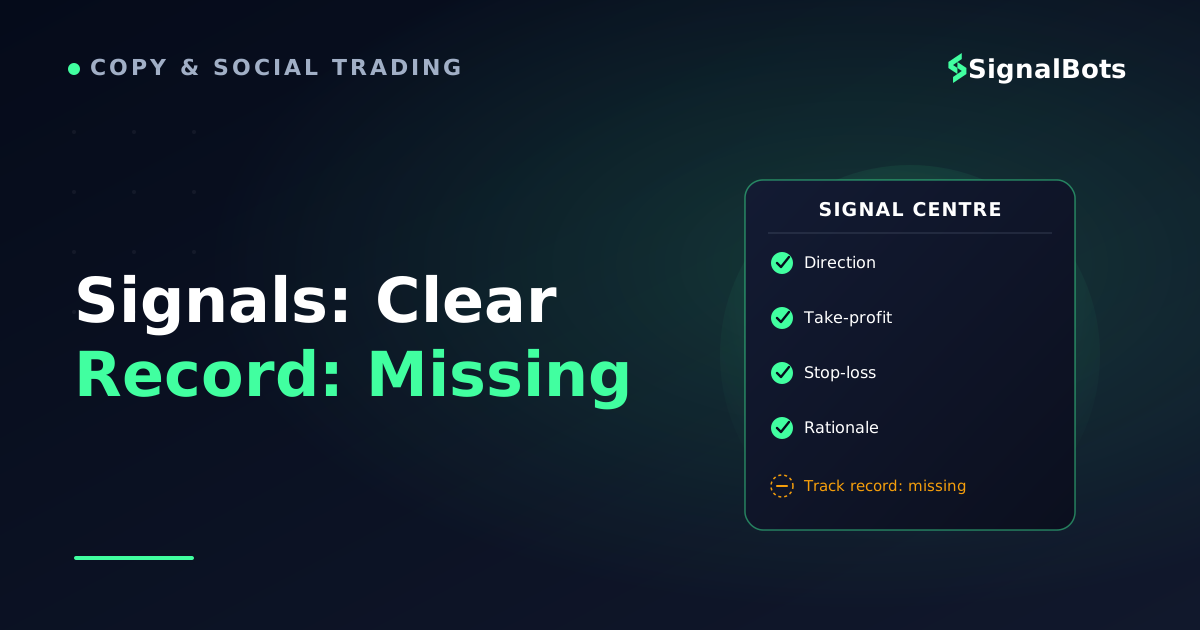
Each signal carries a direction, a suggested stop-loss and take-profit, and a written rationale; position size, timing and the decision to trade stay entirely with you.
No win rate, audited history or backtest is published for the feed, so each signal's own reward-to-risk arithmetic is the only performance check available before you act.
Treat it as a second opinion on an account you already hold, not as a reason to choose Alpari over another broker.
Table of Contents (19 min read)Contents
What Alpari's Trading Signal Service Actually Is
Start with the fact that reframes everything else: Alpari does not write these signals. It licenses them.
A trading signal here is a research product bought from a third-party analytics firm and displayed inside Alpari's own apps. You are not subscribing to your broker's house view — you are reading another company's analysis through your broker's interface. That distinction decides who is accountable for quality, and it decides what you can realistically verify before you act.
Where the Signals Come From
The provider is Trading Central, an established market-research firm whose output appears inside a long list of retail brokers. Alpari describes the method as technical-analysis indicators plus AI-driven algorithms, with a team of analysts validating what the models produce before publication.
That is a hybrid pipeline, and it helps to be precise about what it is and is not:
It is not a named trader's discretionary call. No individual's judgment — and no individual's personal record — sits behind any given signal.
It is not pure automation either. Human analysts stand between the model output and your screen.
From where you sit, it is still a black-box system. You get the conclusion and a short rationale. You never get the rules, the parameters, or the historical behaviour of those rules.
Alpari pairs this with a second third-party analytics package, FX Blue, pitched at more experienced traders. That one is closer to an indicator and analysis toolkit than a signal feed — worth keeping separate in your head, because when people say "Alpari signals" they almost always mean the Trading Central feed inside the Signal Centre.
What Each Alpari Signal Contains
Every call arrives with the same skeleton — the standard signal anatomy you would expect from a research feed:
Direction — buy or sell on a named instrument.
Suggested take-profit level — where the idea is treated as having worked.
Suggested stop-loss level — where it is treated as wrong.
Rationale — a short written case for the setup behind the call.
Read the word suggested carefully. It is doing more work in that list than it looks.
Whether the call fits your bias and your open exposure
Take-profit
A suggested level to close in profit
Whether to bank partials or hold for the full move
Stop-loss
A suggested level to close the loss
Whether that stop distance is one your account can carry
Rationale
A short written case for the setup
Whether the reasoning actually convinces you
Position size
Nothing — sizing is not part of a signal
Lot size, and therefore your entire monetary risk
Timing
The moment the call was published
Whether price is still near the level when you see it
Alpari's signal gives you a direction and two levels. Every decision that determines how much you can lose stays with you.
The bottom two rows are where the real risk lives. A signal that is right about direction can still empty an account if you size it wrong, and a signal that was excellent four hours ago can be worthless by the time you open the app.
Which Markets Alpari's Signals Cover
The feed spans four asset classes: FX, cryptocurrencies, US stocks and indices. For a forex-first account that is broader than most people expect — you can pick up a call on an index or a US equity CFD without leaving the same app.
Two caveats matter more than the breadth.
Alpari publishes no instrument-level coverage list. You cannot find out in advance which pairs or tickers the feed actually fires on, or how often. Combined with the access rule in the next section, that means you cannot confirm your own instruments are covered until after you have funded an account.
Independent reviews single out instrument choice as a weak point. Reviewers who have looked at the signal offering specifically describe the range as limited next to what dedicated signal sources provide.
The practical move is simple. If you trade a narrow set of pairs, open the Signal Centre and just watch it for a few weeks before planning anything around it. A feed that fires steadily on EUR/USD and US indices but rarely touches the crosses you actually trade is not a feed you can build a routine on.
How to Access Alpari's Signals
Three facts cover the entire access question.
Where. The Signal Centre, inside the Alpari app, and reachable from the desktop platform. It is not a Telegram channel, not a mailing list, and not a window inside MetaTrader — the feed lives in Alpari's own software.
Who. Live account holders. A demo account does not unlock it. That is the most awkward fact about evaluating this service: you have to fund before you can watch the signals long enough to judge them.
Cost. There is no separate subscription line — the feed comes bundled with the account. That also tells you how the economics work. The service exists to make you trade, and the broker earns on the spread and commission of the trades you place, not on a signal fee. Free is accurate, but it is not the same as disinterested.
Alongside the live feed, Alpari runs a lighter channel: daily trade ideas delivered by email. Same research family, different shape — a digest you read, rather than a feed wired into your order ticket.
Step by Step: From Signal to Order Ticket
How a signal reaches your account
From Trading Central's model to your order ticket
1
The models flag a setup
Technical-analysis indicators and AI screens scan the covered markets and surface a candidate trade.
2
Analysts validate it
Trading Central's analyst team reviews the machine output before the signal is published to brokers.
3
It lands in Signal Centre
The call appears in your Alpari app with direction, suggested stop-loss, take-profit and a written rationale.
4
The order ticket auto-fills
Tapping through pre-populates a ticket with the direction and the suggested levels already entered.
5
You confirm — or you don't
Nothing executes until you set your own size and press the button yourself. Execution stays manual throughout.
Five steps, and the only one that moves money is the one you perform.
Step five is the one to sit with. The auto-filled ticket is a convenience, not an automation: it saves you typing two price levels, and that is the whole of what it does. Two things it never does for you.
It does not size the trade. A suggested stop distance is a price, not a risk. Converting that distance into lots is your job, and it is where the difference between a survivable losing streak and an account-ending one is genuinely decided. Run the numbers through a forex position size calculator before you confirm anything.
It does not re-check the price. A call you open hours after publication can be a stale signal — price has already travelled toward the target, so the reward-to-risk you would actually get bears no resemblance to the one the signal implied. Measure the distance to the stated level first; a pre-filled ticket looks equally confident either way.
Is Alpari's Trading Signal Service Worth Using?
Alpari tells you what to trade. It does not tell you how the last hundred of those calls turned out.
The honest answer turns less on whether the signals are good than on something you can assess right now: how much evidence Alpari gives you to decide that at all.
What Alpari Doesn't Publish
For a service whose entire value is predictive, the evidence file is thin. There is no historical win rate published for the feed, and no verified track record you can audit.
Nor are any backtested results published for the models underneath it — nothing that would show you how those rules behaved across past market conditions, which is the minimum a systematic method should be able to produce.
What Alpari does publish is a plainly worded disclaimer: the signals are never guaranteed to work, and you act on them entirely at your own risk. Credit where it is due — that is more candid than a lot of signal marketing. But notice what it leaves you holding. A research product you are invited to trade on, with no performance record of any kind in public, that you cannot sample until you have funded an account.
Whatever you conclude, size every one of these trades as though the next is a loser; our full risk warning explains why that is the only sane framing for signal-led trading.
There is, however, one performance number you can compute yourself — and on a signal-by-signal basis it is the one that matters most. Any direction plus a stop and a target implies a reward-to-risk ratio, and every reward-to-risk ratio implies a break-even win rate: the hit rate below which that geometry loses money however persuasive the rationale reads.
Suppose a signal comes through long on EUR/USD with the stop thirty pips below the entry and the target sixty pips above — illustrative numbers, not a live call. That shape needs to be right barely more than one time in three to break even before costs.
The one number you can check yourself
What a signal's own geometry tells you
Long setup
Reward zone+0.0060
Risk zone−0.0030
TP 1.0910
Entry 1.0850
SL 1.0820
Reward-to-risk ratioYou aim for 2.00x what you risk
1 : 2.00
Risk (1R)
0.0030
Reward
0.0060
Break-even win rate
33.3%
Illustrative levels only. Drag the stop or target to see how quickly the break-even win rate moves against you.
Do that for a fortnight of signals and you will learn more about the feed than any marketing page can tell you. You will know whether the levels it suggests are even geometrically capable of paying — before you get to the harder question of whether its direction calls are right.
What Independent Reviews Say
Independent broker-review desks that have assessed Alpari's signal offering specifically — not the brokerage as a whole — land on the unenthusiastic side. The recurring criticisms line up with what you can observe yourself: a limited instrument selection inside the feed, and trading costs on the associated accounts that reviewers judge high relative to the alternatives. Trader feedback quoted in those reviews describes the analytics as underwhelming in practice.
Two things are worth saying about that verdict.
First, it is weak evidence taken alone. Impressions from an anonymous trader over an unknown number of signals, sized in an unknown way, prove very little — a losing month tells you almost nothing about an edge, and reviewers rarely disclose how they followed the calls.
Second, weak evidence is the only evidence on offer, and the reason it is the only evidence on offer is a choice Alpari made. When a provider publishes no record, third-party impressions fill the vacuum by default. A feed that published its own results would not be at the mercy of someone's bad fortnight.
Worth It If, Skip It If
Worth using if:
You already hold a funded Alpari account and would treat the feed as a second opinion, not a trading plan.
You trade the liquid FX pairs, US indices or US equity CFDs the feed genuinely covers.
You size every position yourself and would be willing to take the setup on your own analysis anyway.
You value the written rationale as a learning input — seeing why a model flagged a setup is useful even when you skip the trade.
Skip it if:
You would open or fund an Alpari account primarily to get the signals. Nothing published about this feed justifies picking a broker on it.
You need an auditable record before you act on somebody else's analysis.
You want the trades placed for you. This is a feed with a convenient ticket, not automation.
Your instruments sit outside its four asset classes, or you cannot confirm the feed covers them.
What a Publicly Visible Signal Feed Looks Like
The doubt above is not really about the analysis. It is about the absence of anything checkable before you commit — so it is worth knowing that the other shape exists, because it changes what you should ask of any signal source.
Our own free live forex signals feed is one example of that shape. Each call publishes its direction, entry, stop-loss and take-profit as it fires, and the history of previous calls stays visible on the page for anyone to read — no account, no deposit, no login required to look. That is a statement about transparency, not about outcomes: being able to inspect every past call is what lets you judge a feed rather than trust it.
The boundary is just as clear. It is a feed you read and act on yourself, not a connector that places trades and not a broker account — it replaces none of Alpari's order ticket, execution or account tooling, and it covers forex only, not the crypto, US-stock and index categories the Signal Centre spans.
Signals or Copy Trading — Which Alpari Route Fits You
There is a second way to get somebody else's trading decisions into your Alpari account, and choosing between them is really a decision about how much of the work you want to keep.
Following signals keeps you in the chair. Every call stops at your judgment, your sizing and your click. Copy trading removes that stop: you attach your account to a strategy provider, and their positions mirror into yours automatically, scaled against your balance. The setup mechanics for Alpari's copy trading — linking the account, setting allocation, and the regional rules on who can use it — are a separate subject from this one.
Two ways to outsource the analysis
Following Alpari's signals vs. copying another trader
Alpari's Signal Centre
You read a direction, a stop-loss and a take-profit, then decide whether to take the trade at all.
You choose the position size, so risk per trade is never a surprise you discover afterwards.
The written rationale makes each call a learning input as well as an instruction.
Nothing happens while you are away from the app — missed calls are the standing cost.
Fits traders who want a second opinion, not a replacement for their own judgment.
VS
Alpari's copy trading
Trades mirror into your account automatically, scaled to your balance.
You choose a strategy provider once, then decide only when to stop copying.
It keeps working while you sleep, including through news you would have sat out.
You inherit somebody else's risk appetite along with their entries.
Fits traders short on screen time who accept losing trade-by-trade control.
Neither route publishes the record you would need to call one better — so choose on the failure mode you can live with.
The deciding question is not which performs better. Neither route publishes anything that would let you answer that honestly. The real question is what happens when a losing streak arrives, because the two fail in completely different ways.
Signals fail slowly and visibly. You see each call, you decline the ones that look wrong, and you can stop reading the feed on any given morning without touching a setting. Copy trading fails while you are asleep — the drawdown accumulates on somebody else's decisions, and your only lever is when you pull the plug. If you would rather miss trades than be surprised by them, the Signal Centre is the route that suits you. If screen time is your binding constraint, it is not.
It is not a product name Alpari uses on its global site today — the phrase surfaces far more often on third-party listings than on Alpari's own pages. People searching it generally mean one of two things: the Trading Central feed inside the app's Signal Centre, which is the service described throughout this guide, or the older MetaTrader-based arrangement in which traders subscribed to another account's signals for a fee. If you hold a current Alpari account, the Signal Centre is what you are looking for.
Are Alpari's trading signals free?
There is no separate subscription charge — the Signal Centre is included with a live account. That does not make it costless. You can only reach it by funding an account, and the broker's return arrives through the trades you place off the back of it. Judge it as a bundled account feature, not as a standalone signal service you are getting for nothing.
How accurate are Alpari's signals?
Nobody outside Alpari and Trading Central can answer that, because no accuracy figure is published: no win rate, no audited history, and no way to sample the feed on a demo first. Alpari's own terms state plainly that the signals are never guaranteed to be successful. If accuracy is your deciding criterion, the honest position is that the data to decide with does not exist publicly — you would be evaluating the feed yourself, live, with real money. Treat any accuracy percentage you see quoted elsewhere with suspicion unless it arrives with a complete, checkable trade history.
Can I see Alpari's signals on a demo account?
No. Signal access is restricted to live account holders, so a demo will not show you the feed. The closest thing to a trial is to fund the minimum, watch the Signal Centre for a few weeks without trading it, and score the calls on paper yourself. It is slower, but it is the only way to gather evidence before you put money behind one.
Do Alpari's signals appear in MT4 or MT5?
The Signal Centre feed lives in Alpari's own app and desktop platform rather than in a MetaTrader terminal window. Trading Central's wider analysis tooling is offered to clients separately and is MetaTrader-compatible, but the one-tap "signal to pre-filled ticket" flow described above is a feature of the Alpari app.
Can I automate Alpari's signals?
Not through the Signal Centre. The pre-filled order ticket still waits on your confirmation, so the flow is assisted manual trading rather than auto-trading. Hands-off execution means going a different route entirely — copy trading, or an expert advisor and connector that receive signals programmatically. That is a separate decision with a different risk profile, not a switch you can flip inside the app.
Sources & Further Reading
Want to go deeper? These independent, authoritative sources shaped this guide — each one is worth reading in full:
The Binary Options Desk is the SignalBots editorial team for fixed-time and OTC trading coverage. We research and write the guides that explain expiry timing, payout structure and disciplined entry across the major brokers.



Discussions 0
Leave a comment